


Search results
Search for "plants" in Full Text gives 158 result(s) in Beilstein Journal of Nanotechnology.
Recrystallization of tubules from natural lotus (Nelumbo nucifera) wax on a Au(111) surface
Beilstein J. Nanotechnol. 2011, 2, 261–267, doi:10.3762/bjnano.2.30
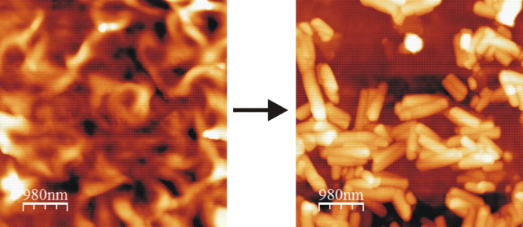
- leaf surfaces. Experimental The nonacosan-10-ol wax materials, which were extracted with chloroform from lotus (Nelumbo nucifera) leaves, were obtained from the Nees Institute for Biodiversity of Plants at Bonn University. These wax materials, which were used in all our experiments, are actually a

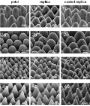
Hierarchically structured superhydrophobic flowers with low hysteresis of the wild pansy (Viola tricolor) – new design principles for biomimetic materials
Beilstein J. Nanotechnol. 2011, 2, 228–236, doi:10.3762/bjnano.2.27

- Anna J. Schulte Damian M. Droste Kerstin Koch Wilhelm Barthlott Nees Institute for Biodiversity of Plants, University of Bonn, Meckenheimer Allee 170, Bonn, Germany Rhine-Waal University of Applied Sciences, Landwehr 4, Kleve, Germany 10.3762/bjnano.2.27 Abstract Hierarchically structured flower
- leaves (petals) of many plants are superhydrophobic, but water droplets do not roll-off when the surfaces are tilted. On such surfaces water droplets are in the “Cassie impregnating wetting state”, which is also known as the “petal effect”. By analyzing the petal surfaces of different species, we
- covered with a dense layer of small hydrophobic wax tubules. In plants, surface waxes occur as thin films (two-dimensional waxes) or as wax tubules, platelets, rodlets or other three-dimensional waxes [1][10]. In lotus leaves, air remains trapped below a water droplet and the contact area between the



Moisture harvesting and water transport through specialized micro-structures on the integument of lizards
Beilstein J. Nanotechnol. 2011, 2, 204–214, doi:10.3762/bjnano.2.24
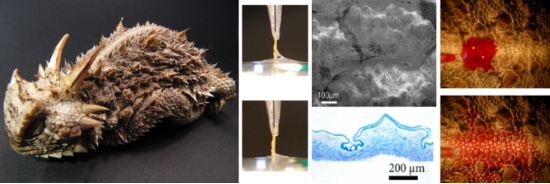
- system is filled, water is ingested and thus sucked through the capillary system from all over the body, similar to the capillary system in plants where transport takes place via vessels due to evaporation of the water at the leaves which serve as a sink. However, as depicted in Figure 9B the velocity


Functional morphology, biomechanics and biomimetic potential of stem–branch connections in Dracaena reflexa and Freycinetia insignis
Beilstein J. Nanotechnol. 2011, 2, 173–185, doi:10.3762/bjnano.2.21

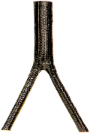
- plants is one of the most important assets for developing large arborescent growth forms with complex crowns. While the form and development of branching in gymnosperms and dicotyledonous trees is widely understood, very little is known about branching patterns and the structure of branch–stem-junctions
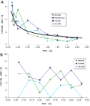
- determination of the maximal force, stress and strain at rupture as well as the fracture toughness. Functional morphology was correlated with the mechanical behaviour of these plants and compared to data of other dicotyledonous trees. The high energy absorption found in the rupture process of lateral branches
- woody plants is their ability to form branches and canopies. Some of these branches can grow continuously and be as long-lived as the stems. This has always intrigued naturalists and botanists, and therefore, branching in woody plants has been the subject of scientific studies for centuries. These




Superhydrophobicity in perfection: the outstanding properties of the lotus leaf
Beilstein J. Nanotechnol. 2011, 2, 152–161, doi:10.3762/bjnano.2.19
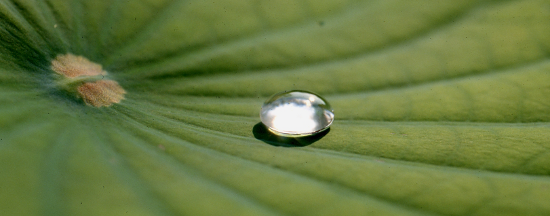
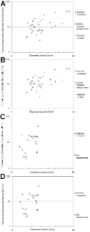
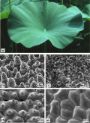
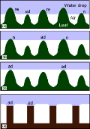
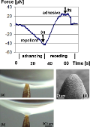
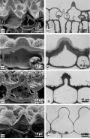
- become an icon for superhydrophobicity and self-cleaning surfaces, and have led to the concept of the ‘Lotus effect’. Although many other plants have superhydrophobic surfaces with almost similar contact angles, the lotus shows better stability and perfection of its water repellency. Here, we compare the
- with contact angles >150° and their surface morphologies. Many studies, in which the properties of lotus leaves were compared with those of other superhydrophobic plants, have shown the superiority of the upper side of the lotus leaf. A standard tool for the determination of wettability or water
- repellency is the measurement of the static contact angle by the ‘sessile drop’ method. Neinhuis and Barthlott (1997) [7] for example, measured contact angles on the lotus leaf of 162°, which are among the highest of the compared species, but many other (43%) of the tested superhydrophobic plants also showed







Superhydrophobic surfaces of the water bug Notonecta glauca: a model for friction reduction and air retention
Beilstein J. Nanotechnol. 2011, 2, 137–144, doi:10.3762/bjnano.2.17

- Petra Ditsche-Kuru Erik S. Schneider Jan-Erik Melskotte Martin Brede Alfred Leder Wilhelm Barthlott Nees Institute for Biodiversity of Plants, Rheinische Friedrich-Wilhelms University of Bonn, Meckenheimer Allee 170, Bonn, 53115, Germany Department of Zoology: Functional Morphology and
- Biomechanics, Christian-Albrechts-University of Kiel, Am Botanischen Garten 1–9, Kiel, 24098, Germany Lehrstuhl Strömungsmechanik, Universität Rostock, Albert Einstein Str. 2, Rostock, 18051, Germany 10.3762/bjnano.2.17 Abstract Superhydrophobic surfaces of plants and animals are of great interest for
- the air film on most superhydrophobic surfaces usually lasts no longer than a few days, a few semi-aquatic plants and insects are able to hold an air film over a longer time period. Currently, we found high air film persistence under hydrostatic conditions for the elytra of the backswimmer Notonecta



Biomimetic materials
Beilstein J. Nanotechnol. 2011, 2, 135–136, doi:10.3762/bjnano.2.16
- Wilhelm Barthlott Kerstin Koch Nees Institute for Biodiversity of Plants, Rheinische Friedrich-Wilhelms University of Bonn, Meckenheimer Allee 170, 53115 Bonn, Germany Rhine-Waal-University of Applied Sciences, Landwehr 4, 47533 Kleve, Germany 10.3762/bjnano.2.16 Life is a specific characteristic
- of our planet. The diversity of life, biodiversity, is one of the most fascinating phenomena. We know some 1.8 million different species, but all extrapolations show that probably 20 million or more species exist: We know less than 10% of the plants, animals and micro-organisms living on the planet
Biomimetics inspired surfaces for drag reduction and oleophobicity/philicity
Beilstein J. Nanotechnol. 2011, 2, 66–84, doi:10.3762/bjnano.2.9

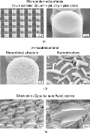
- , nanodevices, and processes which provide desirable properties. Hierarchical structures with dimensions of features ranging from the macroscale to the nanoscale are extremely common in nature and possess properties of interest. There are a large number of objects including bacteria, plants, land and aquatic
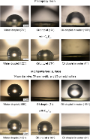
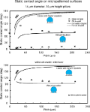
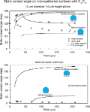
- behavior of oil droplets on various superoleophobic surfaces created in the lab. Keywords: aquatic animals; biomimetics; drag; lotus plants; shark skin; superhydrophobicity; superoleophobicity; Introduction Biologically inspired design, adaptation, or derivation from nature is referred to as ‘biomimetics
- understanding of the functions provided by objects and processes found in nature can guide us to imitate and produce nanomaterials, nanodevices, and processes [2]. There are a large number of objects (bacteria, plants, land and aquatic animals, seashells etc.) with properties of commercial interest. Natural








Other Beilstein-Institut Open Science Activities



