Search results
Search for "surface modification" in Full Text gives 193 result(s) in Beilstein Journal of Nanotechnology.
Photoactivation of luminescence in CdS nanocrystals
Beilstein J. Nanotechnol. 2014, 5, 355–359, doi:10.3762/bjnano.5.40
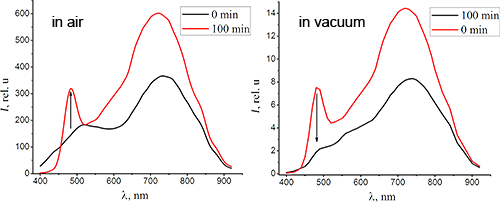
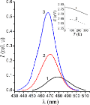
- the surface of NC. The observed effect is explained by the recombination mechanism that is responsible for the short-wavelength emission band. Keywords: cadmium sulfide (CdS); luminescence; nanoparticles; short-wavelength emission band; surface modification; Introduction Semiconductor nanocrystals


Structural, optical and photocatalytic properties of flower-like ZnO nanostructures prepared by a facile wet chemical method
Beilstein J. Nanotechnol. 2013, 4, 763–770, doi:10.3762/bjnano.4.87

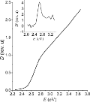
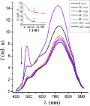
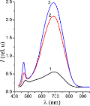
- visible emission from ZnO nanostructures upon ageing is due to their surface modification with Zn(OH)2, which results in a decrease of the crystalline quality. Figure 7 shows the UV–vis absorption spectra of a 10 μM MB solution with sample S2’ as the photocatalyst. It can be seen that the photodegradation


New hybrid materials based on poly(ethyleneoxide)-grafted polysilazane by hydrosilylation and their anti-fouling activities
Beilstein J. Nanotechnol. 2013, 4, 671–677, doi:10.3762/bjnano.4.75

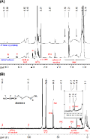
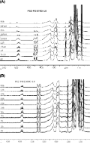
- (glass, polycarbonate, aluminium, steel, etc.) combined with a high brightness, a non-stick surface, and the resistance to heat, fire and UV irradiation. Poly(ethylene oxide) or poly(oxyethylene) (PEO) is a non-toxic polymer, which is used as a surface-modification agent, because it is effective in





Mapping of plasmonic resonances in nanotriangles
Beilstein J. Nanotechnol. 2013, 4, 588–602, doi:10.3762/bjnano.4.66
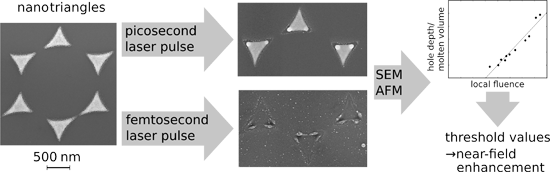
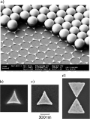
- fluence associated with this ablation threshold of the plasmonic structures is strongly dependent on the particle size and shape and can be higher, the same or even lower than the removal threshold. Above the ablation threshold , the surface modification takes the form of material removal as well as




Digging gold: keV He+ ion interaction with Au
Beilstein J. Nanotechnol. 2013, 4, 453–460, doi:10.3762/bjnano.4.53
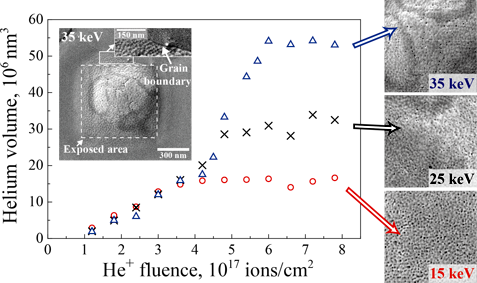
- guaranteed tip radius of less than 10 nm, and a typical resonance frequency of 150 kHz. The scan size was 2 × 2 μm2. Results and Discussion Au{111} surface modification We have recorded sequences of images of submicron size to study the evolution of the Au{111} surface under the impact of a focused He+ beam
- holes starts to appear on the surface (see Figure 2a). With a further increase of the fluence the porous structure gets more pronounced (Figure 2b and Figure 2c). In the case of 25 keV primary ion energy the surface modification initially looks similar to the one at 15 keV (Figure 2d), but at a fluence
- heal the defects. That process can be enhanced by in situ heating of a sample during ion bombardment. We mention, that the surface modification depends not only on the final fluence, but also on the speed at which it was generated. With an increase of the dose per scan, the modifications occur more


Photoelectrochemical and Raman characterization of In2O3 mesoporous films sensitized by CdS nanoparticles
Beilstein J. Nanotechnol. 2013, 4, 255–261, doi:10.3762/bjnano.4.27

- the SILAR deposition. The surface modification of In2O3 with CdS nanoparticles leads to the spectral sensitization of photoelectrochemical processes that manifests itself in a red shift of the long-wavelength edge in the photocurrent spectrum by 100–150 nm. Quantum-confinement effects lead to an


Selective surface modification of lithographic silicon oxide nanostructures by organofunctional silanes
Beilstein J. Nanotechnol. 2013, 4, 218–226, doi:10.3762/bjnano.4.22
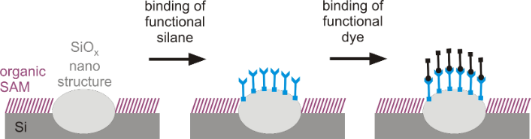


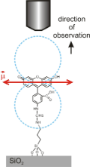
![[Graphic 2]](/bjnano/content/inline/2190-4286-4-22-i2.png?max-width=637&scale=1.18182) (red arrow) of FITC bound to a SiO2 surface.
(red arrow) of FITC bound to a SiO2 surface.
Controlled deposition and combing of DNA across lithographically defined patterns on silicon
Beilstein J. Nanotechnol. 2013, 4, 72–76, doi:10.3762/bjnano.4.8

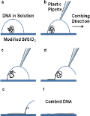
- molecules across lithographically defined patterns. The technique involves surface modification of Si/SiO2 substrates with a hydrophobic silane by using gas-phase deposition. Thereafter, DNA molecules are aligned by dragging the droplet on the hydrophobic substrate with a pipette tip. Using this procedure
- DNA–peptide conjugates. We suggest this method as a simple yet reliable technique for depositing and aligning DNA and DNA derivatives across nanofabricated patterns. Keywords: AFM; DNA molecular combing; DNA–peptide complexes; molecular electronics; surface modification; Introduction DNA is the
- but with 3-aminopropyltrimethoxysilane (Sigma-Aldrich) and one hour incubation time. The optimal conditions for combing were achieved with 20 mM ammonium acetate at pH 5.1 and N-octyldimethylchlorosilane surface modification. Molecular combing of DNA was performed according to the following procedure


Effect of normal load and roughness on the nanoscale friction coefficient in the elastic and plastic contact regime
Beilstein J. Nanotechnol. 2013, 4, 66–71, doi:10.3762/bjnano.4.7
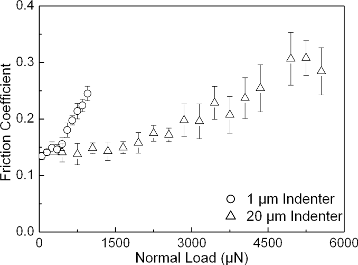
- tribological processes is fundamental to many basic and applied problems, such as wetting, capillarity, adhesion, lubrication, sealing, hardness, micro/nanoindentation, atomic-scale probing, surface modification and manipulation [1][2][3]. The contact of two bodies may be defined by the influential parameters


Reversible mechano-electrochemical writing of metallic nanostructures with the tip of an atomic force microscope
Beilstein J. Nanotechnol. 2012, 3, 824–830, doi:10.3762/bjnano.3.92

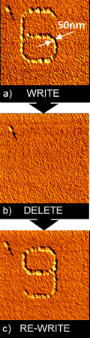
- related instruments can be used as tools for surface modification and nanolithography [9][10][11][12][41][42][43][44][45][46][47][48], even down to the atomic scale [41][42][43][44][45]. The great advantage of these instruments for nanoelectrochemistry is the fact that they also allow the in situ and real


Polymer blend lithography: A versatile method to fabricate nanopatterned self-assembled monolayers
Beilstein J. Nanotechnol. 2012, 3, 620–628, doi:10.3762/bjnano.3.71

- -defined surface chemistry. Here, we are aiming for a lateral polymer phase morphology that can be completely removed by a selective solvent to make the substrate available for well-defined chemical surface modification. This can be achieved by inserting a silane SAM, which then exposes a functional group


Nano-structuring, surface and bulk modification with a focused helium ion beam
Beilstein J. Nanotechnol. 2012, 3, 579–585, doi:10.3762/bjnano.3.67

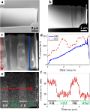
- surface and structure using advanced transmission electron microscopy (TEM) techniques such as energy filtered TEM (EFTEM) and electron energy loss spectroscopy (EELS). We also present the limitations of this surface modification technique. Results and Discussion Sample 1 is a silicon lamella shown after


Glassy carbon electrodes modified with multiwalled carbon nanotubes for the determination of ascorbic acid by square-wave voltammetry
Beilstein J. Nanotechnol. 2012, 3, 388–396, doi:10.3762/bjnano.3.45

- this study for the development of the analytical method for AA analysis. GCE surface modification The effect of using an increasing concentration of MWCNTs in 0.1% (w/v) Nafion solution to modify the GCE is depicted in the voltammograms of 1 mmol/L AA in 0.1 M acetate buffer presented in Figure 2. The


Variations in the structure and reactivity of thioester functionalized self-assembled monolayers and their use for controlled surface modification
Beilstein J. Nanotechnol. 2012, 3, 213–220, doi:10.3762/bjnano.3.24

- sulfonate-bearing surface to constitute an important approach to systematic surface modification. Keywords: siloxane-anchored self-assembled monolayers; sulfonated interfaces; surface chemistry; Introduction Functionalized self-assembled monolayers (SAMs) provide powerful tools for conveniently adjusting


Surface functionalization of aluminosilicate nanotubes with organic molecules
Beilstein J. Nanotechnol. 2012, 3, 82–100, doi:10.3762/bjnano.3.10

- electrophilicity compared to silicon. Consequently, P–O–C bonds are quite stable against hydrolysis, and P–O–H groups are quite stable against homocondensation. Thus, during the surface-modification process, they should form only monolayers, independent of the water content. Moreover, organophosphoric acids can
- , it can be positively charged and dispersed under acidic conditions by electrostatic repulsion. It should be noted that surface modification of inorganic nanostructures in an aqueous solution is an environmentally friendly method. Figure 5 shows the thermogravimetric profiles of the original imogolite
- suitable for the modification of imogolite, because surface modification with organosilanes usually needs dry conditions in order to prevent unfavorable side reactions. Whereas with an AlOH functionalized external surface imogolite is a very hydrophilic material and can be dispersed only in acidic water by


Micro to nano: Surface size scale and superhydrophobicity
Beilstein J. Nanotechnol. 2011, 2, 327–332, doi:10.3762/bjnano.2.38

- post structure was fabricated. The processed wafers were broken into individual dies and cleaned in de-ionized water, 2-propanol and acetone. Surface modification For the chemical surface modification, a benzophenone-based silane (4-(3’-chlorodimethylsilyl)propyloxybenzophenone) was first synthesized


![[Graphic 1]](/bjnano/content/inline/2190-4286-2-38-i2.png?max-width=637&scale=1.18182) are in...
are in...


Twofold role of calcined hydrotalcites in the degradation of methyl parathion pesticide
Beilstein J. Nanotechnol. 2011, 2, 99–103, doi:10.3762/bjnano.2.11

- its degradation products have to be retained and/or decomposed in aqueous solutions. Studies concerning the surface modification of cationic clays and hydrotalcites with organic ions, as pesticide sorbents, have been reviewed by Cornejo et al. [5]. For instance, MP undergoes degradation when it is


Magnetic nanoparticles for biomedical NMR-based diagnostics
Beilstein J. Nanotechnol. 2010, 1, 142–154, doi:10.3762/bjnano.1.17

- ). Bioorthogonal nanoparticle detection In addition to the previous strategies to improve the MNP core to enhance their relaxivities, surface modification of nanoparticles also improves their biosensing capabilities by amplifying their targeting valency for DMR applications. Bioorthogonal “click” chemistry has