

Search results
Search for "C. elegans" in Full Text gives 6 result(s) in Beilstein Journal of Nanotechnology.
Nanoinformatics: spanning scales, systems and solutions
Beilstein J. Nanotechnol. 2026, 17, 423–427, doi:10.3762/bjnano.17.28
- toxicity of GO was observed, and attributed to the surface interactions between TA and GO as well as to the inherent biological properties of TA in C. elegans. The findings provide insights that can be utilised for the design of safer nanomaterials, as part of the Safe and Sustainable by Design (SSbD

Internal 3D temperature mapping in biological systems using ratiometric light-sheet imaging and lipid-coated upconversion nanothermometers
Beilstein J. Nanotechnol. 2025, 16, 2306–2316, doi:10.3762/bjnano.16.159
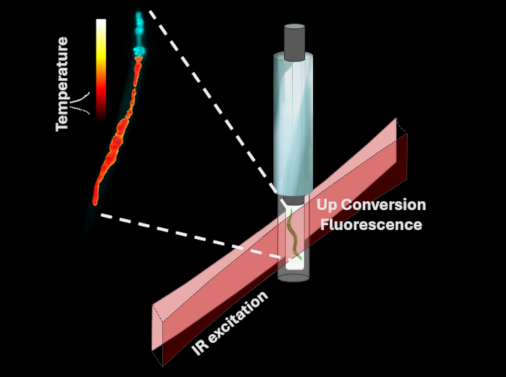
- enables real-time thermal mapping with both high spatial and temporal resolution at the cellular and subcellular levels. To validate the method, we performed 3D temperature imaging on fixed Caenorhabditis elegans (C. elegans) after UCNP ingestion. The proposed technique represents a cutting-edge method
- for accurate 3D analysis of temperature-driven biological processes. It holds significant potential for applications in living organisms, offering a non-invasive tool to monitor intracellular and organ-specific temperature dynamics. Keywords: C. elegans; 3D imaging; fluorescent intensity ratio; light
- millimeters [40]. LSFM decouples excitation and detection, illuminating only the focal plane and thereby minimizing photobleaching and photothermal effects while enabling rapid volumetric acquisition. The present work aims to extend this technique to larger biological specimens, specifically C. elegans, an


Interaction of graphene oxide with tannic acid: computational modeling and toxicity mitigation in C. elegans
Beilstein J. Nanotechnol. 2024, 15, 1297–1311, doi:10.3762/bjnano.15.105
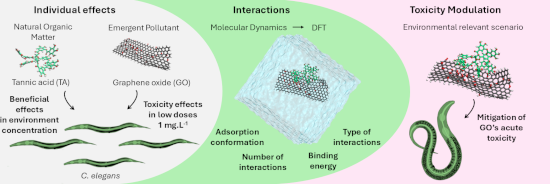
- -dependent mitigating effect on the toxicity of GO, which can be attributed not only to the surface interactions between the molecule and the material but also to the inherent biological properties of TA in C. elegans. Our findings contribute to a deeper understanding of GO’s environmental behavior and
- model in studies of environmental toxicology [31]. Because of its abundance in the environment, its important role in the decomposition and cycling of nutrients, and its sensibility to environmentally relevant concentrations of hazard products, C. elegans is considered a good environmental indicator of
- C. elegans at low concentrations (e.g., above 0.1 mg·L−1) [11][14]; the main mechanisms of toxicity reported in literature are damage to intestinal cavity and secondary organs, such as reproductive organs and neurons [14][34][35]. The sensibility of the nematode to GO made it a good model to


A review on the biological effects of nanomaterials on silkworm (Bombyx mori)
Beilstein J. Nanotechnol. 2021, 12, 190–202, doi:10.3762/bjnano.12.15

- ), sensitivity, and moderate body size make Caenorhabditis elegans (nematode) [45] an ideal model organism to study environmental nanotoxicity at the nanoscale level. C. elegans was used as a model organism to evaluate the impact of an exposure to a 50–100 mg/L dose of graphite, graphite oxide nanoplatelets, and


Nanocuration workflows: Establishing best practices for identifying, inputting, and sharing data to inform decisions on nanomaterials
Beilstein J. Nanotechnol. 2015, 6, 1860–1871, doi:10.3762/bjnano.6.189

- approach can be found within the C. elegans field with the WormBase repository (http://www.wormbase.org/#01-23-6). Notably, the genomics and WormBase workflows also take different approaches to the responsibility of entering data into a public repository. The genomics field requires authors to submit their


Carbon nano-onions (multi-layer fullerenes): chemistry and applications
Beilstein J. Nanotechnol. 2014, 5, 1980–1998, doi:10.3762/bjnano.5.207
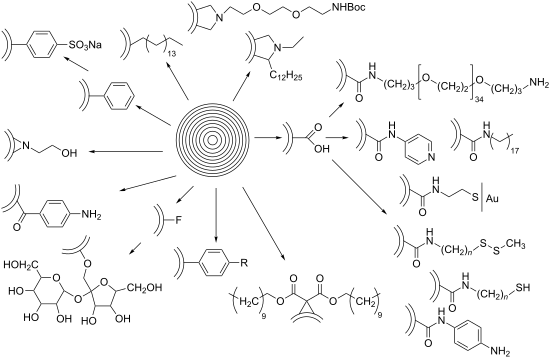
- biological marking of D. melanogaster, they used fluorescent CNOs also as imaging agents to study E. coli and C. elegans in vivo [51]. In a recent report from our group [40], we used fluorescein-functionalized CNOs in a comparative toxicological study in vitro and in vivo, including biological marking


Other Beilstein-Institut Open Science Activities