

Search results
Search for "MXenes" in Full Text gives 12 result(s) in Beilstein Journal of Nanotechnology.
Materials challenges in solid-state sensors for continuous monitoring of ions in water
Beilstein J. Nanotechnol. 2026, 17, 935–973, doi:10.3762/bjnano.17.66
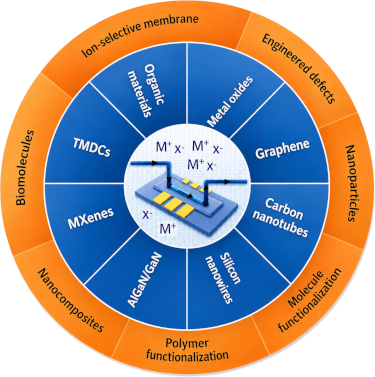
- of active materials have been investigated, including metal oxides, graphene, carbon nanotubes, silicon nanowires, AlGaN/GaN, MXenes, transition metal dichalcogenides, and organic polymers all of which can be tailored for sensor development. Sensor selectivity and functionality can be enhanced


Advancing nanolithography: a comprehensive review of materials for local anodic oxidation with AFM
Beilstein J. Nanotechnol. 2026, 17, 275–291, doi:10.3762/bjnano.17.19
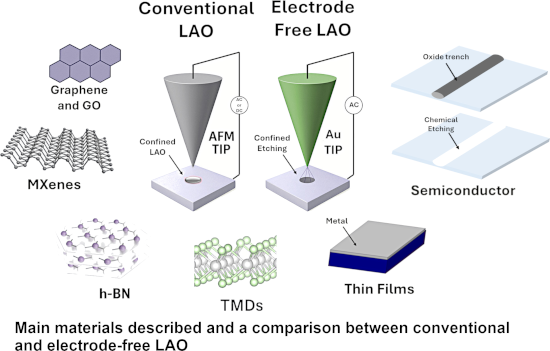
- (MXenes) that may introduce new oxidation dynamics. Regrettably, key factors such as oxygen, humidity, and light, which contribute to the ambient degradation of few-layer BP [107], may present significant challenges for the application of LAO. The conductive properties of MXenes range from metallic to


Missing links in nanomaterials research impacting productivity and perceptions
Beilstein J. Nanotechnol. 2025, 16, 2168–2176, doi:10.3762/bjnano.16.149
- , other 2D nanomaterials, such as elemental 2D materials (e.g., borophene, phosphorene, and silicene), transition metal dichalcogenides (e.g., MoS2, WS2, and NbSe2), transition metal oxides (e.g., MnO2, Fe2O3, and Ni(OH)2 nanosheets), MXenes (e.g., Ti3C2, Ti2C, and Ta4C3), 2D halides (e.g., CrI3, NiI2
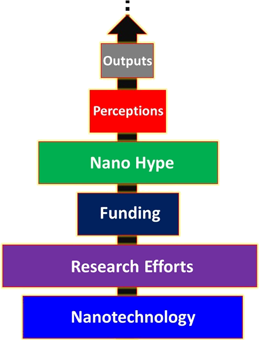
- nanotubes, graphene, metal oxides, quantum dots, and MXenes are among the most extensively studied and explored nanomaterials. These materials have been researched in nearly every discipline, leading to the establishment of numerous startups and companies focused on their production, processing, and
- , though nanomaterials research has made impressive scientific advances, its translation into mass-market products remains partial. Therefore, it raises a vital and valid question: Why are heavily researched nanomaterials such as carbon nanotubes, graphene, metal oxides, quantum dots, and MXenes still so
Nanotechnology-based approaches for the removal of microplastics from wastewater: a comprehensive review
Beilstein J. Nanotechnol. 2025, 16, 1607–1632, doi:10.3762/bjnano.16.114
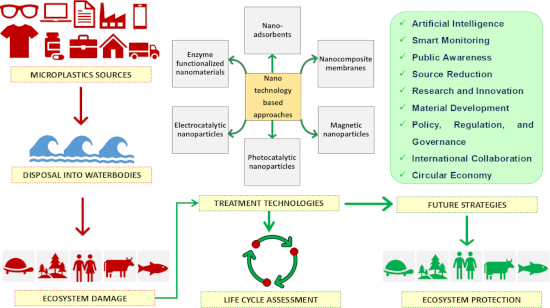
- various nanoenabled treatment strategies such as adsorption, photocatalysis, and membrane filtration using materials like metal-organic frameworks, carbon-based nanomaterials, MXenes, and metal oxides. It also highlights recent innovations such as microrobotic systems and AI-assisted detection frameworks
- removal of 85.8% for polystyrene particles (90–140 nm) and 91.4% for poly(1,1-difluoroethylene) particles (60–110 nm). These findings highlight the potential of this material as a promising approach for eliminating small scale MPs from environmental water sources. MXenes and metal oxides: MXenes, two
- , and Tx represents surface functional groups like oxygen, fluorine, hydroxy, or hydrogen. MXenes are synthesized by selective removal of A-layers with elements from group IIIA or IVA, such as aluminium or silicon, from a parent material. This process results in a nanomaterial with an expansive surface


Laser processing in liquids: insights into nanocolloid generation and thin film integration for energy, photonic, and sensing applications
Beilstein J. Nanotechnol. 2025, 16, 1428–1498, doi:10.3762/bjnano.16.104






Exploring surface charge dynamics: implications for AFM height measurements in 2D materials
Beilstein J. Nanotechnol. 2024, 15, 767–780, doi:10.3762/bjnano.15.64
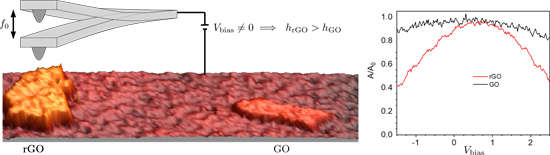
- ], sensors [2], and biomedical applications [3][4], among other areas [5][6][7][8]. Graphene-related materials [8], transition metal dichalcogenides [9], boron nitride [10], and MXenes [11], among many others, exhibit novel and exotic properties, which markedly differ from their bulk counterparts [12]. This


Upscaling the urea method synthesis of CoAl layered double hydroxides
Beilstein J. Nanotechnol. 2023, 14, 927–938, doi:10.3762/bjnano.14.76

- (P, As, Sb and Bi)) to multielementals (e.g., boron nitrate, metal dichalcogenides, MXenes, layered metal/covalent organic frameworks, or layered hydroxides/oxides) [9][10][11]. These systems exhibit an enormous variability in their physicochemical properties, which are defined by their layer-to


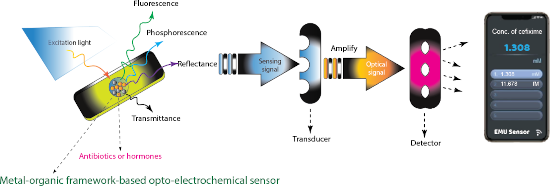
Metal-organic framework-based nanomaterials as opto-electrochemical sensors for the detection of antibiotics and hormones: A review
Beilstein J. Nanotechnol. 2023, 14, 631–673, doi:10.3762/bjnano.14.52


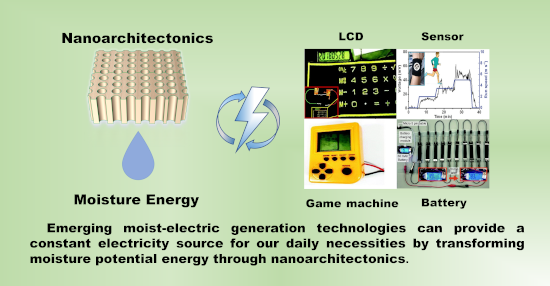
Application of nanoarchitectonics in moist-electric generation
Beilstein J. Nanotechnol. 2022, 13, 1185–1200, doi:10.3762/bjnano.13.99
- John Wiley and Sons. Copyright © 2018 WILEY-VCH Verlag GmbH & Co. KGaA, Weinheim. This content is not subject to CC BY 4.0. (g) Measured VOC and ISC values from the MXenes TEPG (transpiration-driven electrokinetic power generators) with NaCl solutions of various concentrations. Figure 4g was reproduced


ZnO and MXenes as electrode materials for supercapacitor devices
Beilstein J. Nanotechnol. 2021, 12, 49–57, doi:10.3762/bjnano.12.4
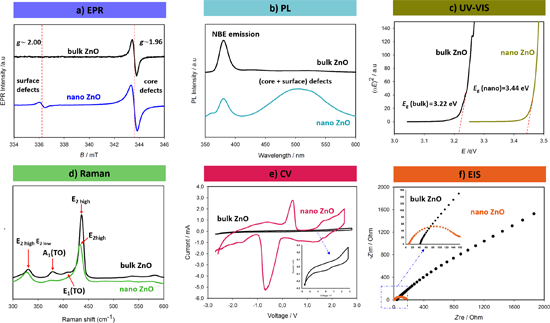
- , recently developed metal oxides, specifically nanostructured ZnO, and MXenes with their defect structures, size effects, as well as optical and electronic properties have been presented as electrode material in supercapacitor devices. The discussion of MXenes along with ZnO, although different in chemistry
- materials; electrodes; MXenes; supercapacitors; zinc oxide (ZnO); Introduction In this article, the past, the present, and the prospects of ZnO and MXenes are discussed in terms of their usage as electrode materials in supercapacitor devices. Recently, supercapacitors gained a lot of attention due to their
- optical and electrical properties. This review will give a prospect to researchers working on the development of electrode materials for efficient supercapacitors. The discussion of MXenes along with ZnO, although different in chemistry, also highlights the differences in dimensionality when it comes to
Adsorption and diffusion characteristics of lithium on hydrogenated α- and β-silicene
Beilstein J. Nanotechnol. 2017, 8, 1742–1748, doi:10.3762/bjnano.8.175

- atoms with silicene is stronger than with graphene, and the adsorption of metal atoms leads to the metalization of silicene [37]. It was calculated that the adsorption of Li atoms results in the stabilization of the unstable distorted T-phase of MoS2 [38]. In addition, Zr-based MXenes were found to be


Nanostructures for sensors, electronics, energy and environment III
Beilstein J. Nanotechnol. 2017, 8, 1530–1531, doi:10.3762/bjnano.8.154
- ., silicene, phosphorene, transition metal dichalcogenides, MXenes), which now number more than 6,000. The topic of nanoparticles is the focus of this Thematic Series, the use of which spans from biosensing to gas detection and from removing pollutants from water to new generations of solar cells. The