


Search results
Search for "gallic acid" in Full Text gives 14 result(s) in Beilstein Journal of Nanotechnology.
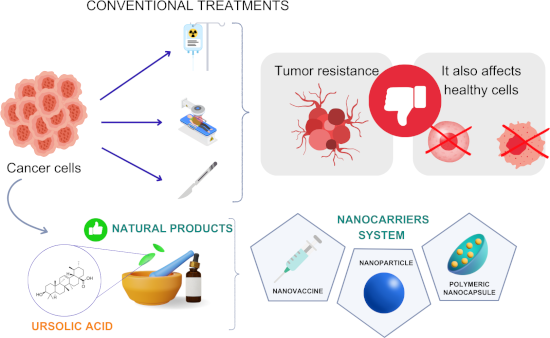
Prospects of nanotechnology and natural products for cancer and immunotherapy
Beilstein J. Nanotechnol. 2025, 16, 1644–1667, doi:10.3762/bjnano.16.116



Ferroptosis induction by engineered liposomes for enhanced tumor therapy
Beilstein J. Nanotechnol. 2025, 16, 1325–1349, doi:10.3762/bjnano.16.97
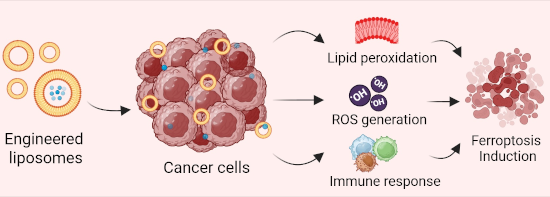
- of the metal polyphenol network hybrid liposome was 198 nm with a spheroidal shape and a zeta potential of approximately −15 mV. Nebulization resulted in approximately 8.2 times higher lung accumulation than intravenous injection. Co-delivery of a gallic acid-Fe metal polyphenol network and


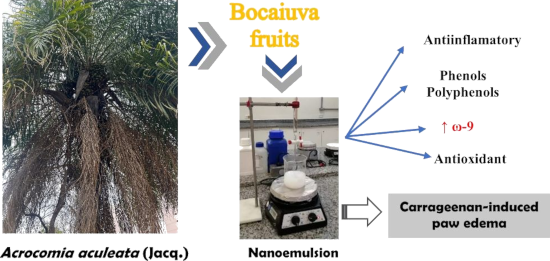
Acrocomia aculeata oil-loaded nanoemulsion: development, anti-inflammatory properties, and cytotoxicity evaluation
Beilstein J. Nanotechnol. 2025, 16, 1277–1288, doi:10.3762/bjnano.16.93
- standard addition method and a standard reference material (Sigma, USA). The results were expressed as gallic acid equivalent. Determination of carotenoid content Carotenoid content was evaluated spectrophotometrically (Shimatsu, Japan) following the procedure described by Rodriguez-Amaya. The molar


Hydrogels and nanogels: effectiveness in dermal applications
Beilstein J. Nanotechnol. 2025, 16, 1216–1233, doi:10.3762/bjnano.16.90
- suppressions of ear edema, pruritus, high IgE levels, epidermal swelling, and mast cell infiltration in Balb/c mouse model [62]. Temperature- and pH-responsive hydrogels loaded with gallic acid were developed using a combination of biocompatible polymers: Pluronic F-127, N,N,N-trimethyl chitosan, and
- polyethylene glycolated hyaluronic acid. The system was designed to be incorporated into therapeutic fabrics for transdermal application, making it a potentially valuable tool for treating conditions such as atopic dermatitis. The release mechanism of gallic acid followed a first-order kinetic model, in which
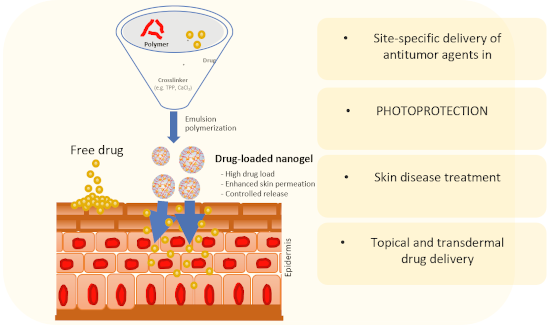
- the release rate decreases as the amount of gallic acid remaining in the gel diminishes [116]. Nanogels as dermal drug carriers Recent advances have demonstrated the successful use of nanogels as drug carriers. Some benefits of nanogel applications as dermal DDSs are shown in Figure 2. It includes


Classification and application of metal-based nanoantioxidants in medicine and healthcare
Beilstein J. Nanotechnol. 2024, 15, 396–415, doi:10.3762/bjnano.15.36
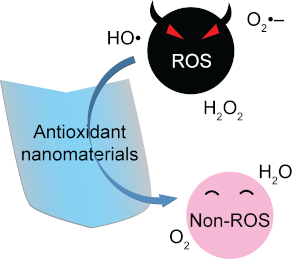
- acid was covalently grafted on the surface of SiO2 nanoparticles. SiO2 nanoparticles provided thermal stability and chemical inertness while gallic acid provided chain-breaking antioxidant properties. By grafting antioxidant compounds on SiO2 nanoparticles, the deterioration can be decreased [59
- ]. Similarly, gallic acid was covalently grafted on magnetite with an average size of 5 and 8 nm. The functionalization of ultrasmall magnetite with gallic acid increased free radical scavenging two- to fourfold compared to free magnetite [60]. Centurion et al. investigated the assembly of natural polyphenolic
- nm that display chain-breaking antioxidant activities [57][58]. The incorporation of nanomaterials and natural chain-breaking antioxidants is one of the most efficient strategies to combine the advantages of nanomaterials and natural antioxidants. For example, the natural phenolic compound gallic


In search of cytotoxic selectivity on cancer cells with biogenically synthesized Ag/AgCl nanoparticles
Beilstein J. Nanotechnol. 2022, 13, 1505–1519, doi:10.3762/bjnano.13.124

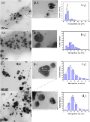
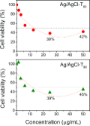
- , agricultural residues, such as fruit peels, have the potential to be used for the development of nanoparticles [10][11][12][13]. Pineapple peel has also been valued as a good source of silver salt-reducing compounds. Pineapple peel extracts have been reported to contain polyphenols such as gallic acid
- its flavonoid content. Li et al. [14] reported that some phenolic compounds, such as gallic acid, catechin, epicatechin, and ferulic acid are present in pineapple peel extracts. On the other hand, Steingass et al. [19] reported an extensive phytochemical study, by HPLC-DAD-ESI-MSn and GM-MS, of
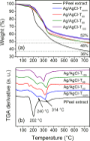
- flavonoids, terpenes, tannins, and gallic acid; 1230 cm−1 corresponds to the tension of tertiary alcohols and flavonoids; 1026 cm−1 is related to C–O vibration in tannins and flavonoids; and 918 cm−1, 865 cm−1, and 705 cm−1 correspond to out-of-plane C–H vibration in gallic acid and catechin. According to





The role of deep eutectic solvents and carrageenan in synthesizing biocompatible anisotropic metal nanoparticles
Beilstein J. Nanotechnol. 2021, 12, 924–938, doi:10.3762/bjnano.12.69
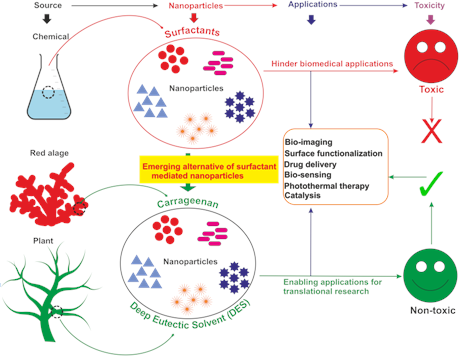
- systems. Guar-gum-fabricated gold nanoparticles (GA-GNPs) in a DES were synthesized for the use as X-ray contrast agent. The precursors for the DES used were choline chloride, gallic acid and glycerol. The X-ray attenuation coefficient of GA-GNPs was three times higher than that of the clinically used


Comprehensive review on ultrasound-responsive theranostic nanomaterials: mechanisms, structures and medical applications
Beilstein J. Nanotechnol. 2021, 12, 808–862, doi:10.3762/bjnano.12.64


A review on the green and sustainable synthesis of silver nanoparticles and one-dimensional silver nanostructures
Beilstein J. Nanotechnol. 2021, 12, 102–136, doi:10.3762/bjnano.12.9


Scavenging of reactive oxygen species by phenolic compound-modified maghemite nanoparticles
Beilstein J. Nanotechnol. 2019, 10, 1073–1088, doi:10.3762/bjnano.10.108
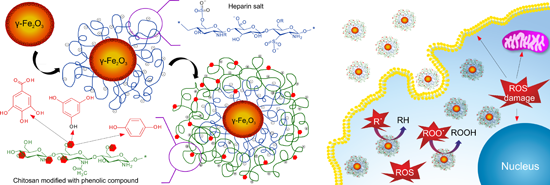
- Abstract Maghemite (γ-Fe2O3) nanoparticles obtained through co-precipitation and oxidation were coated with heparin (Hep) to yield γ-Fe2O3@Hep, and subsequently with chitosan that was modified with different phenolic compounds, including gallic acid (CS-G), hydroquinone (CS-H), and phloroglucinol (CS-P
- modified with polymers via a layer-by-layer (LbL) technique [17]. Two naturally derived polymers, namely, anionic heparin and cationic chitosan, were used as nanoparticle coatings, and three phenolic compounds, including hydroquinone, phloroglucinol, and gallic acid, differing in the number of hydroxy
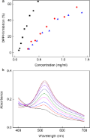
- . Moreover, the radical scavenging ability of CS-P was closer to that of CS-H than that of CS-G. The antioxidant properties of hydroquinone, which has only two hydroxy groups attached to the aromatic ring, were relatively low, whereas those of gallic acid, which has three hydroxy groups and a carbonyl group





Performance of natural-dye-sensitized solar cells by ZnO nanorod and nanowall enhanced photoelectrodes
Beilstein J. Nanotechnol. 2017, 8, 287–295, doi:10.3762/bjnano.8.31

- cm−1. 2-Hydroxy-1,4-napthaquinone (C10H6O3), frequently called lawsone [15][18], is one of the constituents of the natural dye henna in addition to other compounds, such as gallic acid, sterols, resin, tannin and coumarins [19]. Lawsone (Figure 4b), the main component of henna extract, has been used


Voltammetric determination of polyphenolic content in pomegranate juice using a poly(gallic acid)/multiwalled carbon nanotube modified electrode
Beilstein J. Nanotechnol. 2016, 7, 1104–1112, doi:10.3762/bjnano.7.103
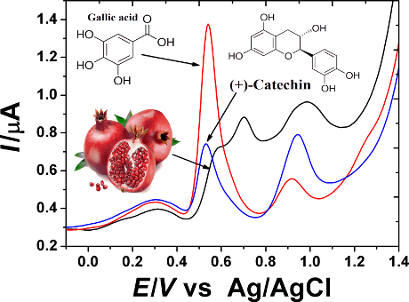
- Refat Abdel-Hamid Emad F. Newair Unit of Electrochemistry Applications (UEA), Chemistry Department, Faculty of Science, Sohag University, Sohag 82524, Egypt 10.3762/bjnano.7.103 Abstract A simple and sensitive poly(gallic acid)/multiwalled carbon nanotube modified glassy carbon electrode (PGA
- /MWCNT/GCE) electrochemical sensor was prepared for direct determination of the total phenolic content (TPC) as gallic acid equivalent. The GCE working electrode was electrochemically modified and characterized using scanning electron microscope (SEM), cyclic voltammetry (CV), chronoamperometry and
- chronocoulometry. It was found that gallic acid (GA) exhibits a superior electrochemical response on the PGA/MWCNT/GCE sensor in comparison with bare GCE. The results reveal that a PGA/MWCNT/GCE sensor can remarkably enhance the electro-oxidation signal of GA as well as shift the peak potentials towards less


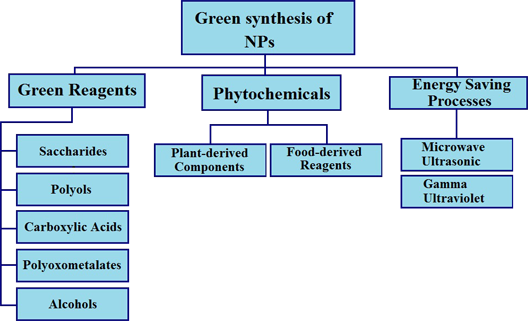
Green and energy-efficient methods for the production of metallic nanoparticles
Beilstein J. Nanotechnol. 2015, 6, 2354–2376, doi:10.3762/bjnano.6.243


A catechol biosensor based on electrospun carbon nanofibers
Beilstein J. Nanotechnol. 2014, 5, 346–354, doi:10.3762/bjnano.5.39
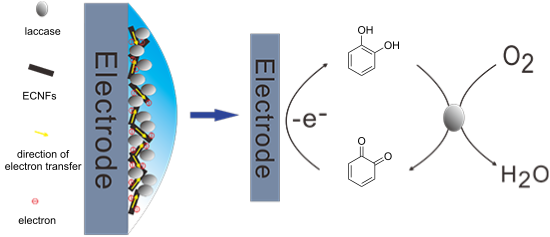
- laccase–Nafion–ECNFs/GCE exhibits a quite outstanding analytical performance and this new sensor could be useful in the detection of catechol. Interferences and biosensor stability Catechol and some other phenolic compounds, including catechin, epicatechin, gallic acid, guaiacol, phenol and aminophenol
- (pH 5.5). Inset: A magnification of the third addition of catechol (a); The linear calibration curve of the current response on the catechol concentration (b). Relative responses of the laccase–Nafion–ECNFs/GCE for different phenolic compounds (catechol, catechin, epicatechin, gallic acid, guaiacol





