


Search results
Search for "low-energy method" in Full Text gives 3 result(s) in Beilstein Journal of Nanotechnology.
Targeting the vector of arboviruses Aedes aegypti with nanoemulsions based on essential oils: a review with focus on larvicidal and repellent properties
Beilstein J. Nanotechnol. 2025, 16, 1894–1913, doi:10.3762/bjnano.16.132
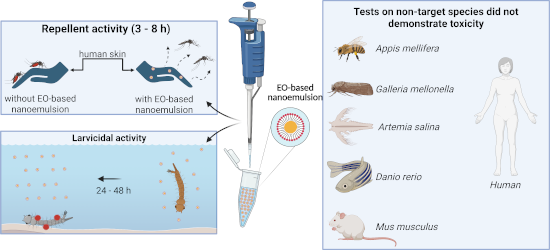
- through a low-energy method, using polysorbate 20 as a surfactant. The formulation presented an average droplet size ranging from 244.6 to 280.4 nm, a polydispersity index of less than 0.25, and a negative zeta potential (−15.7 to −18.6 mV), maintaining stability for 14 days. In the bioassays, fourth
- bicyclogermacrene, valerianol, β-pinene, and sesquirosefuran being the major substances in the essential oil of leaves (81.4%), suggesting a key role of this metabolites in larvicidal activity [113][115]. The oil was extracted using hydrodistillation and incorporated into the nanoemulsion by the low-energy method
- using a low-energy method with sorbitan monooleate 80 and polysorbate 20. The NE presented an average droplet size of 74.5 nm (±1.939) and a polydispersity index of 0.271 (±0.007), remaining physicochemically stable for up to 180 days. Larvicidal bioassays against third-stage Aedes aegypti larvae


Multifunctional anionic nanoemulsion with linseed oil and lecithin: a preliminary approach for dry eye disease
Beilstein J. Nanotechnol. 2025, 16, 1711–1733, doi:10.3762/bjnano.16.120

- efficacy and safety for ocular administration. Keywords: eye drops; micelles; low-energy method; ophthalmic vehicle; sample dilution; stability; Introduction Dry eye disease (DED) is a multifactorial condition affecting the ocular surface, characterized by changes in tear fluid composition and/or



Development and characterization of potential larvicidal nanoemulsions against Aedes aegypti
Beilstein J. Nanotechnol. 2024, 15, 104–114, doi:10.3762/bjnano.15.10
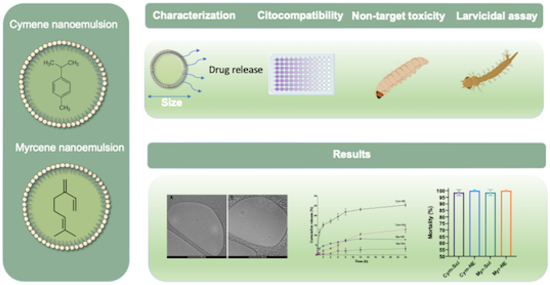
- effective pest control. Subsequent investigations should further optimize these formulations to unlock their full potential as part of integrated pest management. Experimental Preparation of terpene nanoemulsions Cymene (Cym-NE) and myrcene (Myr-NE) nanoemulsions were obtained by a low-energy method


Other Beilstein-Institut Open Science Activities



