

Search results
Search for "nano-qRASTR" in Full Text gives 2 result(s) in Beilstein Journal of Nanotechnology.
Nanoinformatics: spanning scales, systems and solutions
Beilstein J. Nanotechnol. 2026, 17, 423–427, doi:10.3762/bjnano.17.28
- enzymatic activity of the hatching enzyme ZHE1. The developed nano-quantitative read across structure–toxicity relationship (nano-qRASTR) model, featuring three attributes, outperformed the previously reported simple QSTR model, and enabled prediction of zebrafish embryo toxicity of 35 diverse MeOx

Introducing third-generation periodic table descriptors for nano-qRASTR modeling of zebrafish toxicity of metal oxide nanoparticles
Beilstein J. Nanotechnol. 2024, 15, 1142–1152, doi:10.3762/bjnano.15.93
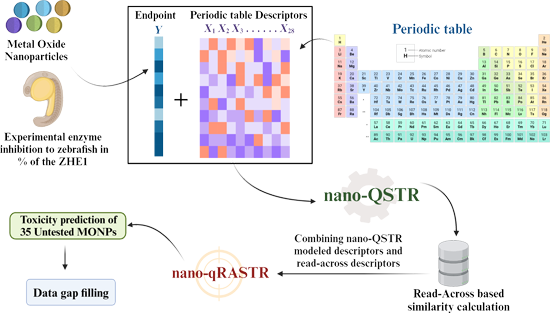
- model, a nano-quantitative read across structure–toxicity relationship (nano-qRASTR) model was created. This model integrated read-across descriptors with modeled descriptors from the nano-QSTR approach. The nano-qRASTR model, featuring three attributes, outperformed the previously reported simple QSTR
- model, despite having one less MONP. This study highlights the effective utilization of the nano-qRASTR algorithm in situations with limited data for modeling, demonstrating superior goodness-of-fit, robustness, and predictability (R2 = 0.81, Q2LOO = 0.70, Q2F1/R2PRED = 0.76) compared to simple QSTR
- models. Finally, the developed nano-qRASTR model was applied to predict toxicity data for an external dataset comprising 35 MONPs, addressing gaps in zebrafish toxicity assessment. Keywords: metal nanoparticles; metal oxide nanoparticles; nano-qRASTR; periodic table descriptors; QSAR; zebrafish


Other Beilstein-Institut Open Science Activities