

Search results
Search for "nanoemulsion" in Full Text gives 15 result(s) in Beilstein Journal of Nanotechnology.
Advances in nanotechnology applied to natural products
Beilstein J. Nanotechnol. 2026, 17, 555–558, doi:10.3762/bjnano.17.36
- formulated as oil-in-water (O/W) or water-in-oil (W/O) systems [3]. These carriers have been widely used to deliver natural products, particularly essential or fixed oils and their isolated constituents, for a wide range of applications. In this thematic issue, contributions examine nanoemulsion-based
- products have also been widely investigated for their antiparasitic activity [9]. Notably, some of the studies featured here suggest that nanoemulsion droplets can be internalized by infected macrophages, increasing local exposure at the host–parasite interface and thereby enhancing leishmanicidal activity
Beyond the shell: exploring polymer–lipid interfaces in core–shell nanofibers to carry hyaluronic acid and β-caryophyllene
Beilstein J. Nanotechnol. 2025, 16, 2015–2033, doi:10.3762/bjnano.16.139
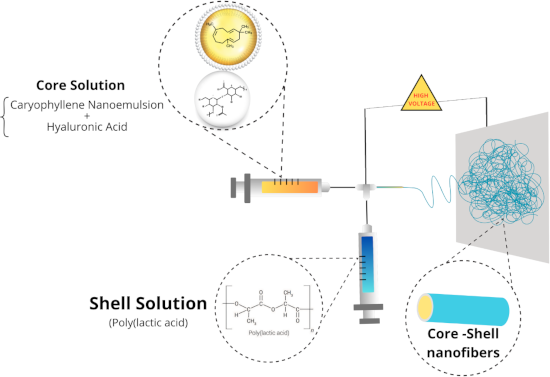
- structural integrity and effectively encapsulating a core comprising a nanoemulsion containing β-caryophyllene (NE-βCp) alongside HA. A rigorous optimization of the electrospinning process was critical, involving the systematic evaluation of key parameters. This optimization successfully identified the
- encapsulated within a PLA shell, highlighting substantial potential for biomedical applications by overcoming key material integration hurdles. Keywords: co-axial nanofibers; electrospinning; hybrid nanosystem; nanofibers; nanoemulsion; poly(lactic acid); Introduction Driven by the significant potential of
- administration via dressings made of biocompatible polymers containing lipid nanosystems [41][42][43]. Numerous researchers have successfully encapsulated nanoemulsions into nanofibers for diverse applications, including studies by Kaur et al. (2024) showing superior wound healing with bakuchiol nanoemulsion




Targeting the vector of arboviruses Aedes aegypti with nanoemulsions based on essential oils: a review with focus on larvicidal and repellent properties
Beilstein J. Nanotechnol. 2025, 16, 1894–1913, doi:10.3762/bjnano.16.132
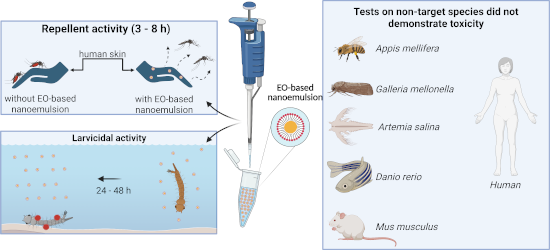
- nanoemulsions are discussed. In addition, this review highlights challenges and perspectives on pharmaceutical nanotechnology towards nanoemulsions as safe, effective, and eco-friendly tools for controlling Ae. Aegypti. Keywords: Aedes aegypti; arboviruses; mosquito vector; nanoemulsion; nanotechnology
- acetylcholinesterase (Figure 3). In this context, Romano et al. (2024) investigated the use of a nanoemulsion formulated with an essential oil extracted from the leaves of Murraya koenigii to evaluate its efficacy as a larvicide against the Ae. aegypti mosquito [108]. This plant, known as curry in India, is widely
- larvicidal activity [108]. Thus, a nanoemulsion with an average droplet size of 140 nm containing 1% of essential oils was evaluated on third-instar larvae (treated for 24 hours) at 1:100 and 1:200 (v:v) dilutions. The results reveal high mortality at different concentrations, with LC50 values of 11.8 µg/mL


Phytol-loaded soybean oil nanoemulsion as a promising alternative against Leishmania amazonensis
Beilstein J. Nanotechnol. 2025, 16, 1826–1836, doi:10.3762/bjnano.16.126
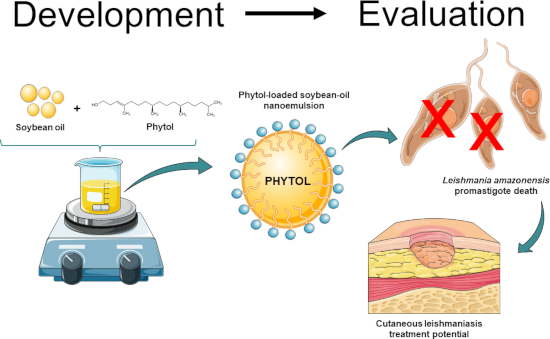
- and effective topical therapy for cutaneous leishmaniasis. Keywords: cutaneous leishmaniasis; Leishmania amazonensis; nanoemulsion; negleted tropical disease; phytol; Introduction Leishmaniasis is one of the 20 listed neglected tropical diseases (NTDs), affecting over 350 million people globally
- agents such as surfactants and co-surfactants, forming a kinetically stable system. With droplet sizes ranging from 20 to 500 nm, NEs can significantly enhance drug permeability and bioavailability [24][25][26][27]. Therefore, the present study aimed to develop a nanoemulsion containing phytol, produced
- via the low-energy emulsification method, as a novel potential pharmacological alternative for the treatment of cutaneous leishmaniasis. Results Phytol-loaded soybean-oil nanoemulsion Blank-NE and soybean oil nanoemulsions loaded with phytol (PHYT-NE) were successfully prepared using the phase


Multifunctional anionic nanoemulsion with linseed oil and lecithin: a preliminary approach for dry eye disease
Beilstein J. Nanotechnol. 2025, 16, 1711–1733, doi:10.3762/bjnano.16.120

- for therapeutic effectiveness. In contrast to traditional drug delivery systems (DDS), a functional ophthalmic nanoemulsion was specifically designed to alleviate symptoms of DED by leveraging its antioxidant and osmoprotective properties. The study evaluated the optimal concentration of lecithin
- investigated as potential drug delivery technologies [14][15]. However, our formulation is not a drug delivery system (DDS) since it lacks pharmacological agents. Instead, it is a functional nanoemulsion designed to mimic the tear film’s properties and provide antioxidant and osmoprotective benefits, aiming to
- therapeutic option for this ocular condition. Artificial tear products commonly used to alleviate symptoms of DED contain various ingredients that promote osmoprotective and antioxidant effects. In this context, this study proposes the development of an ophthalmic nanoemulsion with multifunctional action



Acrocomia aculeata oil-loaded nanoemulsion: development, anti-inflammatory properties, and cytotoxicity evaluation
Beilstein J. Nanotechnol. 2025, 16, 1277–1288, doi:10.3762/bjnano.16.93
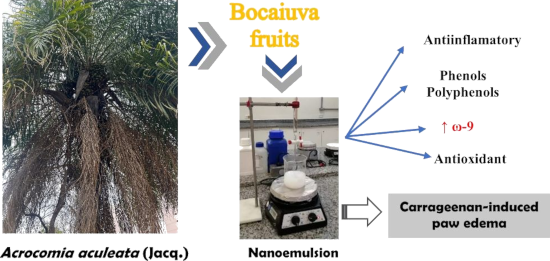
- have several medical applications. However, little is known about its pharmacological activity. Therefore, this study aimed to develop and evaluate the anti-inflammatory activity of a nanoemulsion loaded with the oil extracted from the pulp of the fruit of Acrocomia aculeata. Griffin’s method
- determined the hydrophilic–lipophilic equilibrium ratio of the nanoemulsion. It was shown to have an adequate droplet size (173.60 nm) with excellent homogeneity (polydispersity index 0.200). The anti-inflammatory activity of the nanoemulsion was evaluated by the carrageenan-induced paw edema method. Finally
- , the non-hemolytic and cytotoxic activity of the nanoformulation was determined to assess its safety. The nanoemulsion loaded with Acrocomia aculeata fruit pulp oil was shown to have parameters suitable for its characterization, impressive anti-inflammatory activity, and a safe profile. Keywords


Fabrication of metal complex phthalocyanine and porphyrin nanoparticle aqueous colloids by pulsed laser fragmentation in liquid and their potential application to a photosensitizer for photodynamic therapy
Beilstein J. Nanotechnol. 2025, 16, 1088–1096, doi:10.3762/bjnano.16.80
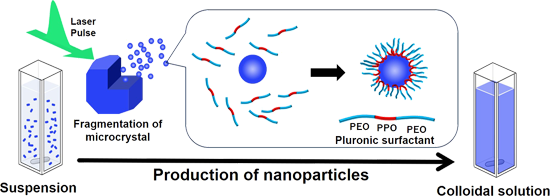
- hydrophobic interactions between the hydrophobic nanoparticles’ surface and the hydrophobic PPO block of F-127. A nanoemulsion having a core (MPcs or PtOEP nanoparticle)–shell (F-127) structure formed immediately after laser fragmentation of microcrystals, leading to the generation of highly dispersive


Nanotechnological approaches for efficient N2B delivery: from small-molecule drugs to biopharmaceuticals
Beilstein J. Nanotechnol. 2024, 15, 1400–1414, doi:10.3762/bjnano.15.113
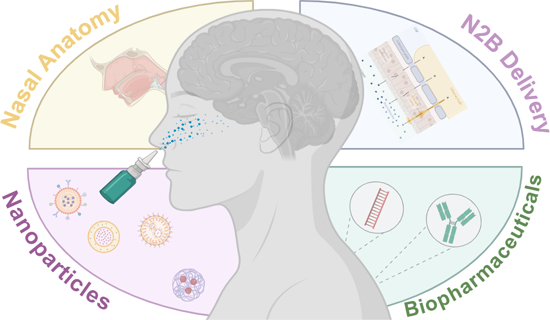
- nanoemulsion formulation with a particle size of 91.20 nm increased the drug absorption into the brain via the intranasal route compared to the mucoadhesive suspension form [115]. The encapsulation of a poorly soluble drug, cannabidiol, into nanoemulsions for the treatment of epilepsy was also evaluated. The


Therapeutic effect of F127-folate@PLGA/CHL/IR780 nanoparticles on folate receptor-expressing cancer cells
Beilstein J. Nanotechnol. 2024, 15, 954–964, doi:10.3762/bjnano.15.78
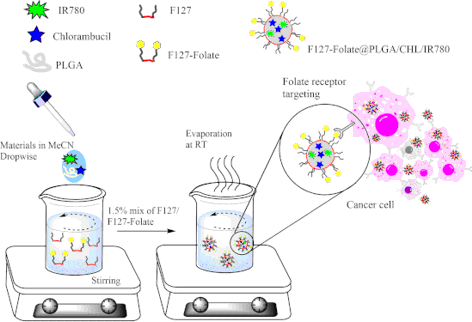
- pluronic F127 (F127), can be used in the water phase to lower the surface tension of the organic phase and to produce the nanoemulsion during the homogenization process [5][6][7]. F127 is a copolymer made up of blocks of poly(ethylene oxide)–poly(propylene oxide)–poly(ethylene oxide), PEO100–PPO65–PEO100



Development and characterization of potential larvicidal nanoemulsions against Aedes aegypti
Beilstein J. Nanotechnol. 2024, 15, 104–114, doi:10.3762/bjnano.15.10
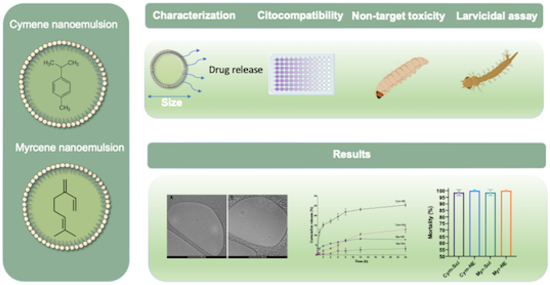
- involving Galleria mellonella larvae. Additionally, we investigated the insecticidal efficacy of monoterpenes against the mosquito Aedes aegypti, the primary dengue vector, via larval bioassay. Employing a low-energy approach, we successfully generated nanoemulsions. The cymene-based nanoemulsion exhibited
- a hydrodynamic diameter of approximately 98 nm and a zeta potential of −25 mV. The myrcene-based nanoemulsion displayed a hydrodynamic diameter of 118 nm and a zeta potential of −20 mV. Notably, both nanoemulsions demonstrated stability over 60 days, accompanied by controlled release properties and
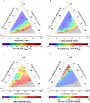
- HLB, one can obtain the nanoemulsion with the smallest droplet size, leading to more stable formulations [20]. The rHLB is usually determined by preparing NEs with different ratios of surfactant blends and choosing the most stable formulation to determine the rHLB of the oil phase [21


Nanotechnological approaches in the treatment of schistosomiasis: an overview
Beilstein J. Nanotechnol. 2024, 15, 13–25, doi:10.3762/bjnano.15.2

- permeability through the cellular membrane by making a nanoemulsion of Curcuma longa extract (i.e., the curcumin plant source). The nanoemulsion showed an effect against adults of S. mansoni in vitro (especially males). This is an interesting finding because data from the literature reports that females are
- mechanism by which the nanoemulsion could reduce the worm burden is its antimicrobial activity, connecting changes in microbiota with the response to parasites. However, the mechanism of action of carvacrol remains unknown [67]. Repositioned drugs Works utilizing compounds repositioned from other diseases
- schistosomiasis treatment. Araújo et al. [76] developed a cationic nanoemulsion to increase solubility. This nanoemulsion increases efficiency in vitro, causing the death of female worms within three hours, alterations in tegument within 48 hours, and reduced male worm motility. A hypothesis suggested by the


Polymer nanoparticles from low-energy nanoemulsions for biomedical applications
Beilstein J. Nanotechnol. 2023, 14, 339–350, doi:10.3762/bjnano.14.29
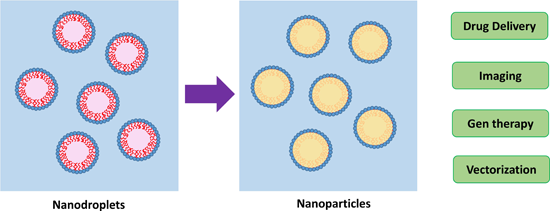
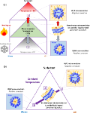
- liquid phase. They are out-of-equilibrium nanocolloids in which phase separation is expected from thermodynamics, but is delayed by the presence of surfactants adsorbed on the droplets surface. Accordingly, nanoemulsion formation depends on the way the sample is prepared, for example, on the order of
- component addition or on the thermal history. Nanoemulsions are not to be confused with microemulsions, which are equilibrium systems with thermodynamic stability [4]. Because of their very small drop size, the main mechanism for nanoemulsion destabilization is commonly attributed to Ostwald ripening
- ] proceeds at constant temperature (Figure 1b). Here, the change in the curvature of the surfactant layer from negative to positive or vice versa is driven by the addition of water (which increases POE hydration) to a mixture of oil + surfactant to produce an O/W nanoemulsion [14]. Under continued dilution




Use of nanosystems to improve the anticancer effects of curcumin
Beilstein J. Nanotechnol. 2021, 12, 1047–1062, doi:10.3762/bjnano.12.78

- used to produce their CUR-nicotinamide nanococrystal. The nanosystem showed a higher dissolution rate, in addition to antinociceptive and anti-inflammatory effects. In contrast to their advantages, cocrystals are not easily obtained. Another option is to formulate a nanoemulsion that contains CUR as
- the molecule of interest alongside another bioactive entity (i.e., coadministration). Curcumin–piperine nanoemulsion (CUR–PIP) is a great example of this combination approach as a chemotherapy agent against various types of cancer. Piperine has been shown to act as a bioenhancer molecule that improves
- nanoemulsion (25 µM-7 µM) inhibited cell proliferation by 50% via cell cycle arrest at the G2/M phase and induced apoptosis. In addition, a CUR nanoemulsion exerted a four-fold increase in caspase-3, in contrast to a six-fold increase exerted by co-administered CUR–PIP. Curcumin is also commonly co-loaded in


Phase inversion-based nanoemulsions of medium chain triglyceride as potential drug delivery system for parenteral applications
Beilstein J. Nanotechnol. 2020, 11, 213–224, doi:10.3762/bjnano.11.16

- Kolliphor HS 15. The experimental results indicate, that nanoemulsions with particles of small and tunable size can be easily formed without homogenization by thermal cycling. Keywords: cellular toxicity; isotonicity; nanoemulsion; phase inversion; solvent free; surface properties; Introduction Nanoscaled
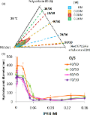
- incipient phase inversion from 81.5 °C at 0.4 wt % NaCl concentration to 65.4 °C at 5 wt % NaCl concentration. The particles in the nanoemulsion had an average diameter (zave) of 56–59 nm and a remarkably narrow polydispersity index (PDI) distribution of 0.03–0.06. The salinity did not have a significant
- influence on the particle diameter and the PDI of the nanoemulsion formed by shock dilution. Figure 2 shows the particle diameters and the PDIs of different nanoemulsions prepared using 1.75 wt % and 5 wt % NaCl solutions. Nanoemulsions were successfully formed using solutions of the compositions indicated




BergaCare SmartLipids: commercial lipophilic active concentrates for improved performance of dermal products
Beilstein J. Nanotechnol. 2019, 10, 2152–2162, doi:10.3762/bjnano.10.208
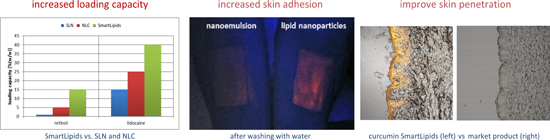
- cream, the melting enthalpy will decrease. Thus, the physical stability of SmartLipids is easy to analyze and to prove. Chemical stabilization of active agents Classical fluid carriers such as nanoemulsion and liposomes have a limited ability to protect labile lipophilic active agents. Due to the
- carrier systems, but only with limited increase in stability. Stabilities reported were 20% after ten days in liposomes [18], 40% after 24 h in a nanoemulsion [19], 50% after 24 h in zein colloidal particles [19] and 60% after one month in a nanoemulsion stabilized by silica [20]. A screening was
- with production capacities of up to 10.000 L/h (large scale). The obtained hot nanoemulsion is cooled, the lipid blend re-crystallizes and forms solid lipid particles. The suspensions are preserved by standard preservatives (e.g., euxyl® PE 9010) or are alternatively prepared preservative-free by