


Search results
Search for "nanothermometry" in Full Text gives 2 result(s) in Beilstein Journal of Nanotechnology.
Internal 3D temperature mapping in biological systems using ratiometric light-sheet imaging and lipid-coated upconversion nanothermometers
Beilstein J. Nanotechnol. 2025, 16, 2306–2316, doi:10.3762/bjnano.16.159
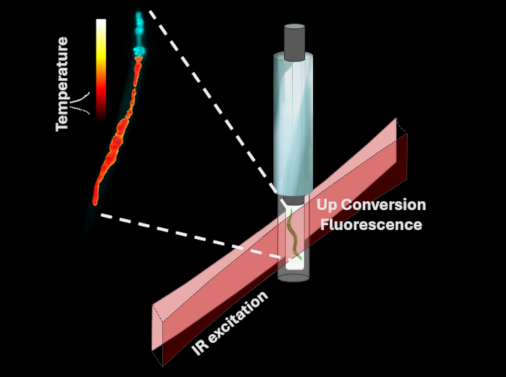
- estimate temperature through ratiometric imaging of two thermally coupled fluorescence bands. This work demonstrates the feasibility of volumetric temperature mapping in internal biological systems using light-sheet fluorescence microscopy and lipid-coated UCNPs as nanothermometry markers. This approach
- ratios [18][19][20][21][22][23][24][25][26][27][28][29] and polarization anisotropy [30][31]. In biological applications involving fluorescent nanothermometry, light–tissue interactions must be carefully considered for an accurate temperature measurement. To address this, a wide range of luminescent
- volumetric temperature sensing through fluorescence-lifetime or UC nanothermometry. However, these approaches remain limited by point-by-point scanning, shallow penetration depth, and narrow fields of view (typically below 100 µm), restricting their applicability to intact organisms. Beyond these


Time-resolved universal temperature measurements using NaYF4:Er3+,Yb3+ upconverting nanoparticles in an electrospray jet
Beilstein J. Nanotechnol. 2018, 9, 2916–2924, doi:10.3762/bjnano.9.270
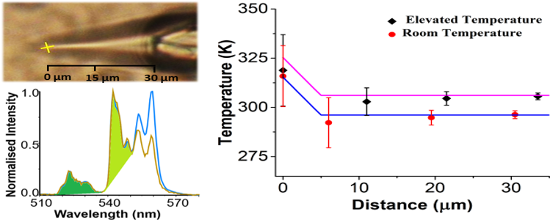
- understand temperature-dependent reactions such as protein unfolding inside microjet/microdroplets and microfluidic systems. Keywords: electrospray; microjet; nanothermometry; temperature measurement; time-resolved measurement; upconverting nanoparticles; Introduction There is need and interest to non


Other Beilstein-Institut Open Science Activities



