
Search results
Search for "seta" in Full Text gives 17 result(s) in Beilstein Journal of Nanotechnology.
Micro- and nanoscale effects in biological and bioinspired materials and surfaces
Beilstein J. Nanotechnol. 2026, 17, 214–217, doi:10.3762/bjnano.17.14
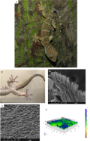
- adhesion. They combined molecular dynamics for the simulation of the adhesive contact between the gecko spatula and the substrate with finite element modeling of the mechanical behavior of the adhesive seta to understand key aspects of gecko seta adhesion across scales. Besides these studies, focusing on
Subdigital integumentary microstructure in Cyrtodactylus (Squamata: Gekkota): do those lineages with incipiently expressed toepads exclusively exhibit adhesive setae?
Beilstein J. Nanotechnol. 2026, 17, 38–56, doi:10.3762/bjnano.17.4
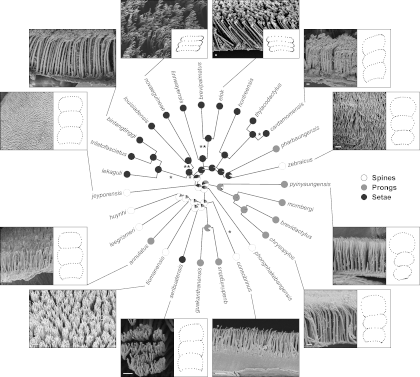
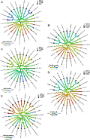
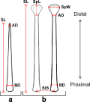
- toepads. Spines were found to be the ancestral subdigital microstructures of Cyrtodactylus, with multiple independent transitions to prongs (three times) and setae (twice). One shift towards setae defines a largely seta-bearing clade, exhibiting a strong phylogenetic signal and supports our third
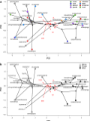
- which expressed no clear tendencies towards lamella-like scales. One terrestrial, one generalist, six saxicoline, and four arboreal species had setae. Of these, the four arboreal species strongly expressed lamella-like scales, while three of the saxicoline seta-bearing species (belonging to the
- pulchellus group) as well as the generalist C. cardamomensis Murdoch et al., 2019 [56] showed tendencies towards lamella-like scales. The remaining seta-bearing species showed no clear tendencies towards lamella-like scales (Figure 2, Table 2, [43]). Ancestral state reconstruction (ASR) Microstructure types


Molecular and mechanical insights into gecko seta adhesion: multiscale simulations combining molecular dynamics and the finite element method
Beilstein J. Nanotechnol. 2025, 16, 2055–2076, doi:10.3762/bjnano.16.141
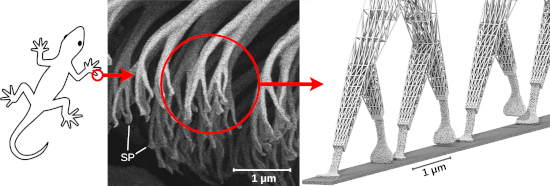
- University, Am Botanischen Garten 1–9, D-24118 Kiel, Germany 10.3762/bjnano.16.141 Abstract Gecko adhesion, enabled by micro- and nanoscale structures known as setae and spatulae, has prompted extensive research. We present a concurrent multiscale computational model of a seta that integrates molecular
- limitations inherent in single-scale models. Keywords: finite element method; gecko adhesion; hybrid modeling; molecular dynamics; multiscale simulations; seta; spatula; Introduction Geckos possess the ability to adhere to a variety of substrates, a trait attributed to specialized micro- and nanoscale
- treatment to an entire seta with multiple spatulae. Since purely particle-based simulation techniques are limited by the number of atoms (or coarse-grained beads), it becomes computationally unfeasible to model an entire seta at molecular resolution. A back-of-the-envelope calculation gives an estimate of






Functional morphology of cleaning devices in the damselfly Ischnura elegans (Odonata, Coenagrionidae)
Beilstein J. Nanotechnol. 2024, 15, 1260–1272, doi:10.3762/bjnano.15.102
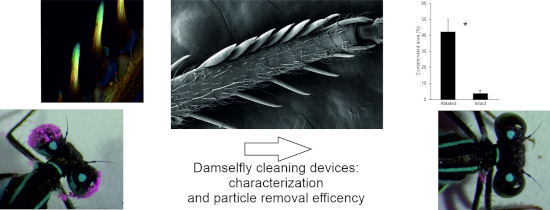
- particle removal efficiency in intact insects and in insects with ablated grooming devices. The grooming devices are constituted of long setae from which a concave cuticular lamina develops towards the medial side of the leg. Each seta shows a material gradient of resilin from its basal to the distal
- portion and from the seta to the cuticular lamina. The removal of the grooming devices induces a strong increase in the contaminated areas on the eyes after grooming. Further studies on insect grooming can provide valuable data on the functional morphology of insect micro- and nanostructures and can
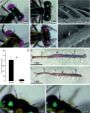
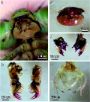
- about 210 µm in length and 44 µm in width and emerge from a well-developed socket (Figure 1b), which gives rise to a long seta, from which a concave cuticular lamina develops towards the medial side of the leg (Figure 1c,d). The border of the cuticular lamina showed indentations and appeared lobate


Comparative analysis of the ultrastructure and adhesive secretion pathways of different smooth attachment pads of the stick insect Medauroidea extradentata (Phasmatodea)
Beilstein J. Nanotechnol. 2024, 15, 612–630, doi:10.3762/bjnano.15.52
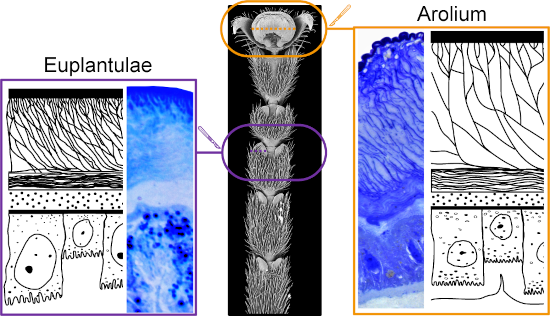
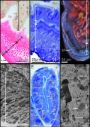
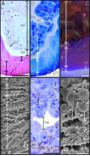
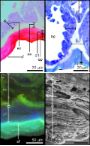
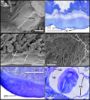
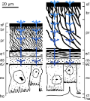
- show a weak green autofluorescence signal in CLSM (Figure 4D). These findings indicate that the epidermal cell layer consists of exocrine cells (ex). Furthermore, the lateral sides of the tarsomeres exhibited discernible nerve bundles and hair/seta attachment sites (ha), extending into the epidermal



Suspension feeding in Copepoda (Crustacea) – a numerical model of setae acting in concert
Beilstein J. Nanotechnol. 2023, 14, 603–615, doi:10.3762/bjnano.14.50

- numerical simulations, one can integrate an angle to which every seta can rotate toward the mouth, ϕmin. For the first simulations with ϕmin, we excluded the long setae and only simulated the system with short setae (with the optimal configuration, i.e., with soft adhesive tips). The results of this
- Information File 1. Each seta is constructed of a number of elastic segments (long setae: Nx = 14, Nz = 15; short setae: Nx2 = 14, Nz2 = 7) each having the same length dR. The model does not reproduce exactly realistic numbers of the setae segments or particles. It only provides more or less natural dynamics
- segments close to 180°. According to the goals of this study, we varied the stiffness from segment to segment depending on the hypothetical particular structure. A deformation of the setae produced elastic forces proportional to the seta stiffness. The forces were described by the following equations (see


Growing up in a rough world: scaling of frictional adhesion and morphology of the Tokay gecko (Gekko gecko)
Beilstein J. Nanotechnol. 2022, 13, 1292–1302, doi:10.3762/bjnano.13.107
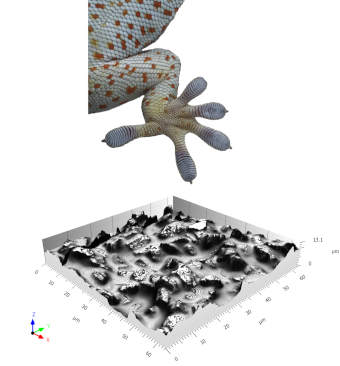
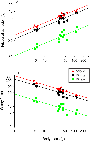
- these parameters, along with the force per seta [18], estimated frictional adhesive force scaled isometrically with body mass (slope = 0.61). Surface roughness The root mean square height of the sandpaper surfaces (Sq) ranged from 34.8 μm (100 grit) to 3.16 μm (3000 grit), highlighting the range of
- , and the average force per seta, are reliant upon the assumption that every single seta makes contact. Our results suggest that, even on incredibly smooth surfaces such as acrylic glass, quite a few setae are not in contact with the surface. However, there are other reasons for this mismatch. The manus
- is also clear that there are constraints in what changes are possible, such as setal width and density. These constraints may simply be due to spacing, which does not appear to change with body size. If spacing among setae does not change, it follows that the diameter of each seta is also likely to


Physical constraints lead to parallel evolution of micro- and nanostructures of animal adhesive pads: a review
Beilstein J. Nanotechnol. 2021, 12, 725–743, doi:10.3762/bjnano.12.57
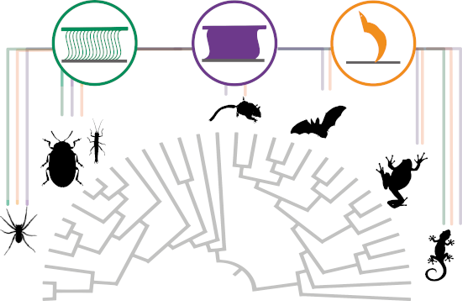
- hairy (seta-like) protuberances with high aspect ratios (higher than 10), many species exhibit smaller sized cuticular nubs (aspect ratio usually <5). Nubs and other surface patterns are reported to be adaptations to tune the contact formation of smooth attachment pads towards specific substrate


A comparison of tarsal morphology and traction force in the two burying beetles Nicrophorus nepalensis and Nicrophorus vespilloides (Coleoptera, Silphidae)
Beilstein J. Nanotechnol. 2019, 10, 47–61, doi:10.3762/bjnano.10.5

- various surfaces compared with their female counterparts [18]. In the present study, we have evaluated whether similar sex-specific differences in tenent seta number and morphology also exist in Nicrophorus and whether this might result in corresponding differences in attachment performance. This
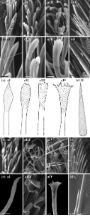
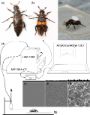
- different types of seta. The first type were setae with distinctly broadened tips (Figure 2, aI–aIV). The second type were bristle-like hairs with pointed tips (Figure 2 bI–bII). In both species, the number of hairs with broadened tips decreased from the fore to the hind tarsus, whereby the number of
- position of the inset on the tarsus is shown in (d). Scale bar: 1 mm. Scale bar (top middle), 20 µm. Abbreviations: aI–aIV and bI–bII refer to the seta types shown in Figure 2; b, robust bristle like hair; hs, hairless stripe; s, spines; T1–T5, tarsomeres 1–5. SEM images and schematic diagrams of the


A new bioinspired method for pressure and flow sensing based on the underwater air-retaining surface of the backswimmer Notonecta
Beilstein J. Nanotechnol. 2018, 9, 3039–3047, doi:10.3762/bjnano.9.282

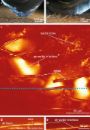
- ) revealed that each seta of the Notonecta hemelytra was part of a sensory complex consisting of (1) a tubular body, (2) a joint membrane and (3) an outer dendritic segment with a dendritic sheath (Figure 3). All sectioned sensillae (n = 15) were hair mechanoreceptors with a well-developed tubular body, a
- an entire hemelytron analyzed by µCT allowed the identification of every single seta and its dendritic canal on the hemelytron (Figure 4). The data suggest that probably all 6,500 setae on one hemelytron are contacted by nerve cells. In light microscopic images of stained hemelytra samples, the
- of each seta most likely detect this deflection. This should enable backswimmers to sense minute pressure changes. If a spherical pressure wave propagates through the water, different setae should be deflected with certain time delays, depending on the direction and velocity of the spherical pressure




The effect of flexible joint-like elements on the adhesive performance of nature-inspired bent mushroom-like fibers
Beilstein J. Nanotechnol. 2018, 9, 2893–2905, doi:10.3762/bjnano.9.268
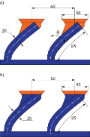
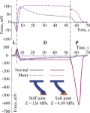
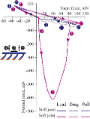
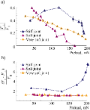
- adhesion during sliding, which is a necessary condition for an adhesive pad bearing animal/robot to climb vertically. The relationship between normal and shear force In their tests with an isolated seta, Autumn et al. [12] concluded that setae exhibit compression in the releasing direction where the shear
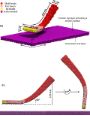
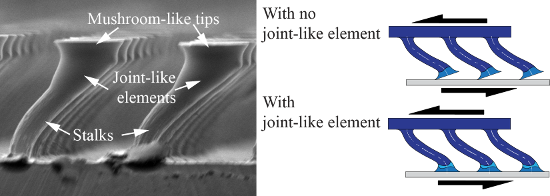
- flexible joint. A higher pull-off is recorded from the soft joint than the very soft joint fibers. The terminal ends of the nanofibers at the end of the seta form a slanted plane as opposed to a horizontal one. The deformation caused in the dragging stage rotates the setae tip such that most of the fibers






Influence of ambient humidity on the attachment ability of ladybird beetles (Coccinella septempunctata)
Beilstein J. Nanotechnol. 2016, 7, 1322–1329, doi:10.3762/bjnano.7.123
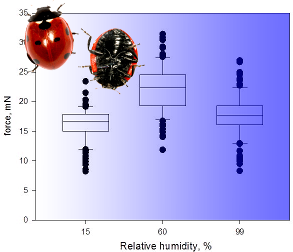
- micro-emulsion of water and oil, with varying fractions of substances [22][23][24][25][26][27][28][29][30][31]. The mixture of both polar and non-polar substances presumably helps to wet both hydrophobic and hydrophilic surfaces building a fluid meniscus between the seta and the substrate to yield high


Functional diversity of resilin in Arthropoda
Beilstein J. Nanotechnol. 2016, 7, 1241–1259, doi:10.3762/bjnano.7.115
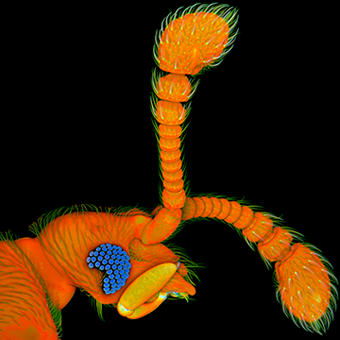
- the setae (Figure 2C). The measurements revealed that the Young’s modulus of the material in the most distal section of each seta is relatively low (1.2 ± 0.3 MPa), whereas it is considerably higher at the setal base (6.8 ± 1.2 GPa). The differences in the Young’s modulus between different regions
- correlate with the resilin proportion observed in the seta material [48]. When the setae are dehydrated, the Young’s modulus of the setal tip material strongly increases from 1.2 to 7.2 GPa, and it exhibits no statistically significant differences along the complete setae [48], which is in accordance with
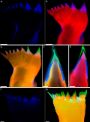
- on the level of each single adhesive tarsal seta, was shown to exist in the seven-spot ladybird (Coccinella septempunctata) [48] (Figure 2A–C). The material of the setal tip contains large proportions of resilin, while the base of the seta consists mainly of sclerotised chitinous material. Between




Aquatic versus terrestrial attachment: Water makes a difference
Beilstein J. Nanotechnol. 2014, 5, 2424–2439, doi:10.3762/bjnano.5.252

- to compare and principally serve to demonstrate that wide-scale comparative studies are sorely needed in this field. Scale issues are also important; some studies are on a particular body part, e.g., the attachment of a single seta, while others are on whole organisms. This is certain to add
- substantial variability and we cannot calculate a reasonable attachment force for the whole animal from measurements of a single seta, tube foot or sucker. Adhesion A variety of different mechanisms contributes to adhesion: (i) mechanical interlocking on a very small scale, (ii) electrostatic forces, (iii


Physical principles of fluid-mediated insect attachment - Shouldn’t insects slip?
Beilstein J. Nanotechnol. 2014, 5, 1160–1166, doi:10.3762/bjnano.5.127

- , cockroaches and ants it has been shown that this adhesive fluid is a two-phasic microemulsion consisting of a hydrophilic, volatile dispersive phase within a hydrophobic, persistent continuous phase [30][35]. In hairy pads, with notably smaller contact points of each seta (and thus an even more complicated


Fibrillar adhesion with no clusterisation: Functional significance of material gradient along adhesive setae of insects
Beilstein J. Nanotechnol. 2014, 5, 837–845, doi:10.3762/bjnano.5.95
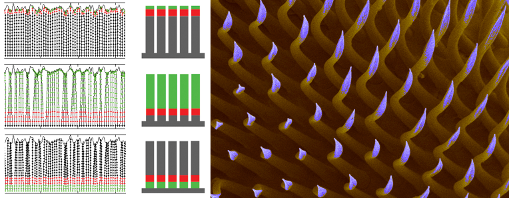
- presented the combined study on the material structure and local mechanical properties in tarsal setae of the beetle Coccinella septempunctata and demonstrated the presence of a material gradient at the level of each single seta [12]. Setal elasticity modulus, probed by atomic force microscope (AFM), ranges
- from 1.2 MPa at the tip [12] to 6.8 GPa at the base. At the setal tip, we revealed the rubber-like protein resilin in rather high concentrations [13][14], whereas at the base of the seta the sclerotised cuticle is dominating. Between tip and the base, there is a gradient of material composition
- sclerotised basal part of the seta, a rather pronounced longitudinal gradient of material composition was revealed. AFM-nanoindentation experiments have revealed rather low elasticity modulus at the setal tip (1.2 ± 0.3 MPa), but the high one at the setal base (2.43 ± 1.9 GPa) [12]. This information about the


Superhydrophobic surfaces of the water bug Notonecta glauca: a model for friction reduction and air retention
Beilstein J. Nanotechnol. 2011, 2, 137–144, doi:10.3762/bjnano.2.17

- larger setae and tiny microtrichia (Figure 2E and Figure 2F). The microtrichia cover shows a similar density (6.0 × 106 mm−2 on average) as the underside of the elytra, but the height is somewhat larger (2.3 µm). On these surfaces two different types of setae occur. The first seta-type (ST 1) is tapered
- and bent while the tips point more or less in the anterio–distal direction. In contrast, the second seta-type (ST 2) is clubbed and points in the posterior direction. The combined density of both setae-types is approximately 250 mm−2. The air film on the upper side of the elytra might help to keep the
- ). Contact angles ranged between 154° and 158°. The tilting angles were less than 5° on the sternites (not measurable) and the underside of the elytra. On the upper side of the elytra the tilting angle was higher (15°), which might be explained by the distant shape of the first seta-type (ST 1). However, in