Search results
Search for "arylation reactions" in Full Text gives 51 result(s) in Beilstein Journal of Organic Chemistry.
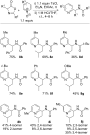
Polysubstituted ferrocenes as tunable redox mediators
Beilstein J. Org. Chem. 2018, 14, 1004–1015, doi:10.3762/bjoc.14.86
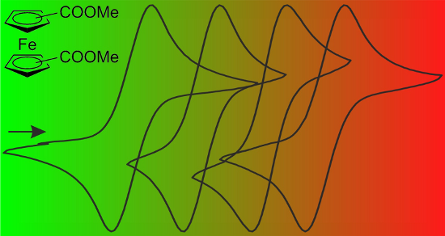
- syntheses [17][18][19][20][21][22][23][24][25][26][27][28]. Tuning of the electrochemical potential of substituted ferrocenium salts promoted a selective oxidative bicyclization reaction under mild conditions (Scheme 1a) [27]. Ferrocene and decamethylferrocene act as redox catalysts in Meerwein arylation
- reactions [29], borylations of arenediazonium salts [30] and in C–H imidation reactions of (hetero)arenes [31] (Scheme 1b,c). Ferrocene has been used as redox mediator for the electrochemical modification of carbon surfaces via electrochemical oxidation of carboxylates [32][33], as mediator for


Synthesis of fluoro-functionalized diaryl-λ3-iodonium salts and their cytotoxicity against human lymphoma U937 cells
Beilstein J. Org. Chem. 2018, 14, 364–372, doi:10.3762/bjoc.14.24
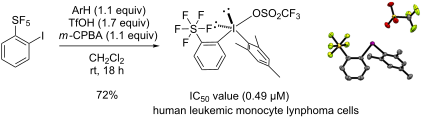
- arylation reactions in synthetic organic chemistry, but their biological properties are not fully understood. Herein, after initially investigating 18 fluoro-functionalized reagents, we discovered that the ortho-fluoro-functionalized diaryliodonium salt reagents showed remarkable cytotoxicity in vitro


Reactivity of bromoselenophenes in palladium-catalyzed direct arylations
Beilstein J. Org. Chem. 2017, 13, 2862–2868, doi:10.3762/bjoc.13.278

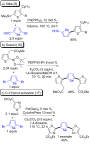
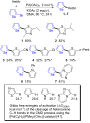
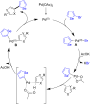
- employed to prepare 2-heteroarylated selenophenes; whereas, 2,5-dibromoselenophene generally gave 2,5-di(heteroarylated) selenophenes in high yields using both thiazole and thiophene derivatives. Moreover, sequential catalytic C2 heteroarylation, bromination, catalytic C5 arylation reactions allowed the
- examined. The expected product 7 was obtained in a high yield of 81%. Thus, for Pd-catalyzed direct heteroarylations of 2-bromoselenophene, only the heteroarenes containing C–H bonds with low Gibbs free energies of activation [41] should be employed. By contrast, the direct arylation reactions with 2,5



Direct catalytic arylation of heteroarenes with meso-bromophenyl-substituted porphyrins
Beilstein J. Org. Chem. 2017, 13, 1524–1532, doi:10.3762/bjoc.13.152
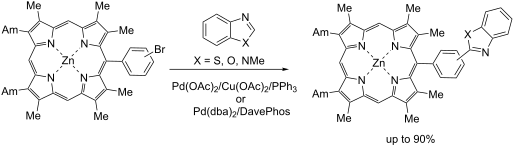
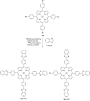
- described in the arylation reactions. In this connection we considered it important to develop an alternative approach to heteroaryl-substituted porphyrins using catalytic arylation of easily accessible meso-(bromophenyl)porphyrins with heterocycles possessing “acidic” C–H bonds, such as benzoxazole (pKa


Chemoselective synthesis of diaryl disulfides via a visible light-mediated coupling of arenediazonium tetrafluoroborates and CS2
Beilstein J. Org. Chem. 2017, 13, 903–909, doi:10.3762/bjoc.13.91

- turns red upon exposure to sunlight due to decomposition and formation of radical species [20]. Subsequently, the photodecomposition of diazonium salts by loss of nitrogen upon exposure to light has been utilized in organic synthesis for example to remove amino groups from anilines [21] or for arylation
- reactions [15][22]. Based on the above research results, we envisioned that a radical pathway may facilitate the formation of diaryl disulfides. Therefore the photocatalyst Ru(bpy)3(PF6)2 (bpy = 2,2’-bipyridine) [23] and a 20 W blue-light LED were chosen as catalyst and the source of visible light


Contribution of microreactor technology and flow chemistry to the development of green and sustainable synthesis
Beilstein J. Org. Chem. 2017, 13, 520–542, doi:10.3762/bjoc.13.51
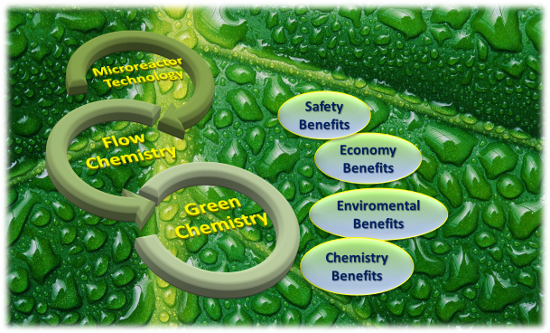
- Ar–Csp3, Ar–Csp2 and Ar–Csp bond-forming reactions. The use of a photochemical flow reactor, consisting of a polyfluorinated tube reactor wrapped around a 500 W Hg lamp, allowed to overcome batch limitations paving the way for metal-free arylation reactions via phenyl cations. Derivatives 14a–g were








Silyl-protective groups influencing the reactivity and selectivity in glycosylations
Beilstein J. Org. Chem. 2017, 13, 93–105, doi:10.3762/bjoc.13.12

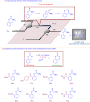
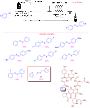
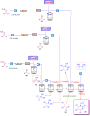
- , the ability of the bulky silyl groups to alter the conformation of the glycosyl-donor ring can be used to control the selectivity. Suzuki and collaborators showed that the C-arylation reactions with the 3,4-O-di(tert-butyldiphenylsilyl)-protected acetate 56 led to the α-glycoside 58 with high


Direct arylation catalysis with chloro[8-(dimesitylboryl)quinoline-κN]copper(I)
Beilstein J. Org. Chem. 2016, 12, 2757–2762, doi:10.3762/bjoc.12.272
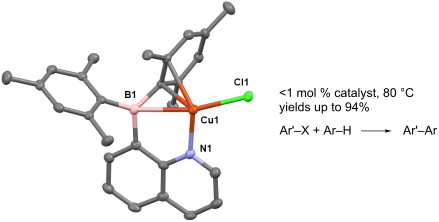
- ], and Cu [34][35][36][37]) or an aluminum-based metal-organic framework [38], and there are several reports of metal-free direct arylation reactions in which the reaction is promoted with 2–3 equivalents KO(t-Bu) and (typically) 10–30 mol % of an additive [39][40][41][42][43][44][45][46][47][48]. The
- )quinoline-κN]copper(I) (2, Scheme 1), and investigate its performance as a catalyst for direct arylation reactions. We note that compound 2 consists of the ambiphilic ligand 1 coordinated to Cu(I) via nitrogen atom coordination and an η3-BCC interaction [52]. Herein we report the use of the preformed
- catalyst 2 and demonstrate good activity for C–X/C–H direct arylation reactions. Results and Discussion The results of direct arylation catalysis are summarized in Table 1. We performed the reaction of iodobenzene with benzene/DMF (10:1 v/v) at 80 °C using a catalyst loading of 2 mol % of 2 and 30


Cationic Pd(II)-catalyzed C–H activation/cross-coupling reactions at room temperature: synthetic and mechanistic studies
Beilstein J. Org. Chem. 2016, 12, 1040–1064, doi:10.3762/bjoc.12.99
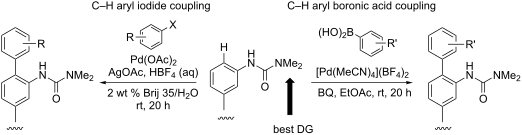
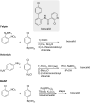
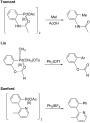
- C–H arylations of arylureas with aryl iodides and arylboronic acids Among the most conceptually attractive approaches to aromatic C–H activation is the efficient synthesis of biaryls through direct arylation reactions. The widespread availability of aryl iodides and arylboronic acids make them






N-Methylphthalimide-substituted benzimidazolium salts and PEPPSI Pd–NHC complexes: synthesis, characterization and catalytic activity in carbon–carbon bond-forming reactions
Beilstein J. Org. Chem. 2016, 12, 81–88, doi:10.3762/bjoc.12.9
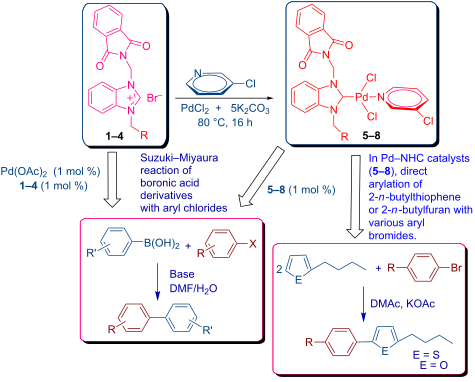
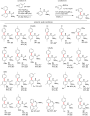
- complexes have been used in different coupling reactions such as Mizoroki–Heck cross-coupling [22][23], Suzuki–Miyaura cross-coupling [24][25], Sonogashira [26] and arylation reactions [27]. There are suitable precatalyst scaffolds, which were developed by Nolan [28], Organ [21] and Buchwald [29]. To find


A convergent, umpoled synthesis of 2-(1-amidoalkyl)pyridines
Beilstein J. Org. Chem. 2016, 12, 1–4, doi:10.3762/bjoc.12.1
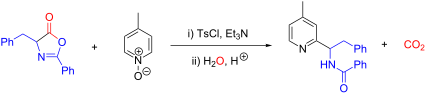
- particular has developed methods for the preparation of α-aryl variants by palladium-catalysed enolate arylation reactions [13][14][15]. More recently, we have sought to develop more sustainable methods for the arylation of amino acid enolate equivalents that avoid the use of precious metal salts and


Pyridylidene ligand facilitates gold-catalyzed oxidative C–H arylation of heterocycles
Beilstein J. Org. Chem. 2015, 11, 2737–2746, doi:10.3762/bjoc.11.295
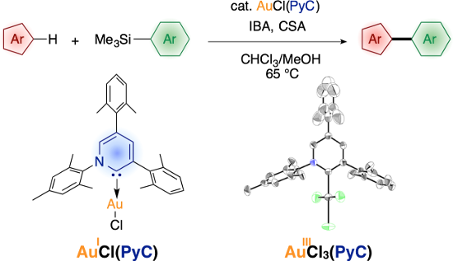
- hereroarenes that has been known to be very sluggish with typical ligand systems [68][69][70][71][72]. In this paper, the C–H arylation reactions of isoxazole, indole, and benzothiophene are presented. In addition, direct observation and isolation of PyC-gold(III) complexes are described. Results and




Recent advances in copper-catalyzed asymmetric coupling reactions
Beilstein J. Org. Chem. 2015, 11, 2600–2615, doi:10.3762/bjoc.11.280
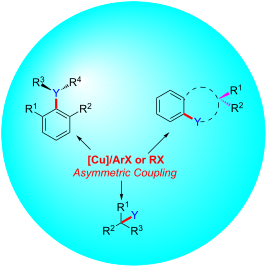
- coupling reactions has not attracted the attention from the organic chemistry community. This may have been due to the fact that these reactions do not allow for the direct creation of new stereochemical centers. Only a few examples were reported for asymmetric N-arylation reactions using a Pd catalytic
- system through an “indirect” way, either by asymmetric desymmetrization or kinetic resolution [40][41][42][43][44]. In most cases, the enantioselectivities were not satisfactory. Recently, a copper catalytic system became another option toward asymmetric N-arylation reactions in term of improving
- biaryl compounds. Synthesis of chiral unsymmetrically substituted biaryl compounds. Atroposelective synthesis of biaryl ligands and natural products by using a chiral diether linker. Enantioselective arylation reactions of 2-methylacetoacetates. Asymmetric aryl C–N coupling reactions following a


Tuning of tetrathiafulvalene properties: versatile synthesis of N-arylated monopyrrolotetrathiafulvalenes via Ullmann-type coupling reactions
Beilstein J. Org. Chem. 2015, 11, 860–868, doi:10.3762/bjoc.11.96
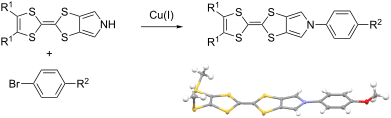
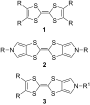
- comparing two possible copper(I) ligands (Figure 2): trans-diaminocyclohexane (DACH) 9a, which was employed before in N-arylations with pyrrolo-TTFs [17][18][19], and its Schiff base derivative 9b, which was reported to be one of the most effective ligands in similar N-arylation reactions with other



Exploration of C–H and N–H-bond functionalization towards 1-(1,2-diarylindol-3-yl)tetrahydroisoquinolines
Beilstein J. Org. Chem. 2014, 10, 2186–2199, doi:10.3762/bjoc.10.226

- reaction. Formation of trimeric boronic acid anhydride was observed via GC–MS, a species less reactive in arylation reactions. When small amounts of water were added on purpose the reaction solution turned black immediately, most likely due to the formation of Pd black which is inactive in the present


Synthesis of trifluoromethyl-substituted pyrazolo[4,3-c]pyridines – sequential versus multicomponent reaction approach
Beilstein J. Org. Chem. 2014, 10, 1759–1764, doi:10.3762/bjoc.10.183

- multicomponent reaction following the path 2→9→7. Azine N-oxides of type 7 are estimated to be of particular interest due to the possibility of further functionalization adjacent to the nitrogen atom (position 4), for instance by palladium-catalyzed direct arylation reactions [31]. NMR spectroscopic


Acid, silver, and solvent-free gold-catalyzed hydrophenoxylation of internal alkynes
Beilstein J. Org. Chem. 2013, 9, 2002–2008, doi:10.3762/bjoc.9.235
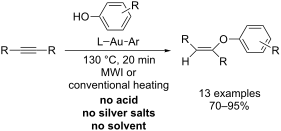
- carried out in an oil bath. HRMS data were obtained on a Thermo Scientific Exactive Plus LC–MS system (ESI). General method for the arylation reactions: general procedure A: For a typical reaction, (NHC)AuCl, 2 equiv of the arylboronic acid, 2 equiv of Cs2CO3, and a magnetic stirring bar were added to a


Palladium(II)-catalyzed Heck reaction of aryl halides and arylboronic acids with olefins under mild conditions
Beilstein J. Org. Chem. 2013, 9, 1578–1588, doi:10.3762/bjoc.9.180
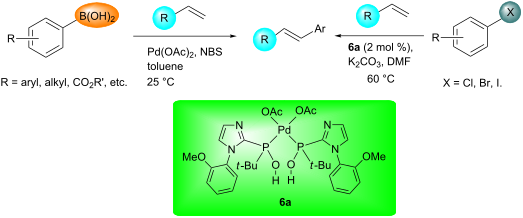
- compared to the conventional trisubstituted phosphine ligands. Despite this advantage, the potential of these ligands has not been fully realized in Heck arylation reactions. Up to now, only a few examples of utilizing SPO-ligated palladium complexes in oxidative Heck reactions have been demonstrated [28


Photoinduced synthesis of unsymmetrical diaryl selenides from triarylbismuthines and diaryl diselenides
Beilstein J. Org. Chem. 2013, 9, 1141–1147, doi:10.3762/bjoc.9.127
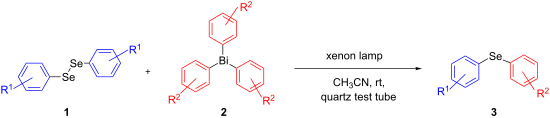
- diaryl selenides from triarylbismuthines and diaryl diselenides has been developed. Although the arylation reactions with triarylbismuthines are usually catalyzed by transition-metal complexes, the present arylation of diaryl diselenides with triarylbismuthines proceeds upon photoirradiation in the
- coupling reactions with organobismuth compounds have been reported [34][35][36][37][38][39][40][41][42][43][44][45][46][47][48][49][50][51][52][53]. Although triphenylbismuthine can generate a phenyl radical [33][54] in the absence of a radical initiator simply by photoirradiation, few arylation reactions


Efficient synthesis of 1,3-diaryl-4-halo-1H-pyrazoles from 3-arylsydnones and 2-aryl-1,1-dihalo-1-alkenes
Beilstein J. Org. Chem. 2011, 7, 1656–1662, doi:10.3762/bjoc.7.195
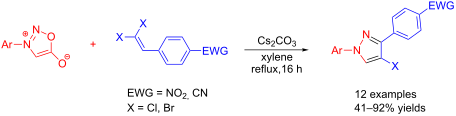
- mechanism for the synthesis of 3. Arylation reactions of pyrazoles (3) with iodobenzene or phenylboronic acid. Screening for optimal reaction conditions.a Synthesis of 1,3-diaryl-4-halo-1H-pyrazoles 3.a Supporting Information Supporting Information File 314: Experimental details and characterization data


Asymmetric synthesis of quaternary aryl amino acid derivatives via a three-component aryne coupling reaction
Beilstein J. Org. Chem. 2011, 7, 1570–1576, doi:10.3762/bjoc.7.185
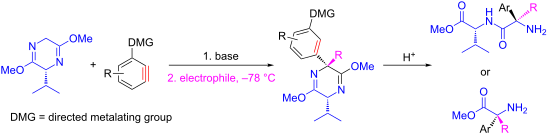
- as the antibacterial fumimycin [20]. Herein, we describe our endeavours towards the synthesis of such valuable compounds by utilizing the multicomponent aryne reaction. Results and Discussion Formation of quaternary Schöllkopf adducts The same procedure was carried out as for the α-arylation
- reactions: The benzyne precursor 2a and Schöllkopf’s bislactim ether 1 were allowed to react with 2.5 equivalents of sec-butyllithium at –95 °C to carry out the required ortho-lithiation for benzyne formation from 2a and the deprotonation of bislactim 1. During warming to room temperature, fragmentation to




Synthesis of fluoranthenes by hydroarylation of alkynes catalyzed by gold(I) or gallium trichloride
Beilstein J. Org. Chem. 2011, 7, 1520–1525, doi:10.3762/bjoc.7.178
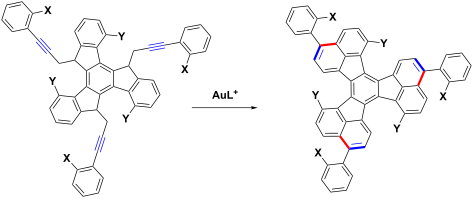
- have already been synthesized by palladium-catalyzed arylation reactions [53][54]. Strategically halogenated decacyclenes with a substitution pattern similar to that of 2 have been used for the synthesis of circumtrindene by flash vacuum pyrolysis [55]. Here we report the results on the synthesis of


Directed aromatic functionalization in natural-product synthesis: Fredericamycin A, nothapodytine B, and topopyrones B and D
Beilstein J. Org. Chem. 2011, 7, 1475–1485, doi:10.3762/bjoc.7.171
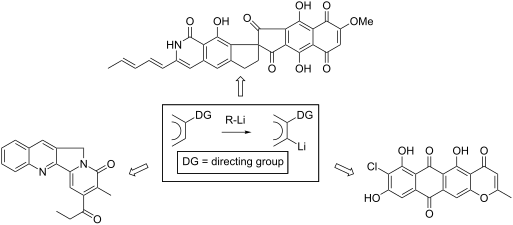
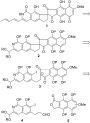
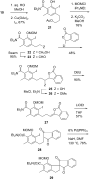
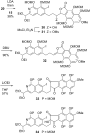
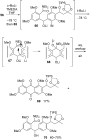
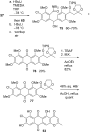
- ]. In the years since, Pd-mediated arylation reactions of enolates have been extensively developed and improved, especially by Buchwald [40][41][42][43] and Hartwig [44][45][46]. Nothapodytine Our group cultivates a long-standing interest in furan chemistry, especially in connection with a process that







Asymmetric synthesis of tertiary thiols and thioethers
Beilstein J. Org. Chem. 2011, 7, 582–595, doi:10.3762/bjoc.7.68

- with electrophiles is general for a range of structures, but until very recently it has not been applicable to arylation reactions. However, we have discovered [75] a variant of a rearrangement reaction of lithiated ureas that we first reported in 2007 [76] in which a lithiated thiocarbamate undergoes








Palladium- and copper-mediated N-aryl bond formation reactions for the synthesis of biological active compounds
Beilstein J. Org. Chem. 2011, 7, 59–74, doi:10.3762/bjoc.7.10

- reactions, copper-mediated Ullmann-type and Chan–Lam-type N-arylation reactions. The discussed examples show that palladium-catalysed reactions are favoured for large-scale applications and tolerate sterically demanding substituents on the coupling partners better than Chan–Lam reactions. Chan–Lam N
- ], benzimidazoles [40][41], sulfonamides [38], pyrroles [42] and lactams [43]. The three typical methods for N-arylation have been extensively reviewed concerning scope and limitation of these reactions [4][44][45][46][47][48]. However, the application of palladium- and copper-mediated N-arylation reactions in the
- and natural product synthesis, a broad application of catalytic C–N-arylation is highly desirable. Evano et al. recently reviewed copper-mediated C–N-arylation reactions in natural product syntheses and discussed different examples from total synthesis using the arylation of alkylamines, amides