


Search results
Search for "biotransformation" in Full Text gives 31 result(s) in Beilstein Journal of Organic Chemistry.
Regio- and stereoselective oxidation of unactivated C–H bonds with Rhodococcus rhodochrous
Beilstein J. Org. Chem. 2012, 8, 496–500, doi:10.3762/bjoc.8.56
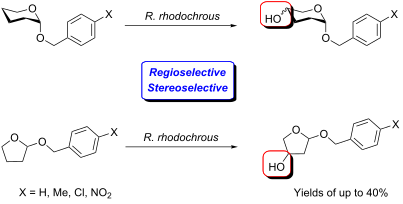
- phenyl ring. Analysis of the products arising from the biotransformation with p-methyl 3b and the p-chloro 3c derivatives revealed that the bacterium was capable of catalysing hydroxylation selectively in the C5-position, providing the C5-axial isomers 4b and 4c and C5-equitorial hydroxylated isomers 5b


Biocatalytic hydroxylation of n-butane with in situ cofactor regeneration at low temperature and under normal pressure
Beilstein J. Org. Chem. 2012, 8, 186–191, doi:10.3762/bjoc.8.20
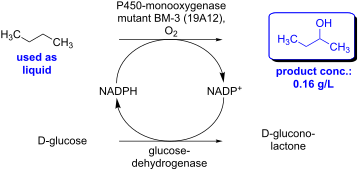
- -called “liquid gas” n-butane (boiling point: −0.5 °C), at a low starting temperature, which was chosen in the range of −5 to 8 °C. For the biotransformation of this liquid gas the following experimental procedure was carried out: First, all components required for the reaction (in a particular solvent
- lacking high-pressure equipment. A current challenge, addressed in our laboratories, is the further improvement of process efficiency and volumetric productivity of this enzymatic oxidation process. In addition, studies of enzyme stability during this biotransformation process are planned as future work


Natural product biosyntheses in cyanobacteria: A treasure trove of unique enzymes
Beilstein J. Org. Chem. 2011, 7, 1622–1635, doi:10.3762/bjoc.7.191
- approaches towards libraries of new compounds or for rational biotransformation of existing leading compounds. This review gives an overview of the current trends in cyanobacterial natural-product research, with a special emphasis on the biosynthetic enzymes. Review Biosynthesis of peptides and polyketides


Chimeric self-sufficient P450cam-RhFRed biocatalysts with broad substrate scope
Beilstein J. Org. Chem. 2011, 7, 1494–1498, doi:10.3762/bjoc.7.173
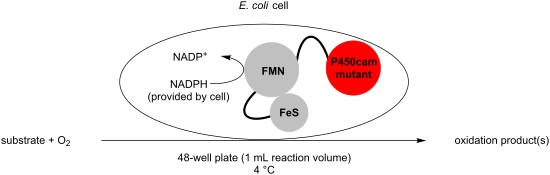
- mutation into our P450cam-RhFRed fused system made the whole cell biotransformation of diphenylmethane as a substrate possible (4 mL reaction in a 15 mL Falcon tube) with a GC–MS yield of 58% of 4-hydroxydiphenylmethane after 48 h (Scheme 1). In order to improve screening throughput, we investigated the
- whole cell biotransformation of diphenylmethane with P450cam(Y96A)-RhFRed in multiwell plates (24, 48 and 96) with different reaction volumes (0.5 mL, 1 mL and 2 mL). The biotransformation carried out in a 48-well plate with a reaction volume of 1 mL was found to give a similar conversion to the 4 mL
- turned out to be the most efficient for the epoxidation of the tetrahydropyridine ring, with substrate 7b epoxidised to 8b in 73% conversion. Racemic epoxide 8b was synthesised to confirm the structure of the biotransformation product and to determine the enantiomeric excess. This was found to be 18% for


Coupled chemo(enzymatic) reactions in continuous flow
Beilstein J. Org. Chem. 2011, 7, 1449–1467, doi:10.3762/bjoc.7.169
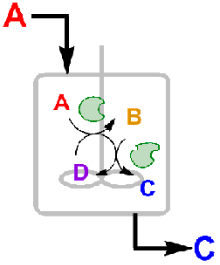
- indispensable part of industrial biotechnology, and are used in the production of a broad range of bulk and fine chemicals [6]. When a microbial multistep biotransformation is carried out in continuous flow it might formally also be considered as a fourth-generation enzymatic process according to the above
- continuous epoxidation of 1,7-octadiene (70) to (R)-7-epoxyoctene (72) by a strain of Pseudomonas oleovorans growing on heptane (71) (Scheme 23) [51]. In a continuous operation, with regard to the aqueous phase, substrates for both growth and biotransformation were supplied in the gas phase from a reservoir


A simple route for renewable nano- sized arjunolic and asiatic acids and self- assembly of arjuna- bromolactone
Beilstein J. Org. Chem. 2008, 4, No. 24, doi:10.3762/bjoc.4.24
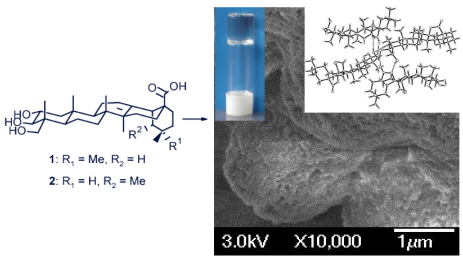
- acid, as a minor component having a close structural resemblance [12][13]. Biotransformation of the ursane to the oleanane skeleton has recently been reported [14], but no simple method for the separation of the two triterpenic acids is known [15]. Herein we report a simple method for separation the




Other Beilstein-Institut Open Science Activities



