


Search results
Search for "reductive coupling" in Full Text gives 36 result(s) in Beilstein Journal of Organic Chemistry.
Zirconoarylation of alkynes through p-chloranil-promoted reductive elimination of arylzirconates
Beilstein J. Org. Chem. 2014, 10, 528–534, doi:10.3762/bjoc.10.48

- reactions using zirconocene species have been reported, in particular for the reductive coupling of alkenes or alkynes with other unsaturated compounds [40][41][42][43]. On the other hand, carbozirconation of alkynes via reaction of zirconacyclopentenes with alcohols, allyl ethers, homoallyl bromides, vinyl


Simple two-step synthesis of 2,4-disubstituted pyrroles and 3,5-disubstituted pyrrole-2-carbonitriles from enones
Beilstein J. Org. Chem. 2014, 10, 466–470, doi:10.3762/bjoc.10.44
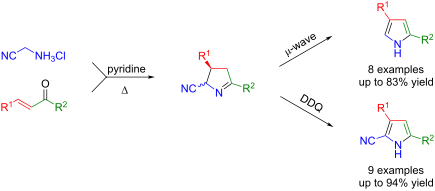
- which can be cyclized to compounds 7 in yields of up to 50% (over 4 steps) [42]. Other methods involve the use of stoichiometric zirconocene dichloride [43], the reductive coupling of alkynes to enones followed by ozonolysis and Paal–Knorr cyclization [21] or the reaction of vinylazides with aldehydes


A new manganese-mediated, cobalt-catalyzed three-component synthesis of (diarylmethyl)sulfonamides
Beilstein J. Org. Chem. 2014, 10, 425–431, doi:10.3762/bjoc.10.39

- imine results from the reaction of the tosylamide with the aldehyde, and the biaryl was formed by reductive coupling of the starting halide. A preformed imine can be used in the process (Table 2, entry 3, result in brackets), indicating that this species might be the reactive electrophilic intermediate


A reductive coupling strategy towards ripostatin A
Beilstein J. Org. Chem. 2013, 9, 1533–1550, doi:10.3762/bjoc.9.175
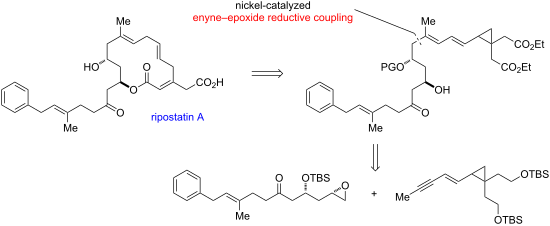
- decarboxylation enables construction of the C15−C16 bond by an aldol reaction. The product of this transformation is of the correct oxidation state and potentially three steps removed from the targeted epoxide fragment. Keywords: catalysis; natural product; nickel; reductive coupling; ripostatin A; synthesis
- potentially sensitive 1,4,7-triene by masking it as a cyclopropyldiene, then unveiling the skipped triene portion via a 1,5-hydrogen rearrangement (Figure 3). This strategy would allow us to take advantage of the high regioselectivity in enyne–epoxide reductive coupling reactions. Furthermore, the proposed
- cyclopropane unit had not been previously tested under nickel-catalyzed reductive coupling conditions. Nickel(0) is known to catalyze the rearrangement of vinylcyclopropanes to cyclopentenes; however, activating substituents are commonly required [19][20][21]. Furthermore, application of a proposed 1,5


Amino-substituted diazocines as pincer-type photochromic switches
Beilstein J. Org. Chem. 2013, 9, 1–7, doi:10.3762/bjoc.9.1
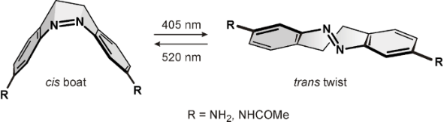
- quantitatively in ortho position to the ethylene bridge, forming 1,2-bis(2-nitro-4-aminophenyl)ethane (3) [11]. Intramolecular reductive coupling of the nitro groups to form the azo unit proceeds with notoriously low yields. The most frequently used procedure using Zn as the reducing agent in Ba(OH)2 [12] or




Metal–ligand multiple bonds as frustrated Lewis pairs for C–H functionalization
Beilstein J. Org. Chem. 2012, 8, 1554–1563, doi:10.3762/bjoc.8.177
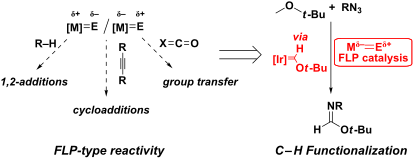
- heterocumulenes [71]. Reductive coupling of two CS2 units at (PNP)Ir═C(H)Ot-Bu [73]. Possible routes to C–H functionalization by 1,2-addition across a polarized metal–element multiple bond. Alkoxycarbene formation by double C–H activation at (PNP)Ir [88]. Catalytic oxidation of MTBE by multiple C–H activations




Fifty years of oxacalix[3]arenes: A review
Beilstein J. Org. Chem. 2012, 8, 201–226, doi:10.3762/bjoc.8.22
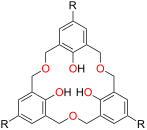
- which two, or all three, units are identical [22]. The method was based on the reductive coupling of silylated derivatives of 2,6-hydroxymethylphenols, in which R is t-Bu, Me, benzyl (Bz), phenyl (Ph), or a halide, as shown in Scheme 3. The reaction takes place under conditions of high dilution at −78












Directed ortho,ortho'-dimetalation of hydrobenzoin: Rapid access to hydrobenzoin derivatives useful for asymmetric synthesis
Beilstein J. Org. Chem. 2011, 7, 1315–1322, doi:10.3762/bjoc.7.154
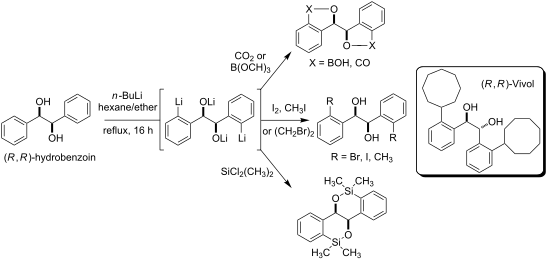
- which arises through the deprotonation of benzyl chloride by 8 and reaction of the resulting benzyl anion with a second equivalent of benzyl chloride. Likewise, attempts to effect a reductive coupling of the tetralithio intermediate to afford the dihydrophenanthrenediol 23 [22] with the aid of various


A practical microreactor for electrochemistry in flow
Beilstein J. Org. Chem. 2011, 7, 1108–1114, doi:10.3762/bjoc.7.127

- platinum electrodes with a surface area of 45 mm2 were positioned with an inter-electrode gap of either 160 µm or 320 µm, and C–C bond forming reactions based on the electro-reductive coupling of activated olefins and benzyl bromide derivatives were reported. The best result obtained was a 98% formation of


Homoallylic amines by reductive inter- and intramolecular coupling of allenes and nitriles
Beilstein J. Org. Chem. 2011, 7, 824–830, doi:10.3762/bjoc.7.94
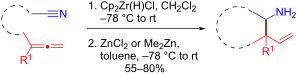
- article, we report a one-pot hydrozirconation of allenes and nitriles that facilitates the reductive coupling to yield N-unprotected homoallylic amines. Results and Discussion We first investigated the addition of allylzirconocenes to N-aluminoimines. N-aluminoisobutyroimine 1 was prepared in situ by the
- protocol for the reductive coupling of allenes and alkynes [38], led to the formation of homoallylic amine 8 in 75% yield after stirring at room temperature for 3 h. Under the optimized conditions for the reaction of benzonitrile (7), we further explored the scope of the reaction of nitriles with 2 (Table
- to that of the zinca-Claisen reaction observed by Suzuki and co-workers [38]. Analogous to the previous work in our group [15], the silyl-substituted allene 16 produced the (E)-vinylsilane 17 as the sole product in this reaction. Given the success of the one-pot intermolecular reductive coupling of


Chiral trimethylsilylated C2- symmetrical diamines as phosphorous derivatizing agents for the determination of the enantiomeric excess of chiral alcohols by 1H NMR
Beilstein J. Org. Chem. 2006, 2, No. 6, doi:10.1186/1860-5397-2-6
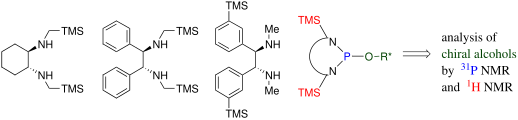
- [30]. (R,R)-1,2-diphenyl-N,N'-bis-trimethylsilanylmethyl-ethane-1,2-diamine 2 was prepared by the same method, starting from (R,R)-diphenyl-ethane-1,2-diamine 5 (Scheme 2) [31]. N,N'-Dimethyl-1,2-bis-(3-trimethylsilanyl-phenyl)-ethane-1,2-diamine 3 was synthesised by reductive coupling of methyl-(3





