


Search results
Search for "carbazoles" in Full Text gives 54 result(s) in Beilstein Journal of Organic Chemistry.
One-pot gold-catalyzed synthesis of 3-silylethynyl indoles from unprotected o-alkynylanilines
Beilstein J. Org. Chem. 2011, 7, 565–569, doi:10.3762/bjoc.7.65
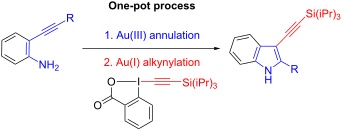
- construction of tetrahydrofurans [21] and aryl-annulated[a]carbazoles [22]. Nakamura examined the cyclization of N-tosyl-o-alkynylanilines and observed an internal transfer of the sulfonyl group to the 3-position of the formed indoles [23][24]. Similar transformations were also achieved for the transfer of


An overview of the key routes to the best selling 5-membered ring heterocyclic pharmaceuticals
Beilstein J. Org. Chem. 2011, 7, 442–495, doi:10.3762/bjoc.7.57
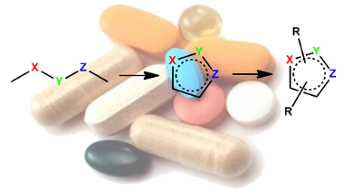
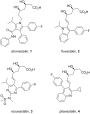
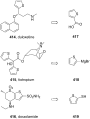
- considered and executed process optimisation study. Carbazoles Carvedilol (136, Coreg) is a general non-selective β-blocker, used in the treatment of mild to moderate congestive heart failure. The structure comprises of a core carbazole ring that plays an important role in its increased activity. The
- carvedilol has an additional antioxidant mode of action. It has been proposed that the carbazole ring may be involved in scavenging oxygen radicals thereby accounting for reduced myocardial damage [41]. Since carbazoles are similar to indoles, analogous methods can be used for their synthesis. The key







Synthesis of 3-(quinolin-2-yl)- and 3,6-bis(quinolin-2-yl)-9H-carbazoles
Beilstein J. Org. Chem. 2010, 6, 966–972, doi:10.3762/bjoc.6.108

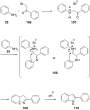
- Yang Li Wentao Gao Institute of Superfine Chemicals, Bohai University, Jinzhou 121000, China 10.3762/bjoc.6.108 Abstract A simple and efficient synthesis of novel 3-(quinolin-2-yl)- and 3,6-bis(quinolin-2-yl)-9H-carbazoles, utilizing sodium ethoxide as a catalyst via a Friedländer condensation
- regard, Meesala et al. [30] recently described a short and facile route to the synthesis of new 3,6-bis(pyrazol-4-yl)carbazoles from 3,6-diacetylcarbazoles through a Vilsmeier reaction. Later, Chaitanya et al. [31] reported a new synthesis of 3-(3-nitrochromenyl)carbazoles, 3,6-bis(3-nitrochromenyl
- )carbazoles under solvent-free conditions by the reaction of β-nitrovinylcarbazole or bis(β-nitrovinyl)carbazole with salicylaldehydes. In light of these findings, and in view of the prominent role structural diversity plays in medicinal and combinatorial chemistry, we felt that there was a real need for the


Anion receptors containing thiazine-1,1-dioxide heterocycles as hydrogen bond donors
Beilstein J. Org. Chem. 2010, 6, No. 50, doi:10.3762/bjoc.6.50
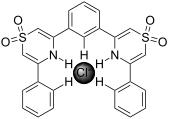
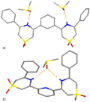
- of nitrogen-based hydrogen bond donor groups such as amides [3][4], ureas [5], pyrroles/indoles/carbazoles [6][7] and sulfonamides [8][9][10][11][12][13][14][15][16][17][18][19][20][21][22][23] to complex the anionic targets in a topologically complementary fashion. Sulfonamides are an interesting


Other Beilstein-Institut Open Science Activities



