


Search results
Search for "dipolar cycloaddition" in Full Text gives 186 result(s) in Beilstein Journal of Organic Chemistry.
[2 + 1] Cycloaddition reactions of fullerene C60 based on diazo compounds
Beilstein J. Org. Chem. 2021, 17, 630–670, doi:10.3762/bjoc.17.55
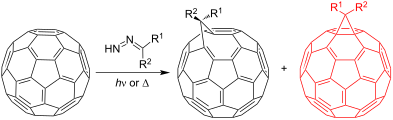
- C60 or b) possible formation of both isomers as a result of 1,3-dipolar cycloaddition of the diazo compound to the fullerene, followed by elimination of molecular nitrogen from the pyrazoline intermediate. Second, the rearrangement of [5,6]-open isomers into thermodynamically more stable [6,6]-closed
- unusual ferrocene-containing block 202 was synthesized (Scheme 37) [158]. 1-(3-(Benzoyl)propyl)-1-phenyl[6,6]methanofullerene (203) was obtained by 1,3-dipolar cycloaddition of a tosylhydrazone derivative (obtained from 1,3-dibenzoylpropane) to C60 (Scheme 38) [159]. 2-Benzoylpropionic acid was used as
1,2,3-Triazoles as leaving groups in SNAr–Arbuzov reactions: synthesis of C6-phosphonated purine derivatives
Beilstein J. Org. Chem. 2021, 17, 193–202, doi:10.3762/bjoc.17.19
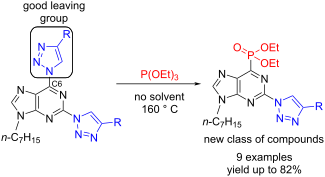
- chlorine at the purine C2 position by azide, and 3) copper-catalyzed azide–alkyne 1,3-dipolar cycloaddition (CuAAC) with different alkynes. Pathway B included: 1) the two-step synthesis of 2,6-bistriazolylpurine derivatives 6 from 2,6-dichloropurine derivative 1 [22] and 2) the SNAr–Arbuzov reaction with


Recent progress in the synthesis of homotropane alkaloids adaline, euphococcinine and N-methyleuphococcinine
Beilstein J. Org. Chem. 2021, 17, 28–41, doi:10.3762/bjoc.17.4
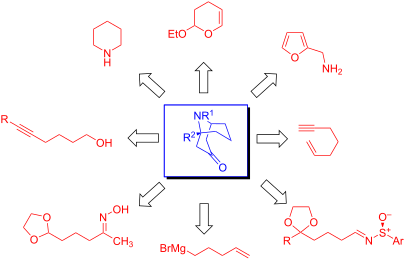
- chemical ecology of Adalia bipunctata and the recent methodologies to obtain adaline (1), euphococcinine (2), and N-methyleuphococcinine (3). Keywords: 9-azabicyclo[3.3.1]nonane; Coccinelid beetles; dipolar cycloaddition; homotropane; ring-closing metathesis; Introduction Coccinellid beetles contain a
- forms. Key (homotropane construction) steps included: i) inter and intramolecular Mannich reaction; ii) double Michael addition in the cyclooctadienone derivative; and iii) intramolecular 1,3-dipolar cycloaddition. As shown in Scheme 1, the azabicyclononane ring is an interesting target for strategies
- dipolar cycloaddition to produce tricyclic isoxazolidines [40]. The synthesis started from 5-hexyn-1-ol (4, Scheme 2). The alcohol was treated with dihydropyran followed by alkylation using butyllithium and then, acetal deprotection, providing the alcohol 5 as a key starting compound for the (±)-adaline


All-carbon [3 + 2] cycloaddition in natural product synthesis
Beilstein J. Org. Chem. 2020, 16, 3015–3031, doi:10.3762/bjoc.16.251
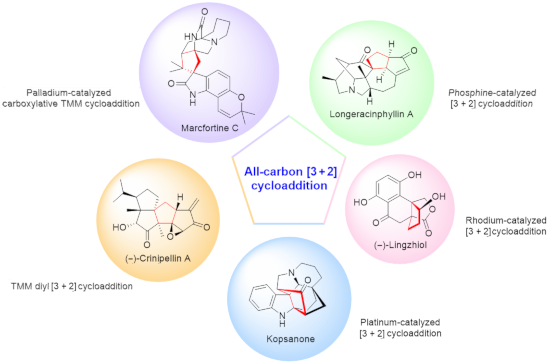
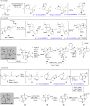
- synthesis of complex natural products (Figure 2). The 1,3-dipolar cycloaddition has been well-documented and widely used for the construction of five-membered heterocycles since the 1960s [13]. However, the development of the all-carbon [3 + 2] cycloaddition, for instance, Berson’s and Little’s [3 + 2







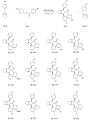
Selective and reversible 1,3-dipolar cycloaddition of 6-aryl-1,5-diazabicyclo[3.1.0]hexanes with 1,3-diphenylprop-2-en-1-ones under microwave irradiation
Beilstein J. Org. Chem. 2020, 16, 2679–2686, doi:10.3762/bjoc.16.218
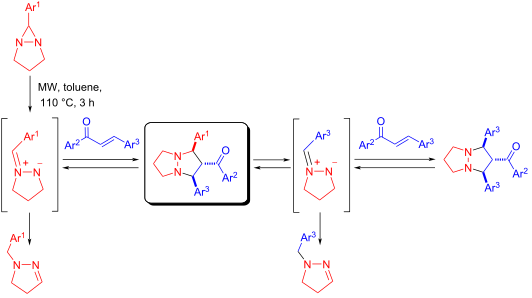
- chemistry and has attracted much interest. For 1,3-dipolar cycloaddition reactions microwave irradiation not only allows to reduce the reaction time and to increase yields, but in some cases also can affect the selectivity of the reaction [34][35][36]. The efficiency of microwave irradiation has been shown
- investigated using only convection heating. The aim of the current work is to investigate the regio- and diastereoselectivity of the microwave-assisted (3 + 2) cycloaddition of 6-aryldiazabicyclo[3.1.0]hexanes with 1,3-diphenylprop-2-en-1-ones. Results and Discussion Herein, we report the 1,3-dipolar
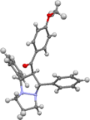
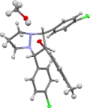
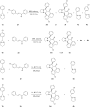
- cycloaddition reaction of 6-aryl-1,5-diazabicyclo[3.1.0]hexanes 1a–d (DABCH) with 1,3-diarylpropenones 2a–l at 110 °С under microwave irradiation using a microwave oven Discover SP in a 10 mL glass reactor. It was found that under these conditions the (3 + 2) cycloaddition products – perhydropyrazolopyrazoles




Azidophosphonium salt-directed chemoselective synthesis of (E)/(Z)-cinnamyl-1H-triazoles and regiospecific access to bromomethylcoumarins from Morita–Baylis–Hillman adducts
Beilstein J. Org. Chem. 2020, 16, 1579–1587, doi:10.3762/bjoc.16.130

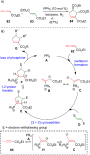
- initiates the allylic rearrangement and thereby facilitates the removal of the crucial phosphonium oxide. The outcome of this process is the structurally relevant azido moiety IIIa, which then undergoes a 1,3-dipolar cycloaddition with the copper acetylide IVa to furnish the 1,4-disubstituted 1,2,3


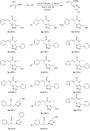


Ferrocenyl-substituted tetrahydrothiophenes via formal [3 + 2]-cycloaddition reactions of ferrocenyl thioketones with donor–acceptor cyclopropanes
Beilstein J. Org. Chem. 2020, 16, 1288–1295, doi:10.3762/bjoc.16.109

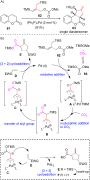
- -methanides (thiocarbonyl ylides) with electron-deficient ethylenic dipolarophiles. This method was extensively developed by Huisgen and co-workers in the 1980s [3][4][5]. In the course of these studies, a non-orthodox stepwise mechanism of the 1,3-dipolar cycloaddition was established by experiments


Synthesis of pyrrolidinedione-fused hexahydropyrrolo[2,1-a]isoquinolines via three-component [3 + 2] cycloaddition followed by one-pot N-allylation and intramolecular Heck reactions
Beilstein J. Org. Chem. 2020, 16, 1225–1233, doi:10.3762/bjoc.16.106
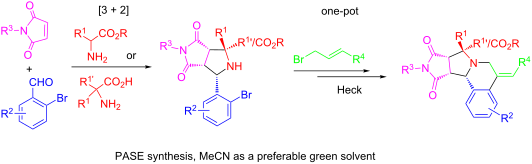
- pyrrolidines II-b was less explored [27][28][29]. In recent years, our lab has reported a series of 1,3-dipolar cycloaddition-initiated methods for the synthesis of diverse heterocycles A–J bearing fused polycyclic rings such as tetrahydroepiminobenzo[b]azocines, tetrahydropyrrolobenzodiazepinones
- via sequential 1,3-dipolar cycloaddition, N-allylation, and intramolecular Heck cyclization reactions [50][51][52][53][54] (Scheme 2, K). Both stabilized and non-stabilized azomethine ylides could be used for the initial [3 + 2] cycloaddition. A multicomponent reaction was combined with one-pot


Combining enyne metathesis with long-established organic transformations: a powerful strategy for the sustainable synthesis of bioactive molecules
Beilstein J. Org. Chem. 2020, 16, 738–755, doi:10.3762/bjoc.16.68
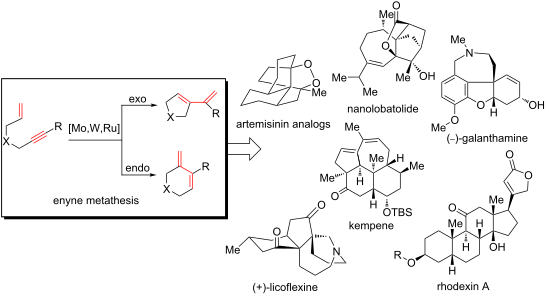
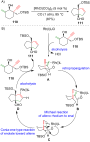
- . Securinega alkaloids The total synthesis of the Securinega alkaloids, (−)-flueggine A (18) and (+)-virosaine B (19), which are potent anticancer agents, was proposed by Wei et al. [90] via a relay ring-closing metathesis (RRCM) associated with a 1,3-dipolar cycloaddition. The enyne precursors bearing a




A systematic review on silica-, carbon-, and magnetic materials-supported copper species as efficient heterogeneous nanocatalysts in “click” reactions
Beilstein J. Org. Chem. 2020, 16, 551–586, doi:10.3762/bjoc.16.52
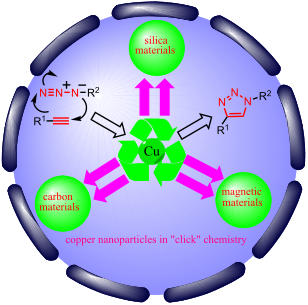
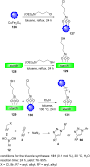
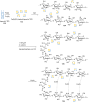
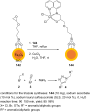
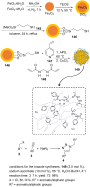
- reactions that are stereospecific, high-yielding, modular, wide in scope, executable under simple reaction conditions, conductable in safe or easily removable solvents, and that generate only nonoffensive byproducts. Of course, the classical Huisgen 1,3-dipolar cycloaddition does not fit into the above
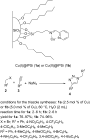
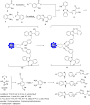
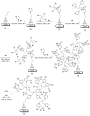
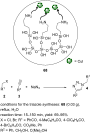
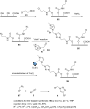
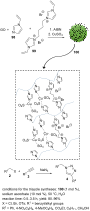
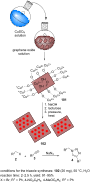
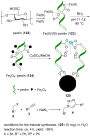
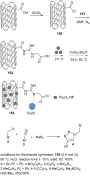
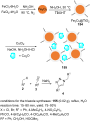
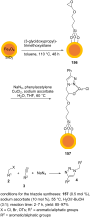
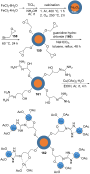
- ]. Generally, urea (72) was calcined and then, CuCl2 was immobilized using sonication (Scheme 13). The nanopolymeric catalyst was applied as a reusable nanocatalyst for promoting the 1,3-dipolar cycloaddition of nitroolefins/phenylacetylenes and sodium azide in water at ambient temperature. High yields of the
- 4-aryl-1,2,3-triazole 76 were obtained in short reaction times. The results indicated that ß-nitrostyrenes/phenylacetylenes containing electron-rich and -deficient groups could participate in the 1,3-dipolar cycloaddition reaction. Notably, the reaction was also extended to bistriazole derivatives















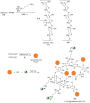

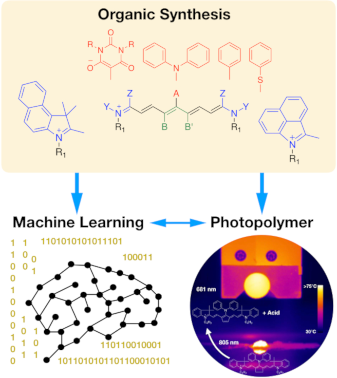
Photophysics and photochemistry of NIR absorbers derived from cyanines: key to new technologies based on chemistry 4.0
Beilstein J. Org. Chem. 2020, 16, 415–444, doi:10.3762/bjoc.16.40


The use of isoxazoline and isoxazole scaffolding in the design of novel thiourea and amide liquid-crystalline compounds
Beilstein J. Org. Chem. 2020, 16, 175–184, doi:10.3762/bjoc.16.20
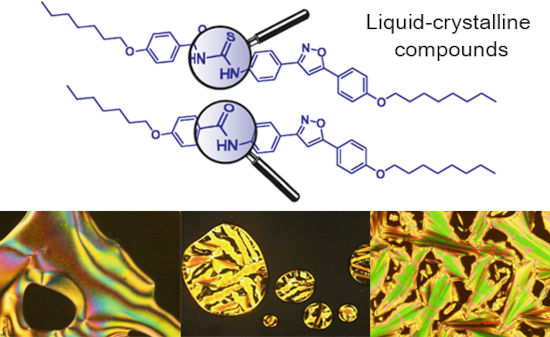
- , 8, 9, 12 and 13 were then prepared by [3 + 2]-1,3-dipolar cycloaddition of nitrile oxide (ArCNO) formed in situ from oximes and a number of alkenes as dipolarophiles, to yield the precursors of the cycloadducts isoxazolines 2, 7 and 11 regioselectively. The cycloadducts were subjected to SnCl2




Unexpected one-pot formation of the 1H-6a,8a-epiminotricyclopenta[a,c,e][8]annulene system from cyclopentanone, ammonia and dimethyl fumarate. Synthesis of highly strained polycyclic nitroxide and EPR study
Beilstein J. Org. Chem. 2019, 15, 2664–2670, doi:10.3762/bjoc.15.259

- observed in a one-pot synthesis from cyclopentanone, dimethyl fumarate and ammonium acetate. This multistep reaction includes 1,3-dipolar cycloaddition of dimethyl fumarate to the cyclic azomethine ylide formed in situ from cyclopentanone and ammonia. The polycyclic amine product was easily converted into
- nitroxide [4]. Here we report the unexpected formation of a highly strained polycyclic amine from cyclopentanone, dimethyl fumarate and ammonium acetate. This multistep reaction obviously includes the 1,3-dipolar cycloaddition of dimethyl fumarate with cyclic azomethine ylide formed in situ from
- heterocycle formation [11]. Presumably, a prototropic shift in the enamine-imine intermediate 4 is followed by electrocyclization to the cyclic azomethine ylide, which then reacts with dimethyl fumarate in a 1,3-dipolar cycloaddition. The suggested mechanism accounts for the trans-position of the methyne


AgNTf2-catalyzed formal [3 + 2] cycloaddition of ynamides with unprotected isoxazol-5-amines: efficient access to functionalized 5-amino-1H-pyrrole-3-carboxamide derivatives
Beilstein J. Org. Chem. 2019, 15, 2623–2630, doi:10.3762/bjoc.15.255

- tethered to cyclohexadienones that can be converted into complex polycycles by Ag-carbenoid-initiated cascades [16]. Recently, Zhu’s group developed a tandem 1,3‑dipolar cycloaddition/cyclopropanation silver-catalyzed reaction of enynals with alkenes [17]. In our previous studies, this silver carbene


Combining the Ugi-azide multicomponent reaction and rhodium(III)-catalyzed annulation for the synthesis of tetrazole-isoquinolone/pyridone hybrids
Beilstein J. Org. Chem. 2019, 15, 2447–2457, doi:10.3762/bjoc.15.237

- prospect of the tetrazole hybridization strategy in drug discovery. Among the most versatile methods for obtaining tetrazoles are the Ugi-azide four-component reaction (Ugi-azide-4CR) [14][15][16] and the 1,3-dipolar cycloaddition of azides with (acyl)cyanides [17][18]. The Ugi-azide-4CR enables the


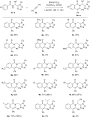


Synthesis of 1-azaspiro[4.4]nonan-1-oxyls via intramolecular 1,3-dipolar cycloaddition
Beilstein J. Org. Chem. 2019, 15, 2036–2042, doi:10.3762/bjoc.15.200
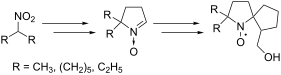
- synthesis of new pyrrolidine nitroxides from 5,5-dialkyl-1-pyrroline N-oxides via the introduction of a pent-4-enyl group to the nitrone carbon followed by an intramolecular 1,3-dipolar cycloaddition reaction and isoxazolidine ring opening. The kinetics of reduction of the new nitroxides with ascorbate were
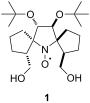
- studied and compared to those of previously published (1S,2R,3′S,4′S,5′S,2″R)-dispiro[(2-hydroxymethyl)cyclopentan-1,2′-(3′,4′-di-tert-butoxy)pyrrolidine-5′,1″-(2″-hydroxymethyl)cyclopentane]-1′-oxyl (1). Keywords: aldonitrone; 1,3-dipolar cycloaddition; pyrrolidine nitroxides; 1-pyrroline-N-oxide
- -enylmagnesium bromide to the corresponding nitrone, oxidation to alkenylnitrone, intramolecular 1,3-dipolar cycloaddition, and isoxazolidine ring opening. Nitroxide 1 showed both an unexpectedly low reduction rate [6] and long relaxation times t1 and tm at room temperature [4]. Unexpectedly high resistance of



Attempted synthesis of a meta-metalated calix[4]arene
Beilstein J. Org. Chem. 2019, 15, 1996–2002, doi:10.3762/bjoc.15.195
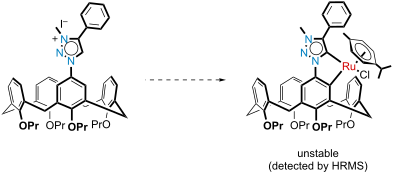
- Ullmann-type coupling to give aryl azide 2, which readily reacted with phenylacetylene in a copper-catalyzed Huisgen 1,3-dipolar cycloaddition to give 1,2,3-triazole 3 (Scheme 1). The formation of the ruthenacycle was then achieved using Albrecht’s method involving regioselective methylation of triazole 3
- our case column chromatography was only used once (to purify the monoazidocalix[4]arene 7), whilst the other procedure needed chromatography at each step. Introduction of the triazole moiety onto the upper rim of the calix[4]arene was then achieved with a copper-catalyzed Huisgen 1,3-dipolar
- cycloaddition between monoazidocalix[4]arene 7 and phenylacetylene, affording monotriazolocalix[4]arene 11 in 87% yield (Scheme 4). Methylation of the triazole was also achieved using excess iodomethane in a rather protracted reaction, to yield the calix[4]arene triazolium iodide salt 12 in effectively




Application of chiral 2-isoxazoline for the synthesis of syn-1,3-diol analogs
Beilstein J. Org. Chem. 2019, 15, 1840–1847, doi:10.3762/bjoc.15.179
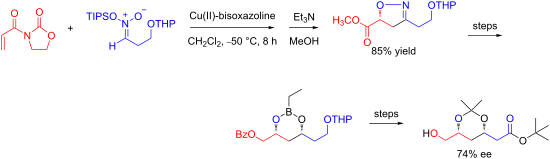
- our continuous efforts in asymmetric syntheses and applications of chiral 2-isoxazolines [49][50][51]. Results and Discussion Our synthesis commenced with a chiral 3,5-disubstituted-2-isoxazoline 3 or 4, which were prepared from silyl nitronate through an asymmetric 1,3-dipolar cycloaddition developed


N-(1-Phenylethyl)aziridine-2-carboxylate esters in the synthesis of biologically relevant compounds
Beilstein J. Org. Chem. 2019, 15, 1722–1757, doi:10.3762/bjoc.15.168

- four stereoisomers with low (ca. 3:1) diastereoselectivity and in a non-enantioselective manner (Scheme 46) [21]. Undoubtedly, it was the 1,3-dipolar cycloaddition of the azomethine ylide 180 with an electron-rich alkene. Fortunately, cycloadducts (2R,3R,4S)-, (2S,3S,4R)-, (2R,3S,4R)- and (2S,3R,4S


Synthesis of pyrrolo[1,2-a]quinolines by formal 1,3-dipolar cycloaddition reactions of quinolinium salts
Beilstein J. Org. Chem. 2019, 15, 1480–1484, doi:10.3762/bjoc.15.149
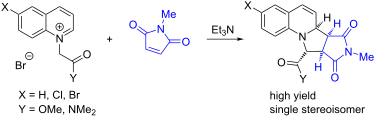
- with triethylamine promoted the reaction of the resulting quinolinium ylides (formally azomethine ylides) with electron-poor alkenes by conjugate addition followed by cyclization or by [3 + 2] dipolar cycloaddition. The pyrroloquinoline products were formed as single regio- and stereoisomers. These
- with a quinoline. Pyrroloquinolines have been found to show antibacterial and antifungal activity, to be ligands for the NK1 receptor, and to be effective against the Hif hypoxia pathway in cancer cell lines [36][37][38]. Almost all of the examples of dipolar cycloaddition reactions involving


Introduction of an isoxazoline unit to the β-position of porphyrin via regioselective 1,3-dipolar cycloaddition reaction
Beilstein J. Org. Chem. 2019, 15, 1434–1440, doi:10.3762/bjoc.15.143
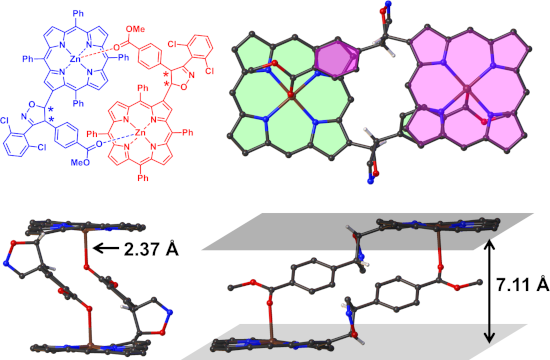
- Collaborative Innovation Center of Chemical Science and Engineering, Tianjin 300072, China 10.3762/bjoc.15.143 Abstract Isoxazoline-linked porphyrins have been synthesized by a regioselective 1,3-dipolar cycloaddition reaction between vinylporphyrin 2 and nitrile oxides. The steric interaction directed the
- confirmed the basic features of the NMR-derived structure. Furthermore, a pair of enantiomers of 3a presented in the crystal, which formed a dimeric complex through intermolecular coordination between the Zn2+ center and the carbonyl group of the second molecule. Keywords: dipolar cycloaddition
- [15][16][17][18][19][20][21][22][23][24]. Among them, the 1,3-dipolar cycloaddition reaction [25] is an efficient method to fuse five-membered rings on the periphery of the porphyrin framework. Because the periphery double bonds of the porphyrin macrocycle are nice dipolarophiles, and can trap 1,3


Synthesis of non-racemic 4-nitro-2-sulfonylbutan-1-ones via Ni(II)-catalyzed asymmetric Michael reaction of β-ketosulfones
Beilstein J. Org. Chem. 2019, 15, 1289–1297, doi:10.3762/bjoc.15.127
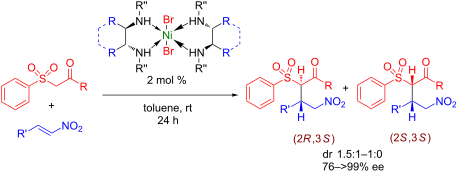
- cytotoxicity [9]. However, it is of great importance to obtain all stereoisomers for the study of biological activity. Therefore, the development of methods for the asymmetric synthesis of polyfunctional sulfones is valuable. The most notable of them are Ag- and Cu-catalyzed 1,3-dipolar cycloaddition reactions




Synthesis and fluorescent properties of N(9)-alkylated 2-amino-6-triazolylpurines and 7-deazapurines
Beilstein J. Org. Chem. 2019, 15, 474–489, doi:10.3762/bjoc.15.41
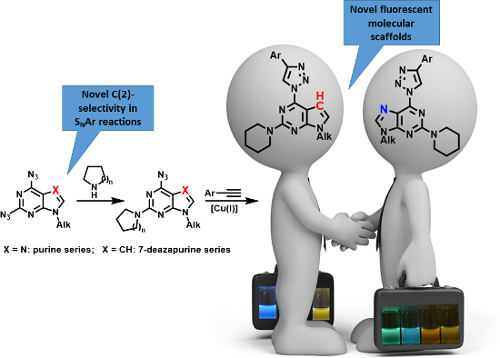
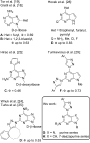
- synthesis of a novel library of 9-alkyl-2-amino-6-triazolylpurine derivatives. Thus, copper-catalyzed azide–alkyne 1,3-dipolar cycloaddition reaction of compounds 6a–c with different para-substituted phenylacetylenes produced the expected compounds 7a–f, 8a–f and 9 (Scheme 1). The yields of 1,3-dipolar




Copper(I)-catalyzed tandem reaction: synthesis of 1,4-disubstituted 1,2,3-triazoles from alkyl diacyl peroxides, azidotrimethylsilane, and alkynes
Beilstein J. Org. Chem. 2018, 14, 2916–2922, doi:10.3762/bjoc.14.270
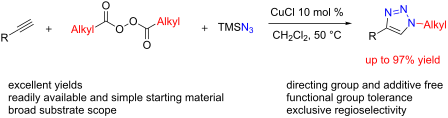
- ], derived from the Huisgen’s 1,3-dipolar cycloaddition of azides and alkynes [22], has conceivably emerged as the premier example of click chemistry. Generally, organic azides are used as the azido source in most of the CuAAC reactions (Scheme 1a) [23]. However, the organic azides with low molecular weight




Ring-opening metathesis of some strained bicyclic systems; stereocontrolled access to diolefinated saturated heterocycles with multiple stereogenic centers
Beilstein J. Org. Chem. 2018, 14, 2698–2707, doi:10.3762/bjoc.14.247
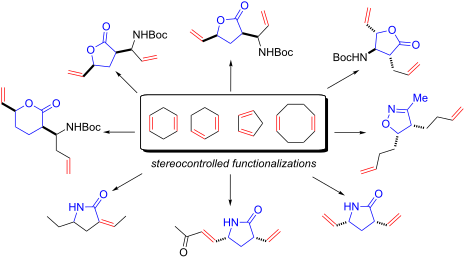
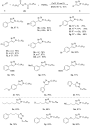
- (5 mol %), leading at 20 °C to δ-lactone derivative (±)-15 although with low yield (Scheme 6, Table 4). In continuation, we selected a cyclooctene-fused system, namely isoxazoline (±)-16 which, in turn, was accessed through nitrile–oxide dipolar cycloaddition, by using nitroethane, DMAP and Boc2O





