


Search results
Search for "molecular complexity" in Full Text gives 53 result(s) in Beilstein Journal of Organic Chemistry.
Tandem catalysis of ring-closing metathesis/atom transfer radical reactions with homobimetallic ruthenium–arene complexes
Beilstein J. Org. Chem. 2010, 6, 1167–1173, doi:10.3762/bjoc.6.133
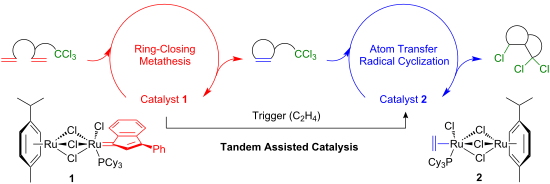
- (Scheme 2). This process, known as assisted tandem catalysis [6], presents significant advantages over multistep synthesis for increasing molecular complexity, particularly in terms of time- and cost-savings, atom economy, environmental friendliness, or applicability to diversity-oriented high-throughput


A thermally-induced, tandem [3,3]-sigmatropic rearrangement/[2 + 2] cycloaddition approach to carbocyclic spirooxindoles
Beilstein J. Org. Chem. 2010, 6, No. 33, doi:10.3762/bjoc.6.33
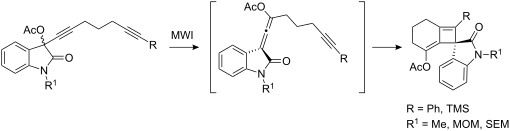
- ] cycloaddition reaction is that the reaction remains selective for the distal double bond of the allene even with densely functionalized allenes [29]. In addition, conversion of the propargylic acetate to the spirooxindole in one step provides a rapid and potentially stereoselective increase in molecular
- complexity. Furthermore, this approach includes a rare example of a thermal [3,3]-sigmatropic rearrangement of a propargylic acetate while metal catalyzed rearrangements of the propargyl acetates are common. Work is currently underway to expand the synthetic utility of this reaction. Experimental


Radical cascades using enantioenriched 7-azabenzonorbornenes and their applications in synthesis
Beilstein J. Org. Chem. 2008, 4, No. 38, doi:10.3762/bjoc.4.38
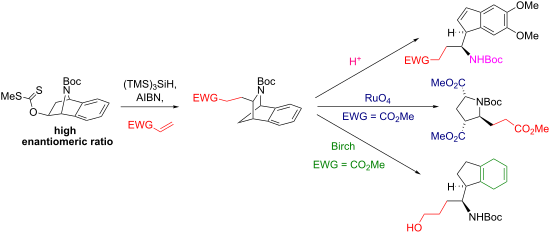
- for the rapid enhancement of molecular complexity. Furthermore, in the structurally similar system created by the formal fusion of the norbornenyl skeleton with an aromatic ring, the ‘nortricyclyl’ radical is delocalised in the originally aromatic π-system. Ring-opening of this ‘nortricyclyl’ radical


Other Beilstein-Institut Open Science Activities



