


Search results
Search for "RCM" in Full Text gives 105 result(s) in Beilstein Journal of Organic Chemistry.
The Shono-type electroorganic oxidation of unfunctionalised amides. Carbon–carbon bond formation via electrogenerated N-acyliminium ions
Beilstein J. Org. Chem. 2014, 10, 3056–3072, doi:10.3762/bjoc.10.323
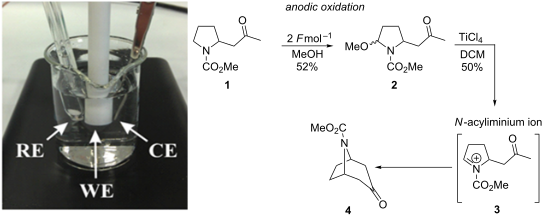
- ) [76][77]. The ability to introduce two carbon–carbon bonds on to the same α-carbon to prepare spirocyclic systems is a challenge, yet the application of electrochemistry in tandem with ring closing metathesis (RCM) readily achieved this feat. The use of the Shono-type electrooxidation in natural
- ]. Preparation of dienes using the Shono oxidation [23]. Combination of an electroauxiliary mediated anodic oxidation and RCM to afford spirocyclic compounds [76]. Total synthesis of (+)-myrtine (66) using an electrochemical approach [78]. Total synthesis of (−)-A58365A (70) and (±)-A58365B (71) [79]. Anodic


Design and synthesis of novel bis-annulated caged polycycles via ring-closing metathesis: pushpakenediol
Beilstein J. Org. Chem. 2014, 10, 2664–2670, doi:10.3762/bjoc.10.280

- rearrangement, a ring-closing metathesis (RCM) and an alkenyl Grignard addition. The introduction of olefinic moieties in the pentacycloundecane (PCUD) framework at appropriate positions followed by RCM led to the formation of novel heptacyclic cage systems. Keywords: Diels–Alder cycloaddition; Grignard
- . The addition of alkyl groups can take place from the less hindered exo side of this caged system. If the R and R’ groups contain unsaturated systems one can think of constructing additional rings on the pentacyclic framework by utilizing ring-closing metathesis (RCM). By varying the length of
- allyl groups in PCUD can be converted to a six-membered ring by RCM [28]. Since the two allyl groups in the PCUD framework are far apart, they did not undergo a RCM reaction. Later, by introducing additional unsaturated fragments in the PCUD system one can generate multiple rings in the PCUD system by


A modular phosphate tether-mediated divergent strategy to complex polyols
Beilstein J. Org. Chem. 2014, 10, 2332–2337, doi:10.3762/bjoc.10.242
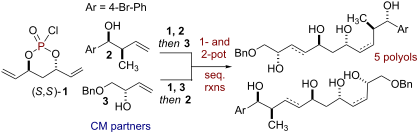
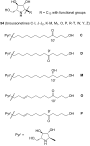
- -mediated, one-pot, sequential RCM/CM/reduction process is reported. A modular, 3-component coupling strategy has been developed, in which, simple “order of addition” of a pair of olefinic-alcohol components to a pseudo-C2-symmetric phosphoryl chloride, coupled with the RCM/CM/reduction protocol, yields
- generates five polyol fragments, bearing differential Z- and E-olefins, from a pair of olefinic-alcohol components A and B and a pseudo-C2-symmetric phosphoryl chloride (S,S)-1. Moreover, the method relies on simple "order of addition" of components for the phosphoryl coupling, ring-closing metathesis (RCM
- diastereoselective reactions including one-pot, sequential RCM/CM/H2 protocols and their applications in total synthesis of various natural products [27][28][29][30][31][32]. In addition, the scope of phosphate-tethered methods was further expanded via extensive RCM studies of different triene subunits utilizing


De novo macrolide–glycolipid macrolactone hybrids: Synthesis, structure and antibiotic activity of carbohydrate-fused macrocycles
Beilstein J. Org. Chem. 2014, 10, 2215–2221, doi:10.3762/bjoc.10.229
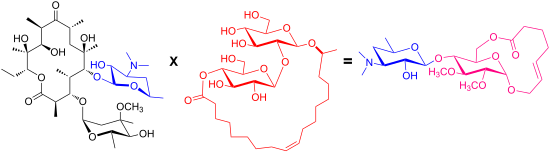
- . Results and Discussion The syntheses of 5 and 6 (Scheme 1) generally followed a ring closing metathesis (RCM) strategy that had been established previously [9]. C4,C6-O-Benzylidene-protected allyl glucoside 7, as a mixture of α- and β-anomers, was the starting material for the synthesis. In the first step
- %) and 10b (56%). Compounds 10a and 10b were poised for RCM by virtue of the two alkenes present in them. RCM of each one, using the second generation Grubbs catalyst, provided E-configured macrolides 5 and 6 in 55 and 66% yield. Both compounds were isolated as crystalline solids after purification by
- macrolides is added to the cyclic glycolipid macrolactone feature of the sophorlipids. De novo macrolide 16 was active against B. anthracis, with a MIC of 115 μg/mL. A 13-membered ring analog of 5 was prepared by acylating 10c with 5-hexenoyl chloride followed by RCM to give 19. This compound also had some


Relay cross metathesis reactions of vinylphosphonates
Beilstein J. Org. Chem. 2014, 10, 1933–1941, doi:10.3762/bjoc.10.201
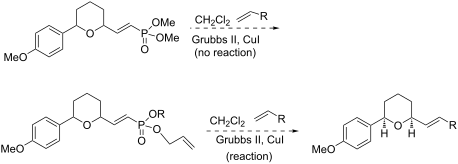
- intermediacy of an additional terminal alkene 11 (Scheme 3) [19][20][21]. Similarly, Hansen and Lee employed an allyl ether to activate enynes toward cross metathesis [22]. Furthermore, there are several examples of vinylphosphonates participating in ring closing metathesis (RCM) reactions [23][24][25
- ]. Therefore, given the propensity for vinylphosphonates to undergo RCM, it was proposed that an allyl phosphonate ester 14 would act as an initial site of metathesis, which would lead to a relay cross metathesis and thus render vinylphosphonates reactive. Results and Discussion A series of cross metathesis
- ring closing metathesis (RCM) to generate the oxaphosphole 22 and a new metal alkylidene 34. The sequence is completed by reaction of the metal alkylidene 34 with the metathesis partner (styrene) to give the tetrahydropyran 25. The formation of the dimeric product 27 is probably the result of a


Olefin cross metathesis based de novo synthesis of a partially protected L-amicetose and a fully protected L-cinerulose derivative
Beilstein J. Org. Chem. 2014, 10, 1023–1031, doi:10.3762/bjoc.10.102
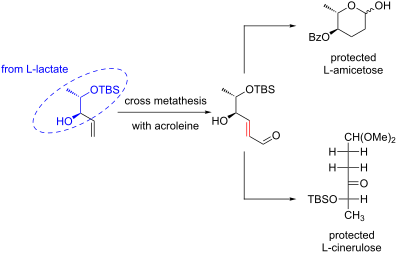
- or its epimer rhodinose, respectively [33]. An approach to amicetose (and a few other 6-desoxy sugars) involves the formation of an enantiopure β,γ-unsaturated δ-valerolactone via ring closing metathesis (RCM). The RCM product is subsequently converted into L-amicetose in four steps [34
- ], respectively, which both use enantiomerically pure L-ethyl lactate (1) as the starting material (Scheme 1). The synthetic routes rely on the highly diastereoselective two-step conversion of ethyl lactate to allylic alcohol 2 [36][37] and further to the RCM precursor 3, which then undergoes RCM-isomerization to
- apparently identical catalysts which are often designated just as “10 wt % Pd on carbon” may vary dramatically. Structures of kigamicin B and aclacinomycin A as representative examples for antineoplastic glycoconjugates. RCM-isomerization approach to L-amicetal 4 and alternative CM approaches to L-amicetose


Isocyanide-based multicomponent reactions towards cyclic constrained peptidomimetics
Beilstein J. Org. Chem. 2014, 10, 544–598, doi:10.3762/bjoc.10.50

- subsequent transformations [19][22][26]. Examples of IMCR orthogonal species or functionalities are alkenes, alkynes and azides which may give the cyclic analogues via subsequent ring closing metathesis (RCM) or 1,3-dipolar cycloadditions. In contrast, protected functional groups first require a deprotection
- stereoinduction was observed for the newly formed stereocenter (dr 1:1). As an extension, the authors performed the Ugi reaction with allyl amine 79 and olefinic amino acids 78 (derived from pyroglutamic acid), that, after a following ring-closure-metathesis (RCM) with Grubb’s catalyst, resulted in bicyclic
- lactams (81, 46% over the two steps, Scheme 24). In addition, an even shorter route by utilizing three olefinic Ugi-substrates was also reported. Herein, the ring closing step included a double RCM and resulted in an equal amount of both products 83a and 83b (ratio 1:1) [75][76]. Triazoles The replacement


The Flögel-three-component reaction with dicarboxylic acids – an approach to bis(β-alkoxy-β-ketoenamides) for the synthesis of complex pyridine and pyrimidine derivatives
Beilstein J. Org. Chem. 2014, 10, 394–404, doi:10.3762/bjoc.10.37
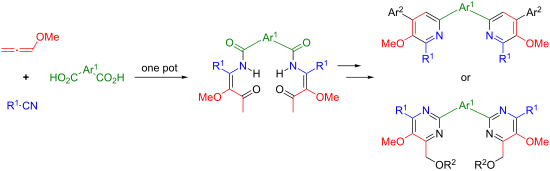
- closing metathesis (RCM) [69] with Grubbs-II-catalyst smoothly leading to the structurally interesting macrocyclic compound 34 in 73% yield. Compounds of this type – incorporating a 17-membered ring – have the potential to serve as structurally quite unique ligands for a variety of applications, e.g. in
- catalysis. With ruthenium-based catalysts bearing N-heterocyclic carbene (NHC) ligands, RCM usually delivers macrocyclic olefins as mixtures of E- and Z-isomers, in most cases in favor of the E-isomer [70][71][72][73]. The E/Z-ratio is often under thermodynamic control, reflecting the energy difference
- -spectroscopy revealed, that compound 36 was obtained as a pair of C2-symmetric diastereomers and that the obtained diol 35 was in fact a racemic mixture. This observation allowed the conclusion that the RCM reaction of 33 produced the expected thermodynamically more stable E-configured macrocyclic olefin 34


Synthesis of the B-seco limonoid core scaffold
Beilstein J. Org. Chem. 2014, 10, 194–208, doi:10.3762/bjoc.10.15
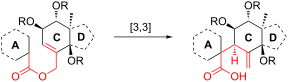
- subsequent esterification with 4-oxocyclohexanecarboxylic acid (25). However, in this case the [3,3]-sigmatropic rearrangement proceeded exclusively via pseudo-equatorial attack, giving after RCM the C9-epi limonoid scaffold 68 as single diastereomer. The sterically demanding rearrangement precursor 70 seems




The difluoromethylene (CF2) group in aliphatic chains: Synthesis and conformational preference of palmitic acids and nonadecane containing CF2 groups
Beilstein J. Org. Chem. 2014, 10, 18–25, doi:10.3762/bjoc.10.4

- that it can accommodate angle strain. For example CF2 compounds display an apparent Thorpe–Ingold effect relative to CH2 in ring closing metathesis reactions (RCM) to cycloheptene [8]. Comparison of the rates of reaction with different substituents at the C-5 position of the diene precursors 1a–d
- , revealed that the CF2 substituent in 1c was as effective as the dicarboxylate 1a or ketal 1b in promoting RCM (Figure 1). This is attributed to C–CF2–C angle widening, which absorbs angle strain in the resultant cycloheptene 2c. In another study we have prepared cyclododecanes 3–5 with regiospecific
- group in 1c accelerates RCM reactions relative to CHF (1d) and CH2 (1e) and with a similar rate to classical or Thorpe–Ingold substituents such as the ketal 1a and dicarboxylate ester 1b [8]. X-ray structures of a) 1,1,4,4- (3) b) 1,1,7,7- (4) and c) 1,1,6,6- (5) tetrafluorocyclododecanes. The CF2


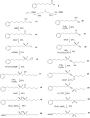


Synthesis of indole-based propellane derivatives via Weiss–Cook condensation, Fischer indole cyclization, and ring-closing metathesis as key steps
Beilstein J. Org. Chem. 2013, 9, 2709–2714, doi:10.3762/bjoc.9.307

- functionalized cis-bicyclo[3.3.0]octane-3,7-dione derivatives are available by the Weiss–Cook reaction, (iv) the double bond generated at the end of the RCM sequence provides an additional handle for further synthetic manipulation. Results and Discussion To realize the strategy shown in Figure 3, cis-bicyclo
- treated with 5-bromo-1-pentene in the presence of NaH to generate the unsymmetrical diketone 8. Having compound 3 in hand, our next task was to construct the propellane derivatives via RCM by using Grubbs catalyst. In this regard, compound 3 was subjected to RCM under the influence of Grubbs 2nd
- generation catalyst in dry CH2Cl2 to furnish the desired RCM product 9 in 94% yield. The unsaturated propellane derivative 9 was subjected to hydrogenation in the presence of 10% Pd/C in dry EtOAc under H2 atmosphere to afford the saturated propellane derivative 4 in 95% yield (Scheme 3). Along similar lines


Bidirectional cross metathesis and ring-closing metathesis/ring opening of a C2-symmetric building block: a strategy for the synthesis of decanolide natural products
Beilstein J. Org. Chem. 2013, 9, 2544–2555, doi:10.3762/bjoc.9.289
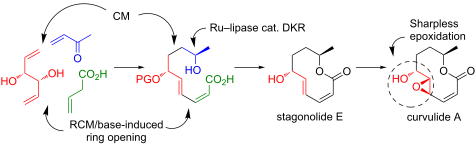
- -membered ring lactones stagonolide E and curvulide A were synthesized using a bidirectional olefin-metathesis functionalization of the terminal double bonds. Key steps are (i) a site-selective cross metathesis, (ii) a highly diastereoselective extended tethered RCM to furnish a (Z,E)-configured dienyl
- ][4][5][6] and its enantiomer ent-1 [7] have emerged as highly valuable starting points for target molecule syntheses which rely on dual olefin metathesis reactions. The two metathesis transformations may either be two identical CM [8][9] or RCM steps [10], yielding C2-symmetric products in which the
- newly formed double bonds remain homotopic, or two different CM or RCM steps, or a combination of one CM and one RCM transformation. The latter cases lead to C1-symmetric products and hence a differentiation of the C–C double bonds generated through metathesis. Examples for the utilization of these


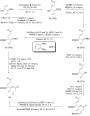


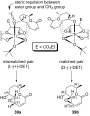


Synthesis of a library of tricyclic azepinoisoindolinones
Beilstein J. Org. Chem. 2012, 8, 1091–1097, doi:10.3762/bjoc.8.120
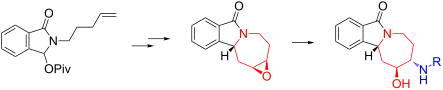
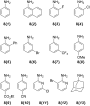
- , the addition to in situ prepared N-acyliminium species, and ring-closing metathesis (RCM) were key steps in the preparation of a tricyclic isoindolinone scaffold. An unusual alkene isomerization process during the RCM was identified and studied in some detail. Chemical diversification for library
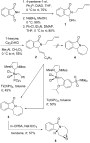
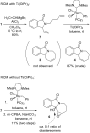
- further oxidized 6, which was structurally assigned by X-ray analysis (Figure 4). The formation of 6 implies the intermediate presence of alkene 4, the product of a regular RCM of diene 2. Accordingly, the isolation of 6, and the absence of significant quantities of 5, confirmed the chelating additive Ti
- the rate of isomerization in RCM [33][34][35], we are unaware of any previous report on an alkene-isomerization-promoting effect of an additive in this reaction. We can speculate that the presence of Ti(OiPr)4 stabilizes the ruthenium alkylidene complex and, thus allows product isomerization to take






Metathesis access to monocyclic iminocyclitol-based therapeutic agents
Beilstein J. Org. Chem. 2011, 7, 699–716, doi:10.3762/bjoc.7.81

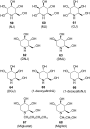
- for the role of olefin metathesis reactions (RCM, CM) as key transformations in the multistep syntheses of pyrrolidine-, piperidine- and azepane-based iminocyclitols, as important therapeutic agents against a range of common diseases and as tools for studying metabolic disorders. Considerable
- ][44][45][46][47] the RCM strategy was immediately recognized as central to success in the flexible construction of N-heterocyclic compounds, including azasugars. Moreover, the metathesis approach to azasugars has greatly benefited from the vast synthetic experience acquired in RCM preparation of a
- host of heterocycles. Any RCM-based protocol to iminocyclitols implies three crucial stages: (i) discovery of a route to obtain stereoselectively, starting from an ordinary substrate, the N-containing prerequisite diene precursor; (ii) RCM cyclization of this diene, with an active catalyst, to access





Olefin metathesis in nano-sized systems
Beilstein J. Org. Chem. 2011, 7, 94–103, doi:10.3762/bjoc.7.13
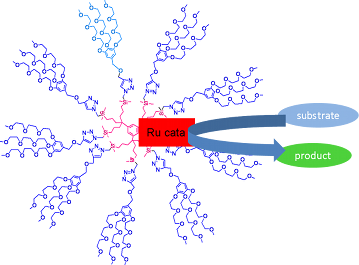
- ) or, more usefully, dendrimer encapsulation – ring closing metathesis (RCM), cross metathesis (CM), enyne metathesis reactions (EYM) – for reactions in water without a co-solvent and (ii) construction and functionalization of dendrimers by CM reactions. Keywords: dendrimer; green chemistry
- ][25]. The three first generations of metallodendrimers 2 and the model complex do not catalyze RCM reactions, but they were efficient catalysts for the ROMP of norbornene under ambient conditions, giving dendrimer-cored stars (Scheme 1 and Scheme 2) [24][25]. Analysis of the molecular weights by size
- produced after decomplexation by visible-light photolysis which removes the temporary activating CpFe+ group [36][37][38]. These compounds are then ideal substrates for RCM and CM. New structures were obtained using this strategy with durene, p-xylene, mesitylene, and pentamethylcobalticinium [39][40][41


Hoveyda–Grubbs type metathesis catalyst immobilized on mesoporous molecular sieves MCM-41 and SBA-15
Beilstein J. Org. Chem. 2011, 7, 22–28, doi:10.3762/bjoc.7.4
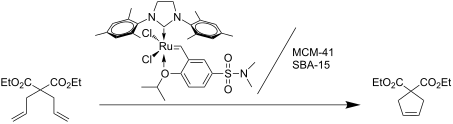
- metathesis polymerization (ROMP) of cyclooctene, ring-closing metathesis (RCM) of diallylsilanes and several types of cross-metathesis reactions. High stability of catalysts, reusability and low Ru leaching were also reported. However, the mode of attachment of the Ru species on the silica surface was
- , respectively. The catalytic activity was tested in the RCM of 1,7-octadiene (Scheme 1, entry 1) and diethyl diallylmalonate (DEDAM) (Scheme 1, entry 2), in the metathesis of methyl oleate (Scheme 1, entry 3) and methyl 10-undecenoate (Scheme 1, entry 4), and in the ROMP of cyclooctene (Scheme 1, entry 5
- ). Figure 3 shows conversion curves for the RCM of DEDAM in dichloromethane, benzene, and cyclohexane, and the RCM of 1,7-octadiene in cyclohexane. For the RCM of DEDAM, 3 (as a homogeneous catalyst) and 3/SBA-15 were used. The reaction proceeded very rapidly in all solvents used (TOF at 10 min was


The allylic chalcogen effect in olefin metathesis
Beilstein J. Org. Chem. 2010, 6, 1219–1228, doi:10.3762/bjoc.6.140
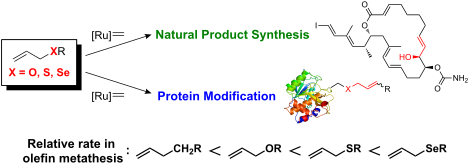
- groups in ring-closing metathesis (RCM) was first identified by Hoye and Zhao in 1999 [19]. In this work, the influence of both the steric and electronic character of allylic substituent of linalool and related analogues in RCM was assessed. The free hydroxy group on linalool greatly enhanced RCM
- construction of complex molecules over the past 10 years. Here we outline a few pertinent and illustrative examples. Schmidt prepared enantiomerically pure dihydropyrans and dihydrofurans bearing an unsaturated olefin tether based on a ring size-selectivity RCM reaction of a triene [21]. In this study, it was
- protecting groups, such as a methyl group, were used. Furthermore, when no protecting group was used (i.e., R = R′ = H, Scheme 2) the RCM reaction was unselective and resulted in a 1:1 mixture of 5- and 6-membered ring products. The selectivity for dihydropyran formation was therefore tuned by substitution


The catalytic performance of Ru–NHC alkylidene complexes: PCy3 versus pyridine as the dissociating ligand
Beilstein J. Org. Chem. 2010, 6, 1188–1198, doi:10.3762/bjoc.6.136
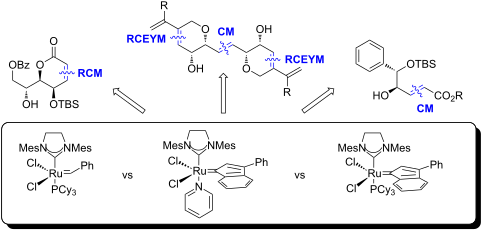
- benzylidene complexes bearing a tricyclohexylphosphine or a pyridine ligand in ring closing metathesis (RCM), cross metathesis, and ring closing enyne metathesis (RCEYM) reactions is compared. While the PCy3 complexes perform significantly better in RCM and RCEYM reactions than the pyridine complex, all
- catalyst is available from the M2 complex by ligand substitution [18] and shows high activity in living ROMP [40], whereas the reactivity in some RCM and CM reactions appears to be diminished [18][41]. During our research directed at the development of novel metathesis-non metathesis reaction sequences [42
- temperature in seven different solvents, under otherwise identical conditions. The results are summarized in Figure 2. Benzene, toluene, dichloromethane and 1,2-dichloroethane are commonly used solvents in Ru-catalyzed RCM reactions. However, for catalyst H only in dichloromethane was high conversion to the


Tandem catalysis of ring-closing metathesis/atom transfer radical reactions with homobimetallic ruthenium–arene complexes
Beilstein J. Org. Chem. 2010, 6, 1167–1173, doi:10.3762/bjoc.6.133
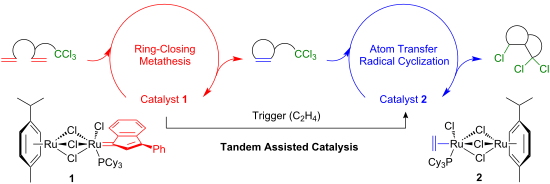
- metathesis; Introduction During the course of our investigations on homobimetallic ruthenium–arene complexes, we found that the indenylidene compound [(p-cymene)Ru(μ-Cl)3RuCl(3-phenyl-1-indenylidene)(PCy3)] (1) was a very efficient promoter for the ring-closing metathesis (RCM) of diethyl 2,2
- ][13][14], ATRP [15][16][17][18], cyclopropanation [19], dihydroxylation [20], hydrogenation [21][22][23], hydrovinylation [24], isomerization [25][26][27][28], oxidation [29], or Wittig reactions [30], to name just a few [31]. In this contribution, we investigate the tandem catalysis of RCM/ATRC
- . Results and Discussion 2,2,2-Trichloro-N-(octa-1,7-dien-3-yl)acetamide (4) was chosen as a model substrate to begin our investigations (Scheme 3). The RCM of this functionalized α,ω-diene was carried out in toluene-d8 (0.2 M) at 30 °C in the presence of 5 mol % of catalyst precursor 1 and monitored by 1H


New library of aminosulfonyl-tagged Hoveyda–Grubbs type complexes: Synthesis, kinetic studies and activity in olefin metathesis transformations
Beilstein J. Org. Chem. 2010, 6, 1159–1166, doi:10.3762/bjoc.6.132
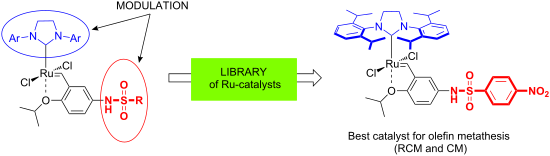
- catalysts was investigated with various substrates in ring-closing metathesis of dienes or enynes and cross metathesis. The results demonstrate that these catalysts show a good tolerance to various chemical functions. Keywords: cross-metathesis; kinetic studies; olefin metathesis; RCM; ruthenium
- weak influence on the behaviour of the catalysts in these cases. Finally, the reactivity profiles of 4a and 4g were compared in various metathesis reactions in order to evaluate the influence of the NHC ligand. The last point of our study was the comparison between catalysts in RCM of dienes or enynes
- . General Procedure for RCM Reactions: A Schlenk tube under an argon atmosphere was filled with the olefin substrate (0.1 mmol) and CH2Cl2 (1 mL). Then, the precatalyst (1 μmol) was added. After the required time, the solvent was removed. The conversion was determined by 1H NMR. Ruthenium precatalysts for


About the activity and selectivity of less well-known metathesis catalysts during ADMET polymerizations
Beilstein J. Org. Chem. 2010, 6, 1149–1158, doi:10.3762/bjoc.6.131
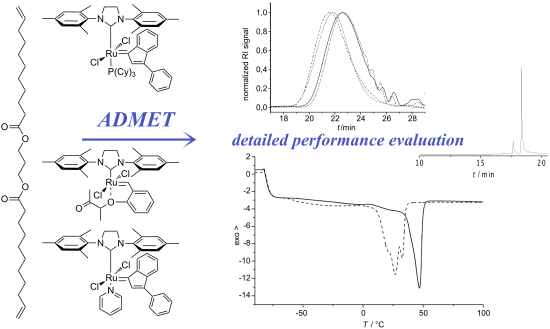
- efficiently isomerizing terminal olefins is a clear indication that metal hydride species are indeed the source of the isomerization. It was reported that a proper selection of solvents and additives can eliminate isomerization with Ru-based metathesis catalysts in RCM [16]. The addition of POCy3 or oxygen
- activity of the catalyst. Furthermore, Johnson and coworkers reported that during a RCM to make a 9-membered ring, chlorinated solvents, such as 1,2-dichloroethane, inhibited olefin isomerization [25]. Grubbs and collaborators showed that catalytic amounts (10 mol %) of 1,4-benzoquinone (BQ) can prevent
- the isomerization of a number of allylic ethers and long chain aliphatic alkenes during RCM and cross metathesis [21]. In the context of ADMET, isomerization of a terminal to an internal olefin, followed by a productive metathesis step with a terminal olefin, would liberate an α-olefin, such as



Light-induced olefin metathesis
Beilstein J. Org. Chem. 2010, 6, 1106–1119, doi:10.3762/bjoc.6.127

- present developments in the use of light to expedite olefin ring-closing, ring-opening polymerisation and cross-metathesis reactions. Keywords: catalysis; light activation; olefin metathesis; photoactivation; photoinitiation; photoisomerisation; RCM; ROMP; ruthenium; tungsten; Introduction The metal
- ring-opening metathesis polymerisation was reviewed in 1997 [63]. The interest in photoactivated olefin metathesis motivated Fürstner [64] to use complex 12b for photoinduced ring closing metathesis (RCM) by using regular neon light or strong daylight as a photon source instead of the UV lamps used
- thus far. Indeed, 12b catalysed the ring-closing metathesis reaction of diallyl tosylamide in 90% yield when illuminated by neon light. Alternatively, the commercially available dimer complex 13 (Figure 5) mixed with PCy3 could be irradiated to produce similar results. Some of the photoinduced RCM




Halide exchanged Hoveyda-type complexes in olefin metathesis
Beilstein J. Org. Chem. 2010, 6, 1091–1098, doi:10.3762/bjoc.6.125
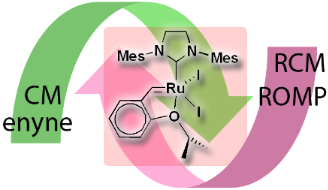
- catalytic performance of the complexes in ring opening metathesis polymerisation, ring closing metathesis, enyne cycloisomerisation and cross metathesis reactions. Keywords: cross metathesis; olefin metathesis; RCM; ROMP; ruthenium; Introduction Since the pioneering reports on the utilisation of N
- substrates are transformed. The lack of reactivity data for halide-exchanged complexes prompted us to investigate the catalytic activity of bromo and iodo analogues of Hoveyda 2nd generation catalyst (1) in ring closing metathesis (RCM), enyne metathesis and cross metathesis (CM). Moreover, the scope of
- before the remaining monomer is completely consumed. RCM, enyne cycloisomerisation and cross metathesis Catalytic activities of 1, 2 and 3 were then evaluated in RCM of diethyl diallylmalonate (7). The reaction progress is shown in Figure 6 (for details see Table 3). While 1 and 2 perform equally, 3 is


Mitomycins syntheses: a recent update
Beilstein J. Org. Chem. 2009, 5, No. 33, doi:10.3762/bjoc.5.33






A short stereoselective synthesis of (+)-(6R,2′S)-cryptocaryalactone via ring- closing metathesis
Beilstein J. Org. Chem. 2009, 5, No. 14, doi:10.3762/bjoc.5.14
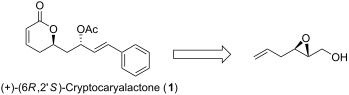
- . Retrosynthetic approach. Synthesis of chiral propargyl secondary hydroxyl group. Determination of the stereochemistry of the 1,3-anti diols. Synthesis of cryptocaryalactone by RCM. Asymmetric alkynylation with phenylacetylene. Supporting Information Supporting Information File 20: Experimental Data





