Search results
Search for "dipolar cycloaddition" in Full Text gives 186 result(s) in Beilstein Journal of Organic Chemistry.
Assembly of fully substituted triazolochromenes via a novel multicomponent reaction or mechanochemical synthesis
Beilstein J. Org. Chem. 2018, 14, 2689–2697, doi:10.3762/bjoc.14.246
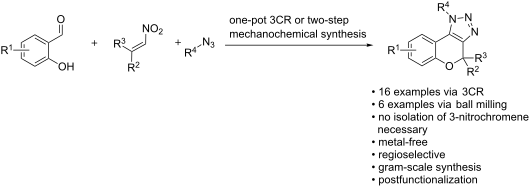
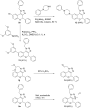
- .14.246 Abstract A new metal-free one-pot three-component procedure towards fully substituted triazolochromenes has been developed, starting from commercially available materials. Salicylaldehydes and nitroalkenes were reacted under solvent-free conditions, followed by a 1,3-dipolar cycloaddition of the
- prove the plausibility of the one-pot three-component reaction, we commenced our trials with the synthesis and isolation of 3-nitro-2H-chromene (3) as reported in the literature [15], followed by the 1,3-dipolar cycloaddition of the nitroalkene moiety with organic azides. We based the 1,3-dipolar
- -nitrochromenes. Because our first step is best performed solvent-free, we opted to try our own optimized solvent-free conditions for the in situ syntheses of 3-nitro-2H-chromenes, followed by the 1,3-dipolar cycloaddition in a reaction vial. Despite being a two-pot procedure, purification of the intermediate 3




An efficient and facile access to highly functionalized pyrrole derivatives
Beilstein J. Org. Chem. 2018, 14, 884–890, doi:10.3762/bjoc.14.75
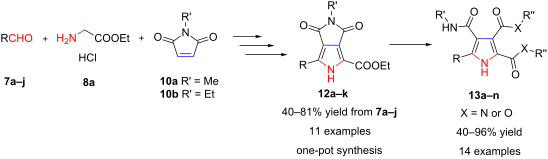
- Chinese Academy of Medical Sciences, 1 Xian Nong Tan Street, Beijing 100050, China 10.3762/bjoc.14.75 Abstract A straightforward and one-pot synthesis of pyrrolo[3,4-c]pyrrole-1,3-diones via Ag(I)-catalyzed 1,3-dipolar cycloaddition of azomethine ylides with N-alkyl maleimide, followed by readily
- substrates. It is conceivable that this efficient construction method for privileged pyrrole scaffolds could deliver more active compounds for medicinal chemistry research. Keywords: azomethine ylides; 1,3-dipolar cycloaddition; one-pot synthesis; polysubstituted pyrroles; pyrrolo[3,4-c]pyrrole-1,3-diones
- methods have been reported till now to synthesize pyrroles and pyrrole containing analogs [6]. In the past decade, 1,3-dipolar cycloaddition has become a fundamental synthetic method for the construction of nitrogen-containing five-membered heterocycles including pyrroles. It is worth to note that



Sequential Ugi reaction/base-induced ring closing/IAAC protocol toward triazolobenzodiazepine-fused diketopiperazines and hydantoins
Beilstein J. Org. Chem. 2018, 14, 626–633, doi:10.3762/bjoc.14.49

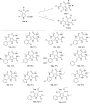
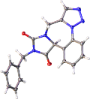
- heterocycle formation and the other an IAAC. Unlike some of the reported strategies using Cu-catalyzed IAAC [13][15], we postulated that the intramolecular dipolar cycloaddition would proceed under thermal conditions (metal-free) due to the close proximity of the azide and similar functionalities in the





Recent applications of click chemistry for the functionalization of gold nanoparticles and their conversion to glyco-gold nanoparticles
Beilstein J. Org. Chem. 2018, 14, 11–24, doi:10.3762/bjoc.14.2
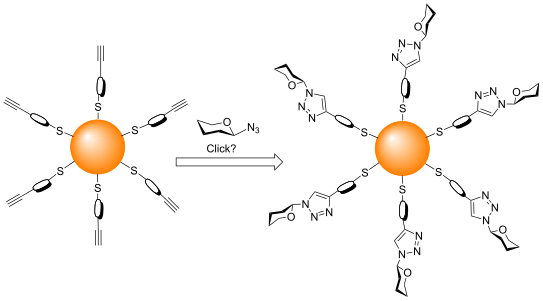
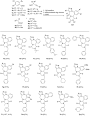
- azide–alkyne Huisgen cycloaddition AuNP surface modification using NCAAC The azide–alkyne Huisgen cycloaddition (AAC) is a 1,3-dipolar cycloaddition between an organic azide and an alkyne that gives triazole products [37][38]. The non-catalysed azide–alkyne Huisgen cycloaddition (NCAAC) is very slow



Recent progress in the racemic and enantioselective synthesis of monofluoroalkene-based dipeptide isosteres
Beilstein J. Org. Chem. 2017, 13, 2637–2658, doi:10.3762/bjoc.13.262
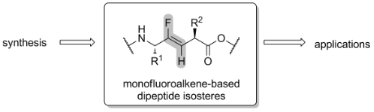
- reacted easily in a SN2 reaction to give a more functionalized molecule. For example, treatment of the chlorinated monofluoroalkene with NaN3 provided the corresponding N3-containing monofluoroalkene. The azide group underwent a 1,3-dipolar cycloaddition to give a 1,2,3-triazole, which is also a peptide


Rh(II)-mediated domino [4 + 1]-annulation of α-cyanothioacetamides using diazoesters: A new entry for the synthesis of multisubstituted thiophenes
Beilstein J. Org. Chem. 2017, 13, 2569–2576, doi:10.3762/bjoc.13.253

- reaction with N-phenyl maleimide, gives rise to formation of S-containing heterocycles by 1,3-dipolar cycloaddition [35]. However, to the best of our knowledge, there are no literature data on analogous intramolecular reactions of C=S ylides involving thiocarbonyl and any other nucleophilic group within


Synthesis, effect of substituents on the regiochemistry and equilibrium studies of tetrazolo[1,5-a]pyrimidine/2-azidopyrimidines
Beilstein J. Org. Chem. 2017, 13, 2396–2407, doi:10.3762/bjoc.13.237

- reactions were planned between phenylacetylene and compounds 6a–c. The 1,2,3-triazole synthesis from the 1,3-dipolar cycloaddition reaction between 6a–c and terminal alkynes catalyzed by copper salts (CuAAC) [41][42][43] confirms that the reaction passes through an azide intermediate. In addition to mild


![[Graphic 9]](/bjoc/content/inline/1860-5397-13-237-i9.svg?max-width=637&scale=1.18182) 4d equilibrium in DMSO-d6 at 25 °C.
4d equilibrium in DMSO-d6 at 25 °C.


Solvent-free copper-catalyzed click chemistry for the synthesis of N-heterocyclic hybrids based on quinoline and 1,2,3-triazole
Beilstein J. Org. Chem. 2017, 13, 2352–2363, doi:10.3762/bjoc.13.232
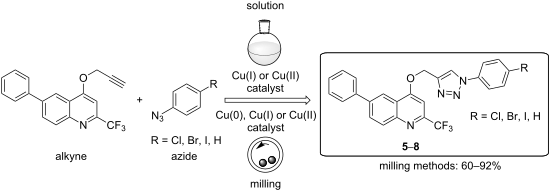
- methine C-3 protons displayed in a 1H,1H-NOESY spectrum of 4 (Figure S10 in Supporting Information File 1). Compound 4 was then submitted to Cu(I)-catalyzed 1,3-dipolar cycloaddition with selected halogen-substituted and non-substituted aromatic azides to yield target N-heterocyclic hybrids 5–8 containing



Mechanochemical synthesis of small organic molecules
Beilstein J. Org. Chem. 2017, 13, 1907–1931, doi:10.3762/bjoc.13.186
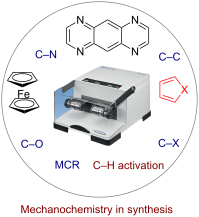
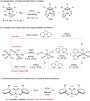
- -Triazoles have important applications in pharmaceutical chemistry [150] and traditionally they are prepared by 1,3-dipolar cycloaddition reactions at high temperature, long reaction times and produce low yield with multiple products [151]. In 2013, Ranu and co-workers reported mechanochemical synthesis of




Synthesis of oligonucleotides on a soluble support
Beilstein J. Org. Chem. 2017, 13, 1368–1387, doi:10.3762/bjoc.13.134
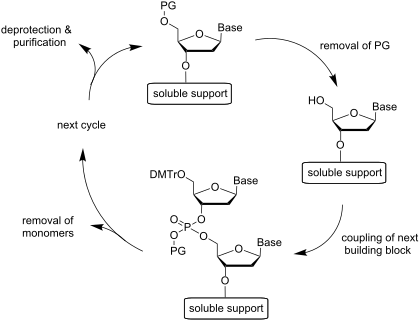
- support (Scheme 3) [42]. Owing to the symmetrical structure of the support, NMR and mass spectroscopic characterization is possible at any stage of the chain assembly. The 3´-terminal nucleoside was immobilized to this support as a 3´-O-(4-pentynoyl) derivative by Cu(I)-catalyzed 1,3-dipolar cycloaddition


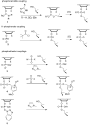




BODIPY-based fluorescent liposomes with sesquiterpene lactone trilobolide
Beilstein J. Org. Chem. 2017, 13, 1316–1324, doi:10.3762/bjoc.13.128
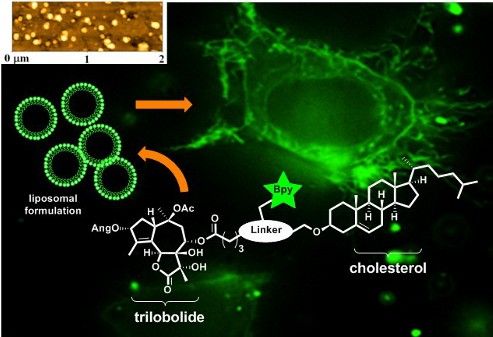
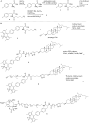
- compound is shown in Scheme 1, part B. Propargyl-ChL [35] was introduced into Huisgen copper-catalyzed 1,3-dipolar cycloaddition [36] (CuAAC) with BODIPY 3. This microwave-assisted reaction catalyzed by CuSO4·5H2O, sodium ascorbate and a catalytic amount of TBTA (tris[(1-benzyl-1H-1,2,3-triazol-4-yl)methyl




An eco-compatible strategy for the diversity-oriented synthesis of macrocycles exploiting carbohydrate-derived building blocks
Beilstein J. Org. Chem. 2017, 13, 1106–1118, doi:10.3762/bjoc.13.110
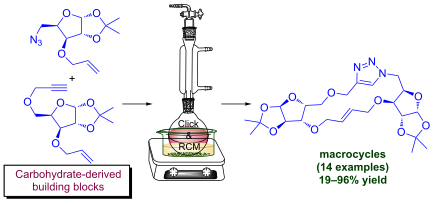
- blocks were coupled via 1,3-dipolar cycloaddition (click reaction) iteratively through the development of a greener base-free Cu(I)-catalyzed azide–alkyne cycloaddition reaction. The cycloadducts were then converted to macrocycles by Ru-catalyzed cyclization reaction using greener and non-hazards


New approach toward the synthesis of deuterated pyrazolo[1,5-a]pyridines and 1,2,4-triazolo[1,5-a]pyridines
Beilstein J. Org. Chem. 2017, 13, 800–805, doi:10.3762/bjoc.13.80

- and a high degree of deuterium incorporation were achieved. The procedure was applied for several 4-R-1-aminopyridinium cations (R = H, Me, OMe). Keywords: deuteration; 1,3-dipolar cycloaddition; pyrazolo[1,5-a]pyridine; 1,2,4-triazolo[1,5-a]pyridine; Introduction Isotopically labeled compounds find


Synthesis of ribavirin 2’-Me-C-nucleoside analogues
Beilstein J. Org. Chem. 2017, 13, 755–761, doi:10.3762/bjoc.13.74

- as for the non-methylated derivative [21]. Then, the 1,3-dipolar cycloaddition reaction of 6 with benzyl azide in toluene at 70 °C led to a mixture of regioisomeric triazoles 7 in a 42:58 ratio. The removal of all protecting groups was achieved by treatment of compounds 7 with ammonia followed by


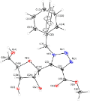


Ultrasound-promoted organocatalytic enamine–azide [3 + 2] cycloaddition reactions for the synthesis of ((arylselanyl)phenyl-1H-1,2,3-triazol-4-yl)ketones
Beilstein J. Org. Chem. 2017, 13, 694–702, doi:10.3762/bjoc.13.68
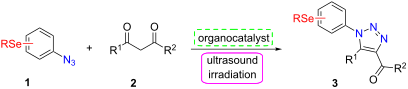
- most attractive way for their preparation is the thermal 1,3-dipolar cycloaddition of alkynes and azides, introduced by Huisgen which usually gives rise to a mixture of 1,4 and 1,5-isomers [16][17][18][19]. More recently, transition metal catalysts based on copper, ruthenium, silver and iridium salts


Isoxazole derivatives as new nitric oxide elicitors in plants
Beilstein J. Org. Chem. 2017, 13, 659–664, doi:10.3762/bjoc.13.65
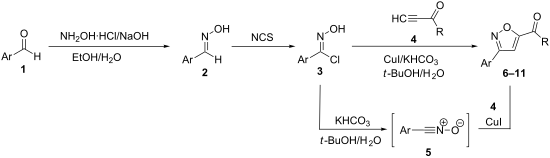
- were obtained in good yields by regiospecific 1,3-dipolar cycloaddition reactions between aromatic nitrile oxides, generated in situ from the corresponding hydroxyimidoyl chlorides, with non-symmetrical activated alkynes in the presence of catalytic amounts of copper(I) iodide. Effects of 3,5
- -disubstituted isoxazoles on nitric oxide and reactive oxygen species generation in Arabidopsis tissues was studied using specific diaminofluoresceine dyes as fluorescence indicators. Keywords: chemical elicitor; 1,3-dipolar cycloaddition; isoxazole; nitric oxide; nitrile oxide; reactive oxygen species
- synthetic approaches towards the isoxazole core include the reactions of hydroxylamine with aryl-β-diketones [20], α,β-unsaturated carbonyl compounds [21], or α,β-unsaturated nitriles [22], and 1,3-dipolar cycloaddition reactions between alkenes or alkynes and nitrile oxides [23][24][25]. Nitrile oxides are


A postsynthetically 2’-“clickable” uridine with arabino configuration and its application for fluorescent labeling and imaging of DNA
Beilstein J. Org. Chem. 2017, 13, 127–137, doi:10.3762/bjoc.13.16
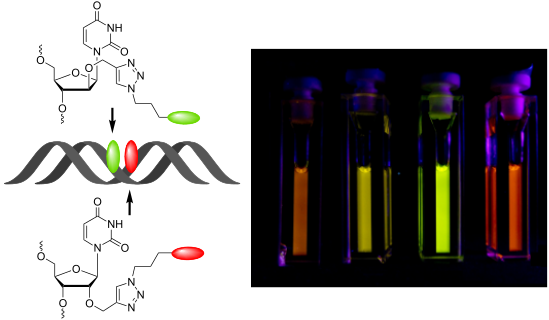
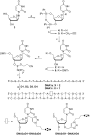
- cells. Keywords: dyes; fluorescence; nucleic acid; oligonucleotide; Introduction The “click”-type reactions [1], in particular the 1,3-dipolar cycloaddition between alkynes and azides (CuAAC) is a broadly applied strategy for postsynthetic oligonucleotide modification since both reactive groups are



Multicomponent synthesis of spiropyrrolidine analogues derived from vinylindole/indazole by a 1,3-dipolar cycloaddition reaction
Beilstein J. Org. Chem. 2016, 12, 2893–2897, doi:10.3762/bjoc.12.288
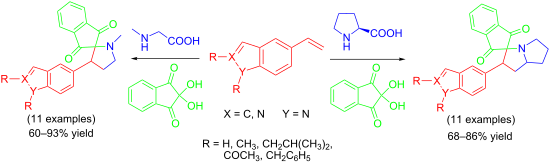
- -pot multicomponent synthesis. The method uses the 1,3-dipolar cycloaddition reaction between N-alkylvinylindole/indazole and azomethine ylides, prepared in situ from cyclic/acyclic amino acids. The 1,3-dipolar cycloaddition proceeds efficiently under thermal conditions to afford the regio- and
- of biological importance [1][2]. The regio- and stereoselective construction of spiro compounds by utilizing the 1,3-dipolar cycloaddition reaction of azomethine ylides has been reported [3][4][5][6]. However, unlike the previous reports, the present method is concise and facilitates the one-pot
- synthesis of multifunctionalized spiranes. The earlier works reveal the use of different reaction conditions to prepare functionalized spiroindane, spiropyrolidine, spiropyrrolizidine and spirooxindole derivatives. Among them, the 1,3-dipolar cycloaddition based route is preferred due to multiple advantages


Versatile synthesis of end-reactive polyrotaxanes applicable to fabrication of supramolecular biomaterials
Beilstein J. Org. Chem. 2016, 12, 2883–2892, doi:10.3762/bjoc.12.287

- [2 + 3] dipolar cycloaddition reactions, or click reactions [10][11][12]. Indeed, our group has reported on PRXs bearing azide groups at the threading CDs for the introduction of ligands and fluorescent molecules in biomaterials applications [13][14]. PRXs bearing reactive azide or alkynyl groups at




Synthesis of spiro[isoindole-1,5’-isoxazolidin]-3(2H)-ones as potential inhibitors of the MDM2-p53 interaction
Beilstein J. Org. Chem. 2016, 12, 2793–2807, doi:10.3762/bjoc.12.278
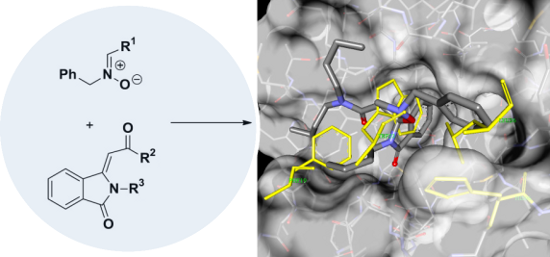
- Farmaco, Università di Catania, Viale A. Doria, 95100 Catania, Italy Dipartimento di Chimica, Università di Pavia, Via Taramelli 12, 27100 Pavia, Italy 10.3762/bjoc.12.278 Abstract A series of spiro[isoindole-1,5-isoxazolidin]-3(2H)-ones has been synthesized by 1,3-dipolar cycloaddition of N
- be linked to the inhibition of the protein–protein p53-MDM2 interaction. Docking measurements support the biological data. Keywords: antitumor agents; DFT studies; 1,3-dipolar cycloaddition; docking studies; spiro-compounds; Introduction The p53 tumor suppressor protein is a transcriptional factor
- construction of the spiro[isoxazolidin-isoindolinone] system. The synthetic scheme (Figure 2) exploits the strategy of the 1,3-dipolar cycloaddition of nitrones on the substrate isoindolin-3-methylene-1-one 2, obtained by a recent methodology of a PdI2 catalyzed aminocarbonylation-N-heterocyclization of 2


A versatile route to polythiophenes with functional pendant groups using alkyne chemistry
Beilstein J. Org. Chem. 2016, 12, 2682–2688, doi:10.3762/bjoc.12.265

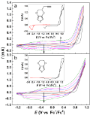
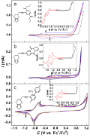
- Huisgen 1,3-dipolar cycloaddition between N-(2-azidoethyl)phthalimide and the alkyne terminal of pyEDOT under ultrasound conditions in 73% yield. Detailed synthetic routes are presented in Supporting Information File 1. Figure 1a shows the cyclic voltammograms (CVs) for electrochemical polymerization of


Sydnone C-4 heteroarylation with an indolizine ring via Chichibabin indolizine synthesis
Beilstein J. Org. Chem. 2016, 12, 2503–2510, doi:10.3762/bjoc.12.245

- other metals and represent a versatile tool for obtaining hybrid heterocycles with properties that are useful for the development of new advanced materials and for medicinal purposes [1][2][3][4]. Recently, we obtained, by 1,3-dipolar cycloaddition reactions of sydnone-ylides as bis(1,3-dipoles) with
- interesting chemical reactions of sydnones are their electrophilic substitution at C-4 and their participation in 1,3-dipolar cycloaddition reactions with olefinic and acetylenic dipolarophiles to form pyrazoles and functional transformation at C-4 [20][21][22][23][24][25][26]. Herein we present the synthesis
- of indolizines 4 (Figure 1) with the indolizine directly attached to C-4 of a sydnone ring by the indolizine Chichibabin approach. In addition, the new indolizine structures 5, connected through a keto group to a sydnone ring, were prepared by 1,3-dipolar cycloaddition reaction starting from the same


Synthesis, dynamic NMR characterization and XRD studies of novel N,N’-substituted piperazines for bioorthogonal labeling
Beilstein J. Org. Chem. 2016, 12, 2478–2489, doi:10.3762/bjoc.12.242
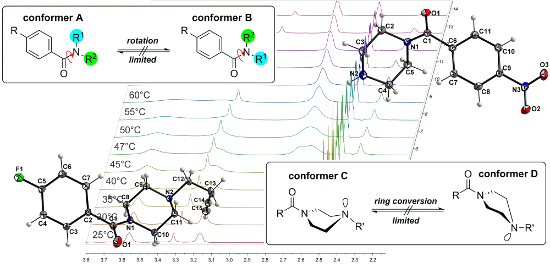
- to demonstrate the Cu-catalyzed azide–alkyne click reaction (Huisgen 1,3-dipolar cycloaddition) and the traceless Staudinger ligation, a proof of concept study was performed for the site-selective labeling of a pharmacologically active peptide and a small organic compound. These compounds provide the


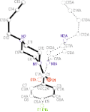


Combined experimental and theoretical studies of regio- and stereoselectivity in reactions of β-isoxazolyl- and β-imidazolyl enamines with nitrile oxides
Beilstein J. Org. Chem. 2016, 12, 2390–2401, doi:10.3762/bjoc.12.233

- nitrile oxides as inverse electron-demand 1,3-dipolar cycloaddition. The found stereoselectivity of the cycloaddition is driven by the higher stability of the E-isomer of the starting enamine, whereas the regioselectivity is controlled by better orbital overlap in the transition state leading to the


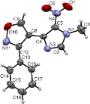


An effective one-pot access to polynuclear dispiroheterocyclic structures comprising pyrrolidinyloxindole and imidazothiazolotriazine moieties via a 1,3-dipolar cycloaddition strategy
Beilstein J. Org. Chem. 2016, 12, 2240–2249, doi:10.3762/bjoc.12.216

- -triazine moieties has been developed. The method relies on a 1,3-dipolar cycloaddition of azomethine ylides generated in situ from isatin derivatives and sarcosine to 6-benzylideneimidazo[4,5-e]thiazolo[3,2-b]-1,2,4-triazine-2,7-diones. Keywords: azomethine ylides; cycloaddition; diastereoselectivity
- constructing complex N-heterocyclic systems in a regio and stereocontrolled fashion is the 1,3-dipolar cycloaddition of azomethine ylides to electron-deficient alkenes as dipolarophiles [2][3][4][5][6][7][8]. The in situ preparation of azomethine ylides from different carbonyl and amino components makes the
- cycloaddition one of the most valuable means of combinatorial chemistry. Such multicomponent reactions are characterized by productivity, operational simplicity, and efficiency [9][10][11][12][13]. A highly interesting class of heterocycles which is accessible through 1,3-dipolar cycloaddition reactions are