


Search results
Search for "hydrazones" in Full Text gives 83 result(s) in Beilstein Journal of Organic Chemistry.
Chemistry of polyhalogenated nitrobutadienes, 10: Synthesis of highly functionalized heterocycles with a rigid 6-amino-3-azabicyclo[3.1.0]hexane moiety
Beilstein J. Org. Chem. 2012, 8, 621–628, doi:10.3762/bjoc.8.69

- derivative 6 in 80% isolated yield (Scheme 1). The interest in such compounds derives from the fact that a number of similar hydrazones, e.g., phenyl(phenylchloromethylidene)hydrazine, exhibit fungicidal, antibacterial, and fungistatic activity [17][18]. In view of the insecticidal properties of some


N-Heterocyclic carbene/Brønsted acid cooperative catalysis as a powerful tool in organic synthesis
Beilstein J. Org. Chem. 2012, 8, 398–402, doi:10.3762/bjoc.8.43
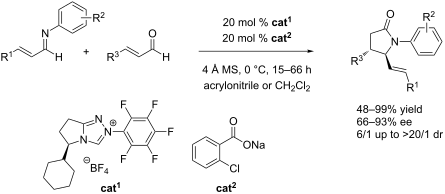
- the search for suitable combinations and, if one of both partners is chiral, the development of enantioselective catalytic processes. Selected examples of the successful deployment of cooperative catalysis in organic synthesis comprise the preparation of chiral γ-lactams from N-acyl hydrazones and α,β


Ugi post-condensation copper-triggered oxidative cascade towards pyrazoles
Beilstein J. Org. Chem. 2011, 7, 1310–1314, doi:10.3762/bjoc.7.153

- possible Ugi pathways to introduce an alkene moiety that is prone to undergo an intramolecular [3 + 2] cycloaddition with a hydrazone, we selected the Ugi coupling between α-hydrazonocarboxylic acids and allylamine as the most straightforward path. There are several reports on the use of hydrazones in Ugi
- uptake of oxygen helps to control the selective oxidation process. Reactions performed under air were faster but led to intractable mixtures. Analogous hydrazones prepared from pyruvic acid and benzoylformic acid with hydrazine derivatives were tested in this Ugi/oxidative cyclization sequence under
- following cyclization failed to give the expected pyrazolidinones and resulted in complex mixture formation. Intermediate Ugi adduct 3g (Table 1, entry 6) only resulted in a small amount of ring-opened product 4g. The reaction is also limited to N-aryl hydrazones due to the lower efficiency of the Ugi


Approaches towards the synthesis of 5-aminopyrazoles
Beilstein J. Org. Chem. 2011, 7, 179–197, doi:10.3762/bjoc.7.25
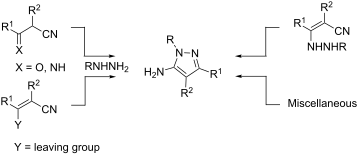
- hydrazines to yield 5-aminopyrazoles 3 [19][20][21][22][23][24][25][26][27][28]. The reaction apparently involves the nucleophilic attack of the terminal nitrogen of the hydrazine on the carbonyl carbon with the formation of hydrazones 2, which subsequently undergo cyclization by the attack of the other
- nitrogen on the nitrile carbon to produce 5-aminopyrazoles 3 (Scheme 1). Utilizing this reaction, a large number of 5-amino-1-heteroarylpyrazoles have been synthesized in our laboratory by the reaction of several heteroarylhydrazines with α-cyanoacetophenones [29][30]. The intermediate hydrazones 2 are
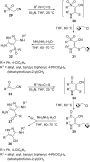
- yielded the corresponding 5-amino-4-phenylpyrazoles 6. These compounds were found to be good antibacterial agents (Scheme 2) [34]. The isolation of hydrazones 8 has also been reported during the condensation of cyanoacetaldehyde (7) with hydrazines [35]. These hydrazones 8 were cyclized to the





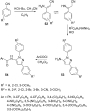


Synthesis of some novel hydrazono acyclic nucleoside analogues
Beilstein J. Org. Chem. 2010, 6, No. 49, doi:10.3762/bjoc.6.49
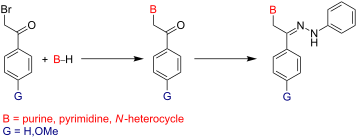
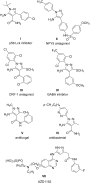
- ). Pharmacokinetic properties and cellular permeability of a drug can be modulated by derivatization to bio-reversible forms of the drug, namely hydrazones [3]. Hydrazone derivatives are prominent structural motifs in numerous pharmaceutically active compounds. Many well known drugs with various clinical activities
- antineoplastic (e.g. bisantrene [4][10]), contain a hydrazone moiety in their structure. Furthermore, various structurally related miconazole bioactive hydrazones are known as antimicrobial and antifungal agents [11][12]. The significance of nucleoside chemistry in drug discovery is well-known and fully
- synthesized hydrazones 2a–2o using PM3. Supporting Information Supporting information features physical and spectroscopic data for all novel compounds 2a–2o. Supporting Information File 84: Synthesis of some novel hydrazono acyclic nucleoside analogues Acknowledgements We thank the Shiraz University of


New diarylmethanofullerene derivatives and their properties for organic thin- film solar cells
Beilstein J. Org. Chem. 2009, 5, No. 7, doi:10.3762/bjoc.5.7
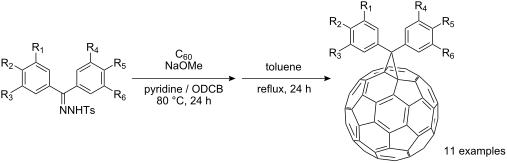
- in the presence of anhydrous AlCl3 gave the carbonyl compounds 15a–k which were treated with p-toluenesulfonylhydrazine to afford the hydrazones 16a–k. Treatment of 16a–k with sodium methoxide or LiHMDS in o-dichlorobenzene (ODCB) gave a mixture of isomeric diarylmethanofullerenes. After purification


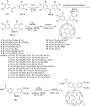


Synthesis of thienyl analogues of PCBM and investigation of morphology of mixtures in P3HT
Beilstein J. Org. Chem. 2008, 4, No. 33, doi:10.3762/bjoc.4.33
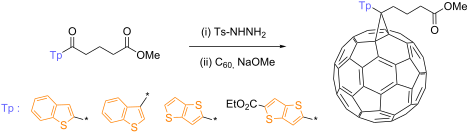
- shifts of bridging units. It is well known that [5,6]fulleroid has low solubility and is thermodynamically unstable; hence, it cannot be used in a photovoltaic device. However, except for 2b, the thienyl-substituted hydrazones 2a, 2c, and 2d yielded only [6,6]methanofullerenes. The hydrazone 2b yielded a


Microwave assisted synthesis of triazoloquinazolinones and benzimidazoquinazolinones
Beilstein J. Org. Chem. 2007, 3, No. 11, doi:10.1186/1860-5397-3-11
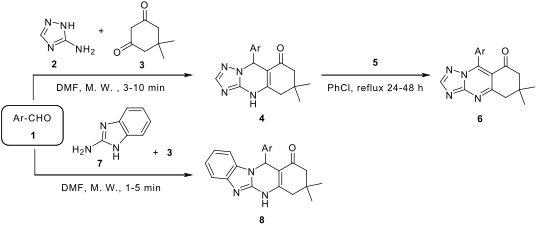
- compounds with 2-ethoxymethyleneaminonitriles. [9] A general route to prepare 5,10-dihydro-[1,2,4]-triazolo-[5,1-b]-quinazolines included the reaction of benzophenone and 1-ureidoethylidene-hydrazones with a mixture of triphenylphosphine, carbon tetrachloride, and triethylamine in dichloromethane. [10


Other Beilstein-Institut Open Science Activities



