Search results
Search for "imine" in Full Text gives 454 result(s) in Beilstein Journal of Organic Chemistry. Showing first 200.
Trifluoromethylated hydrazones and acylhydrazones as potent nitrogen-containing fluorinated building blocks
Beilstein J. Org. Chem. 2023, 19, 1741–1754, doi:10.3762/bjoc.19.127
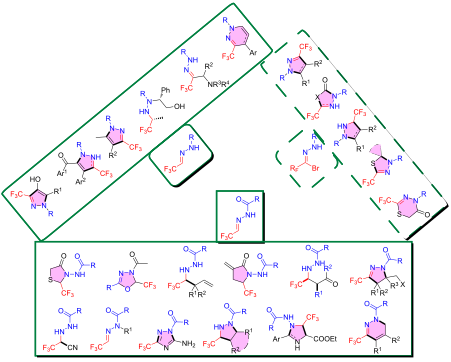
- . Hydrazones can be regarded as electrophilic and nucleophilic imine equivalents, and thus they represent valuable and versatile building blocks in synthetic chemistry [32][33][34][35][36]. Trifluoroacetaldehyde hydrazones can be regarded as an equivalent of fluorine-containing azomethine imines in the
- trifluoroacetonitrile imine, are highly versatile in that they react with olefins, acetylenes, dimethyl fumarate, dimethyl maleate, β-diketones, β-keto esters, bicyclic olefins, and potassium isothiocyanate and isocyanate affording the corresponding trifluoromethyl-containing compounds, generally with good yields [51
- regioselective [3 + 2] cycloadditions [59][60][61][62][63] (Scheme 10a). Similarly, trifluoroacetonitrile imine reacted with mercaptoacetaldehyde and mercaptocarboxylic acids to generate fluorinated 1,3,4-thiadiazines with good yields via a [3 + 3] annulation [64] (Scheme 10b). Meanwhile, mercaptoacetaldehyde as


Effects of the aldehyde-derived ring substituent on the properties of two new bioinspired trimethoxybenzoylhydrazones: methyl vs nitro groups
Beilstein J. Org. Chem. 2023, 19, 1713–1727, doi:10.3762/bjoc.19.125
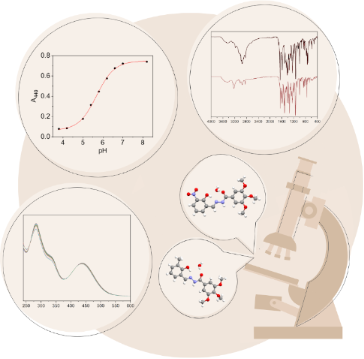
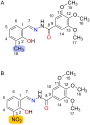
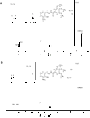
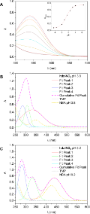
- ability to undergo E/Z isomerization in a stimuli-responsive imine bond is what makes this class useful for applications in the field of molecular electronics, as switchers [5][6]. In addition, these compounds can also adopt syn- or antiperiplanar conformations, due to the constriction of the rotation





Tying a knot between crown ethers and porphyrins
Beilstein J. Org. Chem. 2023, 19, 1630–1650, doi:10.3762/bjoc.19.120
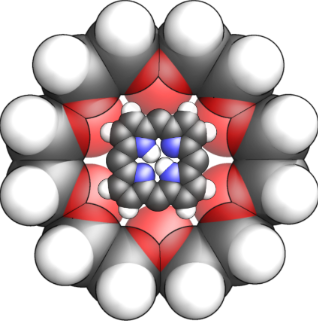
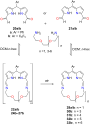
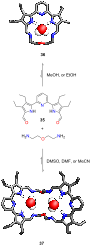
- other two have imine character [11][12]. They are rigid, planar molecules which feature macrocyclic aromaticity due to the cyclic delocalisation of π electrons [13]. The well-defined macrocyclic cavity termed the coordination core, can encompass one, two, or more central ions (typically metal/metalloid
- of the research on crowned porphyrins, the Bowman-James group worked on developing a new type of porphyrinoids called accordion porphyrins. Their seminal contribution, published in 1984, demonstrated a facile synthesis of an imine-linked tetrapyrrole macrocycle in the presence of a metal template and
- laid the ground for a whole new research area of hybrid imine-porphyrinoids [52][53][54]. Bowman-James' work provided an exciting insight into accordion porphyrins' coordination chemistry, demonstrating the tremendous potential of iminoporphyrinoids as macrocyclic ligands. Independently the Sessler


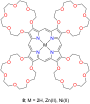
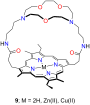

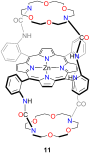






Unravelling a trichloroacetic acid-catalyzed cascade access to benzo[f]chromeno[2,3-h]quinoxalinoporphyrins
Beilstein J. Org. Chem. 2023, 19, 1216–1224, doi:10.3762/bjoc.19.89
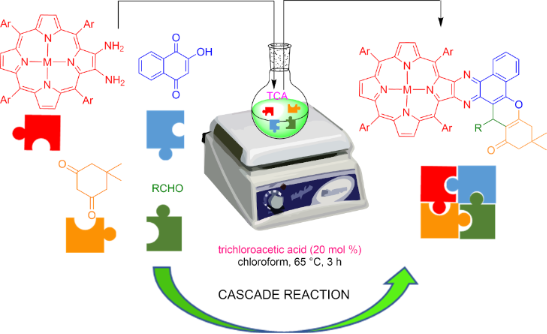
- beginning of the reaction, copper(II) 2,3-diamino-5,10,15,20-tetraarylporphyrins 1 react with 2-hydroxynaphthalene-1,4-dione (2) in the presence of trichloroacetic acid to form an imine intermediate which on intramolecular cyclization affords a key benzo[f]quinoxalinoporphyrin intermediate 17. Further, a


Synthesis of tetrahydrofuro[3,2-c]pyridines via Pictet–Spengler reaction
Beilstein J. Org. Chem. 2023, 19, 991–997, doi:10.3762/bjoc.19.74
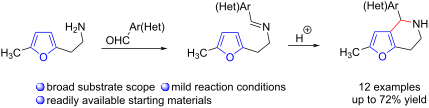
- -c]pyridines. From the analysis of the literature data [2][40][41][42][43], we suggested that the interaction of furanic amines with various aldehydes in an acidic media should be accompanied by the formation of the corresponding imine, the generation of the iminium cation, and subsequent Pictet
- the results of our study of this tandem reaction. Results and Discussion Initially, we synthesized the key imine 3a by refluxing a solution of the starting 2-(5-methylfuran-2-yl)ethylamine (1a) and commercially available benzaldehyde (2a) in absolute CH3CN for one hour in a quantitative yield. To our
- delight, when 2 equiv of HCl were subsequently added to the solution of imine 3a at 50 °C, the formation of the desired 2-methyl-4-phenyl-4,5,6,7-tetrahydrofuro[3,2-c]pyridine (4a) was observed in 26% yield (Table 1, entry 1). It should be noted that most part of the product 4a was formed as the


Aromatic C–H bond functionalization through organocatalyzed asymmetric intermolecular aza-Friedel–Crafts reaction: a recent update
Beilstein J. Org. Chem. 2023, 19, 956–981, doi:10.3762/bjoc.19.72

- with the elimination of a H+ ion to form the functionalized aromatic moieties. The aza-Friedel–Crafts reaction is a subclass of the originally reported transformation that couples an imine with an aromatic system allowing for a facile incorporation of an alkylamine functionality into the aromatic
- lone pair of electrons of the imine nitrogen to a suitable vacant orbital of the metal center, thus enhancing the electrophilicity of the imine carbon atom by imparting a positive character on the adjacent heteroatom [22][23]. With the advent of different types of organocatalysts, the aza-Friedel
- –Crafts reaction has also been explored under the influence of organocatalysis. However, here organocatalysts act as Brønsted acids which form noncovalent interactions (H-bonding) with the imine nitrogen to enhance the electrophilicity of the imine component. In addition, by selecting suitable imine




Clauson–Kaas pyrrole synthesis using diverse catalysts: a transition from conventional to greener approach
Beilstein J. Org. Chem. 2023, 19, 928–955, doi:10.3762/bjoc.19.71
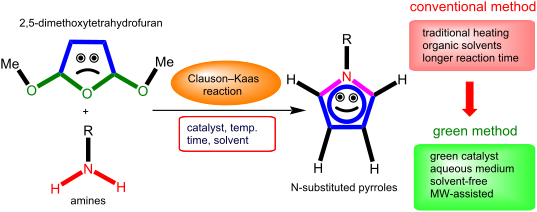
- shown in Scheme 20b. In this mechanism, calcium nitrate first activates the decomposition process of 2,5-DMTHF (2) from A to B. Further, a nucleophilic attack of amines 42 on B generates imine intermediate C. Finally, intramolecular nucleophilic attack by enamine D on the aldehyde group, dehydration and




Synthesis of aliphatic nitriles from cyclobutanone oxime mediated by sulfuryl fluoride (SO2F2)
Beilstein J. Org. Chem. 2023, 19, 901–908, doi:10.3762/bjoc.19.68
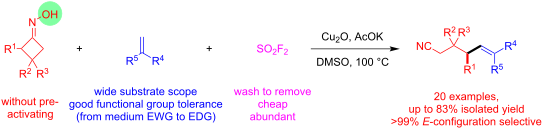
- afford the iminyl radical intermediate II. In the following step, the ring-strain of cyclobutanone is released under the promotion of the imine radical, giving the C-centered radical III which is subsequently captured by the alkene. Meanwhile, the radical IV transfers an electron to [Cun+1] regenerating


Pyridine C(sp2)–H bond functionalization under transition-metal and rare earth metal catalysis
Beilstein J. Org. Chem. 2023, 19, 820–863, doi:10.3762/bjoc.19.62
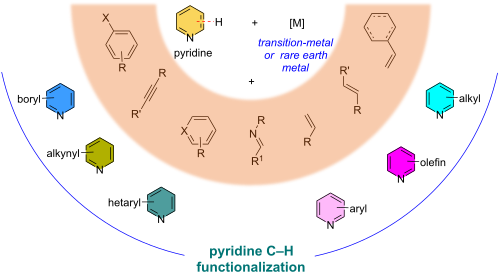
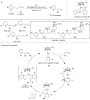
- involves the formation of (dibenzylamido)yttrium complex 28 by the reaction of yttrium complex 26 with HNBn2. Then σ-bond metathesis between the Y–N bond of 28 and the ortho-C–H bond of pyridine gives η2-pyridyl species 29 which on imine insertion produces species 30. Subsequent protonation then provides
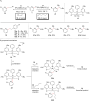
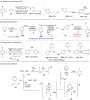
- yields generating a library of isonicotinic and nicotinic acid derivatives. Another inexpensive and non-toxic iron-catalyzed C–H arylation of pyridines has been reported by DeBeof and co-workers [98]. Using the imine in 147 as directing group, afforded the arylated pyridine products 150 in good to high
- reaction conditions. Also, the additive KF was employed in order to minimize the oxidative iron-catalyzed homocoupling of 148. An imine directing group at the para-position in pyridine 147 lead to activated ortho-position products 150 within 15 minutes. The imine group of the products can further be
















Eschenmoser coupling reactions starting from primary thioamides. When do they work and when not?
Beilstein J. Org. Chem. 2023, 19, 808–819, doi:10.3762/bjoc.19.61
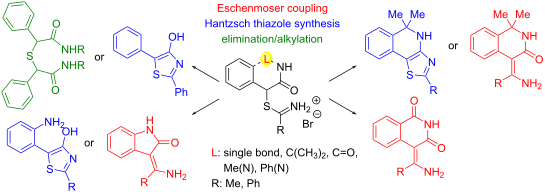
- . recommended [24] a polar aprotic solvent such as DMSO that facilitates the formation of both α-thioiminium salt (III) as well as Eschenmoser contraction involving the attack of the exposed carbanion towards the imine/iminium group (V). Based on our previous experience [3][4] we favor dimethylformamide (DMF
- ) level of theory. Quantum calculations (Figure 2) have shown that the reaction pathway that involves an intramolecular proton transfer between the α-carbon and imine nitrogen through TS1 is much more favorable for imidothioate derived from 4-bromoisoquinoline-1,3(2H,4H)-dione (3) and 3-bromooxindole (1


Sulfate radical anion-induced benzylic oxidation of N-(arylsulfonyl)benzylamines to N-arylsulfonylimines
Beilstein J. Org. Chem. 2023, 19, 771–777, doi:10.3762/bjoc.19.57
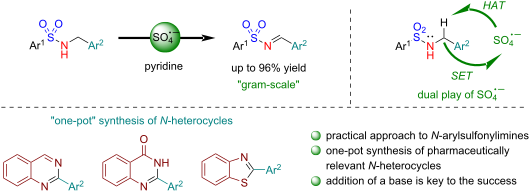
- single electron transfer (SET), is proposed to be involved in the plausible reaction mechanism. Keywords: arylsulfonylimine; benzylic oxidation; benzyl sulfonamide; K2S2O8; sulfate radical anion; Introduction Among various imine compounds [1], N-arylsulfonylimines are perhaps the most prominent due to
- of the intermediate product 2c and 2-aminobenzamide gave 2-(p-tolyl)quinazolin-4(3H)-one (4b) in 85% yield. Furthermore, when various other ortho-substituted aniline derivatives such as 2-aminobenzylamine, 2-aminothiophenol, and o-phenylenediamine are reacted with imine 2a in a similar manner, the
- abstracts the activated NH proton to produce imine 2. The dual role of SO4·− involving HAT and SET is proposed in this plausible mechanism, which requires further investigation. Similarly, a plausible mechanism for the one-pot synthesis of N-heterocycles is shown in Scheme 6. Initially, the N


Construction of hexabenzocoronene-based chiral nanographenes
Beilstein J. Org. Chem. 2023, 19, 736–751, doi:10.3762/bjoc.19.54
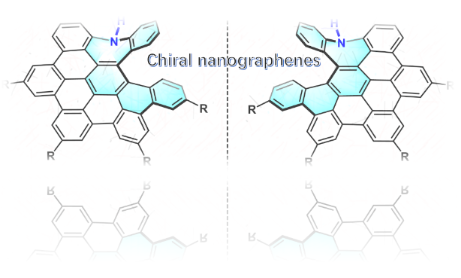
- through oxidative cyclodehydrogenation and imine formation in a 72% yield. It was noted that no other regioisomer was detected for the asymmetrical precursor 30. The pair of enantiomers was confirmed by the racemic structure's single-crystal X-ray diffractometry and separated by chiral HPLC, and no




Palladium-catalyzed enantioselective three-component synthesis of α-arylglycine derivatives from glyoxylic acid, sulfonamides and aryltrifluoroborates
Beilstein J. Org. Chem. 2023, 19, 719–726, doi:10.3762/bjoc.19.52
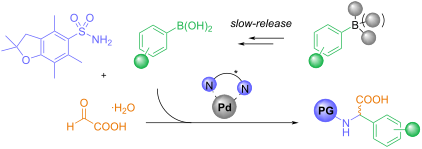
- imine species provide a very flexible approach to the arylglycine scaffold [2][9]. The Petasis borono-Mannich reaction constitutes a prominent example for such an imine-based multicomponent reaction (Scheme 1a). The reaction of glyoxylic acid, an amine component and an arylboronic acid offers a highly
- situ generation of reactive imine species, we have disclosed iron- and bismuth-catalyzed three-component reactions for the synthesis of α-arylglycines [14][15][16], in which the arylboronic acid could be replaced with an electron-rich (hetero)arene as nucleophile. In parallel, we have developed




Enolates ambushed – asymmetric tandem conjugate addition and subsequent enolate trapping with conventional and less traditional electrophiles
Beilstein J. Org. Chem. 2023, 19, 593–634, doi:10.3762/bjoc.19.44
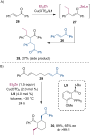
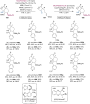
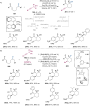
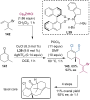
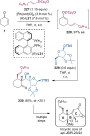
- been shown to impart high levels of enantioselectivity for these ketones [46]. We performed the conjugate addition for 2 h and then added imine 58 having a tosyl protecting group. The workup allowed the isolation of domino products 59 as a mixture of diastereomers with dr 3:2 and enantiomeric purities
- introduced during the conjugate addition). On the other hand, a typical problem of these reactions was also revealed. The diastereoselectivity with respect to the addition to the imine was only very modest. To address the problem of low facial selectivity of the imine addition, we continued our study with
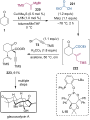
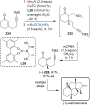
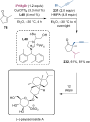
- ligands is that they can also promote the conjugate additions of aryl-based or branched Grignard reagents (Scheme 17) [49]. Further extending this methodology, we have investigated formaldehyde imine equivalents. These kinds of imines are not readily available, but they are highly important synthetic









C3-Alkylation of furfural derivatives by continuous flow homogeneous catalysis
Beilstein J. Org. Chem. 2023, 19, 582–592, doi:10.3762/bjoc.19.43
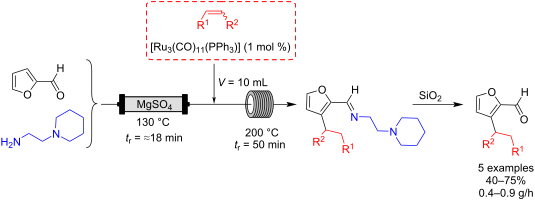
- .19.43 Abstract The C3-functionalization of furfural using homogeneous ruthenium catalysts requires the preinstallation of an ortho-directing imine group, as well as high temperatures, which did not allow scaling up, at least under batch conditions. In order to design a safer process, we set out to
- formation of the imine directing group and the C3-functionalization with some vinylsilanes and norbonene. Keywords: biomass; C–H activation; flow; furfural; homogeneous catalysis; Introduction The conversion of biomass derivatives into value-added products is one of the key branches of green chemistry and
- reaction conditions while providing products in shorter reaction times. In addition, the ability to couple multiple reactors with a flow apparatus could also enable us to perform these functionalizations directly from furfural by forming the imine in a first reactor. It should be noted that, in batch, in


A new oxidatively stable ligand for the chiral functionalization of amino acids in Ni(II)–Schiff base complexes
Beilstein J. Org. Chem. 2023, 19, 566–574, doi:10.3762/bjoc.19.41
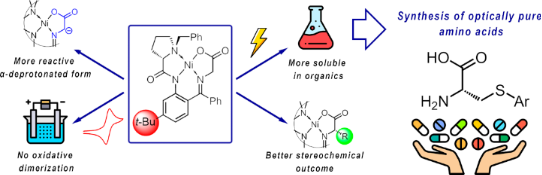
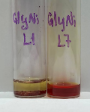
- reversibility can be reached at scan rates above 20 V/s allowing the E1/2 estimation. Similarly to previously studied complex (ΔAlaNi)L1 [36], electron transfer to (ΔAlaNi)L7 is mainly ligand centered. The DFT-estimated LUMO is formed as an overlap of the π antibonding orbitals of the dehydroalanine and imine



Transition-metal-catalyzed domino reactions of strained bicyclic alkenes
Beilstein J. Org. Chem. 2023, 19, 487–540, doi:10.3762/bjoc.19.38
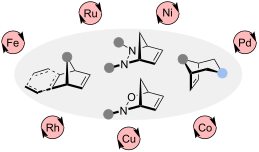
- occurs producing 144. Subsequently, coordination of the Rh(I) to the electrophilic cyano group leads to an intramolecular addition producing 145. The imine undergoes a hydrolysis releasing the final carboannulated product 141 as well as regeneration of the active Rh(I) catalyst. A similar mechanism can



















Computational studies of Brønsted acid-catalyzed transannular cycloadditions of cycloalkenone hydrazones
Beilstein J. Org. Chem. 2023, 19, 477–486, doi:10.3762/bjoc.19.37
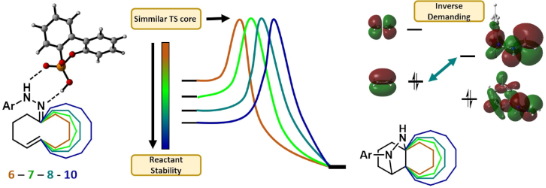
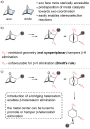
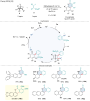
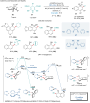
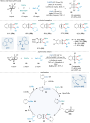
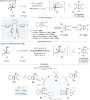
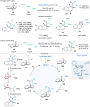
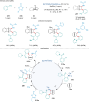
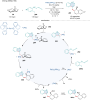
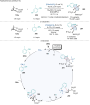
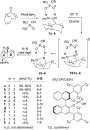
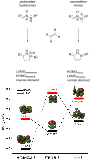
- )) geometries for the transition structures of series a–f. Top: Cycloaddition of protonated hydrazones as inverse-demand reaction of cycloaddition of azomethine imines. Bottom: molecular orbitals involved in the reaction and energy diagram of the reactivity of ethylene with azomethine imine and protonated




An efficient metal-free and catalyst-free C–S/C–O bond-formation strategy: synthesis of pyrazole-conjugated thioamides and amides
Beilstein J. Org. Chem. 2023, 19, 231–244, doi:10.3762/bjoc.19.22
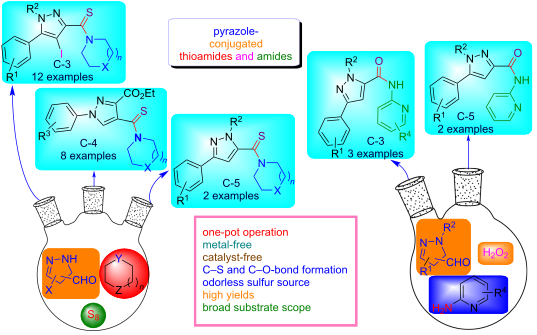
- nucleophilic attack of morpholine (C) on elemental sulfur may react with the intermediate 13 to afford another intermediate 15, which undergoes oxidation to release the thioamide-tethered pyrazole 1C. On the other hand, the pyrazole carbaldehyde 1 forms imine intermediate 16 by condensation with 2
- -aminopyridine. Thereafter, a nucleophilic attack of H2O2 on the imine carbon may afford the intermediate 17. Finally, the loss of a water molecule from the intermediate 17 may generate the pyrazole-pyridine conjugate with amide linkage 1F. Conclusion In summary, a simple, straightforward and efficient approach


Practical synthesis of isocoumarins via Rh(III)-catalyzed C–H activation/annulation cascade
Beilstein J. Org. Chem. 2023, 19, 100–106, doi:10.3762/bjoc.19.10
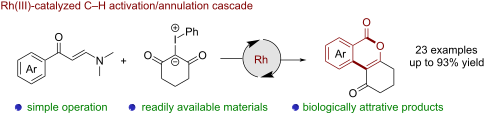
- , which undergoes a rapid migratory insertion to give intermediate 1-C. The protonation of 1-C produces the intermediate 1-D with the regeneration of the active Rh catalyst for the next catalytic cycle. Under acidic conditions, the further protonation of compound 1-D delivers an imine intermediate 1-E
- , which undergoes an intramolecular annulation to give 1-F. The final isocoumarin product 3ba can be generated from 1-F by elimination of imine 1-G [39]. Finally, the rapid hydrolysis of the resulting 1-G gives rise to acetaldehyde and dimethylamine as byproducts. Conclusion In summary, an efficient Rh


Catalytic aza-Nazarov cyclization reactions to access α-methylene-γ-lactam heterocycles
Beilstein J. Org. Chem. 2023, 19, 66–77, doi:10.3762/bjoc.19.6

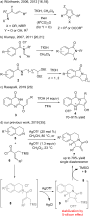
- , entry 4). The scope of the reaction with 3,4-dihydroisoquinoline substrates as cyclic imines was investigated under these conditions [35]. In the current work, we first opted to examine the activities of other Lewis acids in the aza-Nazarov cyclization of imine 5a with acyl chloride 6b. The reason of
- , were obtained as single diastereomers. In order to assess the scalability of the aza-Nazarov cyclization, we investigated the synthesis of the previously unreported lactam 7c via the reaction between imine 5b and acyl chloride 6b on a gram scale (Scheme 2). Acyl chloride 6b was prepared in four steps
- chloride at 60 °C in 95% yield (2.6 g) and with a dr (E:Z) of 3:1 (Scheme 2a). When imine 5b was reacted with 6b on an 8.0 mmol scale with the use of AgOTf (20 mol %) in acetonitrile at 80 °C, the aza-Nazarov product 7c was isolated in 61% yield (1.42 g) as a single diastereomer. This result clearly



Combining the best of both worlds: radical-based divergent total synthesis
Beilstein J. Org. Chem. 2023, 19, 1–26, doi:10.3762/bjoc.19.1
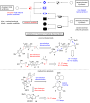
- in the formation of spirolactam 157 in 73% yield (Scheme 13). The reaction is estimated to take place initially with the one electron reduction to α-amino radical 164. This step is thought to be facilitated after TFA protonates the formed imine. Afterwards, radical addition of 164 to 156, generates
- ). Thus, upon irradiation, iridium polypyridyl photocatalyst allowed the oxidation of the phosphate complex 207 to radical cation 206, which can be readily trapped by TEMPO, and hence stabilizing the imine and allowing cyclization with the pendant amine to form the pyrroloindoline core 210 in 81% yield











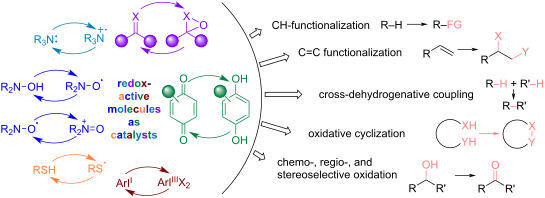
Redox-active molecules as organocatalysts for selective oxidative transformations – an unperceived organocatalysis field
Beilstein J. Org. Chem. 2022, 18, 1672–1695, doi:10.3762/bjoc.18.179
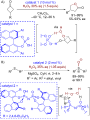
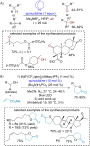
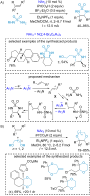
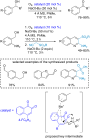
- intermediate is depicted in Scheme 28). Quinone derivatives could also be generated in situ by anodic oxidation of phenolic compounds. An example of such process is the electrocatalytic biomimetic synthesis of secondary amines by o-azaquinone catalysis [130] (Scheme 29). Under anodic oxidation conditions imine
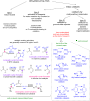
- of a hydroperoxide (terminal oxidant) on a ketone or imine, respectively, is followed by intramolecular cyclization with O–O bond cleavage and the formation of a strained 3-membered ring, an electrophilic oxygen atom donor for oxidative processes (Scheme 30). It should be noted that in the ketone











Synthesis of (−)-halichonic acid and (−)-halichonic acid B
Beilstein J. Org. Chem. 2022, 18, 1629–1635, doi:10.3762/bjoc.18.174
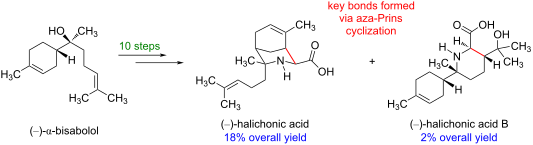
- derived from a common biosynthetic pathway starting from farnesyl pyrophosphate and glycine [5]. This prompted us to investigate a biomimetic synthesis in which the halichonic acids could be prepared from a common imine intermediate via divergent intramolecular aza-Prins cyclizations [8]. Herein, we
- amine derivatives (e.g., hydrochloride salt, mandelic acid salt, phthalimide, ketopinic acid amide, salicylaldehyde imine, p-toluenesulfonamide, acetamide, etc.), all attempts to separate the resulting isomers (which were oils) were similarly unsuccessful. Seeking an alternative to column chromatography
- evolution (likely H2) occurred. However, no reduction of the amide was observed, even after stirring at room temperature for 24 hours. In an effort to “salvage” the reaction by reducing the amide to the corresponding N-benzylamine (which could potentially be oxidized to the corresponding imine with IBX [18


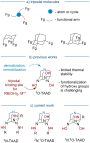
1,4,6,10-Tetraazaadamantanes (TAADs) with N-amino groups: synthesis and formation of boron chelates and host–guest complexes
Beilstein J. Org. Chem. 2022, 18, 1424–1434, doi:10.3762/bjoc.18.148
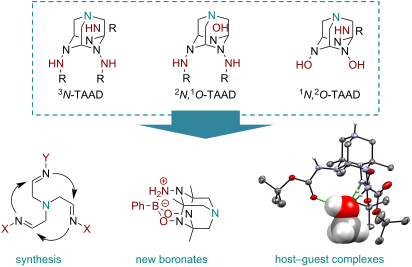
- bearing a free amino group (Scheme 4). However, this product was prone to a ring–chain isomerization forming an equilibrating mixture of azaadamantane 15, tris-imine 16, and bicycle 17 in solution as determined by NMR data (see Supporting Information File 1 for details). We were able to shift the