Search results
Search for "nucleophilic substitution" in Full Text gives 363 result(s) in Beilstein Journal of Organic Chemistry. Showing first 200.
Controlling the reactivity of La@C82 by reduction: reaction of the La@C82 anion with alkyl halide with high regioselectivity
Beilstein J. Org. Chem. 2023, 19, 1858–1866, doi:10.3762/bjoc.19.138
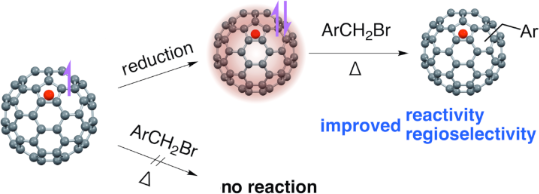
- reaction is believed to occur via electron transfer, followed by the radical coupling of La@C2v-C82 and benzyl radicals, rather than by bimolecular nucleophilic substitution reaction of La@C2v-C82 anion with 1. Keywords: electron transfer; metallofullerene; radical; reduction; Introduction Fullerenes
- transfer, followed by bimolecular nucleophilic substitution (SN2) reaction [8]. Endohedral metallofullerenes, wherein one or more metal atoms are encapsulated inside a fullerene cage, have garnered research interest [12][13][14][15]. The encapsulation of metal atoms can result in electron transfer from the


Radical chemistry in polymer science: an overview and recent advances
Beilstein J. Org. Chem. 2023, 19, 1580–1603, doi:10.3762/bjoc.19.116
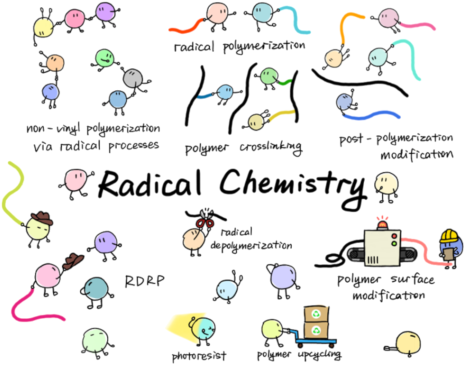
- overwhelmingly more common in the latter because there are other more selective and efficient solution chemistry methods for post-polymerization modification, such as nucleophilic substitution [94][96]. In this section, we discuss the radical chemistry used in both processes. 3.1 Post-polymerization modification




N-Sulfenylsuccinimide/phthalimide: an alternative sulfenylating reagent in organic transformations
Beilstein J. Org. Chem. 2023, 19, 1471–1502, doi:10.3762/bjoc.19.106
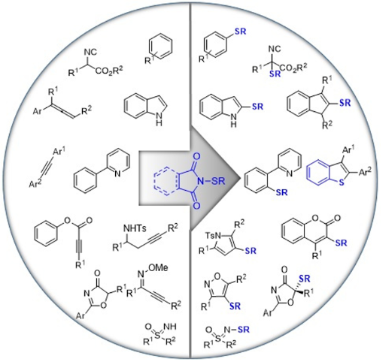
- reductive elimination to yield ketone 78. In the acylthiolation cycle, the azaphilic ZnCl2 activated NTSE 1’’’ via N–Zn coordination to facilitate the leaving ability of succinimide. Then, nucleophilic substitution of arylmagnesium bromide 75 to intermediate IV provided thioester 79. In 2022, Gao and co


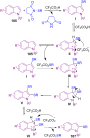


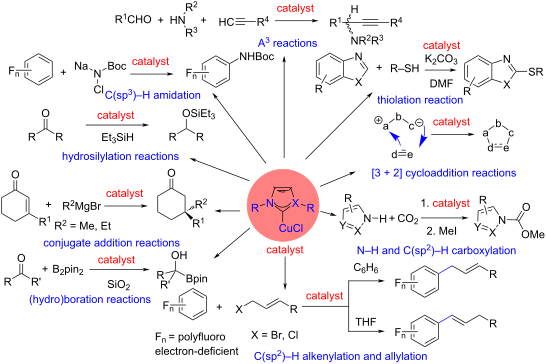
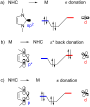
Application of N-heterocyclic carbene–Cu(I) complexes as catalysts in organic synthesis: a review
Beilstein J. Org. Chem. 2023, 19, 1408–1442, doi:10.3762/bjoc.19.102
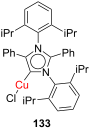
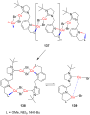
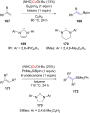
- diaminocarbenes) Cu(I) hexamethyldisilazide complexes by using lithium hexamethyldisilazide as a base in 2017 (Scheme 15) [29]. The initially formed NHC–CuCl complexes 41, 44, and 47 reacted with another molecule of LiN(SiMe3)2 to undergo nucleophilic substitution of Cl by a bis(trisilyl)amino group to furnish










One-pot nucleophilic substitution–double click reactions of biazides leading to functionalized bis(1,2,3-triazole) derivatives
Beilstein J. Org. Chem. 2023, 19, 1399–1407, doi:10.3762/bjoc.19.101
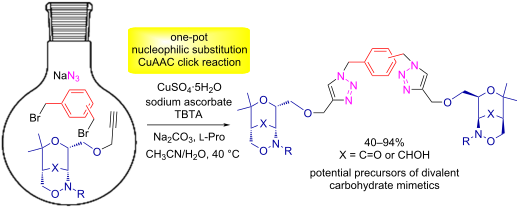
- Hans-Ulrich Reissig Fei Yu Institut für Chemie und Biochemie, Freie Universität Berlin, Takustrasse 3, D-14195 Berlin, Germany Asymchem Boston Corporation, 10 Gill Street, Woburn, Massachusetts, 01801, USA 10.3762/bjoc.19.101 Abstract The nucleophilic substitution of benzylic bromides with sodium
- carbohydrate mimetics, but the reductive cleavage of the 1,2-oxazine rings to aminopyran moieties did not proceed cleanly with these compounds. Keywords: alkynes; azides; copper catalysis; nucleophilic substitution; 1,2-oxazines; Introduction The concept of click reactions [1][2], in particular, the
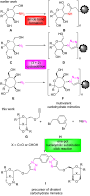
- . In this study we investigated the compatibility of the nucleophilic substitution of 1,2-, 1,3- or 1,4-bis(bromomethyl)benzene H with sodium azide and the copper-catalyzed alkyne–azide cycloadditions with compounds of type G to provide divalent compounds I (Scheme 1). These may serve as precursors of



Synthesis of ether lipids: natural compounds and analogues
Beilstein J. Org. Chem. 2023, 19, 1299–1369, doi:10.3762/bjoc.19.96
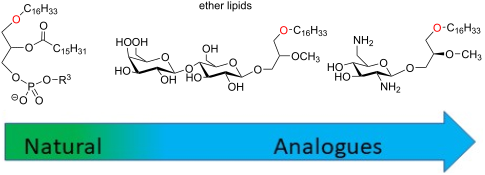
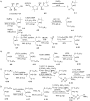
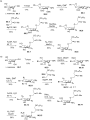
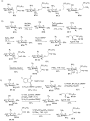
- mesylation produced 17.3. Then, the nucleophilic substitution (SN2) reaction of benzoate with 17.3 produced the benzoate ester 17.4 with an inversion of configuration. Then, the two protecting groups (ester and trityl) were removed to produce (S)-17.6. The modification of the sn-2 position is illustrated in
- mesylated to 29.2. Then, a bromine atom was introduced via a nucleophilic substitution with LiBr in acetone to form 29.3. Finally, the primary bromide was used to introduce different ammonium salts as illustrated with compound 29.4. A variation of this sequence consisted in placing an ether function in






Organic thermally activated delayed fluorescence material with strained benzoguanidine donor
Beilstein J. Org. Chem. 2023, 19, 1289–1298, doi:10.3762/bjoc.19.95
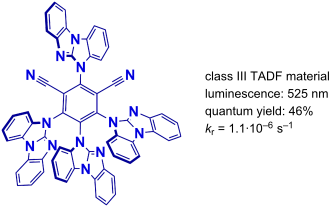
- containing a rigid benzoguanidine ligand in its molecular structure. Results and Discussion Synthesis and structure 4BGIPN was prepared in 70% yield by aromatic nucleophilic substitution reaction from 2,4,5,6-tetrafluoroisophthalonitrile and 5H-benzo[d]benzo[4,5]imidazo[1,2-a]imidazole (benzoguanidine) after


Metal catalyst-free N-allylation/alkylation of imidazole and benzimidazole with Morita–Baylis–Hillman (MBH) alcohols and acetates
Beilstein J. Org. Chem. 2023, 19, 1251–1258, doi:10.3762/bjoc.19.93
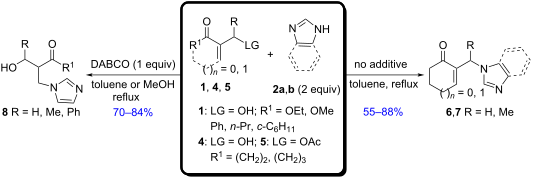
- various nucleophiles, including C- and heteronucleophiles, such as compounds bearing –OH, –SH, and –NH groups [4][5][6][7]. Among them, the carbon–nitrogen bond formation through N-nucleophilic substitution reactions plays a central role for the synthesis of numerous compounds exhibiting various
- precursors in nucleophilic allylic substitution reactions with amines, presumably due to the perceived poor leaving group ability and low reactivity of the hydroxy group. Interestingly, the direct nucleophilic substitution of the corresponding alcohols has drawn much attention because of the availability of
- in the presence of imidazole (2a), as a powerful nucleophilic additive, affording, via competitive allylic nucleophilic substitution in toluene at reflux, a mixture of the corresponding N-substituted morpholine and N-substituted imidazole derivatives 6 [23]. In addition, a literature survey showed


First synthesis of acylated nitrocyclopropanes
Beilstein J. Org. Chem. 2023, 19, 892–900, doi:10.3762/bjoc.19.67
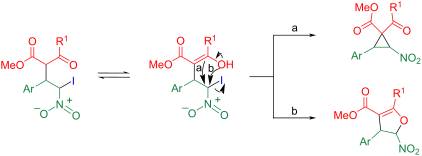
- ) halogenation, and 3) ring closure (Scheme 2). β-Nitrostyrene 2 serves as an appropriate acceptor for conjugate addition by diethyl malonate (3a) to afford adduct 4a, in which the methine group flanked by two carbonyl groups is readily halogenated, and the subsequent intramolecular nucleophilic substitution by


Nucleophile-induced ring contraction in pyrrolo[2,1-c][1,4]benzothiazines: access to pyrrolo[2,1-b][1,3]benzothiazoles
Beilstein J. Org. Chem. 2023, 19, 646–657, doi:10.3762/bjoc.19.46
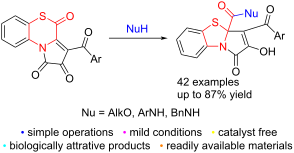
- intermediates D [57], which underwent intramolecular nucleophilic substitution of the chloro substituent at C3a position with S5 [58] to give intermediates E. Then, intermediates E readily decarbonylated [59][60] to afford compounds 17 (Scheme 21). We suppose that in the reaction of APBTTs 1 with nucleophiles
- 16a–d, the formation of compounds 17 could proceed via a similar pathway, since Nu-groups of compounds 16a–d are good bulky leaving groups for nucleophilic substitution reactions. Nevertheless, the pathway of formation of compounds 17 is questionable and may become a subject of a new study. Conclusion


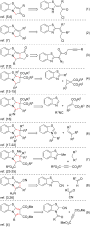


Enolates ambushed – asymmetric tandem conjugate addition and subsequent enolate trapping with conventional and less traditional electrophiles
Beilstein J. Org. Chem. 2023, 19, 593–634, doi:10.3762/bjoc.19.44
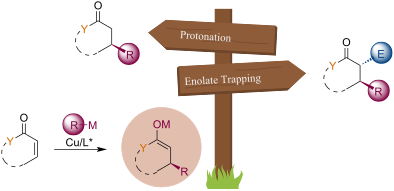
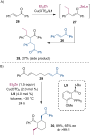
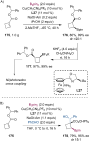
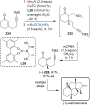
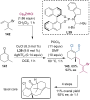
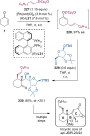
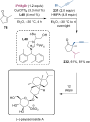
- addition with Grignard reagents Feringa and co-workers realized the tandem conjugate addition of Grignard reagents to 4-chlorocrotonates 46 [42]. The enolate 47, which was formed in this process, underwent an intramolecular nucleophilic substitution to form cyclopropane derivatives. Thioesters, esters as









A new oxidatively stable ligand for the chiral functionalization of amino acids in Ni(II)–Schiff base complexes
Beilstein J. Org. Chem. 2023, 19, 566–574, doi:10.3762/bjoc.19.41
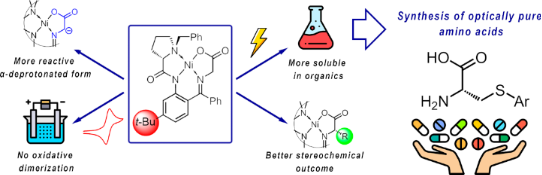
- as the starting platform for the modification of an amino acid moiety by nucleophilic substitution and addition reactions, including electrochemically induced processes [5][16][17][18][31]. The electrochemical behavior of the new complexes was investigated to get an experimental support for their



Functionalization of imidazole N-oxide: a recent discovery in organic transformations
Beilstein J. Org. Chem. 2022, 18, 1575–1588, doi:10.3762/bjoc.18.168
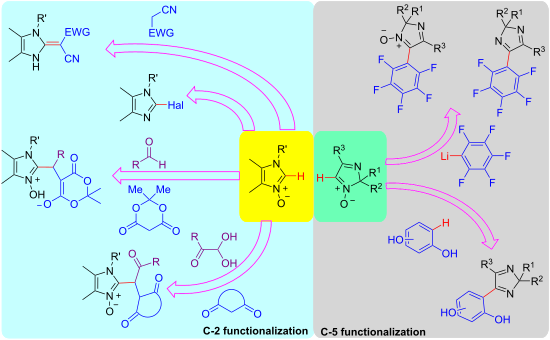
- summarized so that the chemists, researchers, and pharmaceutical industries find its effectiveness in near future for the synthesis of potent, novel, and non-toxic drug molecules. Keywords: functionalization; imidazole N-oxide; mechanistic insights; multicomponent reaction; nucleophilic substitution
- substitution reactions Metal-free coupling reaction through nucleophilic substitution of H-atom (SNH) In 2020, a C–H/C–Li coupling reaction between 2H-imidazole 1-oxides and pentafluorophenyllithium under transition metal-free conditions was reported by Timofey D. Moseev and co-workers [17]. The reaction
- proceeds through the nucleophilic substitution of a H-atom (SNH) at the C-5 position of the imidazole N-oxides. This reaction methodology can be considered as suitable process for the syntheses of bioactive imidazole compounds containing (poly)fluoroaryl moieties. Interestingly, in some of the





Synthesis of C6-modified mannose 1-phosphates and evaluation of derived sugar nucleotides against GDP-mannose dehydrogenase
Beilstein J. Org. Chem. 2022, 18, 1379–1384, doi:10.3762/bjoc.18.142
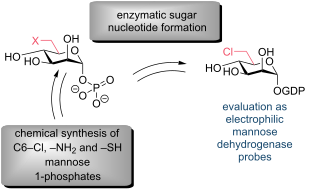
- , syntheses of C6-modified mannose 1-phosphates 13 and 17 were developed (Scheme 1). The synthesis of 6-amino-6-deoxymannose 1-phosphate 13 started from protected thioglycoside 10 [6]. A two-step modification using Appel halogenation followed by nucleophilic substitution with azide furnished 11. Conversion of


A one-pot electrochemical synthesis of 2-aminothiazoles from active methylene ketones and thioureas mediated by NH4I
Beilstein J. Org. Chem. 2022, 18, 1249–1255, doi:10.3762/bjoc.18.130
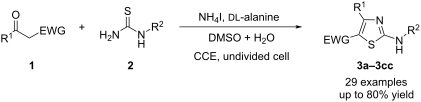
- produce α-iodo ketone with the molecular I2 produced by anodic oxidation. Subsequently, the nucleophilic substitution between intermediate 4 and thiourea tautomer gives α-sulfur substituted ketone 5. Intermediate 5 undergoes intramolecular nucleophilic addition to the carbonyl group and followed by




Scope of tetrazolo[1,5-a]quinoxalines in CuAAC reactions for the synthesis of triazoloquinoxalines, imidazoloquinoxalines, and rhenium complexes thereof
Beilstein J. Org. Chem. 2022, 18, 1088–1099, doi:10.3762/bjoc.18.111
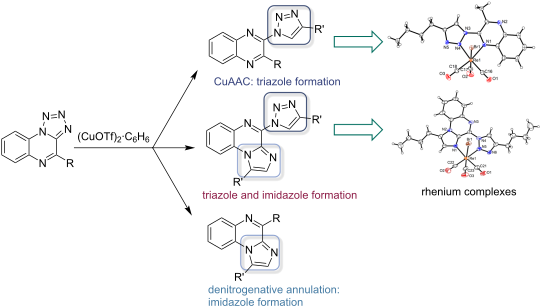
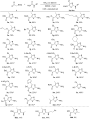
- - (14o) functionality can also be applied for various other reactions. Possible modifications of compounds 14 were exemplarily shown for 14j, which was converted to the amine-substituted product 14j* via nucleophilic substitution with a yield of 77% (see Scheme 3). However, alkynes 4 with reactive and


Electrochemical vicinal oxyazidation of α-arylvinyl acetates
Beilstein J. Org. Chem. 2022, 18, 1026–1031, doi:10.3762/bjoc.18.103
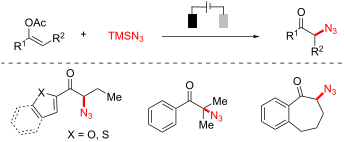
- development of a green, efficient, and sustainable protocol for the synthesis of azidoketones is of great significance [7][8][9]. Retrosynthetically, the nucleophilic substitution of α-bromoketones by sodium azide [10] and oxidation of the azido alcohols [11] are among the most straightforward methods to




Synthetic strategies for the preparation of γ-phostams: 1,2-azaphospholidine 2-oxides and 1,2-azaphospholine 2-oxides
Beilstein J. Org. Chem. 2022, 18, 889–915, doi:10.3762/bjoc.18.90
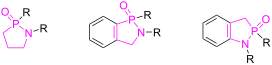
- 1-substituted 2-ethoxy-1,2-azaphospholidine-4-carboxylate 2-oxides 203 were synthesized in 70% and 39% yields, respectively, from ethyl 2-((chloro(ethoxy)phosphoryl)methyl)acrylate (202) and benzyl- and adamantylmethylamines via aza-Michael addition and intramolecular nucleophilic substitution. The
- synthetic method showed very limited substrate scope. Only less bulky primary amines underwent the first aza-Michael addition and then intramolecular nucleophilic substitution. However, aromatic amines, aniline, 2,3-dihydro-1H-inden-4-amine, and the bulky aliphatic primary amine adamantylamine did not







Synthesis of novel alkynyl imidazopyridinyl selenides: copper-catalyzed tandem selenation of selenium with 2-arylimidazo[1,2-a]pyridines and terminal alkynes
Beilstein J. Org. Chem. 2022, 18, 863–871, doi:10.3762/bjoc.18.87
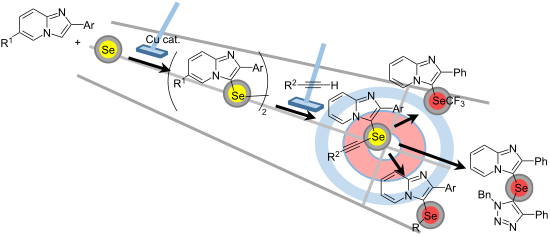
- inexpensive and easy to handle Se powder as the Se source. The reaction proceeded with terminal alkynes having various substitutions, such as aryl, vinyl, and alkyl groups. The obtained alkynyl imidazopyridinyl selenide was found to undergo nucleophilic substitution reaction on Se atom using organolithium
- phenyllithium in THF at −78 °C led to a nucleophilic substitution reaction with the elimination of the ethynyl group to form the desired phenylimidazopyridinyl selenide 6a in 49% yield. In the reaction with n-butyllithium, alkyl derivative 6b was isolated in the same way. The reaction of 4aa with the Ruppert
- synthesized using a simple operation that can be performed under aerobic conditions. Moreover, the results showed that the obtained compounds underwent nucleophilic substitution reactions involving the elimination of the alkyne moiety on Se atoms to form aryl or alkyl imidazopyridinyl selenides and



Synthesis of α-(perfluoroalkylsulfonyl)propiophenones: a new set of reagents for the light-mediated perfluoroalkylation of aromatics
Beilstein J. Org. Chem. 2022, 18, 788–795, doi:10.3762/bjoc.18.79
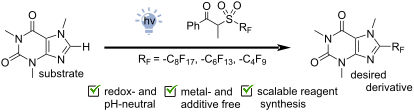
- envisioned the bimolecular nucleophilic substitution between an α-halopropiophenone as the “dummy group” scaffold and the corresponding perfluorinated sodium sulfinate salt – also visualized as the installation of the photocleavable moiety onto the perfluoroalkyl chain [15][16][17][18][19]. The precursory
- obtain the corresponding sulfinate in limited yield, the decomposition of this compound after several days at 4 °C, and within a few minutes under heating deemed its applicability impractical. After this first step, we proceeded to test the nucleophilic substitution between our perfluoroalkylsulfinate
- under thermal conditions afforded product 5 in only 30% yield and underscored the sluggish reactivity of these sulfinate derivatives towards undergoing nucleophilic substitution (Scheme 2). To solve this problem, we turned to the use of α-iodopropiophenone (6), generated from its bromide counterpart


A trustworthy mechanochemical route to isocyanides
Beilstein J. Org. Chem. 2022, 18, 732–737, doi:10.3762/bjoc.18.73
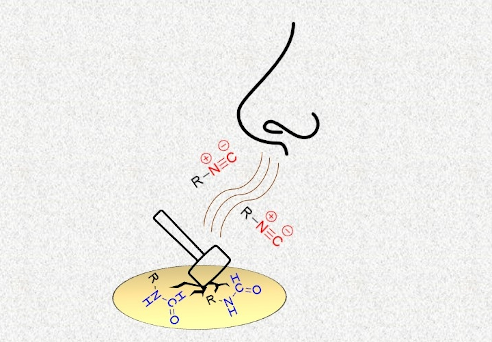
- attributed to their probable reaction mechanism where the nitrogen atom not only promotes the enolate derivative formation as already described in literature [33][34] but it may also generate a positively charged intermediate at the transition state [35], enhancing the nucleophilic substitution. Obviously


Substituent effect on TADF properties of 2-modified 4,6-bis(3,6-di-tert-butyl-9-carbazolyl)-5-methylpyrimidines
Beilstein J. Org. Chem. 2022, 18, 497–507, doi:10.3762/bjoc.18.52
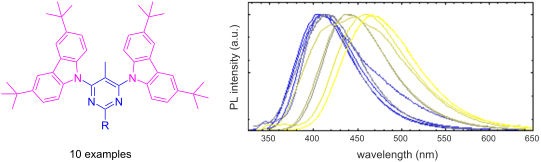
- nucleophilic substitution of the methylsulfonyl group with sodium cyanide and 4-(tert-butyl)thiophenol. The thorough photophysical analysis was carried out to assess the impact of different substituents in position 2 of the pyrimidine ring. It was shown that HOMO–LUMO overlap and the resulting ΔEST can be




The asymmetric Henry reaction as synthetic tool for the preparation of the drugs linezolid and rivaroxaban
Beilstein J. Org. Chem. 2022, 18, 438–445, doi:10.3762/bjoc.18.46
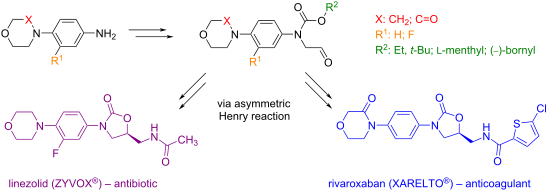
- the R2O- part of the carbamate group does not modify the structure of linezolid (1), because this molecular moiety is cleaved during the intramolecular nucleophilic substitution in the final reaction step (Scheme 2). The catalysts derived from ligands Ia, IIa, IIIa, and IV were also tested in the


Synthesis of piperidine and pyrrolidine derivatives by electroreductive cyclization of imine with terminal dihaloalkanes in a flow microreactor
Beilstein J. Org. Chem. 2022, 18, 350–359, doi:10.3762/bjoc.18.39
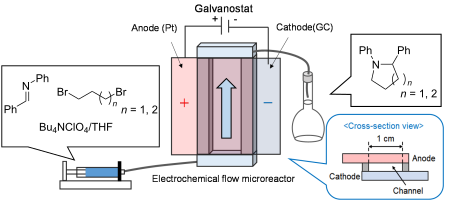
- ]. Conventional synthetic methods for piperidine derivatives include nucleophilic substitution (route (1) in Scheme 1), reductive amination (route (2)), intramolecular cyclization of amines and alkenes (route (3)), the Diels–Alder reaction and subsequent reduction (route (4)), and the radical cyclization reaction


Site-selective reactions mediated by molecular containers
Beilstein J. Org. Chem. 2022, 18, 309–324, doi:10.3762/bjoc.18.35
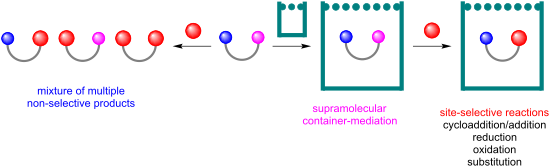
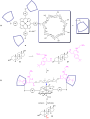
- , azides, halides and alkenes, oxidation of remote C–H bonds and alkenes, and substitution reactions involving ring-opening cyclization of epoxides, nucleophilic substitution of allylic chlorides, and hydrolysis reactions. The product selectivity is interpreted as the consequence of the space shape and
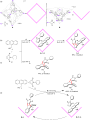
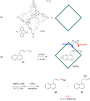
- could mimic the catalysis behavior of the active sites of enzymes. In 2012, the Fujita group reported a site-selective nucleophilic substitution reaction of allylic chlorides mediated by cage host J (Figure 12) [74]. Usually, this reaction occurs both at the α and γ positions of the allylic chloride
- . Site-selective monoepoxidation of α,ω-dienes mediated by the water-soluble cavitand host E. Site-selective ring-opening reaction of epoxides mediated by cavitand I with an inwardly directed carboxylic acid module. Site-selective nucleophilic substitution reaction of allylic chlorides mediated by cage