Search results
Search for "racemization" in Full Text gives 123 result(s) in Beilstein Journal of Organic Chemistry.
Cross-dehydrogenative coupling for the intermolecular C–O bond formation
Beilstein J. Org. Chem. 2015, 11, 92–146, doi:10.3762/bjoc.11.13
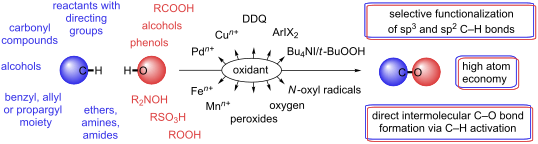
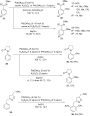
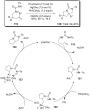
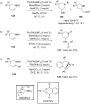
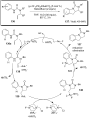
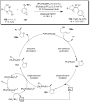
- ketones, under the reaction conditions, resulting in the partial racemization [186]. Good results were achieved in the oxidative C–O coupling of ketones, aldehydes and β-dicarbonyl compounds 198 with carboxylic acids 199 in the presence of the Bu4NI/t-BuOOH system [194] (Scheme 41). The coupling can be









A facile synthesis of functionalized 7,8-diaza[5]helicenes through an oxidative ring-closure of 1,1’-binaphthalene-2,2’-diamines (BINAMs)
Beilstein J. Org. Chem. 2015, 11, 9–15, doi:10.3762/bjoc.11.2
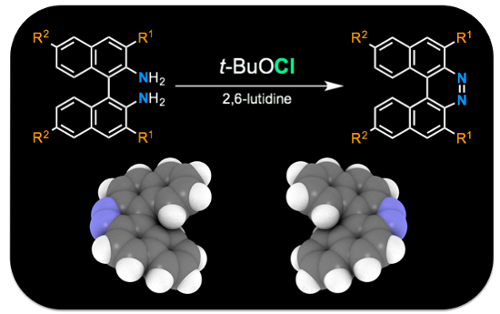
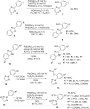
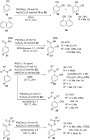
- information of 1a through rapid racemization of optically active 2a or of the reaction intermediates. Having identified the optimized conditions for the oxidative ring-closure of 1a, we then turned our attention to applying this method to the preparation of functionalized 7,8-diaza[5]helicenes (Scheme 3


First chemoenzymatic stereodivergent synthesis of both enantiomers of promethazine and ethopropazine
Beilstein J. Org. Chem. 2014, 10, 3038–3055, doi:10.3762/bjoc.10.322

- identified as a key step in optimizing the process to avoid racemization. To save one step less, we initiated our efforts by direct transformation of the sec-alcohol functionality in afore-obtained compound (±)-3 under modified Mitsunobu [78][79] reaction conditions using Ph3P (1.1 equiv), DEAD (1.1 equiv




Automated solid-phase peptide synthesis to obtain therapeutic peptides
Beilstein J. Org. Chem. 2014, 10, 1197–1212, doi:10.3762/bjoc.10.118

- development of racemization suppressants such as the most popular HOBt (1-hydroxybenzotriazole) [55]. HOBt traps the O-acylisourea, an intermediate, which tends to racemization, and forms the activated species. Nowadays, a great variety of coupling reagents are commercially available reaching from traditional
- reflected in rapid heating on a molecular level [73]. The strength of the heating is influenced by solvents, reactants, sample volumes and the mode of mixing. It has to be noted that an optimization of temperature is mandatory in order to avoid racemization and side reactions [74]. Application of automated


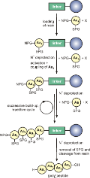


Atherton–Todd reaction: mechanism, scope and applications
Beilstein J. Org. Chem. 2014, 10, 1166–1196, doi:10.3762/bjoc.10.117

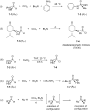
- stereochemistry of the AT reaction was reported by Reiff and Aaron [29]. They used enantiopure O-isopropyl methylphosphonite 7-1 (Scheme 7-i) as a substrate. This substrate was purified by distillation with no racemization. However, rapid racemization was observed when 7-1 was treated with sodium methoxide in
- ; consequently, the (R) configuration is preserved in the course of this reaction). The authors also observed a racemization (Scheme 7-ii) when the same reaction was achieved without the addition of a nucleophile (aniline in the present case). The use of similar reaction conditions (CCl4, NEt3) led Mikolajczyk
- et al. [30] to observe the formation of a mixture of diastereoisomers due to a racemization at the phosphorus atom. However, this racemization was not always observed which points out the different stability of diastereoisomeric species (cyclic phosphite in the present case). Other conditions of




Amino acid motifs in natural products: synthesis of O-acylated derivatives of (2S,3S)-3-hydroxyleucine
Beilstein J. Org. Chem. 2014, 10, 1135–1142, doi:10.3762/bjoc.10.113
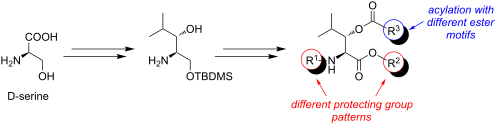
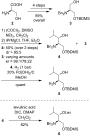
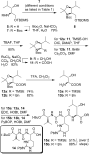
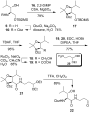
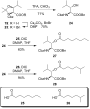
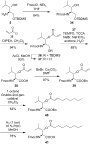
- and Grignard addition. The enantiomeric purity of reisolated 3 was determined by HPLC analysis as its racemization can readily occur via silyl migration under the basic reaction conditions (see Supporting Information File 2 for HPLC chromatograms and for the synthesis of the racemic reference). After




Preparation of phosphines through C–P bond formation
Beilstein J. Org. Chem. 2014, 10, 1064–1096, doi:10.3762/bjoc.10.106
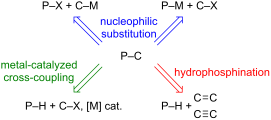
- . Most reactions gave 89 in low to good yields but in some cases the product could not be isolated, probably due to instability of the product. During the coupling reaction with 13h partial inversion of the phosphorus atom occurred, resulting in racemization. Nickel: Most research has focused on the use


Isocyanide-based multicomponent reactions towards cyclic constrained peptidomimetics
Beilstein J. Org. Chem. 2014, 10, 544–598, doi:10.3762/bjoc.10.50

- points and they provide the Ugi-products 53a,b in high yields and mainly as trans-isomers (de >88%), without racemization. As an extension, two other enantiopure isocyanides were combined with a variety of carboxylic acids furnishing a small library of bicyclic dipeptide mimics (55a–d, Scheme 17) in good


Synthesis and stereochemical assignments of diastereomeric Ni(II) complexes of glycine Schiff base with (R)-2-(N-{2-[N-alkyl-N-(1-phenylethyl)amino]acetyl}amino)benzophenone; a case of configurationally stable stereogenic nitrogen
Beilstein J. Org. Chem. 2014, 10, 442–448, doi:10.3762/bjoc.10.41

- commercial application of chiral complex 1 is rather limited. The major shortcomings of compound 1 are: problematic scale up of its synthesis, partial racemization of the N-(benzyl)proline moiety and undesirable stereochemical outcomes. To overcome these deficiencies we initiated a project aiming to design a


Synthesis and biological activity of N-substituted-tetrahydro-γ-carbolines containing peptide residues
Beilstein J. Org. Chem. 2014, 10, 155–162, doi:10.3762/bjoc.10.13
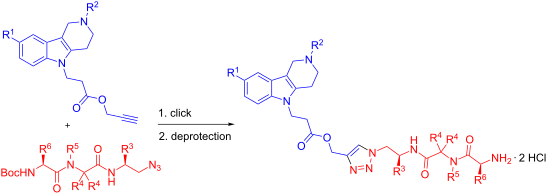
- catalytic amounts of CsF (Scheme 1). The corresponding protected azidopeptides 5 [14][15] are accessible by the Ugi multicomponent reaction [16][17][18][19] of chiral isocyanoazides 4 [20] with carbonyl compounds, amines and Boc-protected amino acids (Scheme 2). As we showed before, the racemization of the


Garner’s aldehyde as a versatile intermediate in the synthesis of enantiopure natural products
Beilstein J. Org. Chem. 2013, 9, 2641–2659, doi:10.3762/bjoc.9.300
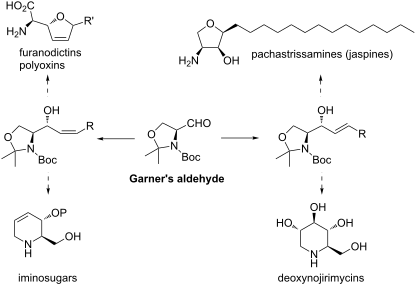
- compound (i.e. cleaving off the proton) is done by the addition of Et3N at cold temperatures (–78 to –60 °C). According to Roush, the use of triethylamine for this transformation led to partial racemization of 1 (85% ee). Dondoni noticed that changing the base to the bulkier base N,N-diisopropylethylamine
- aldehyde 1. As a conclusion of the above results we see that reversing the order of the two first reaction steps has a significant effect on the overall yield (from Garner’s 86% to Dondoni’s 94–98%). Less racemization can be observed with the reduction–oxidation sequence. Of course, other methods for the
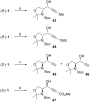
- olefinating reagents) and 2) E/Z-selectivity of the reaction. Moriwake et al. noticed in their synthesis of vinylglycinol 64 that the reaction of methyltriphenylphosphonium bromide with KH as the base provided 62 in fairly good yield, but with complete racemization of the product (Scheme 25) [101]. This





New developments in gold-catalyzed manipulation of inactivated alkenes
Beilstein J. Org. Chem. 2013, 9, 2586–2614, doi:10.3762/bjoc.9.294
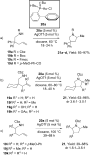
- diastereopure complex 35. Interestingly, the strong [Au(I)]–[Au(I)] aurophilic interaction in 35 prevented racemization even if chiral anions were removed (Scheme 10a). (S)-33 found application in the intramolecular hydroamination of 36, delivering 37 in quantitative yield (98%) and moderate enantioselectivity








Synthesis of enantiomerically pure N-(2,3-dihydroxypropyl)arylamides via oxidative esterification
Beilstein J. Org. Chem. 2013, 9, 2129–2136, doi:10.3762/bjoc.9.250

- any racemization under these optimized conditions. Higher dilutions of NMP resulted in longer reaction times and lower yields. A plausible mechanism for the ring opening of epoxide with a nitrogen heterocyclic carbene is presented in Scheme 3. Yadav and co-workers reported the ring opening of epoxide


Non-cross-linked polystyrene-supported 2-imidazolidinone chiral auxiliary: synthesis and application in asymmetric alkylation reactions
Beilstein J. Org. Chem. 2013, 9, 2113–2119, doi:10.3762/bjoc.9.248

- % de). In almost cases, the recovery and recycling of this soluble polymer-supported chiral auxiliary were achieved to produce highly optical pure carboxylic acids (99% ee). The alkylated polymer 6a was also treated with LiAlH4 and NaOMe. Unexpectedly, racemization occurred under these cleavage
- . Unexpectedly, racemization occurred under these cleavage conditions to produce the corresponding chiral alcohol and ester in 80% and 77% ee, respectively. Synthesis of NCPS-supported 2-imidazolidinone chiral auxiliary 3 through direct copolymerization of 2-imidazolidinone derived monomer 2 with styrene


Total synthesis of (−)-epimyrtine by a gold-catalyzed hydroamination approach
Beilstein J. Org. Chem. 2013, 9, 2042–2047, doi:10.3762/bjoc.9.242
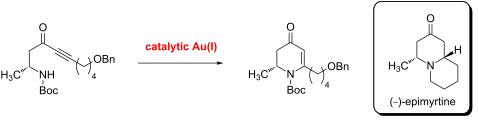
- the in situ deprotection of the amine function to permit the cyclization by Michael addition. However, in some instances partial racemization of the reaction products was observed [22]. Here, one major advantage of gold catalysis is the use of very mild conditions for the cyclization, thereby avoiding
- any racemization and obtaining N-protected compounds which may be useful for further transformations. In order to illustrate the efficiency of our method, we were interested in extending this methodology to quinolizidine privileged structures. Our retrosynthetic analysis is shown in Scheme 2. We


A practical synthesis of long-chain iso-fatty acids (iso-C12–C19) and related natural products
Beilstein J. Org. Chem. 2013, 9, 1807–1812, doi:10.3762/bjoc.9.210

- a single diastereoisomer (as determined by 1H NMR) in 80% yield. Cleavage of the chiral auxiliary using LiOH/H2O2 (which occurs without racemization at the α-position) [64] afforded (S)-2,15-dimethylpalmitic acid (30) in 98% yield. 2-Hydroxy-15-methylpalmitic acid has been identified from a range of


Inter- and intramolecular enantioselective carbolithiation reactions
Beilstein J. Org. Chem. 2013, 9, 313–322, doi:10.3762/bjoc.9.36

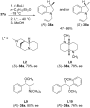
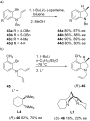
- formation of six-membered rings, though the slow cyclization rate results in racemization. The use of a phenylthio-substituted alkene favors the cyclization, and the faster reaction rate results in an improved optical purity of the indolizidines 35 and 36, though with moderate diastereo- and
- enantioselectivity. The addition of TMEDA increases the rate of racemization, resulting in an inversion of diastereoselectivity to obtain 36, albeit in racemic form [44]. The enantioselective cycloisomerization of achiral organolithiums in the presence of a chiral ligand has been reported with aryllithium reagents





Asymmetric synthesis of host-directed inhibitors of myxoviruses
Beilstein J. Org. Chem. 2013, 9, 197–203, doi:10.3762/bjoc.9.23
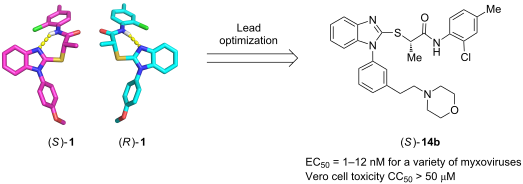
- known to limit racemization in peptide coupling reactions [16]. The enantiomeric excesses of the starting materials were ca. 95%. No erosion of stereochemistry in the products 12 was observed as determined by chiral HPLC. Recrystallization of 12 from ethanol did not increase the enantiomeric excess of


The multicomponent approach to N-methyl peptides: total synthesis of antibacterial (–)-viridic acid and analogues
Beilstein J. Org. Chem. 2012, 8, 2085–2090, doi:10.3762/bjoc.8.234
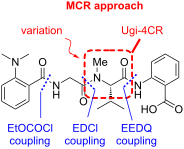
- coupling with carbodiimides, HBTU, HATU, and PyBroP failed or resulted in very low conversions. The addition of a catalytic amount of DMAP to the carbodiimide-mediated reactions improved the conversions, but resulted in severe racemization. The best result was obtained by employing N-ethoxycarbonyl-2


Asymmetric desymmetrization of meso-diols by C2-symmetric chiral 4-pyrrolidinopyridines
Beilstein J. Org. Chem. 2012, 8, 1778–1787, doi:10.3762/bjoc.8.203
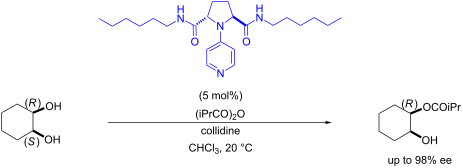
- associated with the higher mono/diacylation ratio in the asymmetric acylation of 22a promoted by 14 (Table 6, entries 6–8). (Notice: Enantioenriched 23a gradually undergoes partial racemization when it is kept as a CHCl3 solution probably via intramolecular acyl migration: e.g., from 88% ee to 71% ee after


On the mechanism of action of gated molecular baskets: The synchronicity of the revolving motion of gates and in/out trafficking of guests
Beilstein J. Org. Chem. 2012, 8, 90–99, doi:10.3762/bjoc.8.9
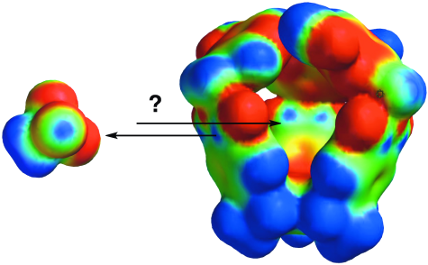
- the gates in the process of the in/out guest exchange necessitates additional scrutiny. In particular, a careful inspection of the additivity of free energies [21] pertaining to the constrictive ΔG‡in/out and intrinsic ΔG° binding energies of the guests [11] as well as the racemization of the basket
- racemization of basket 1 The aromatic gates in basket 1 interact through hydrogen bonding, as exemplified by a large downfield shift of the signal corresponding to (O=C)N−H protons (δ = 11.6 ppm at 298.0 K, Figure 2) [13]. In addition, the aromatic gates are dynamic, each one revolving about its axis to give
- rise to two enantiomeric conformers 1A and 1B (Figure 7A). The interconversion kinetics of the 1A/B racemization can be followed by dynamic NMR spectroscopy in which a singlet corresponding to Ha/Hb nuclei at high temperatures is seen to split into two doublets at low temperatures. In particular, the


Valence isomerization of cyclohepta-1,3,5-triene and its heteroelement analogues
Beilstein J. Org. Chem. 2011, 7, 1713–1721, doi:10.3762/bjoc.7.201
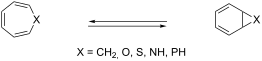
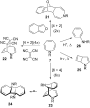
- almost similar boat puckering for all. From the racemization of substituted benzene oxides (Scheme 2), the oxepine ring inversion barrier was estimated at 6.5 kcal·mol−1 at 135 K [45][46], which is similar to the 3.5 kcal·mol−1 calculated for the parent oxepine (3) at the QCISD(T)/6-31G(d) level [40




Asymmetric synthesis of quaternary aryl amino acid derivatives via a three-component aryne coupling reaction
Beilstein J. Org. Chem. 2011, 7, 1570–1576, doi:10.3762/bjoc.7.185
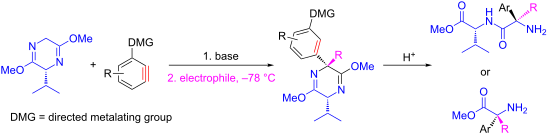
- . Hydrolysis of the sterically less hindered adducts gave the corresponding quaternary amino acids with no racemization, whereas hydrolytic ring opening gave the corresponding valine dipeptides from bulkier bislactims. Keywords: aryl amino acids; arynes; asymmetric; multicomponent; quaternary; Introduction




Synthesis of (−)-julocrotine and a diversity oriented Ugi-approach to analogues and probes
Beilstein J. Org. Chem. 2011, 7, 1504–1507, doi:10.3762/bjoc.7.175
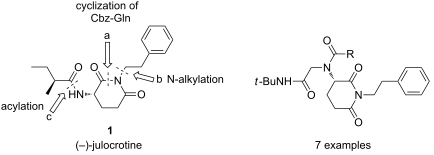
- % yield in optically pure form [16]. To alkylate the imide-moiety, glutarimide 3 was reacted with phenylethyl bromide in the presence of potassium carbonate at room temperature. The desired compound 4 was obtained in 98% isolated yield, but analysis revealed racemization. Indeed, the equilibration at the


Coupled chemo(enzymatic) reactions in continuous flow
Beilstein J. Org. Chem. 2011, 7, 1449–1467, doi:10.3762/bjoc.7.169
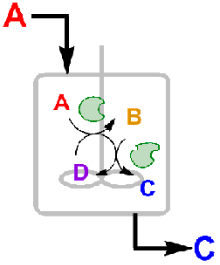
- immobilized Candida antarctica lipase B (Novozym 435) was used as a heterogeneous catalyst in the kinetic resolution of the alcohol 22 [30]. Racemization of the unreacted (S)-22 was achieved with acidic zeolite catalysts. Both heterogenous catalysts were coated with ionic liquids for improved stability of the