Search results
Search for "C–C-bond formation" in Full Text gives 153 result(s) in Beilstein Journal of Organic Chemistry.
Scope and limitations of a DMF bio-alternative within Sonogashira cross-coupling and Cacchi-type annulation
Beilstein J. Org. Chem. 2016, 12, 2005–2011, doi:10.3762/bjoc.12.187

- , Dorset, SP8 4XT, UK School of Science and Technology, University of New England, Armidale, Australia, 2351 10.3762/bjoc.12.187 Abstract Pd-catalysed C–C bond formation is an essential tool within the pharmaceutical and agrochemical industries. Many of these reactions rely heavily on polar aprotic
- tool for C–C bond formation in the pharmaceutical industry [4]. While the Sonogashira reaction can be effectively carried out in a variety of media [1][2], in the general sense this process clearly relies upon the use of dipolar aprotic solvents, in particular DMF. Indeed, some 41% of all Sonogashira
- fundamental reactions that typically employ DMF [31][32]. The replacement of solvents with regulatory issues with bio-derived alternatives has provided a series of advances within the cross-coupling arena [33], allowing efficient C–C bond formation via cornerstone Pd-based methods including Suzuki–Miyaura [34



Artificial Diels–Alderase based on the transmembrane protein FhuA
Beilstein J. Org. Chem. 2016, 12, 1314–1321, doi:10.3762/bjoc.12.124
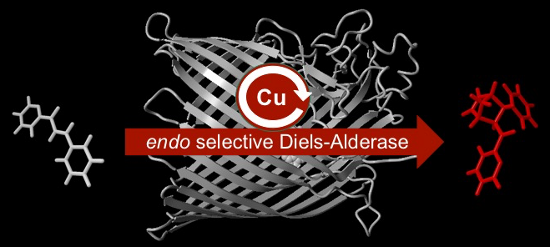
- reported. The Diels–Alder reaction is a powerful C–C bond formation reaction, widely used in organic chemistry, e.g., for the synthesis of natural products [28]. This reaction is known to be catalyzed by Lewis acids such as a Cu(II) complex [29]. Additionally, structurally defined catalysts are found to


Stereoselective synthesis of tricyclic compounds by intramolecular palladium-catalyzed addition of aryl iodides to carbonyl groups
Beilstein J. Org. Chem. 2016, 12, 1236–1242, doi:10.3762/bjoc.12.118
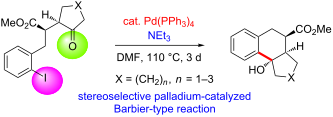
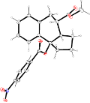
- proposed on the basis of DFT calculations by Solé and Fernández [24][25][26]. The intermediate arylpalladium species is certainly generated by the standard oxidative insertion of palladium(0) into the C–I bond of the aryl iodide moiety. After the C–C bond formation leading to the bi- or tricyclic products




Conjugate addition–enantioselective protonation reactions
Beilstein J. Org. Chem. 2016, 12, 1203–1228, doi:10.3762/bjoc.12.116
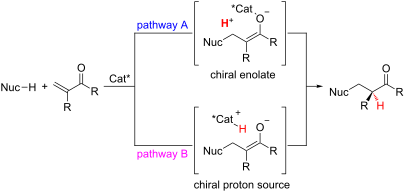
- the reaction, the iminium ions rapidly interconvert via single-bond rotation. After irreversible C–C bond formation the E-s-cis- and E-s-trans-iminiums give rise to the Z- and E-enamines, respectively, which undergo a directed enantiospecific protonation to give either the R- or S-product. Thus, the




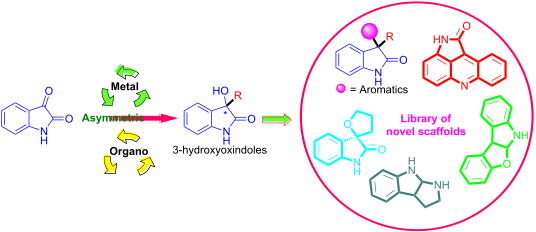
Catalytic asymmetric synthesis of biologically important 3-hydroxyoxindoles: an update
Beilstein J. Org. Chem. 2016, 12, 1000–1039, doi:10.3762/bjoc.12.98
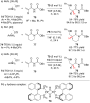
- of 10% of catalyst loading. Interestingly, the protocol employed gem-diols as equivalents of fluorinated aryl/alkyl methyl ketone enolates for the C–C bond formation accompanied the release of trifluoroacetate. This method showed a broad substrate scope including gem-diols with phenyl rings


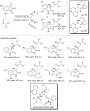


Copper-mediated arylation with arylboronic acids: Facile and modular synthesis of triarylmethanes
Beilstein J. Org. Chem. 2016, 12, 496–504, doi:10.3762/bjoc.12.49
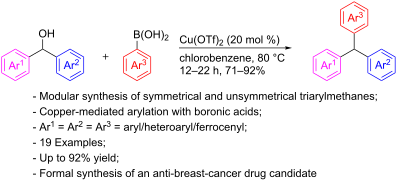
- . Recently, we reported a copper-catalyzed C–C bond formation by substitution of the labile C(4)SMe group in 4H-chromenes or C(3)–OH in isoindolinones with aryl/alkenyl groups by employing the corresponding boronic acids [51][52]. Continuing these efforts, we designed a copper-catalyzed synthesis of a
- PhCu(OTf) (15) and B(OH)2(OTf) [61]. The intermediate 15 then reacts with diphenylmethanol 9 to provide the intermediate 16. Formation of the intermediate 16 can be attributed to Lewis acidic characteristics of 15 and Lewis basic characteristics of diphenylmethanol (9a). The crucial C–C bond formation
- provide triarylmethanes. However, when we employed 2,6-dimethoxyphenylboronic acid 10l, surprisingly, we isolated the triarylmethane 11l, in which the C–C bond formation took place on the C(3) carbon of the 2,6-dimethoxyphenylboronic acid instead of the C(1) carbon, as illustrated in 11m (Scheme 4


Cascade alkylarylation of substituted N-allylbenzamides for the construction of dihydroisoquinolin-1(2H)-ones and isoquinoline-1,3(2H,4H)-diones
Beilstein J. Org. Chem. 2016, 12, 301–308, doi:10.3762/bjoc.12.32

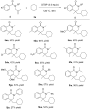
- -substituted heterocycles has been considered as an efficient organic synthetic strategy, which is often featured by a new ring and dual C–C bond formation in one process [35][36][37][38][39][40][41][42]. Recently, the group of Liu reported a cascade alkylarylation of N-alkyl-N-phenylacryamide with simple





N-Methylphthalimide-substituted benzimidazolium salts and PEPPSI Pd–NHC complexes: synthesis, characterization and catalytic activity in carbon–carbon bond-forming reactions
Beilstein J. Org. Chem. 2016, 12, 81–88, doi:10.3762/bjoc.12.9
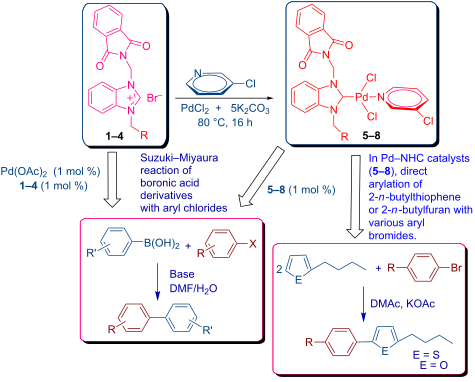
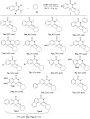
- arylation (for 5–8) reactions. As catalysts, they demonstrated a highly efficient route for the formation of asymmetric biaryl compounds even though they were used in very low loading. For example, all compounds displayed good catalytic activity for the C–C bond formation of 4-tert-butylphenylboronic acid
- used as a substrate with catalyst 6, sp2–sp2 C–C bond formation with 2-n-butylfuran was achieved with a yield of 49% in just 1 h (Table 1, entry 5). The product was obtained in a much lower yield when the same reaction was carried out with 5 as a catalyst. Compounds 7 and 8 as catalysts were displaying
- better results than complexes 5 and 6 for the same reaction (Table 1, entries 6 and 7). When we employed electron-neutral bromobenzene as a substrate instead of 4-bromoacetophenone, C–C bond formation (2-butyl-5-phenylthiophene) was achieved in 97% yield using catalyst 8 at 110 °C with a reaction time of


Recent advances in copper-catalyzed asymmetric coupling reactions
Beilstein J. Org. Chem. 2015, 11, 2600–2615, doi:10.3762/bjoc.11.280
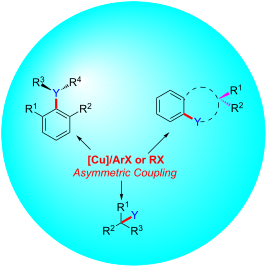
- different products: the SN2-product or the SN2’-product (Scheme 24). Usually, SN2’ regioselective allylic substitutions, which create a new stereogenic center, are more valuable. Methods that allow the SN2’ regioselective C–C bond formation have been extensively studied over the past years. In contrast to


Versatile synthesis and biological evaluation of novel 3’-fluorinated purine nucleosides
Beilstein J. Org. Chem. 2015, 11, 2509–2520, doi:10.3762/bjoc.11.272

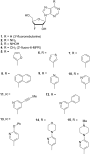
- ’-deoxy-3’-fluororibosides 16–20. Synthesis of 2-aminopurine 3’-deoxy-3’-fluororibosides 21–23. C–C bond formation by Stille and Suzuki cross-coupling. Antitumor activity of newly synthesized compounds. Supporting Information Supporting Information File 444: Experimental procedures, characterization data



Copper-catalyzed arylation of alkyl halides with arylaluminum reagents
Beilstein J. Org. Chem. 2015, 11, 2400–2407, doi:10.3762/bjoc.11.261
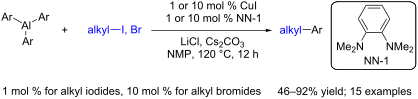
- excellent yields. Keywords: alkylation; arylalkanes; copper; cross-coupling; organoaluminum; Introduction Cross-coupling reactions represent one of the most important transformation for carbon–carbon (C–C) bond formation in organic synthesis [1][2][3][4][5][6][7][8][9]. These reactions, typically


Ruthenium indenylidene “1st generation” olefin metathesis catalysts containing triisopropyl phosphite
Beilstein J. Org. Chem. 2015, 11, 1520–1527, doi:10.3762/bjoc.11.166
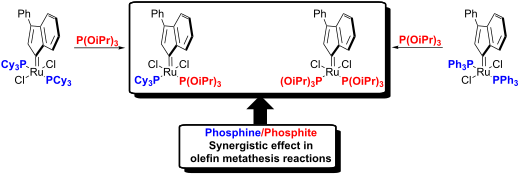
- -type ligands. Keywords: 1st generation; indenylidene; metathesis; phosphite; ruthenium; Introduction The olefin metathesis reaction is a powerful tool for C–C bond formation in the synthesis of highly valuable organic compounds [1][2][3][4]. Protocols involving W-, Mo- and Ru-based pre-catalysts can


Cathodic hydrodimerization of nitroolefins
Beilstein J. Org. Chem. 2015, 11, 1163–1174, doi:10.3762/bjoc.11.131
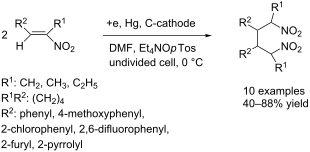
- the easy access to nitroolefins in large variety, the C–C bond formation with the introduction of two nitro groups in a 1,4-distance and the conversions of the nitro group by reduction to oximes and amines, the conversion into aldehydes and ketones via the Nef reaction and base catalyzed condensations
- C–C bond formation can lead to α,α-, α,β- and ß,ß-coupled products. The 1H NMR spectra and MS data support in all cases a ß,ß-coupling. A α,β- or a α,α-coupling would lead to the occurrence of methyl singlets or non-coupled benzylic protons. Such signals were not observed in the spectra of the
- hydrodimers. The stereochemistry of the hydrodimer results from a β,ß-C–C bond formation and from a α,δ-diprotonation, which creates a dimer with four stereocenters with the exception of dimer 3, which has only two stereocenters. This means 23 diastereomers can be formed, which are decreased to six


Multivalent polyglycerol supported imidazolidin-4-one organocatalysts for enantioselective Friedel–Crafts alkylations
Beilstein J. Org. Chem. 2015, 11, 730–738, doi:10.3762/bjoc.11.83
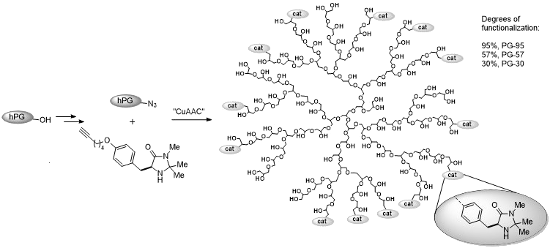
- organocatalysis has allowed for selective C–C bond formation by using small organic molecules [25][26][27][28][29][30][31]. In contrast to metal complexes, chiral or achiral organocatalysts are easily attached on supports. They do not suffer from metal leaching and they can be reused more readily [32][33][34][35


Novel biphenyl-substituted 1,2,4-oxadiazole ferroelectric liquid crystals: synthesis and characterization
Beilstein J. Org. Chem. 2015, 11, 233–241, doi:10.3762/bjoc.11.26
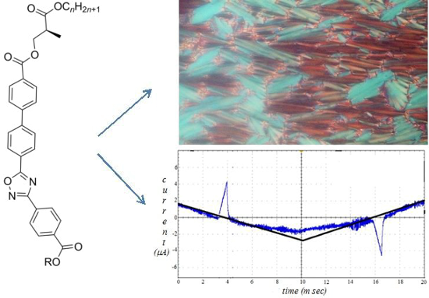
- 5a is borylated under Miyaura coupling conditions [31][32][33][34] with bis(pinacolato)diborane (pin2b2) to give benzyl 4-(5-(4-(4,4,5,5-tetramethyl-1,3,2-dioxaborolan-2-yl)phenyl)-1,2,4-oxadiazol-3-yl)benzoate (6a), which facilitated the C–C bond formation of a biphenyl group. The same methodology

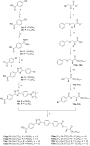


Sequential decarboxylative azide–alkyne cycloaddition and dehydrogenative coupling reactions: one-pot synthesis of polycyclic fused triazoles
Beilstein J. Org. Chem. 2014, 10, 3031–3037, doi:10.3762/bjoc.10.321
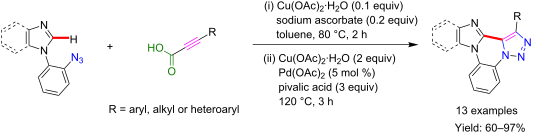
- several advantages over the classical C–C bond formation method including the stability and preparation of the starting material and the non-hazardous byproducts. In 2011, Kolarovič et al. [6] first reported the copper-catalyzed decarboxylative [3 + 2] cycloaddition reaction of 2-alkynoic acid with


Recent advances in the electrochemical construction of heterocycles
Beilstein J. Org. Chem. 2014, 10, 2858–2873, doi:10.3762/bjoc.10.303
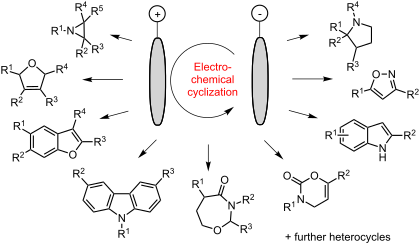
- method for the synthesis of oxindoles and 3-oxotetrahydroisoquinolines 47 via intramolecular cyclization under C–C-bond formation was reported by Atobe, Fuchigami et al. (Scheme 18) [63]. The protocol is based on the anodic oxidation of α-(phenylthio)acetamides 46 in the presence of Et3N∙3HF. The latter
- °C with olefins bearing a nucleophilic group (Scheme 27) [76]. The cyclization is initiated by nucleophilic attack of the alkene on the acyl iminium species under C,C-bond formation. The resulting cationic intermediate is then trapped by the tethered nucleophile in an exo cyclization step under




A novel 4-aminoantipyrine-Pd(II) complex catalyzes Suzuki–Miyaura cross-coupling reactions of aryl halides
Beilstein J. Org. Chem. 2014, 10, 2821–2826, doi:10.3762/bjoc.10.299

- complexes of 4-AAP have shown anti-inflammatory, analgesic, antiviral, antipyretic, antirheumatic and antimicrobial activity [20][21]. Despite the potential biological importance of 4-AAP, the catalytic activity of its transition metal complexes for C–C bond formation have not yet been investigated. Herein


Electrocarboxylation: towards sustainable and efficient synthesis of valuable carboxylic acids
Beilstein J. Org. Chem. 2014, 10, 2484–2500, doi:10.3762/bjoc.10.260
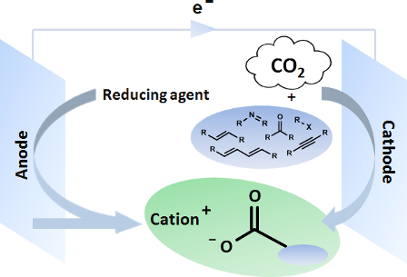
- electrons per CO2 molecule, as shown in Scheme 3 for olefins, with the C–C bond formation highlighted in bold. Industrial organic electrosynthesis The chemical industry is devoting increasing research efforts to the field of organic electrosynthesis [31]. An extended series of electro-organic processes have


Exploration of C–H and N–H-bond functionalization towards 1-(1,2-diarylindol-3-yl)tetrahydroisoquinolines
Beilstein J. Org. Chem. 2014, 10, 2186–2199, doi:10.3762/bjoc.10.226

- salt [11]. This synthesis has been streamlined by cross dehydrogenative coupling (CDC) – a powerful method for C–C-bond formation via the C–H bonds of a pro-nucleophile and a pro-electrophile [12][13][14]. A landmark contribution published by Li and co-workers reported the successful introduction of


Palladium-catalysed cross-coupling reaction of ultra-stabilised 2-aryl-1,3-dihydro-1H-benzo[d]1,3,2-diazaborole compounds with aryl bromides: A direct protocol for the preparation of unsymmetrical biaryls
Beilstein J. Org. Chem. 2014, 10, 1107–1113, doi:10.3762/bjoc.10.109

- moisture, their ease with which they are accessible and their non-toxicity, these compounds have, to the best of our knowledge, never been used in any transition metal-catalysed C–C bond formation reaction as coupling partners except for their 2-alkyl/alkenyl-substituted analogues [14]. We are aware of


Aza-Diels–Alder reaction between N-aryl-1-oxo-1H-isoindolium ions and tert-enamides: Steric effects on reaction outcome
Beilstein J. Org. Chem. 2014, 10, 848–857, doi:10.3762/bjoc.10.81
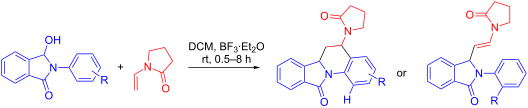
- ]. The reaction of 2-chloroquinoline with 2-formylphenylboronic acid yielded tetracyclic isoindoloquinoline using Suzuki cross-coupling conditions where the C–C bond formation is followed by nucleophilic attack of the pyridine lone pair on the neighbouring aldehyde and proton migration [21]. Several
- can be explained based on steric and electronic factors. In the case derived from 3-chloro-4-fluoroaniline, the C–C bond formation occurred at position 6 of the aromatic ring as it was sterically favoured. In case of the 2-naphthylamine derivative, position 1 of the naphthalene ring is known to be


Direct and indirect single electron transfer (SET)-photochemical approaches for the preparation of novel phthalimide and naphthalimide-based lariat-type crown ethers
Beilstein J. Org. Chem. 2014, 10, 514–527, doi:10.3762/bjoc.10.47

- reactions, including C–C bond formation and addition to unsaturated centers. Because of their importance, α-heterolytic fragmentation reactions of radical anions and cations have been intensively studied from synthetic and mechanistic perspectives [11][12][13][14][15][16][17][18][19][20][21][22][23][24][25
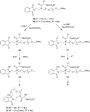
- -peptides via the intermediacy of interconverting zwitterionic biradicals 21 and 22. The biradicals 24 generated by silyl transfer from the zwitterionic biradicals undergo C–C bond formation to form macrocyclic products 23 (Scheme 5). In addition, these studies have shown that the length and nature of the
- , each as a mixture of diastereomers. In these processes, SET from the terminal α-silyl ether donor sites to the excited phthlaimide chromophores produces zwitterionic biradicals 50, which then undergo methanol-assisted desilylation to form biradicals 52, whose cyclization by C–C bond formation produced




Aminofluorination of 2-alkynylanilines: a Au-catalyzed entry to fluorinated indoles
Beilstein J. Org. Chem. 2014, 10, 449–458, doi:10.3762/bjoc.10.42
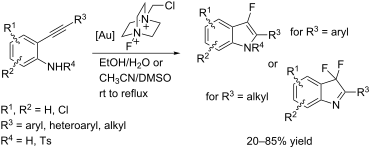
- [39]. When the same reaction was performed in the presence of [bis(trifluoromethanesulfonyl)imidate](triphenylphosphine)gold(I) catalyst [40] (5 mol %), the formation of the difluorinated 3H-indole 2a was observed although in low overall yield (Table 1, entry 2). No traces of C–C bond formation, a


Recent applications of the divinylcyclopropane–cycloheptadiene rearrangement in organic synthesis
Beilstein J. Org. Chem. 2014, 10, 163–193, doi:10.3762/bjoc.10.14
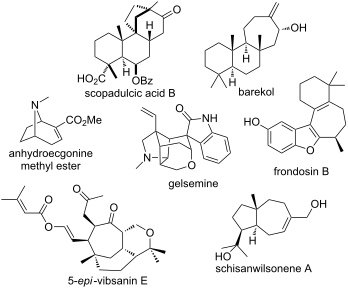
- cyclohepta[cd]oxindole core 32 proved the synthetic versatility of a [3,3]-sigmatropic rearrangement for direct C–C-bond formation at the C4 position of the indole nucleus, and thus provides experimental evidence for the biosynthetic proposal. Applications to natural product synthesis Fatty acid metabolites