Search results
Search for "SN2'" in Full Text gives 211 result(s) in Beilstein Journal of Organic Chemistry. Showing first 200.
β-Hydroxy sulfides and their syntheses
Beilstein J. Org. Chem. 2018, 14, 1668–1692, doi:10.3762/bjoc.14.143
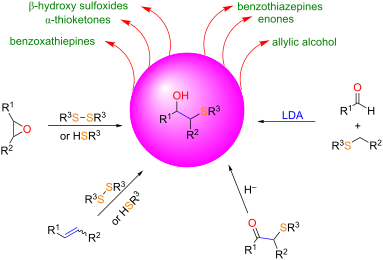
- ][83]. A single coupling product was obtained from the reaction of N-(trifluoroacetyl)glutathione dimethyl ester and triethylamine in methanol at 23 °C for 4 h in 80% yield, which occurred via SN2 displacement by nucleophilic sulfur at C-6. Selective hydrolysis of the trifluoroacetyl triester in a


Anomeric modification of carbohydrates using the Mitsunobu reaction
Beilstein J. Org. Chem. 2018, 14, 1619–1636, doi:10.3762/bjoc.14.138
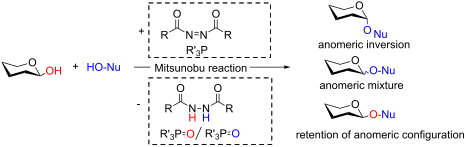
- ][12]. The standard Mitsunobu reaction involves coupling of an alcohol and a nucleophile in a dehydrative SN2 process activated by a reactive combination of a triaryl- or trialkylphosphine as reducing agent and a dialkyl azodicarboxylate as oxidant. In a redox process, the phosphine species is oxidized
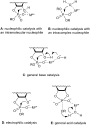
- anomerically modified carbohydrate with inversion of configuration at the anomeric center, according to a SN2 mechanism. Pathway A can also proceed through a SN1 mechanism when the intermediate glycosyloxyphosphonium ion is less stable. Then, it can decompose into the corresponding anomeric oxocarbenium ion
- -configured glycosyloxyphosphonium ions, which are in turn displaced by the nucleophile in the expected SN2 fashion, resulting in a respective anomeric mixture of products (cf. Scheme 2). In contrast to this, the yields of the obtained aryl sialosides strongly correlated with the pKa of the utilized phenols


Glycosylation reactions mediated by hypervalent iodine: application to the synthesis of nucleosides and carbohydrates
Beilstein J. Org. Chem. 2018, 14, 1595–1618, doi:10.3762/bjoc.14.137
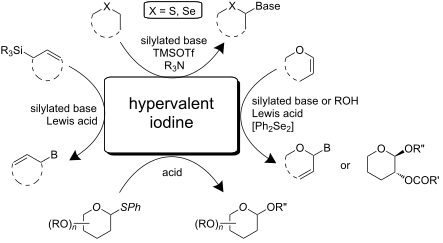
- -thiosugar derivatives. We thus developed the first synthetic route accessing the 4-thiosugar derivative by way of bicyclic intermediate 8 from diacetoneglucose (5). Construction of the bicyclic ring of 8 was achieved by consecutive inter-/intramolecular SN2 reactions of the dimesylate derivative 7 obtained
- by intramolecular SN2 reaction at the 5-position by sulfur atom. Secondary, ring contraction from thiopyranose to thiofuranose occurred to produce 5-aldehyde 26. Finally, hydride reduction of 26 gave the 4-thiofuranose derivative 27. The Pummerer-type glycosylation reaction of 5-O-silylated sulfoxide
- reacted with a nucleobase, giving a mixture of α- and β-anomers since the reaction might occur by the simple SN2 reaction. Thus, the reaction proceeded through both paths a and b in method A, but path a was predominant in the reaction of method B [45] (Figure 3). Nishizono et al. applied the hypervalent


Cross-coupling of dissimilar ketone enolates via enolonium species to afford non-symmetrical 1,4-diketones
Beilstein J. Org. Chem. 2018, 14, 992–997, doi:10.3762/bjoc.14.84
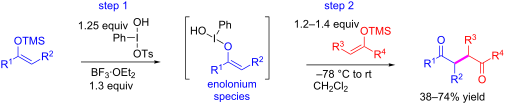
- -membered heterocycles such as thiophenes, furans, and pyrroles. Consequently, numerous multistep approaches to unsymmetrical 1,4-dicarbonyl compounds involving, e.g., SN2-type displacements [1] or highly functionalized substrates such as β-ketoesters [2][3] or β-ketosulfones [4] have been developed



Phosphodiester models for cleavage of nucleic acids
Beilstein J. Org. Chem. 2018, 14, 803–837, doi:10.3762/bjoc.14.68
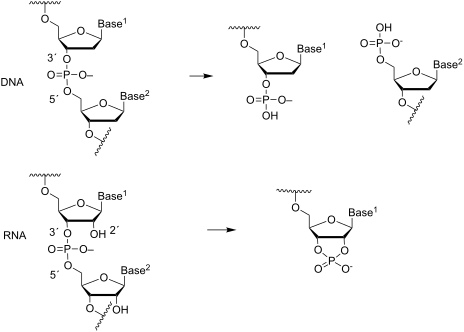
- proceeds via a pentacoordinated species having the structure of a trigonal bipyramid. In case this species represents an energy maximum on a single barrier energy profile, as with SN2 displacement at carbon, the reaction is called concerted and the pentacoordinated species is a transition state. The



Enantioselective dioxytosylation of styrenes using lactate-based chiral hypervalent iodine(III)
Beilstein J. Org. Chem. 2018, 14, 659–663, doi:10.3762/bjoc.14.53
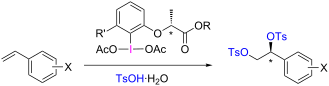
- proceed via an SN2 reaction of a cyclic intermediate such as I1, judging from the syn selectivity of the dioxytosylation [52][53]. The attack of the tosylate ion on I1 possibly takes place at the benzylic position or at the methylene carbon atom. The positive charge of I1 may be stabilized by the aryl
- styrene with 4a–e preferentially gave (S)-3, which forms via an electrophilic addition of the iodane toward the Si face of styrene, followed by an SN2 reaction with the tosylate ion. If an SN1 mechanism were involved in the oxytosylation of I1, the enantiomeric ratio of 3 would decrease owing to the
- planar structure of the benzylic cation. Thus, the tosylate ion may act as an effective nucleophile for the SN2 reaction of I1. The stereoface-differentiation in the dioxytosylation reaction using the lactate-derived aryl-λ3-iodanes is similar to that in preceding reactions [14], which include the


Synthesis of a sucrose-based macrocycle with unsymmetrical monosaccharides "arms"
Beilstein J. Org. Chem. 2018, 14, 634–641, doi:10.3762/bjoc.14.50

- alternative way to the desired amine 12a, based on the SN2 reaction of the activated alcohol 13 [34][35] with benzylamine, also failed (Scheme 2). The Mitsunobu approach to convert the hydroxy group into an amine function was also unsuccessful. Although 13 reacted with phthalimide gave the desired product 13a


High-yielding continuous-flow synthesis of antimalarial drug hydroxychloroquine
Beilstein J. Org. Chem. 2018, 14, 583–592, doi:10.3762/bjoc.14.45
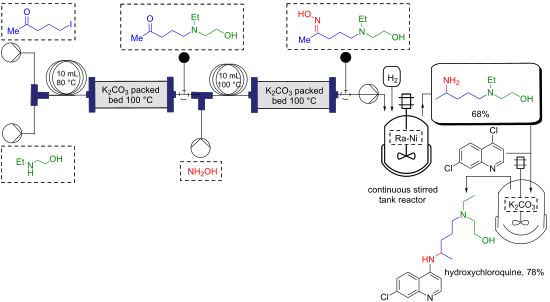
- significant opportunity for optimization. While the recent improved route (Scheme 1b) by Li and co-workers [21] eliminates the protection–deprotection steps, its use of a complex multi-transition-metal-catalyst system to achieve direct SN2 substitution of the chlorine on 3 by amine 7, is sub-optimal [22][23


Stereochemical outcomes of C–F activation reactions of benzyl fluoride
Beilstein J. Org. Chem. 2018, 14, 106–113, doi:10.3762/bjoc.14.6
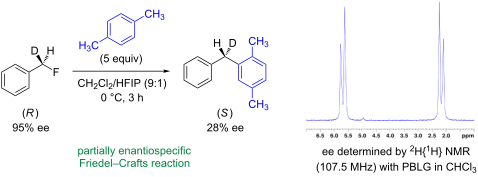
- an enantiopure isotopomer of benzyl fluoride to identify whether the reaction conditions favour a dissociative (SN1) or associative (SN2) pathway. [2H]-Isotopomer ratios in the reactions were assayed using the Courtieu 2H NMR method in a chiral liquid crystal (poly-γ-benzyl-L-glutamate) matrix and
- substantial F···HOR hydrogen bond interactions, rather than through electrostatic stabilisation only [3]. This stabilisation was suggested to lead to a purely associative bimolecular (SN2) mechanism. The authors also studied the C–F activated Friedel–Crafts reactions [6][7] using very strong hydrogen bond
- benzylic carbocation and a formal equivalent of HF (which behaves in an autocatalytic manner as a stronger hydrogen bond donor than HFIP or TFA). Overall, there are three possible mechanistic pathways that these C–F activation reactions could follow: SN1, SN2, and a mixed SN1/SN2 pathway. Typically


Conformational preferences of α-fluoroketones may influence their reactivity
Beilstein J. Org. Chem. 2017, 13, 2915–2921, doi:10.3762/bjoc.13.284
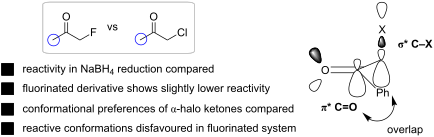
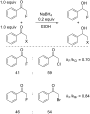
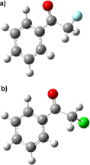
- ; Introduction α-Halogenated ketones are widely used electrophiles in organic synthesis, being highly reactive in both nucleophilic addition to the carbonyl group and in SN2 nucleophilic displacements [1]. Our research group has recently been exploring the synthesis and reactivity of α-fluorinated ketones [2][3
- electrophiles available to synthetic chemists for SN2 substitution [5]. The orbital overlap in α-halogenated ketones also provides activation to the carbonyl group, making it more reactive towards nucleophilic addition than non-halogenated carbonyl compounds [6]. However, relatively little work has been





Acid-catalyzed ring-opening reactions of a cyclopropanated 3-aza-2-oxabicyclo[2.2.1]hept-5-ene with alcohols
Beilstein J. Org. Chem. 2017, 13, 2888–2894, doi:10.3762/bjoc.13.281
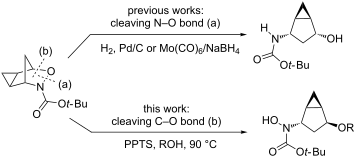
- reactions. The scope of the reaction was successfully expanded to include primary, secondary, and tertiary alcohol nucleophiles. Through X-ray crystallography, the stereochemistry of the product was determined which confirmed an SN2-like mechanism to form the ring-opened product. Keywords: acid catalysis
- compound 19 for the cleavage of the C–O bond (b) (Scheme 4). We initially anticipated that the SN2’ type ring-opening would occur which would lead to the formation of ring-opened product 27 (Scheme 5). However, in all cases tested, only the SN2 type ring-opened product 26 was formed. Results and Discussion
- cleavage of the C–O bond as seen in path A, the free carbocation 28 would form in an SN1-like manner. The nucleophile could therefore attack from either the top or the bottom, forming products 26a and 29. Alternatively, in path B the oxygen atom could be protonated and undergo an SN2-like mechanism with


Recent progress in the racemic and enantioselective synthesis of monofluoroalkene-based dipeptide isosteres
Beilstein J. Org. Chem. 2017, 13, 2637–2658, doi:10.3762/bjoc.13.262
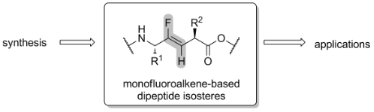
- =CH]-Gly isosteres, a SN2’ reaction upon 3,3-difluoropropene substrates can be used, as shown by Taguchi’s group. The synthesis of monofluoroalkenes starting from 3,3-difluoropropenes and using trialkylaluminium reagents was developed. Using this methodology, they were able to prepare Boc-Nva-ψ[CF=CH
- ]-Gly isostere [26] via a SN2’ reaction (Scheme 3). The defluorinative allylic alkylation of terminal 3,3-difluoropropene 10 with triethylaluminium selectively provided the corresponding (Z)-monofluoroalkene 11. In this case, the use of Et3Al allowed access to a norvaline (Nva) isostere. Then, alcohol
- reacted easily in a SN2 reaction to give a more functionalized molecule. For example, treatment of the chlorinated monofluoroalkene with NaN3 provided the corresponding N3-containing monofluoroalkene. The azide group underwent a 1,3-dipolar cycloaddition to give a 1,2,3-triazole, which is also a peptide


Phosphonic acid: preparation and applications
Beilstein J. Org. Chem. 2017, 13, 2186–2213, doi:10.3762/bjoc.13.219
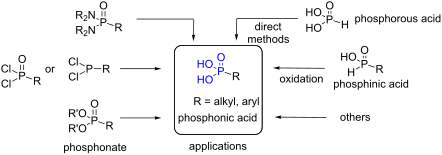
- could consist in a nucleophilic substitution (SN2) involving chloride ions as nucleophilic species to produce the intermediate II. Then, a repetition of this mechanism yields phosphonic acid. The preponderant route is likely governed by the stability of the carbocation and the steric hindrance around
- avoid side reactions (from SN1 or SN2 mechanism) [204] that can involve the functional groups present in the amino acid or peptide. These conditions were applied to prepare the compound 82 from 81 [205][206] (Figure 24). 4. From dichlorophosphine (R–PCl2) or dichlorophosphine oxide (R–P=OCl2) Aryl- and


Enzymatic synthesis of glycosides: from natural O- and N-glycosides to rare C- and S-glycosides
Beilstein J. Org. Chem. 2017, 13, 1857–1865, doi:10.3762/bjoc.13.180
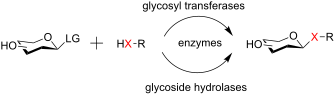
- sugar during GT-catalysed reactions, GTs are also classified as inverting or retaining (Figure 1). Inverting GTs operate via a SN2 mechanism in a single displacement step where an acid/base residue enhances the nucleophilicity of the acceptor, via an oxocarbenium-like transition state. Unlike inverting
- GTs, there is much controversy of the molecular mechanism of retaining GTs [13][14][15]. Retention of the anomeric carbon stereochemistry can occur either following a two-step displacement SN2 type mechanism (as in retaining GH), or via a “SNi-like” mechanism, that involves a front-side single
- nucleophilic attack of the acceptor, however, little information is known on the pathways involved in these reactions (SN2 or SNi-like), because of the few examples of such enzymes characterization in literature, when compared to canonical O- and N-GTs. S-Glycosyltransferases Few examples of natural S




Chiral phase-transfer catalysis in the asymmetric α-heterofunctionalization of prochiral nucleophiles
Beilstein J. Org. Chem. 2017, 13, 1753–1769, doi:10.3762/bjoc.13.170
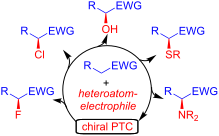
- for further functionalizations by stereospecific nucleophilic SN2-type displacement reactions with different nucleophiles [66][85][86][87]. Accordingly, it comes as no surprise that their asymmetric synthesis has been intensively investigated in the past, either relying on asymmetric (transition


Mechanochemical N-alkylation of imides
Beilstein J. Org. Chem. 2017, 13, 1745–1752, doi:10.3762/bjoc.13.169
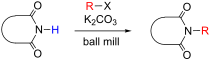
- a precedence in the application of weaker base in mechanochemical synthesis of triphenylphosphoranes [32]. Often DMF is used as solvent in imide alkylation reactions, which promotes SN2 reactions [33] and its low volatility is advantageous over more environmentally friendly solvents which might be
- . Computational section To elucidate reasons for the observed regioselectivities, the reactions of uracil and 7,8-dimethylalloxazine with benzylamine and ethyl bromide were studied by DFT calculations using the B3LYP/6-311+G**//B3LYP/6-31G*+ZPVE method. The transition-state calculations of the SN2 reaction of


Synthesis and metal binding properties of N-alkylcarboxyspiropyrans
Beilstein J. Org. Chem. 2017, 13, 1542–1550, doi:10.3762/bjoc.13.154
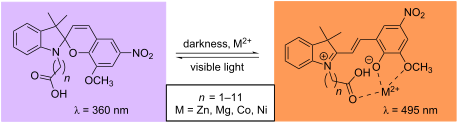
- mL) or the absence of polar aprotic solvent-mediated acceleration of this SN2 process (Table 1, compare entries 6, 7 and 8). The relative instability of indolium salts is well-documented [26] and our attempts to purify compounds 3 by silica gel chromatography or recrystallisation were unsuccessful
- -bromocarbonyls such as bromoacetic acid are excellent SN2 electrophiles, and N-alkylation of 2,3,3-trimethylindolenine (1) with bromoacetic acid (2a) was successful, if somewhat sluggish, at room temperature. Reaction of the crude indolium salt 3a with 3-methoxy-5-nitrosalicylaldehyde (5) was also conducted at




Strategies toward protecting group-free glycosylation through selective activation of the anomeric center
Beilstein J. Org. Chem. 2017, 13, 1239–1279, doi:10.3762/bjoc.13.123

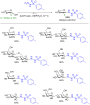
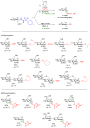
- glycosylated with the opposite stereochemistry at the anomeric position to the donor in an SN2-like mechanism that is reasonably well understood. Retaining GTs provide glycosides with the same stereochemistry at the anomeric position as the donor. However, the mechanism(s) is less well understood and is still
- group contains two heteroatoms, X and Y that can be activated at the remote atom (Y) by an electrophilic species (H of an alcohol) or a metal cation resulting in a reactive intermediate. This complex could then undergo an SN2-like attack of a hydroxy group to furnish the glycoside with inversion of
- SN2-like reaction (Scheme 9). The most unfortunate drawbacks of the procedure include the need for a large excess of the alcohol acceptor and the multistep synthesis of the galactosyl donor. The synthesis of the monoprotected activated galactosyl donor requires the use of protecting groups, however




Substitution of fluorine in M[C6F5BF3] with organolithium compounds: distinctions between O- and N-nucleophiles
Beilstein J. Org. Chem. 2017, 13, 703–713, doi:10.3762/bjoc.13.69

- elimination of LiF. In contrary, the cation–anion bonds in O-nucleophiles and in N-nucleophiles are ionic (M = K, Na) and the fluoride affinities of K+ and Na+ are smaller than that of Li+. These factors determine the reaction route with K[C6F5BF3] by a simple SN2 mechanism. Preparation of


Fluorescent carbon dots from mono- and polysaccharides: synthesis, properties and applications
Beilstein J. Org. Chem. 2017, 13, 675–693, doi:10.3762/bjoc.13.67
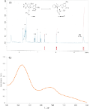
- , each CD sample was exposed to the same concentration (0.001 M) of divalent metal cations Cu2+, Cd2+, Sn2+ or Zn2+ in solution and the fluorescence response monitored. The starch-based S-CDs showed an interesting PL response, whereas the fluorescence output increased when in solution with all metal ions


The reductive decyanation reaction: an overview and recent developments
Beilstein J. Org. Chem. 2017, 13, 267–284, doi:10.3762/bjoc.13.30
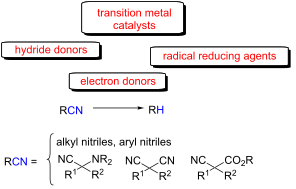
- substituted carbocycles [119][120]. An example in described in Scheme 22. The 5-membered ring is formed via a K2CO3 mediated SN2 – conjugate addition sequence between malononitrile and 6-bromo-2-hexenoate derivatives 67a,b. Dicyanocyclopentanes 68a,b are treated with tributyltin hydride/AIBN giving the


Nucleophilic displacement reactions of 5′-derivatised nucleosides in a vibration ball mill
Beilstein J. Org. Chem. 2017, 13, 87–92, doi:10.3762/bjoc.13.11
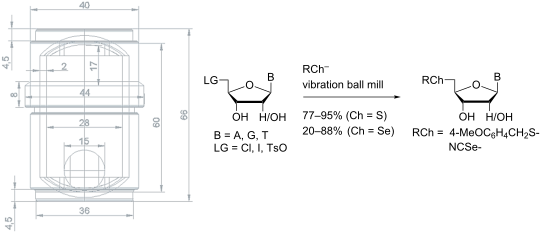
- conditions) [16]. Following Sikchi and Hultin’s original description of nucleoside derivatisation in a low-energy, planetary ball mill [17], commercial, higher energy vibration mills have been used to facilitate established [18][19][20][21] and unprecedented [22] nucleoside transformations. Remarkably, SN2


First DMAP-mediated direct conversion of Morita–Baylis–Hillman alcohols into γ-ketoallylphosphonates: Synthesis of γ-aminoallylphosphonates
Beilstein J. Org. Chem. 2016, 12, 2906–2915, doi:10.3762/bjoc.12.290

- corresponding SN2-type products 6a–d in 63 to 70% isolated yields. Alternatively, the alcohol 5 produced the corresponding acetate 7 which, mediated by Ce(III), was successfully converted into the corresponding γ-aminoallylphosphonates 8a–d. Keywords: allylic substitution; γ-aminoallylphosphonate; Arbuzov
- phosphites gave the corresponding phosphonates 4b and 4c in 60–62% yields. The reaction of secondary alcohols 3b and 3c with trialkyl phosphites was also surveyed. Under the previous reaction conditions (solvent-free, 80 °C, without any additive) an SN2’-type reaction followed by an Arbuzov rearrangement


Superelectrophilic activation of 5-hydroxymethylfurfural and 2,5-diformylfuran: organic synthesis based on biomass-derived products
Beilstein J. Org. Chem. 2016, 12, 2125–2135, doi:10.3762/bjoc.12.202
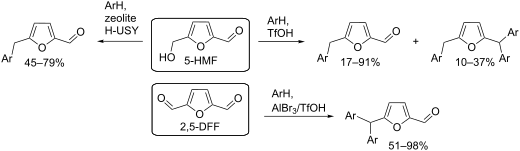
- (Table 2), this reaction, most probably, proceeds through an SN2 pathway, where “pure” heteroaromatic cation B is not formed. At least the reaction may go through late transition state, in which the C–O bond in the CH2O+H2 group is rather elongated, resulting in a larger positive charge on this carbon


Synthesis of the C8’-epimeric thymine pyranosyl amino acid core of amipurimycin
Beilstein J. Org. Chem. 2016, 12, 1765–1771, doi:10.3762/bjoc.12.165
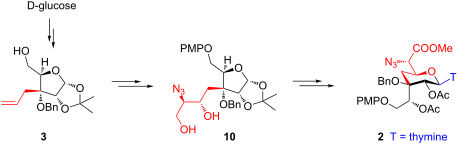
- orientation indicating 5’S absolute configuration as anticipated from the SAE mnemonic in compound 8. As the C5’ and C6’ stereocenters in 14 are derived from the regioselective SN2 opening of epoxide 8 by NaN3, the configuration at the C6’ (carrying azido group) was therefore assigned as 6’R. In the 1H NMR