


Search results
Search for "aldol reaction" in Full Text gives 138 result(s) in Beilstein Journal of Organic Chemistry.
Thiazole formation through a modified Gewald reaction
Beilstein J. Org. Chem. 2015, 11, 875–883, doi:10.3762/bjoc.11.98

- the more stable (electron withdrawing group) anion enable a retro-aldol reaction following. Substituted malonitriles are also tolerated forming the corresponding cyanothiazole in good yield, with no indication of the dithiazole product observed (entry 8, Table 4). Benzyl groups are also tolerated


Diastereoselective and enantioselective conjugate addition reactions utilizing α,β-unsaturated amides and lactams
Beilstein J. Org. Chem. 2015, 11, 530–562, doi:10.3762/bjoc.11.60

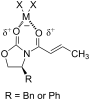
- , enantioselective tandem conjugate addition–aldol reaction of cyclic enones [19]. While tandem conjugate addition–α-functionalization reactions were well known prior to Feringa’s publication [20] (Scheme 1), this work was unique because of the high enantioselectivity that was observed through the use of a chiral




Copper-catalyzed cascade reactions of α,β-unsaturated esters with keto esters
Beilstein J. Org. Chem. 2015, 11, 213–218, doi:10.3762/bjoc.11.23

- conjugate reduction of the α,β-unsaturated diester with newly generated copper hydride, followed by aldol reaction to yield the key intermediate alkoxide A, which is subjected to further lactonization to form the lactone. Lam’s group has furnished a cobalt-catalyzed conjugate reductive aldolization
- of γ-carboxy-γ-lactones via a copper-catalyzed cascade reaction. Considering that the reported conjugate addition–aldolization–lactonization cascade reactions proceed via the key intermediate A in Figure 1, we envisioned that the conjugate reduction of a methacrylate and the following aldol reaction


(2R,1'S,2'R)- and (2S,1'S,2'R)-3-[2-Mono(di,tri)fluoromethylcyclopropyl]alanines and their incorporation into hormaomycin analogues
Beilstein J. Org. Chem. 2014, 10, 2844–2857, doi:10.3762/bjoc.10.302

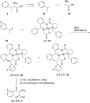
- by experimental tests [36]. The initially formed main product (R,R,R)-28 in the aldol reaction of acetaldehyde with 10 had the same configuration at C-2 as the proline unit in 10. The absolute configuration of this nickel(II) complex was determined by a single crystal X-ray structure analysis (see
- product 28 can coordinate the Ni atom liberating the carboxylate moiety and thus making the proton at C-2 accessible to base attack (Scheme 4). In order to obtain (R)-allo-threonine (4), it is necessary to carry out the aldol reaction of (R)-10 with an excess of acetaldehyde under strongly basic




Total synthesis of the proposed structure of astakolactin
Beilstein J. Org. Chem. 2014, 10, 2421–2427, doi:10.3762/bjoc.10.252

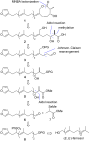
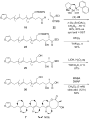
- sesterterpene metabolite isolated from the marine sponge Cacospongia scalaris, has been achieved, mainly featuring Johnson–Claisen rearrangement, asymmetric Mukaiyama aldol reaction and MNBA-mediated lactonization. Keywords: aldol reaction; astakolactin; lactonization; MNBA; terpenoids; Introduction
- constructed via an aldol reaction with ethyl acetate, followed by anti-selective methylation [32][33]. The trisubstituted alkene moiety of the prenyl chain of 3 could be stereoselectively constructed via a Johnson orthoester–Claisen rearrangement of 4 [34][35][36], which would be generated from compound 5
- . The construction of the α-methylene-β-hydroxy ester moiety in 5, which is commonly known as a Morita–Baylis–Hillman adduct, would be achieved via an aldol reaction between aldehyde 6 and ester 7, followed by oxidative deselenization [37]. The linear precursor 8 would be prepared from (E,E)-farnesol






A new charge-tagged proline-based organocatalyst for mechanistic studies using electrospray mass spectrometry
Beilstein J. Org. Chem. 2014, 10, 2027–2037, doi:10.3762/bjoc.10.211
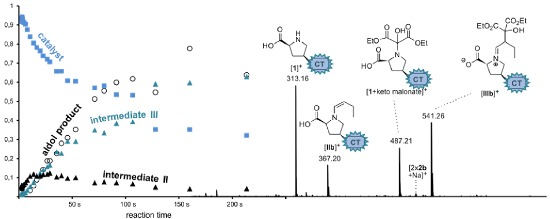
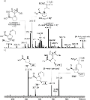
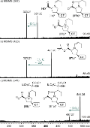
- charged proline catalyst has been tested in the direct asymmetric inverse aldol reaction between aldehydes and diethyl ketomalonate. Two intermediates in accordance with the List–Houk mechanism for enamine catalysis have been detected and characterized by gas-phase fragmentation. In addition, their
- of organic reactions, such as the direct asymmetric aldol reaction, one of the most important C–C bond-forming reactions in organic synthesis [51]. The currently accepted mechanism suggests a central enamine intermediate which forms a Zimmerman–Traxler-like transition state with the acceptor
- center by a rigid phenyl linker (Figure 1). We then tested the applicability of 1 for ESIMS mechanistic studies on the first “inverse” crossed aldol reaction (Scheme 1) published in 2002 by Jørgensen and coworkers [54] in which the aldehyde acts as the donor in contrast to the “normal” crossed aldol



Five-membered ring annelation in [2.2]paracyclophanes by aldol condensation
Beilstein J. Org. Chem. 2014, 10, 2021–2026, doi:10.3762/bjoc.10.210
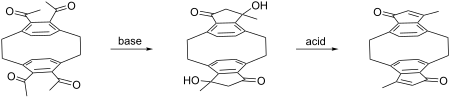
- -tetraene (6), passing through the p-xylylene intermediate 8 en route [7]. We were, furthermore, interested in studying the aldol reaction of 9, since this process should pose several stereochemically interesting questions. As illustrated in Scheme 3, there are six different products that could be formed by
- dehydration experiment described below. The most plausible mechanism for the above aldol reaction also favors the discussed structural assignments. As shown above in Scheme 2, the starting material 9 favors a conformation in the solid state in which all carbonyl groups point towards the “inner” space of the
- the formation of 12 and 15 in the aldol reaction, both containing endo-configurated OH groups only (Scheme 4). The reaction is initiated by proton abstraction from one of the acetyl groups (9→16). The resulting enolate subsequently attacks the vicinal acetyl group, pushing the developing alcoholate


Synthesis of a bifunctional cytidine derivative and its conjugation to RNA for in vitro selection of a cytidine deaminase ribozyme
Beilstein J. Org. Chem. 2014, 10, 1906–1913, doi:10.3762/bjoc.10.198
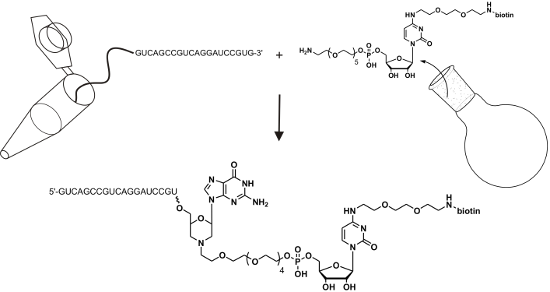
- RNA catalysts that support an aldol reaction between an aldehyde and a ketone, relevant to the synthesis of sugars [6], or the linkage of ribose to nucleobases to generate nucleotides [7]. Such ribozymes are seen as important functional entities underscoring the RNA world theory, where ribonucleic


Synthesis and bioactivity of analogues of the marine antibiotic tropodithietic acid
Beilstein J. Org. Chem. 2014, 10, 1796–1801, doi:10.3762/bjoc.10.188
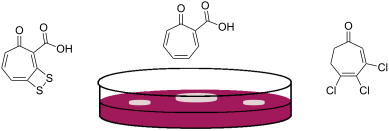
- . Cyclohexenone 6 was first converted with NaHMDS and TMSCl into the corresponding silylenol ether that upon oxidation with m-CPBA under migration of the TMS group yielded the protected hydroxy ketone 7. Aldol reaction with tert-butyl acetate to 8a and deprotection with TBAF gave 9a in 24% yield over four steps


Atherton–Todd reaction: mechanism, scope and applications
Beilstein J. Org. Chem. 2014, 10, 1166–1196, doi:10.3762/bjoc.10.117

- studied the enantioselective crossed aldol reaction of aldehydes with trichlorosilyl enol ethers. They obtained the aldol products in high yields with moderate to good enantioselectivities [101]. The chiral phosphoramidates used in this study and tested in many other enantioselective reactions (aldol
- reaction [102], Michael addition [103], Diels–Alder reaction [104], Friedel–Crafts alkylation [105]) illustrate the use of phosphoramidates as organocatalysts. These phosphoramidates were not synthesized by an AT reaction. Instead, the reaction of an amine with an electrophilic phosphorus species (P–Cl




A convenient enantioselective decarboxylative aldol reaction to access chiral α-hydroxy esters using β-keto acids
Beilstein J. Org. Chem. 2014, 10, 969–974, doi:10.3762/bjoc.10.95

- appears as a common procedure, affording chiral tertiary alcohols which are ubiquitous in the biological sciences and pharmaceutical industry [1][2][3][4][5][6]. The decarboxylative aldol reaction, broadly used for the generation of ester enolate equivalents by the promotion of releasing CO2, has become
- stereocontrolled nucleophilic alkylation [15][16][17][18][19], alkynylation [20][21], 1,2-addition [22][23][24][25][26] and aldol reaction [27][28][29][30][31][32] have been developed. Various nucleophiles such as organometallics, boronic acids and unsaturated ketones can be tolerated in this context (Figure 2
- investigating different Lewis acids with various chiral PyBox ligands 4–8 (Table 1), we discovered that Sc(OTf)3 and tridentate PyBox ligand 6a could promote the decarboxylative aldol reaction of β-keto acid 1a with α-keto ester 2a in excellent yield with high enantioselectivity in toluene (Table 1, entry 9


Addition of H-phosphonates to quinine-derived carbonyl compounds. An unexpected C9 phosphonate–phosphate rearrangement and tandem intramolecular piperidine elimination
Beilstein J. Org. Chem. 2014, 10, 883–889, doi:10.3762/bjoc.10.85
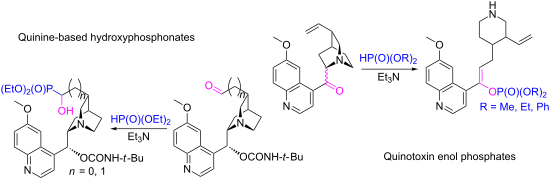
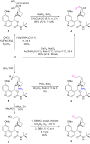
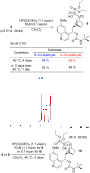
- we planned to envisage a nucleophilic addition of dialkyl phosphites to quinine-based carbonyl compounds and obtain 1-hydroxyalkylphosphonate derivatives (Abramov reaction, phospha-aldol reaction [22][23]). The scope, stereochemistry and side-reactions of the addition are described. Results and
- -aldol) reaction. These carbonyl compounds reacted with dialkyl and diphenyl phosphites producing quinotoxin enol phosphates that resulted from a tandem phosphonate–phosphate rearrangement and an intramolecular piperidine elimination. It can be hypothesized that the driving force of the structural




Synthesis of complex intermediates for the study of a dehydratase from borrelidin biosynthesis
Beilstein J. Org. Chem. 2014, 10, 634–640, doi:10.3762/bjoc.10.55
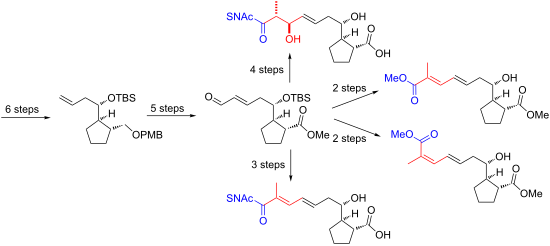
- allylation as well as an anti-selective aldol reaction. Reference compounds representing the E- and Z-configured double bond isomers as potential products of the dehydratase reaction were obtained from a common precursor aldehyde by Wittig olefination and Still–Gennari olefination. The final deprotection of
- polyketide-derived thioesters suited for biosynthesis studies. Keywords: aldol reaction; coenzyme A; natural products; pig liver esterase; polyketide biosynthesis; protection groups; Introduction Borrelidin (1) is a macrolactone polyketide natural product with promising antibacterial, antimalarial
- thioester building blocks was planned for the synthesis of 6a and 6b. Starting from aldehyde 11, a common precursor for all molecules required in this study, aldol reaction and following transesterification should lead to thioester 8. The bismethyl esters 7a and 7b as well as the SNAc thioesters 6a and 6b


Flow synthesis of phenylserine using threonine aldolase immobilized on Eupergit support
Beilstein J. Org. Chem. 2013, 9, 2168–2179, doi:10.3762/bjoc.9.254
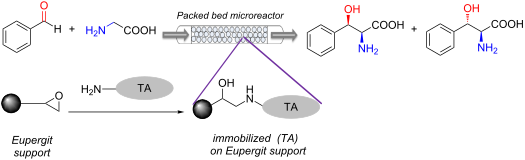
- metal complexes [36]. Enzymes overcome these drawbacks as they are not toxic and they can be obtained easily from microorganisms. Threonine aldolases (TA) are a class of enzymes which is PLP (pyridoxal-5’-phosphate) dependent and can catalyze the aldol reaction between glycine and a variety of aromatic


The chemistry of isoindole natural products
Beilstein J. Org. Chem. 2013, 9, 2048–2078, doi:10.3762/bjoc.9.243
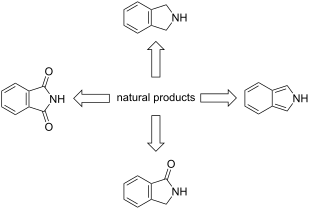
- condensation of primary amines with o-diacylbenzene 19 (Scheme 2) [13]. After initial formation of 20, isomerization to 21 and 22 can occur through a sequential dehydration–hydration process. Dimerization of 21 and 22 generates 23, the substrate for a formal retro-Aldol reaction. Loss of formaldehyde gives 24
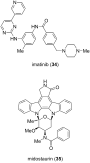
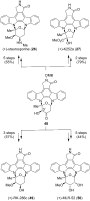
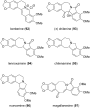
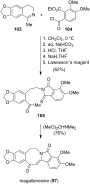
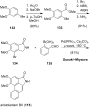
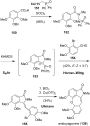
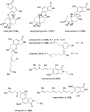
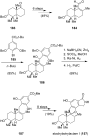
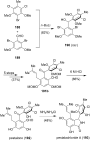
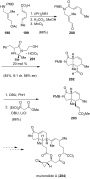
- therapeutic potential of 91 and derivatives thereof (Scheme 9) [73]. The synthesis could be accomplished in 26 steps and includes two key steps: the 8-oxabicyclo[3.2.1]octane unit was synthesized via an unprecedented 2-oxonia-[3,3]-sigmatropic aldol reaction cascade and the isoindolinone moiety was assembled
















A reductive coupling strategy towards ripostatin A
Beilstein J. Org. Chem. 2013, 9, 1533–1550, doi:10.3762/bjoc.9.175
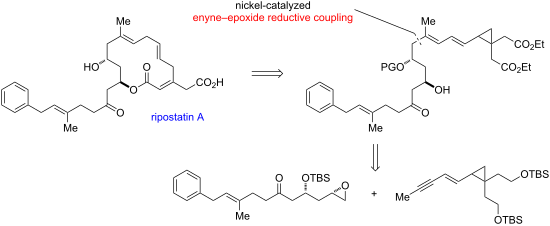
- decarboxylation enables construction of the C15−C16 bond by an aldol reaction. The product of this transformation is of the correct oxidation state and potentially three steps removed from the targeted epoxide fragment. Keywords: catalysis; natural product; nickel; reductive coupling; ripostatin A; synthesis
- the known allylic alcohol [58]. To synthesize ketone 57, we opted to utilize an asymmetric aldol reaction to set the stereochemistry of the β-hydroxy group. Since the report of Evans’s diastereoselective asymmetric aldol reaction using the boron enolates of N-acyloxazolidinones [59], numerous chiral
- analogous procedure for aldol reaction and oxidation the TMSE β-ketoester was obtained (Scheme 17). Treatment with an excess of TBAF in THF at room temperature overnight resulted in formation of the β-hydroxyketone 63. Although the yield for this transformation remained moderate, it was higher than that


Development of an additive-controlled, SmI2-mediated stereoselective sequence: Telescoped spirocyclisation, lactone reduction and Peterson elimination
Beilstein J. Org. Chem. 2013, 9, 1443–1447, doi:10.3762/bjoc.9.163

- functionalisation of the side chain. The ratio of 2b/4b was optimized by adjusting the SmI2/MeOH ratio and the reaction time to minimise retro-aldol reaction and the formation of saturated ketolactone byproduct 4b (Table 1). Lowering the amount of SmI2 and MeOH used and shortening the reaction time resulted in




Anionic cascade reactions. One-pot assembly of (Z)-chloro-exo-methylenetetrahydrofurans from β-hydroxyketones
Beilstein J. Org. Chem. 2013, 9, 1319–1325, doi:10.3762/bjoc.9.148

- -dichloroethylene is converted into the corresponding chloro-acetylene anion 9 [4][5]. This nucleophilic species adds rapidly, though reversibly, to acetone, leading ultimately to the formation of 5. However, in this case, competitive aldol reaction appears to take place, delivering the adduct 8. The subsequent
- sole base (Scheme 4). In stark contrast, applying this procedure to the keto-alcohol 14 resulted in a mediocre 13% yield of 6, probably due to a rapid retro-aldol reaction of the derived, rather hindered, potassium alkoxide. Applying the LDA/KOt-Bu protocol improved the yield to 41%. It thus transpires





Metal-mediated aminocatalysis provides mild conditions: Enantioselective Michael addition mediated by primary amino catalysts and alkali-metal ions
Beilstein J. Org. Chem. 2013, 9, 155–165, doi:10.3762/bjoc.9.18
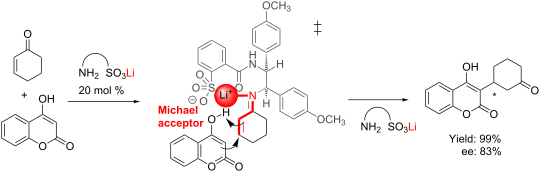
- direct aldol reaction, which is mediated by copper ions and amino acid derivatives [14] or enamine nucleophilic addition to palladium π-allyl electrophiles [15][16][17]. We report the development of new catalysts based on chiral 1,2-diamines and present their application in the asymmetric addition of 4



Reactions of salicylaldehyde and enolates or their equivalents: versatile synthetic routes to chromane derivatives
Beilstein J. Org. Chem. 2012, 8, 2166–2175, doi:10.3762/bjoc.8.244

- cascade reaction of salicylaldehyde (5) and malononitrile (20) involving an aldol reaction followed by intramolecular cyclization and finally a dehydration to give intermediate 21. A subsequent Michael addition of the indole (25) to intermediate 21 gives cation 26, which loses a proton to give the product
- reaction between salicylaldehyde (5) and acetonitrile (28) involving an aldol reaction, cyclization and dehydration. A subsequent Michael addition of nitromethane (30) to the product of the cascade reaction gave the desired product 32. Kovalenko and co-workers used a quantitative amount of piperidine in
- (5), followed by an intramolecular aldol reaction and final dehydration to give the desired chromene derivative. Related work involving asymmetric reaction of salicylaldehyde derivatives and α,β-unsaturated carbonyl compounds in the synthesis of 2-phenylchromenes was reported by Li and co-workers


Mechanochemistry assisted asymmetric organocatalysis: A sustainable approach
Beilstein J. Org. Chem. 2012, 8, 2132–2141, doi:10.3762/bjoc.8.240
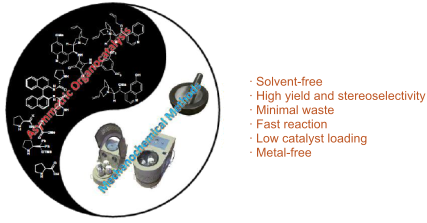
- , viz. ball-milling and grinding with pestle and mortar. Review Aldol reaction Since the origin of organocatalysis, the asymmetric aldol reaction has been one of the most intensely studied reactions, providing an easy access to chiral β-hydroxycarbonyl compounds, which are important building blocks for
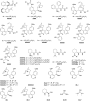
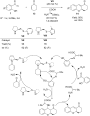
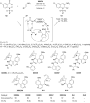
- various bioactive molecules [28]. Among different organocatalysts used for asymmetric aldol reactions, proline and its derivatives emerged as powerful catalysts for the enamine activation of donor aldehyde or ketone. Bolm’s group reported a solvent-free asymmetric organocatalytic aldol reaction under ball
- observed. The ball-milling approach was applied to the (S)-BINAM-L-prolinamide (II) catalysed direct aldol reaction between ketones and aldehydes under solvent-free conditions by Najera and co-workers (Scheme 3) [33][34]. Using 5–10 mol % of II and 10–20 mol % of benzoic acid as additive, the aldol


Determination of the relative configuration of tropinone and granatanone aldols by using TBDMS ethers
Beilstein J. Org. Chem. 2012, 8, 1877–1883, doi:10.3762/bjoc.8.216

- was determined as exo,syn by comparison of NMR data of the aldol isomers, in particular vicinal coupling constants and shifts corresponding to the side-chain CH group, with data of related TBDMS derivatives and confirmed by single-crystal X-ray diffraction. Keywords: aldol reaction; exo–endo
- and enantiomerically pure aldols of tropinone (8-methyl-8-azabicyclo[3.2.1]octan-3-one) and granatanone (9-methyl-9-azabicyclo[3.3.1]nonan-3-one) (Figure 1) were synthesized by enantioselective deprotonation with lithium amide bases followed by diastereoselective aldol reaction with aldehydes [10][11
- combined with separation on a silica column. The major products of the direct solventless aldol reaction of tropinone and granatanone [20] were assigned the exo,syn configuration on the bases of their NMR data and NMR data of the corresponding TBDMS ethers. The assigned exo,syn configuration of the


Organocatalytic tandem Michael addition reactions: A powerful access to the enantioselective synthesis of functionalized chromenes, thiochromenes and 1,2-dihydroquinolines
Beilstein J. Org. Chem. 2012, 8, 1668–1694, doi:10.3762/bjoc.8.191

- 2006, using diarylprolinolether as an effective organocatalyst. This method involved an oxa-Michael attack of salicylaldehydes 1 on the α,β-unsaturated aldehydes 2 activated through an iminium ion formation with the catalyst Ib, followed by an intramolecular aldol reaction and the subsequent water
- solvent, the test reaction provided the chiral chromenes 3 in good yields (up to 98%) and enantioselectivities (99%) at room temperature (Scheme 3). In 2009, Xu et al. [45] developed an efficient protocol for the asymmetric tandem oxa-Michael–aldol reaction using chiral amine/chiral acid organocatalyst
- (>99%). Extending the methodology adopted by Hong et al., the same group [53] reported a diastereoselective domino oxa-Michael–Michael–Michael–aldol reaction as the key step for the construction of the hexahydro-6H-benzo[c]chromene skeleton of the biologically active natural product (+)-conicol (26






Asymmetric total synthesis of smyrindiol employing an organocatalytic aldol key step
Beilstein J. Org. Chem. 2012, 8, 1112–1117, doi:10.3762/bjoc.8.123
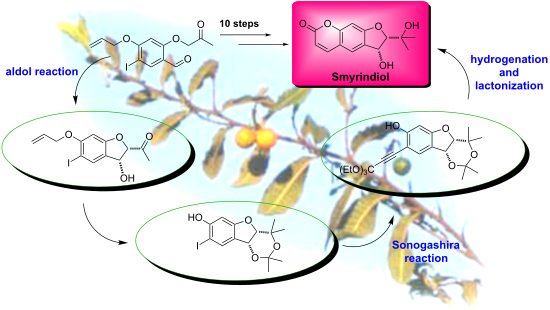
- intramolecular aldol reaction as the key step, is described. Smyrindiol was synthesized from commercially available 2,4-dihydroxybenzaldehyde in 15 steps, with excellent stereoselectivity (de = 99%, ee = 99%). In the course of this total synthesis a new and mild coumarin assembly was developed. Keywords: aldol
- intramolecular aldol reaction of O-acetonyl-salicylaldehydes was described by our research group (Scheme 3) [10]. We envisaged that this 5-enolexo aldolization could be utilized to construct the 1,3-diol moiety of smyrindiol, if a coumarin derivative of the O-acetonyl-salicylaldehyde were to be used. The
- addition of a methyl group to the carbonyl of the aldol product would yield smyrindiol (Scheme 4). Unfortunately, all attempts to conduct the intramolecular aldol reaction with the ketoaldehyde 4 failed (Scheme 5). Instead of the expected hydroxy ketone 3, we obtained a complex reaction mixture. This was


Aldol elaboration of 4,5,6,7-tetrahydroisoxazolo[4,3-c]pyridin-4-ones, masked precursors to acylpyridones
Beilstein J. Org. Chem. 2012, 8, 308–312, doi:10.3762/bjoc.8.33

- condensation to give new 3-alkenyl-4,5,6,7-tetrahydroisoxazolo[4,3-c]pyridine-4-ones, which are masked forms related to the acylpyridone natural products. Keywords: aldol reaction; fused-ring systems; heterocycles; isoxazole; metalation; pyridone; Introduction The 3-acyl-4-hydroxypyridin-2-one moiety 1





