


Search results
Search for "chromatographic separation" in Full Text gives 106 result(s) in Beilstein Journal of Organic Chemistry.
Kinetic studies and predictions on the hydrolysis and aminolysis of esters of 2-S-phosphorylacetates
Beilstein J. Org. Chem. 2010, 6, 732–741, doi:10.3762/bjoc.6.87
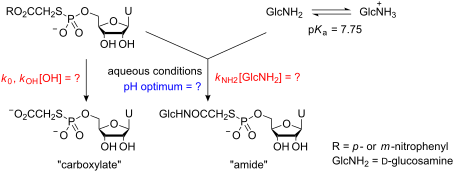
- with ~30% of the “carboxylate” arising through competing hydrolysis processes. Chromatographic separation proved time consuming and resolution of the products was poor, further illustrating the need to improve selectivity and avoid purification steps. Furthermore, the preparation of bromoacetyl-N


Polar tagging in the synthesis of monodisperse oligo(p-phenyleneethynylene)s and an update on the synthesis of oligoPPEs
Beilstein J. Org. Chem. 2010, 6, No. 57, doi:10.3762/bjoc.6.57
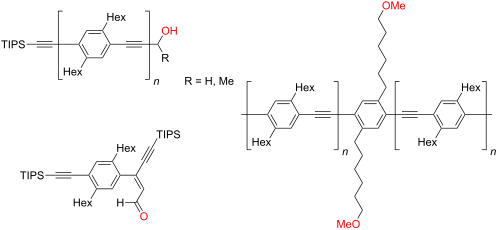
- alkyne protecting groups triisopropylsilyl and hydroxymethyl (HOM) and on the polar tagging with the hydroxymethyl moiety for an easy chromatographic separation of the products. This paper provides an update of this synthetic route. For the deprotection of HOM protected alkynes, γ-MnO2 proved to be
- as polar tags for the chromatographic separation. Polar tagging with HOM [47][48][49] or HOP [34][42][45][50][51][52][53][54][55][56][57] has been the key to the successful syntheses of a variety of aryleneethynylene building blocks and oligomers [42][45][47][48][49][50][51][52] and of oligoeneynes
- amount of the carbometalation product 5a from 2–16% to 1–5%. Nevertheless, large scale preparative chromatographic separation on silica gel is tedious. Carbometalation product 5a and monomer 1a1 have very similar Rf-values and, unfortunately, the byproduct is eluted first. Luckily, contamination of




Novel banana-discotic hybrid architectures
Beilstein J. Org. Chem. 2009, 5, No. 52, doi:10.3762/bjoc.5.52
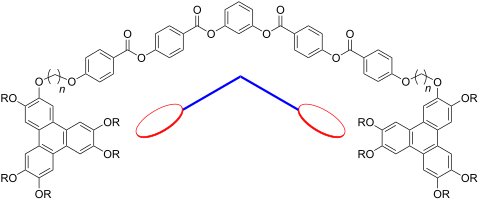
- . Experimental All the reagents and solvents were used as received without any further purification except CH2Cl2 which was dried and distilled before the reactions. Column chromatographic separation was performed on silica gel (100–200 mesh). 1H NMR spectra were recorded in CDCl3 on a 400 MHz (Bruker AMX 400


Synthesis of mesogenic phthalocyanine-C60 donor–acceptor dyads designed for molecular heterojunction photovoltaic devices
Beilstein J. Org. Chem. 2009, 5, No. 49, doi:10.3762/bjoc.5.49
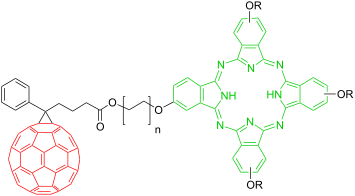
- moiety was chosen to facilitate the chromatographic separation of the unsymmetrical phthalocyanines 10a–d from the major side product 3: the latter bears only relatively apolar, bulky swallow-tail alkoxy groups. In addition, the signal of the terminal methyl group of the MEM moiety serves as a convenient


Synthesis of phosphonate and phostone analogues of ribose-1-phosphates
Beilstein J. Org. Chem. 2009, 5, No. 37, doi:10.3762/bjoc.5.37

- conventional chromatography. Due to the inability to separate α−18 from β−18, route B (Scheme 3) was explored as an alternative. Following the protocol demonstrated by Meyer et al. [4], 5-O-trityl-phosphonates 21a and 21b were obtained as individual epimers after chromatographic separation of the initial


Dimerization of propargyl and homopropargyl 6-azido- 6-deoxy- glycosides upon 1,3-dipolar cycloaddition
Beilstein J. Org. Chem. 2008, 4, No. 30, doi:10.3762/bjoc.4.30

- by acetylation of the intermediate glycosides and chromatographic separation of the anomeric acetates. Next, glycosides 4a–g were submitted to dimerization by 1,3-dipolar cycloaddition reaction. As the catalyst, 10 mol% (EtO)3PCuI was applied and used along with three equivalents diisopropyl


Other Beilstein-Institut Open Science Activities



