


Search results
Search for "water soluble" in Full Text gives 254 result(s) in Beilstein Journal of Organic Chemistry. Showing first 200.
Water-soluble SNS cationic palladium(II) complexes and their Suzuki–Miyaura cross-coupling reactions in aqueous medium
Beilstein J. Org. Chem. 2018, 14, 1859–1870, doi:10.3762/bjoc.14.160
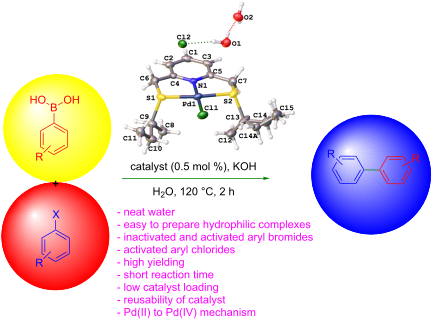
- their SCS analogues, SNS pincer complexes are poorly studied for their use in coupling reactions. Accordingly, a series of water soluble cationic Pd(II) SNS pincer complexes have been successfully synthesised and investigated in detail for their catalytic activity in Suzuki–Miyaura coupling reactions
- microwave heating [7][8][9][10][11][12][13][14][15], ultrasonication [16][17][18], ligand-free methodologies [19][20][21][22][23][24][25] and the use of water-soluble palladium pre-catalysts/catalysts [26][27][28][29][30]. The latter is the preferred choice since it allows for the reusability of the
- the literature are the water-soluble pincer complexes 14, 15 and 16 (Figure 2a). While pincer complex 14 provided moderate (38–68%) GC yields over 6 h at 75 °C using 2 mol % catalyst loading with inactivated aryl bromides, pincer complex 15 was found to be incompatible with both activated and




Strong binding and fluorescence sensing of bisphosphonates by guanidinium-modified calix[5]arene
Beilstein J. Org. Chem. 2018, 14, 1840–1845, doi:10.3762/bjoc.14.157
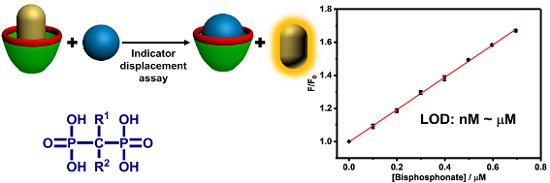
- to their facial modification, Prof. Böhmer demonstrated calixarenes as having “(almost) unlimited possibilities” [17]. We have focused on molecular recognition and self-assembly of water-soluble calixarene derivatives for a long time [18][19][20][21][22][23][24], directed by exploring biomedical


Hypervalent organoiodine compounds: from reagents to valuable building blocks in synthesis
Beilstein J. Org. Chem. 2018, 14, 1508–1528, doi:10.3762/bjoc.14.128
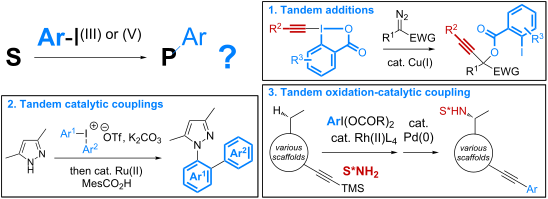
- high yielding N-arylation of 1H-1,2,3-benzotriazole (BTA), utilizing symmetrical diaryl-λ3-iodanes as two-fold aryl donors has been reported in the presence of Pd(OAc)2 and TPPTS as a water-soluble ligand, and copper(II) phenylcyclopropylcarboxylate (Scheme 35) [74]. Noteworthy, it is mentioned that Ar






An overview of recent advances in duplex DNA recognition by small molecules
Beilstein J. Org. Chem. 2018, 14, 1051–1086, doi:10.3762/bjoc.14.93
- , thereby changing the efficiency of the FRET process between the two fluorophores and exhibiting a significant red shift in the emission spectrum. Moreover, the conjugate 43 could be used as an attractive tool for imaging of nuclear DNA in the cells due to its low cytotoxicity. A series of water-soluble






Polysubstituted ferrocenes as tunable redox mediators
Beilstein J. Org. Chem. 2018, 14, 1004–1015, doi:10.3762/bjoc.14.86
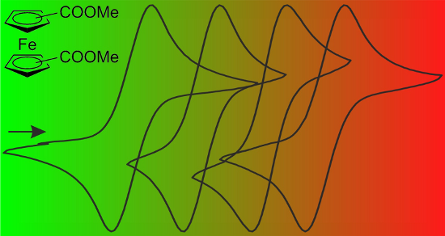
- for oxidation or reduction processes, respectively. This avoids the often kinetically hindered direct ET between electrode and substrate and diminishes overoxidation or overreduction of the substrate. Redox-active ferrocenyl derivatives find application in redox flow batteries [15], with water soluble


Nanoreactors for green catalysis
Beilstein J. Org. Chem. 2018, 14, 716–733, doi:10.3762/bjoc.14.61
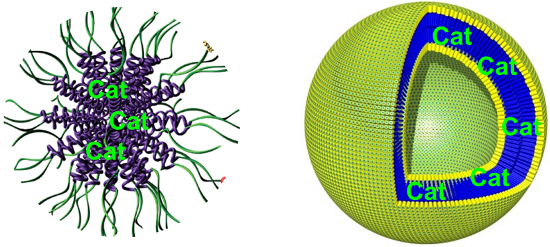
- encapsulated and the best results were achieved when the enzyme was in the lumen (Figure 3b), highlighting the advantage of enzyme compartmentalization and shielding. The explanation for this improved performance is the enlarged contact area between (hydrophobic) substrate and (water soluble) enzyme. Moreover
- . The utility of these dendrimers in hydrogenation reactions resulted in efficient reactions that proceeded with unprecedented selectivity of 99%. Moreover, this system is one of the first of bimetallic catalytic systems to be used for hydrogenation reactions in water. Water soluble dendrimer-stabilized
- (X = I or Br) in water [100]. Other examples of water-soluble dendrimers are peptide- and glycol-based dendrimers [102][103]. As a result of their compositional versatility, they have been reported in many applications for biomedical engineering (e.g., glycopeptide dendrimers for drug delivery [104


Heterogeneous Pd catalysts as emulsifiers in Pickering emulsions for integrated multistep synthesis in flow chemistry
Beilstein J. Org. Chem. 2018, 14, 648–658, doi:10.3762/bjoc.14.52
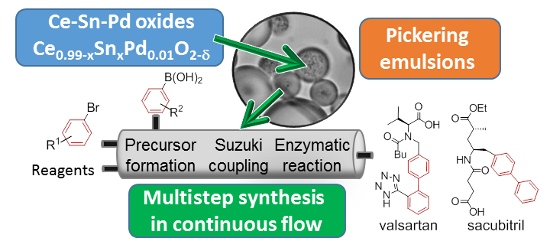
- stabilisation of dispersed drops in a continuous phase. In 2010, Crossley et al. [29] put forward the idea that catalyst particles may both act simultaneously as an emulsifier in Pickering emulsions and serve as the catalyst in which water-soluble reactants and oil-soluble reactants react at the oil–water





Enzyme-free genetic copying of DNA and RNA sequences
Beilstein J. Org. Chem. 2018, 14, 603–617, doi:10.3762/bjoc.14.47
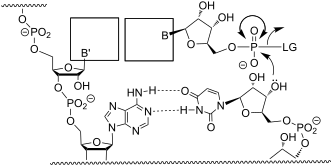
- , the 3'-amine was protected with an azidomethyloxycarbonyl (Azoc) protecting group. This protecting group can be rapidly removed under non-denaturing conditions after incorporation by the complementary nucleotide using the Staudinger reaction with a water-soluble phosphine (Figure 11). This protocol
- assay is another approach to avoid stalling due to inhibition. As mentioned in the Introduction, ligation reactions had been achieved by Naylor and Gilham in aqueous media in presence of a water-soluble carbodiimide as condensing reagent [7]. Likewise, Sulston et al. had used EDC to oligomerize AMP in


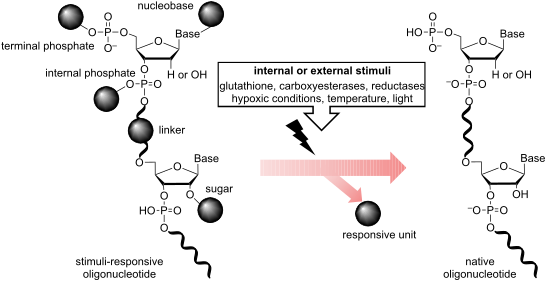
Stimuli-responsive oligonucleotides in prodrug-based approaches for gene silencing
Beilstein J. Org. Chem. 2018, 14, 436–469, doi:10.3762/bjoc.14.32


Fluorogenic PNA probes
Beilstein J. Org. Chem. 2018, 14, 253–281, doi:10.3762/bjoc.14.17
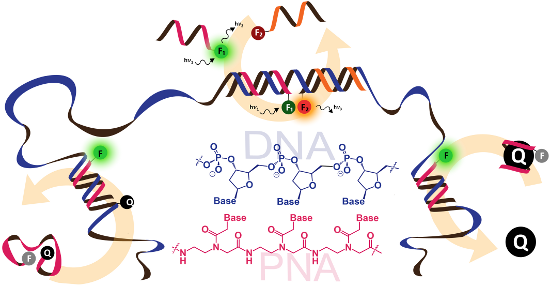
- oligonucleotides or analogues. One notable example is the use of a labeled PNA probe in combination with water-soluble cationic conjugated polyelectrolytes (CCP) for the FRET-based detection of DNA [114]. The CCP is typically an extended π-conjugated system, such as oligophenylene/fluorene with appending




Recent applications of click chemistry for the functionalization of gold nanoparticles and their conversion to glyco-gold nanoparticles
Beilstein J. Org. Chem. 2018, 14, 11–24, doi:10.3762/bjoc.14.2
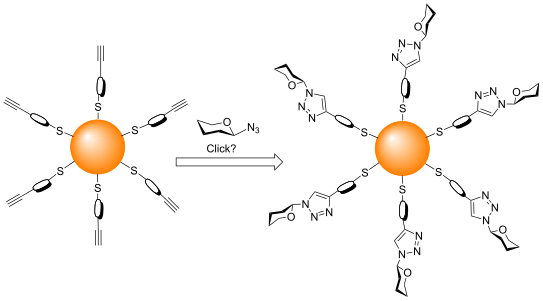
- acetylene-functionalized Thermomyces lanuginosus lipase was then attached to these azide-functionalized water-soluble AuNPs by CuAAC (Scheme 7). It was found that the enzyme retained its activity after the click reaction. However, the vast excesses of both Cu (a one million-fold excess relative to the azide
- catalyst. In order to circumvent this solubility problem, a homogenous water/THF solvent system was used, wherein a solution of the AuNPs in THF was added to either an aqueous solution containing water-soluble alkyne derivatives, or to a THF/water solution of organic soluble alkyne derivatives. The amount
- -AuNPs and ATT-AuNPs (Figure S3) are also provided in Supporting Information File 1. Whenever water-soluble ligands are used to perform exchange reactions on Cit-AuNPs, the wine-red colour of the AuNP solution (which corresponds to the dispersed state of the AuNPs as can be confirmed by TEM), and the SPR

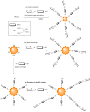


Binding abilities of a chiral calix[4]resorcinarene: a polarimetric investigation on a complex case of study
Beilstein J. Org. Chem. 2017, 13, 2698–2709, doi:10.3762/bjoc.13.268

- have also been studied as hydrogelators [22][23]. Moreover, water soluble chiral calix[4]resorcinarenes have been recently designed and used as chiral shift reagents for NMR applications [24][25][26][27]. The possibility to introduce chiral groups onto the CA scaffold is particularly intriguing from


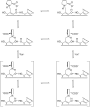


Synthesis of naturally-derived macromolecules through simplified electrochemically mediated ATRP
Beilstein J. Org. Chem. 2017, 13, 2466–2472, doi:10.3762/bjoc.13.243
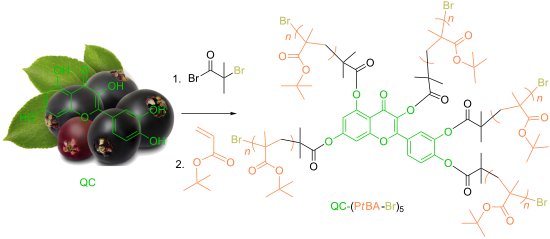
- ][36], and neurodegenerative diseases [27]. PtBA was selected as functional arm of polymer stars because it can be readily transformed to poly(acrylic acid) via deprotection, yielding polyelectrolytes. Such polymers are one of the most extensively studied, industrially important, water-soluble


Structural diversity in the host–guest complexes of the antifolate pemetrexed with native cyclodextrins: gas phase, solution and solid state studies
Beilstein J. Org. Chem. 2017, 13, 2252–2263, doi:10.3762/bjoc.13.222

- studied. Native CDs are water-soluble cyclic oligosaccharides, products of starch degradation, which contain six (α-CD), seven (β-CD) or eight glucopyranose units (γ-CD), accordingly, linked by α-1,4-glycosidic bonds (Figure 1b). They are toroid-like shaped and possess a cone-like hydrophobic cavity of


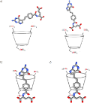


Phosphonic acid: preparation and applications
Beilstein J. Org. Chem. 2017, 13, 2186–2213, doi:10.3762/bjoc.13.219
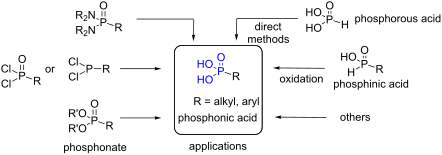
- water soluble catalysts [21], or to improve the water solubility of drug-chelate supramolecular assemblies (e.g., calixarene) [22][23]. The water solubility of phosphonic acid is strongly improved when the phosphonic acid is deprotonated (basic media). It is not rare to observe, when preparing NMR tubes
- with triphenylphosphine functionalized either by two or three phosphonic acid sodium salts; the former being more water soluble than the later [24]. This behavior is associated to the fact that the trisphosphonic acid sodium salt was already solvated at the solid state. The high polarity of the
- . First, a mechanochemical cracking yielded carboradical intermediates that were reacted with red phosphorus and then oxidized in the presence of air to produce graphene phosphonic acid 137 [116] (Figure 39). This material which is water soluble was used as a non-toxic flame-retardant. Conclusion


Superstructures with cyclodextrins: Chemistry and applications IV
Beilstein J. Org. Chem. 2017, 13, 2157–2159, doi:10.3762/bjoc.13.215
- -dienes and bulky stoppers in the presence of CDs (so-called rotaxa-polymerization) was further applied for the syntheses of water-soluble polyisoprene polyrotaxanes [25]. Furthermore, ABA-type block-copolyrotaxanes could be synthesized using this polymerization technique controlled by RAFT chain transfer
Solid-state studies and antioxidant properties of the γ-cyclodextrin·fisetin inclusion compound
Beilstein J. Org. Chem. 2017, 13, 2138–2145, doi:10.3762/bjoc.13.212

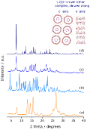
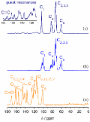
- , neuroprotecting, and suppression or prevention of tumors. The present work describes the preparation of a water-soluble, solid inclusion compound of fisetin with gamma-cyclodextrin (γ-CD), a cyclic oligosaccharide approved for human consumption. A detailed physicochemical analysis of the product is carried out
- GRAS status (list of food additives that are ‘generally recognized as safe’) [9]. The present work describes the preparation of a water-soluble, solid inclusion compound of fisetin with γ-CD (see Scheme 1 for structure and atom labeling). The formation of the γ-CD·fisetin inclusion compound as a solid




An efficient Pd–NHC catalyst system in situ generated from Na2PdCl4 and PEG-functionalized imidazolium salts for Mizoroki–Heck reactions in water
Beilstein J. Org. Chem. 2017, 13, 1735–1744, doi:10.3762/bjoc.13.168

- materials via a simple method. Their corresponding water soluble Pd–NHC catalysts, in situ generated from the imidazolium salts L1–L3 and Na2PdCl4 in water, showed impressive catalytic activity for aqueous Mizoroki–Heck reactions. The kinetic study revealed that the Pd catalyst derived from the imidazolium
- –Pd bonds under aqueous reaction conditions often restricted the reuse of the catalyst and led to undesired residues. Therefore, in recent years, efforts have been turned to the development of water-soluble non-phosphine ligands [28][29][30][31][32][33][34]. In this context, N-heterocyclic carbenes
- functionalization of the N atom of the NHC ring allows for the possible incorporation of water soluble moieties, thus providing more opportunities for water soluble catalyst design [37][38][39]. Since the pioneering report of a sulfonate-functionalized NHC ligand by Shaughnessy [40], a number of water-soluble NHC


Molecular recognition of N-acetyltryptophan enantiomers by β-cyclodextrin
Beilstein J. Org. Chem. 2017, 13, 1572–1582, doi:10.3762/bjoc.13.157
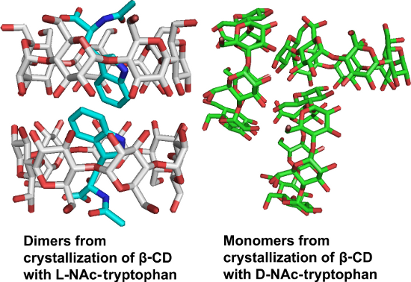
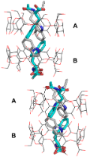
- structure; Introduction Cyclodextrins (CDs) are cyclic, water-soluble carbohydrates with a rather non-polar cavity that can host a variety of organic molecules (guests) and form inclusion complexes [1]. The guest molecules may be completely or partly enclosed inside the cavity depending on their size and




One-pot synthesis of block-copolyrotaxanes through controlled rotaxa-polymerization
Beilstein J. Org. Chem. 2017, 13, 1310–1315, doi:10.3762/bjoc.13.127
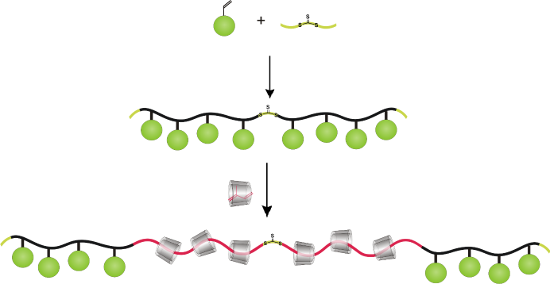
- other polymerization techniques, such as atom transfer radical polymerization, because of the lack of toxic metal additives, and because of good control exerted in aqueous solution. The water-soluble bifunctional CTA S,S′-bis(α,α′-dimethyl-α′′-acetic acid)trithiocarbonate (DMATC) was selected because it
- polyrotaxane synthesis since it is highly water-soluble and provides a sufficiently high binding constant for isoprene [24][25]. Results and Discussion In a first trial, statistical RAFT copolymerization of isoprene complexed in RAMEB was performed with water-soluble bulky comonomers, namely N-[tris


Kinetic analysis of mechanoradical formation during the mechanolysis of dextran and glycogen
Beilstein J. Org. Chem. 2017, 13, 1174–1183, doi:10.3762/bjoc.13.116
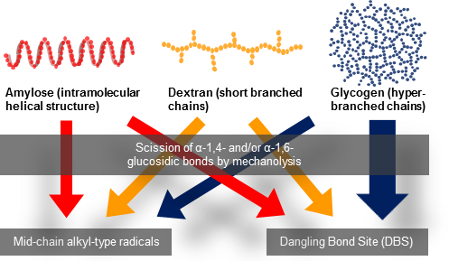
- disclosed the formation of polystyrene on the cotton [18]. In a previous paper, we reported the synthesis of water-soluble graft polymeric prodrugs through the mechanochemical reaction of HEC and methacryloyl derivatives of 5-fluorouracil [19]. We also discussed the nature of drug release from the polymeric


Interactions between shape-persistent macromolecules as probed by AFM
Beilstein J. Org. Chem. 2017, 13, 938–951, doi:10.3762/bjoc.13.95
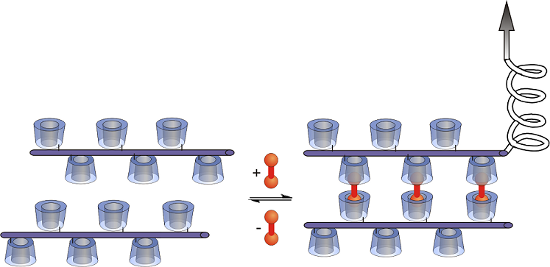
- -Str. 1, 21502 Geesthacht, Germany Jülich Centre for Neutron Science (JCNS) at Heinz Maier-Leibnitz Zentrum (MLZ), Forschungszentrum Jülich GmbH, Lichtenbergstr. 1, 85748 Garching, Germany 10.3762/bjoc.13.95 Abstract Water-soluble shape-persistent cyclodextrin (CD) polymers with amino-functionalized
- than one polymer molecule might be involved. Conclusion In conclusion, regular water-soluble shape-persistent CD polymers based on poly(phenylene butadiynylene) were prepared by a straightforward Glaser coupling/click chemistry approach, which can be attached to planar silicon surfaces as well as AFM






The effect of cyclodextrin complexation on the solubility and photostability of nerolidol as pure compound and as main constituent of cabreuva essential oil
Beilstein J. Org. Chem. 2017, 13, 835–844, doi:10.3762/bjoc.13.84
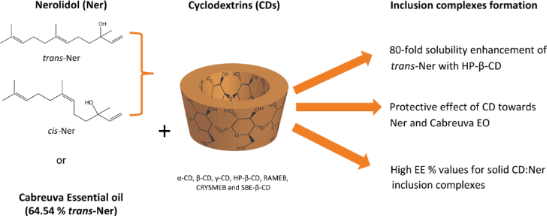
- their high potential to solubilize, stabilize and protect flavors and food ingredients [10][11][12][13]. CDs are non-toxic water-soluble cyclic oligosaccharides composed of six, seven or eight α-(1→4) glucopyranose units giving rise, respectively, to α-, β- and γ-CDs [14]. Their most notable
- characteristic is their ability to form inclusion complexes with poorly soluble guest molecules which are entrapped in the hydrophobic cavity of CDs. Chemical modifications of the hydroxy groups of CDs can be performed to obtain water-soluble CD derivatives like hydroxypropyl-β-CD (HP-β-CD), methylated CDs


Fluorescent carbon dots from mono- and polysaccharides: synthesis, properties and applications
Beilstein J. Org. Chem. 2017, 13, 675–693, doi:10.3762/bjoc.13.67
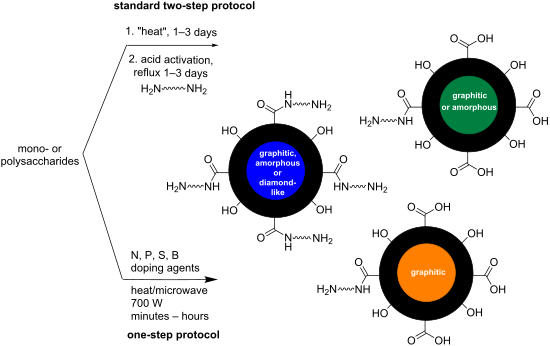
- our knowledge, the first reported example involving a carbohydrate moiety (Scheme 1) [18]. The water-soluble nanoparticles exhibited an amorphous core, as deduced by X-ray diffraction (XRD), while Fourier-transformed infrared (FTIR) spectroscopy analysis indicated the presence of a range of oxygen
- ideal balance of cation and anion valence was found when using CuSO4 which afforded CDs with QY of up to 9.5%, in-line with the state-of-the-art at the time. As an alternative, Kang et al. showed the following year that nitrogen-doped water-soluble fluorescent CDs could be afforded in a one-step
- hydrophobic red fluorescent CDs via surface passivation and polymer coating, in which hydrophilic anhydride groups of the polymer can react with PEG-diamine, via a ring-opening to afford a free acid and an amide-linked SPA, lead to water-soluble CDs ready for bio-labelling applications. The CDs were then


Continuous-flow synthesis of highly functionalized imidazo-oxadiazoles facilitated by microfluidic extraction
Beilstein J. Org. Chem. 2017, 13, 239–246, doi:10.3762/bjoc.13.26
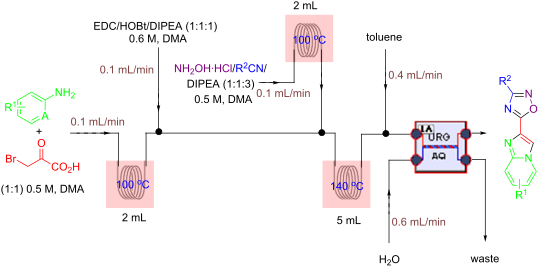
- demonstrated that a liquid–liquid microextraction unit can be utilized to remove high polar water soluble solvents and impurities from products. This scalable method provides the desired oxadiazole derivatives at a rate of ≈0.5 g/h and represents a significant advantage over batch synthesis. We anticipate that





