


Search results
Search for "C–N bond" in Full Text gives 199 result(s) in Beilstein Journal of Organic Chemistry.
Theoretical simulation of the infrared signature of mechanically stressed polymer solids
Beilstein J. Org. Chem. 2017, 13, 1710–1716, doi:10.3762/bjoc.13.165
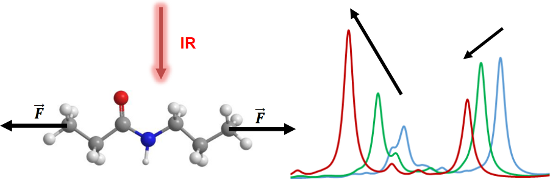
- involving the backbone exhibit a strong force dependence [30]. What is surprising, however, is the almost complete insensitivity of the free C–O stretch. One might expect that the deformation of the amide bond in the backbone changes the electron distribution, and that the weakening of the C–N bond in the


Synthesis of alkynyl-substituted camphor derivatives and their use in the preparation of paclitaxel-related compounds
Beilstein J. Org. Chem. 2017, 13, 1230–1238, doi:10.3762/bjoc.13.122
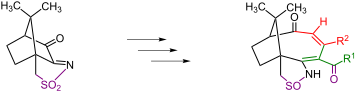
- selective with respect to the alkylation site, and the 2-alkynyl and 3-alkynyl products are formed in similar amounts. Alkynes with small substituents (e.g., heptyne or phenylacetylene) preferentially attack at the C=N bond of the sulfonylimine, suggesting that the carbon atom of the C=N is more




Regioselective (thio)carbamoylation of 2,7-di-tert-butylpyrene at the 1-position with iso(thio)cyanates
Beilstein J. Org. Chem. 2017, 13, 1032–1038, doi:10.3762/bjoc.13.102

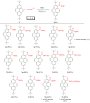
- into 5, but to our knowledge this reaction, which must involve cleavage of the C–N bond, has no precedent in the literature (in contrast to the well-known formation of nitriles from primary thioamides, involving formal elimination of H2S [24]). Encouraged by the above results, we decided to check




Derivatives of the triaminoguanidinium ion, 5. Acylation of triaminoguanidines leading to symmetrical tris(acylamino)guanidines and mesoionic 1,2,4-triazolium-3-aminides
Beilstein J. Org. Chem. 2017, 13, 579–588, doi:10.3762/bjoc.13.57
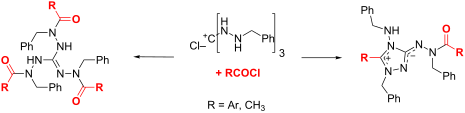
- two moieties is indicated by the long C–N bond “c” (as compared to the other C–N bonds in the triazole ring) and the endocyclic N–N bond, both of which have a high single-bond character. The influence of the substituents on the triazole ring of II and 7a on the bond lengths is moderate. The bond




Pd- and Cu-catalyzed approaches in the syntheses of new cholane aminoanthraquinone pincer-like ligands
Beilstein J. Org. Chem. 2017, 13, 564–570, doi:10.3762/bjoc.13.55

- LiAlH4 (Scheme 2) [37]. Cu-catalyzed amination is known to be a very efficient approach for C–N bond formation [38][39]. The availability of the variety of inexpensive ligands for copper(I) is a crucial benefit in comparison to the Pd-catalyzed variant. Primary amines of different structures can readily


Thiazol-4-one derivatives from the reaction of monosubstituted thioureas with maleimides: structures and factors determining the selectivity and tautomeric equilibrium in solution
Beilstein J. Org. Chem. 2016, 12, 2563–2569, doi:10.3762/bjoc.12.251

- tautomers exist [15][18][20][21][22][23]. (E/Z)-Isomerization of the exocyclic C=N bond of the single imino form was suggested as the cause for the dynamic effect as well [24][25]. In addition, this process complicates the interpretation of NMR spectra of thiazolidines and is a likely source of
- interconverting E/Z-isomers at the exocyclic C=N bond (given in parentheses on Scheme 2) could be involved. Therefore we have thoroughly analyzed the spectroscopic data of thiazolidine 3a from 2D NMR experiments (NOESY, 13C,1H and 15N,1H-HSQC and HMBC) and made a full assignment of all signals. A large difference


Construction of bis-, tris- and tetrahydrazones by addition of azoalkenes to amines and ammonia
Beilstein J. Org. Chem. 2016, 12, 2471–2477, doi:10.3762/bjoc.12.241
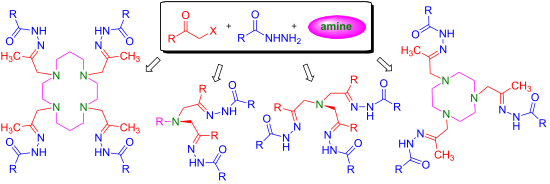
- ][6][7][8][9][10][11][12][13][14][15][16][17]. The hydrazone group is a chemically stable, easily assembled motif with prospective coordination properties, which can be tuned by substitution at the carbon and nitrogen atoms. Furthermore, a reversible E/Z-isomerism of the C=N bond allows controllable
- isomers depends on the substitution pattern and solvent. For example, the E,E-isomer was predominant for 2a in DMSO-d6, while in CDCl3 E,Z-2a was the major isomer. The assignment of stereoisomers was performed using known correlations between the configuration of the C=N bond and the chemical shift of





Robust C–C bonded porous networks with chemically designed functionalities for improved CO2 capture from flue gas
Beilstein J. Org. Chem. 2016, 12, 2274–2279, doi:10.3762/bjoc.12.220
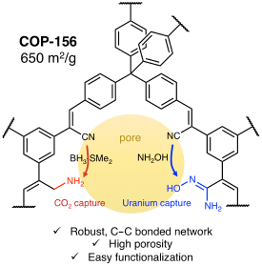
- -amidoxime the 3400 cm−1 region is even broader, due to the combination of both NH and OH stretching. The strong peak at 1664 cm−1 can be attributed to the imine C=N bond of the amidoxime structure. The textural properties were measured through nitrogen sorption isotherms at 77 K and calculated based on the


Synthesis and NMR studies of malonyl-linked glycoconjugates of N-(2-aminoethyl)glycine. Building blocks for the construction of combinatorial glycopeptide libraries
Beilstein J. Org. Chem. 2016, 12, 1939–1948, doi:10.3762/bjoc.12.183
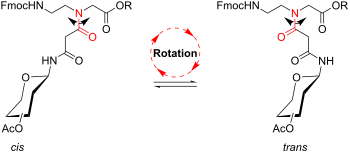
- 2:1 which was in accordance with similar rotamers described in literature [22]. Hereupon, we report on our investigations concerning the structures of the fully protected conjugates 1 and 4 for the rotamers of which around the C–N bond we calculated the respective ΔG‡r-values. Results and Discussion
- bond (C–N bond) we calculated the corresponding ΔG‡r values for building blocks 1a,b from the measured coalescence temperatures (Tc) by using the Eyring model [26]. The ΔG‡c values of the dimeric glycoconjugate 4 could not be determined though because no unambiguous assignment of the rotameric


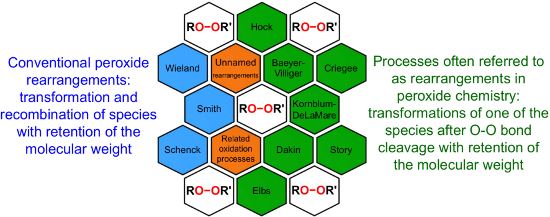
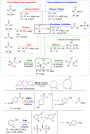
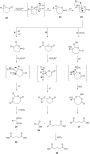
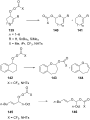
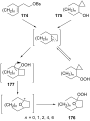
Rearrangements of organic peroxides and related processes
Beilstein J. Org. Chem. 2016, 12, 1647–1748, doi:10.3762/bjoc.12.162













Catalytic Chan–Lam coupling using a ‘tube-in-tube’ reactor to deliver molecular oxygen as an oxidant
Beilstein J. Org. Chem. 2016, 12, 1598–1607, doi:10.3762/bjoc.12.156
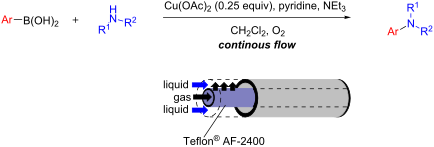
- ; oxygen; “tube-in-tube”; Introduction The functionalisation of aromatic and aliphatic amines has received considerable attention due to the number of biologically active compounds represented by these classes. For this reason different synthetic methods for C–N bond formation have been developed (Scheme


Microwave-assisted synthesis of (aminomethylene)bisphosphine oxides and (aminomethylene)bisphosphonates by a three-component condensation
Beilstein J. Org. Chem. 2016, 12, 1493–1502, doi:10.3762/bjoc.12.146
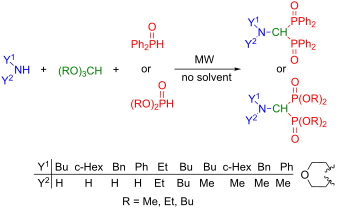
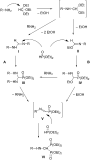
- step is the nucleophilic addition of diethyl phosphite to the C=N bond of the imines resulting in phosphonates III or IV, respectively. Then, the elimination of an amine or ethanol and the addition of another unit of diethyl phosphite may lead to (aminomethylene)bisphosphonates (VI). If the amine is in



The synthesis of functionalized bridged polycycles via C–H bond insertion
Beilstein J. Org. Chem. 2016, 12, 985–999, doi:10.3762/bjoc.12.97
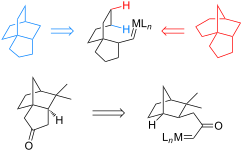
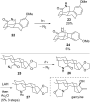
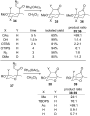
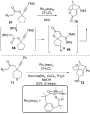
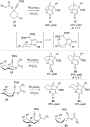
- access to multiple targets from a single intermediate produced on large scale that may be stored until needed [17]. The C–H bond insertion has great potential as a method to access different polycyclic isomers (e.g., 1 or 3) through C–C or C–N bond formation from a carbene or nitrene, respectively







Direct estimate of the internal π-donation to the carbene centre within N-heterocyclic carbenes and related molecules
Beilstein J. Org. Chem. 2015, 11, 2727–2736, doi:10.3762/bjoc.11.294
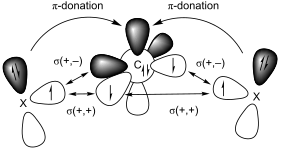
- carbene 8, which approaches a standard C–N single bond (1.46 Å) [104]. The Ccarb–N bond lengths exhibit otherwise a remarkable small range between 1.35–1.38 Å. The C–N bond is slightly longer in the conjugated 6π-electron carbenes which possess some aromatic character than in the non-aromatic analogues
- which previously ascribed to stronger π-conjugation [105][106][107]. The introduction of the heteroatoms O and S in compounds 11 and 12 changes the C–N bond only slightly. The Ccarb–C bond lengths in the conjugated carbenes are between 1.404 Å (9)–1.433 Å (14) while the cAAC system 6 has a much longer


Copper-catalyzed aminooxygenation of styrenes with N-fluorobenzenesulfonimide and N-hydroxyphthalimide derivatives
Beilstein J. Org. Chem. 2015, 11, 2721–2726, doi:10.3762/bjoc.11.293
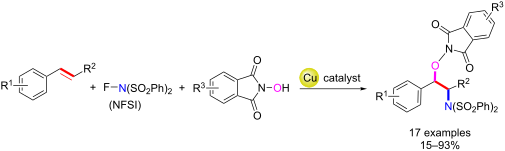
- . The aminooxygenation product could be converted into the corresponding alcohol or free amine through the cleavage of the N–O or C–N bond of the N-hydroxyphthalimide moiety. Keywords: aminooxygenation of styrenes; copper catalysts; N-fluorobenzenesulfonimide; N-hydroxyphthalimide derivatives
- the cleavage of the N–O or C–N bond of the NHPI moiety. Further studies are underway in our lab. Bioactive compounds containing 1,2-aminoalcohol motif. The copper-catalyzed three-component aminooxygenation of styrenes with NFSI and NHPI derivatives. Reaction conditions: 1 (0.9 mmol, 3.0 equiv), NFSI




Bifunctional phase-transfer catalysis in the asymmetric synthesis of biologically active isoindolinones
Beilstein J. Org. Chem. 2015, 11, 2591–2599, doi:10.3762/bjoc.11.279
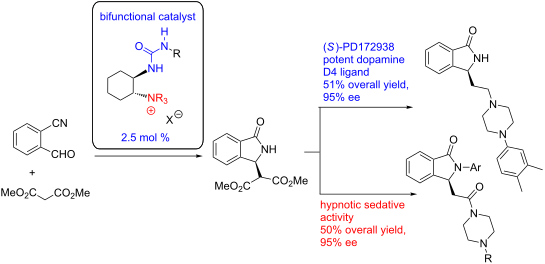
- ]. The racemization probably occurs on the product 9, via the mechanism reported in Scheme 3, as a slower process than the decarboxylation itself. The cleavage of the C–N bond and the formation of the acyclic intermediates 11 with the consequent loss of chirality is probably favored by the protonation of


Iron complexes of tetramine ligands catalyse allylic hydroxyamination via a nitroso–ene mechanism
Beilstein J. Org. Chem. 2015, 11, 2549–2556, doi:10.3762/bjoc.11.275

- ) are established catalysts of C–O bond formation, oxidising hydrocarbon substrates via hydroxylation, epoxidation and dihydroxylation pathways. Herein we report the capacity of these catalysts to promote C–N bond formation, via allylic amination of alkenes. The combination of N-Boc-hydroxylamine with
- cyclohexene (7) [45][46][47], we wished to explore potential C–N bond formation at this position using iron catalysis. Combining cyclohexene (7, in excess) with N-Boc-hydroxylamine (8) as the nitrogen source and the iron complex FeTPA (4) or FeBPMEN (5) afforded a mixture of products: the allylic


Recent advances in copper-catalyzed C–H bond amidation
Beilstein J. Org. Chem. 2015, 11, 2209–2222, doi:10.3762/bjoc.11.240

- copper catalysis is in the C–N bond formation by using carbon sources and nitrogen functional groups such as amides. In this review, the recent progress in the amidation reactions employing copper-catalyzed C–H amidation is summarized. Keywords: amidation; C–H bond; cascade reactions; Copper catalysis
- realized via a tandem Ullmann-type C–N coupling of the Ar–X bond and the amino group in 83 as well as the intramolecular amidation which was believed to assist the oxidative formation of the imine C=N bond (Scheme 22). By making use of this cascade synthetic method, Nagarajan et al. [78] finished the
- synthesis of various polycyclic structured quinazolinones 86 via corresponding starting materials 85 which were synthesized before by stepwise preparation (Scheme 22). Based on a similar strategy of combining an Ullmann C–N bond formation and C–H amidation, Fu and Xu [79] also achieved the cascade reactions




Copper-mediated synthesis of N-alkenyl-α,β-unsaturated nitrones and their conversion to tri- and tetrasubstituted pyridines
Beilstein J. Org. Chem. 2015, 11, 2097–2104, doi:10.3762/bjoc.11.226

- modularity of the Chan–Lam coupling process, and proceeds through a pathway that is distinct from the Liebeskind copper-catalyzed C–N bond coupling and electrocyclization (Scheme 2). Results and Discussion A Chan–Lam coupling between chalcone oxime 6a and cyclohexenylboronic acid (7a) was initially tested



Fates of imine intermediates in radical cyclizations of N-sulfonylindoles and ene-sulfonamides
Beilstein J. Org. Chem. 2015, 11, 1649–1655, doi:10.3762/bjoc.11.181

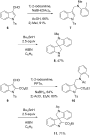
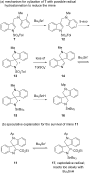
- hemiaminal 29 opens in the other direction (with C–N bond cleavage) to give an α-formyl-γ-amino lactam, which then undergoes C-to-N transformylation. The analysis of the crude reaction mixtures by TLC showed that the spots of formamides 25–27 were present early and grew in intensity with time as the





New palladium–oxazoline complexes: Synthesis and evaluation of the optical properties and the catalytic power during the oxidation of textile dyes
Beilstein J. Org. Chem. 2015, 11, 1175–1186, doi:10.3762/bjoc.11.132
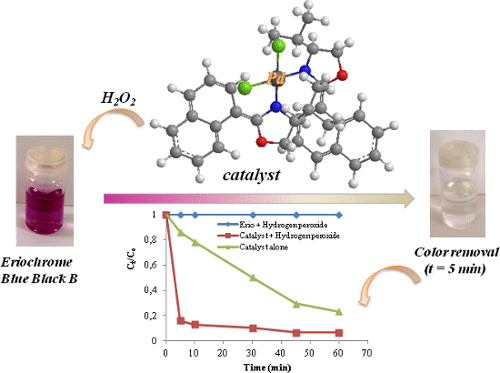
- exo regioisomers. Results obtained in the present study show that naphthyl-oxazoline has a tendency to form exclusively endo-cyclic complexes with the C=N bond within a palladacycle. Furthermore, NMR data analyses demonstrate that the five-membered palladacycle 5a was preferentially formed upon the


Advances in the synthesis of functionalised pyrrolotetrathiafulvalenes
Beilstein J. Org. Chem. 2015, 11, 1112–1122, doi:10.3762/bjoc.11.125
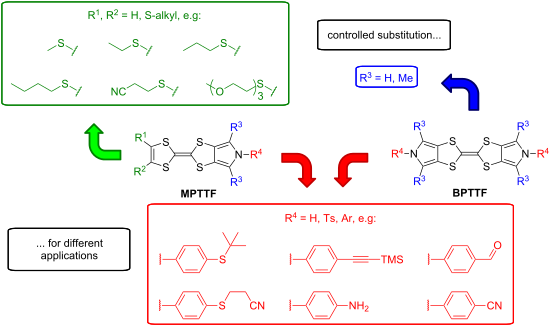
- discussions here will be limited to copper-mediated C–N-bond formation, as we find this to be a flexible and convenient method. Recent work in our laboratory has involved the N-arylation of MPTTFs, including both unsubstituted and thioether-substituted examples (Scheme 6 and Table 3). These materials have


An intramolecular C–N cross-coupling of β-enaminones: a simple and efficient way to precursors of some alkaloids of Galipea officinalis
Beilstein J. Org. Chem. 2015, 11, 884–892, doi:10.3762/bjoc.11.99

- widely applied metal for C–N bond formation [50][51][52]. We then applied the CuI/[L] catalytic system to 3a (see method C in Supporting Information File 1, pages S25 and S26). The choice of the ligand is crucial here, as L7 (Figure 2) had no effect (Table 1, entry 6) whereas using another common ligand


Fluoride-driven ‘turn on’ ESPT in the binding with a novel benzimidazole-based sensor
Beilstein J. Org. Chem. 2015, 11, 563–567, doi:10.3762/bjoc.11.61
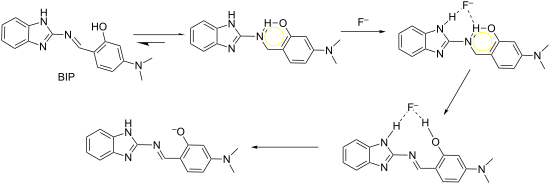
- characteristic bands centered at 410, 276 and 228 nm in CH3CN. Among these, the band in the region around 276 and 228 nm is attributed to the excitation of π electrons localized at the C=N bond and at the aromatic system [30], and the peak at 410 nm was ascribed to the intramolecular charge transition between


Azirinium ylides from α-diazoketones and 2H-azirines on the route to 2H-1,4-oxazines: three-membered ring opening vs 1,5-cyclization
Beilstein J. Org. Chem. 2015, 11, 302–312, doi:10.3762/bjoc.11.35

- in energy, the reaction sequence 10j→13j→14j leading to [3.2.1] adduct 6j seems to be more reasonable than 10j→15j→14j due to the much higher concentrations of the reacting species. Actually, the activation barrier to the bicyclic C–N bond cleavage in 10j is very low, but the equilibrium between 10j





