


Search results
Search for "dye" in Full Text gives 278 result(s) in Beilstein Journal of Organic Chemistry. Showing first 200.
Functional panchromatic BODIPY dyes with near-infrared absorption: design, synthesis, characterization and use in dye-sensitized solar cells
Beilstein J. Org. Chem. 2019, 15, 1758–1768, doi:10.3762/bjoc.15.169
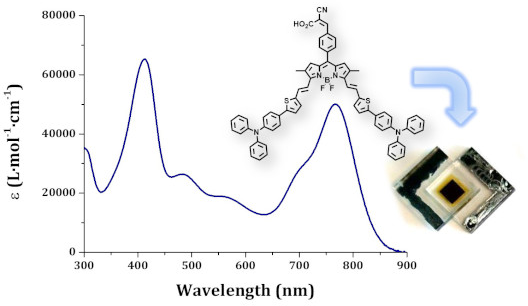
- were computed by density functional theory modelling (DFT) and characterized through UV–vis spectroscopy and cyclic voltammetry (CV) measurements. Finally, we report preliminary results obtained using these functional dyes as photosensitizers in dye-sensitized solar cells (DSSCs). Keywords: boron
- -dipyrromethene; BODIPY; dye-sensitized solar cells; near-infrared absorbers; organic dyes; Introduction The past two decades have witnessed tremendous efforts to develop alternative photovoltaic (PV) technologies. Among them, dye-sensitized solar cells (DSSCs) display numerous advantages compared to its fully
- liquids are employed [4][5]. Besides, this technology enables the fabrication of solar panels that can be prepared semi-transparent, colorful, and out of non-toxic constituents [6]. Historically, Ru(II)–polypyridyl complexes were the most used dyes as photosensitizers in DSSCs (N719 or N749 Black Dye) [7




Synthesis, photophysical and electrochemical properties of pyridine, pyrazine and triazine-based (D–π–)2A fluorescent dyes
Beilstein J. Org. Chem. 2019, 15, 1712–1721, doi:10.3762/bjoc.15.167
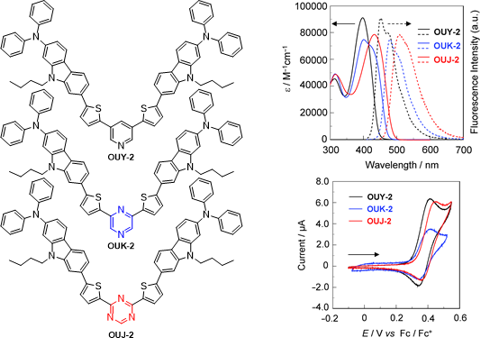
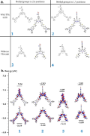
- polarity (i.e., positive fluorescence solvatochromism). The Lippert–Mataga plots for OUY-2, OUK-2 and OUJ-2 indicate that the Δμ (= μe − μg) value, which is the difference in the dipole moment of the dye between the excited (μe) and the ground (μg) states, increases in the order of OUY-2 < OUK-2 < OUJ-2
- ][18][19][20][21][22][23][24], and a promising photosensitizer for dye-sensitized solar cells (DSSCs) [25][26][27][28][29][30][31][32][33][34]. Thus, in this work, to gain insight into the photophysical and electrochemical properties of D–π–A fluorescent dyes with an azine ring as electron-withdrawing
- solvents are fairly large (Table 1). Thus, the fact indicates that the (D–π–)2A fluorescent dyes have advantageous characteristics as emitters for OLEDs and fluorescence probes for biological imaging. It is well accepted that the dipole–dipole interactions between the fluorescent dye and the solvent




Complexation of a guanidinium-modified calixarene with diverse dyes and investigation of the corresponding photophysical response
Beilstein J. Org. Chem. 2019, 15, 1394–1406, doi:10.3762/bjoc.15.139
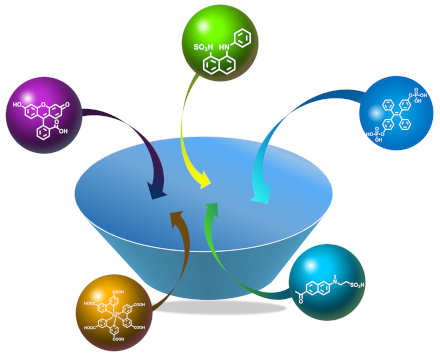
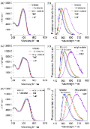
- intramolecular charge-transfer dyes. Phosphated tetraphenylethylene was involved as the classical aggregation-induced emission dye. Sulfonated acedan representing one example of two-photon fluorescent probes, was also investigated. A ruthenium(II) complex with carboxylated bipyridyl ligands was included as a
- representative candidate of luminescent transition-metal complexes. We determined the association constants of the GC5A–dye complexes by fluorescence titration and discuss the complexation-induced photophysical changes. In addition, a comparison of the complexation behavior of GC5A with that of other macrocycles
- use and high sensitivity, and has been widely used in fields of chemistry, biomedicine, environment, and so on [1]. Generally, the conversion of a luminescent dye to a chemosensor requires a grafting recognition motif for a particular analyte, whose installation often involves laborious and time



Host–guest interactions between p-sulfonatocalix[4]arene and p-sulfonatothiacalix[4]arene and group IA, IIA and f-block metal cations: a DFT/SMD study
Beilstein J. Org. Chem. 2019, 15, 1321–1330, doi:10.3762/bjoc.15.131
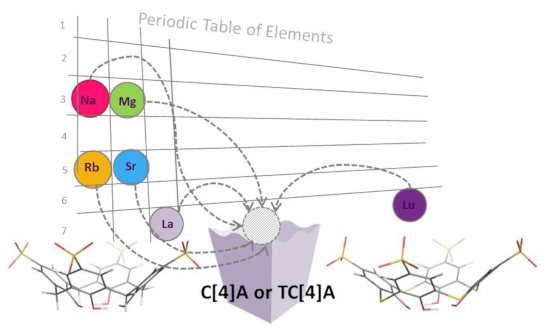
- selectivities; they have demonstrated excellent complex ability towards inorganic cations, organic ammonium cations, pyridinium guests, neutral molecules (alcohols, ketones, nitriles), dye molecules, etc. [26]. p-Sulfonatocalix[n]arenes are complexing agents for structurally diverse biologically active





Ugi reaction-derived prolyl peptide catalysts grafted on the renewable polymer polyfurfuryl alcohol for applications in heterogeneous enamine catalysis
Beilstein J. Org. Chem. 2019, 15, 1210–1216, doi:10.3762/bjoc.15.118
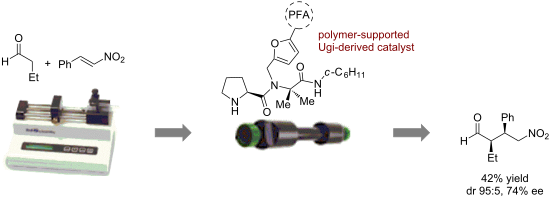
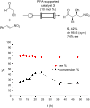
- which a substrate passes through the microreactor without interacting. In some cases, this residence time is measured by the time a dye needs to pass through the reactor. In this work, it was calculated by dividing V0 by the used flow rate (Φ) of 2.5 µL/min. The study of the Michael reaction under


Self-assembly behaviors of perylene- and naphthalene-crown macrocycle conjugates in aqueous medium
Beilstein J. Org. Chem. 2019, 15, 1203–1209, doi:10.3762/bjoc.15.117
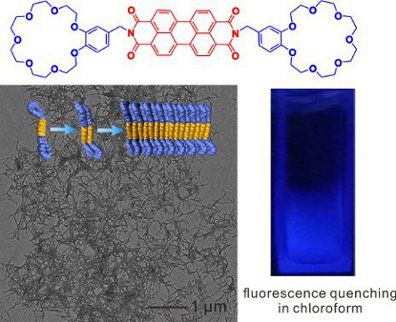
- widely used in the dye industry and have been applied as advanced materials in the fields of fluorescence labeling [58][59], organic semiconducting devices [60][61], and light harvesting [62][63][64][65]. PDI and NDI units have been extensively incorporated into functional supramolecular architectures


Precious metal-free molecular machines for solar thermal energy storage
Beilstein J. Org. Chem. 2019, 15, 1096–1106, doi:10.3762/bjoc.15.106
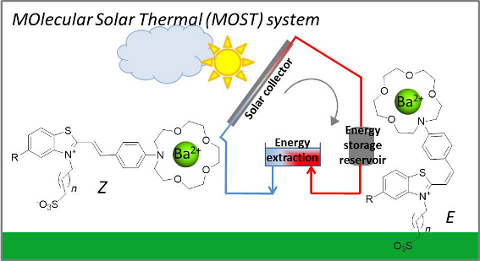
- . First of all, the azacrown nitrogen atom is linked directly to the dye and it is part of the chromophore system, responsible for the “push–pull” effect and the photophysical properties of the dye. This provides control over the “push–pull” effect in the chromophore by switching on and off states (i.e
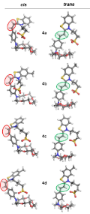
- defined their photophysical behavior in neat acetonitrile (ACN) solution and in the presence of barium cations. Figure 1 shows the absorption spectra of dyes 4a–d measured at different concentrations (cM) of Ba(ClO4)2. All dye solutions have similar absorption profiles with a broad long wavelength band in
- chromoionophore and the spectra in Figure 1 were assigned to the formation of the trans-dye–Ba2+ complex [19]. For all dye solutions, a distinct isosbestic point upon titration was observed, indicating only one kind of complex formation even at the highest Ba2+ concentration. To determine the optimal Ba2




Molecular recognition using tetralactam macrocycles with parallel aromatic sidewalls
Beilstein J. Org. Chem. 2019, 15, 1086–1095, doi:10.3762/bjoc.15.105
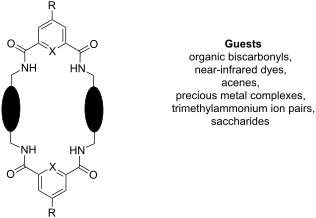
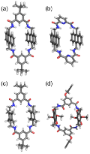
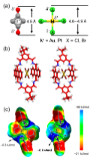
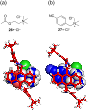
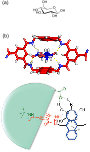
- enables them to be effective hosts for a wide range of guest molecules including organic biscarbonyl derivatives, near-infrared dyes, acenes, precious metal halide complexes, trimethylammonium ion-pairs, and saccharides. Keywords: fluorescent dye; host–guest chemistry; hydrogen bonding; hydrophobic
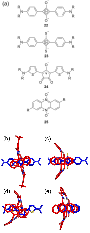
- acene guests Rotaxane template 18 in Scheme 2 is a squaraine dye whose central core has two oxygen atoms that can form hydrogen bonds with the tetralactam NH residues. Squaraine rotaxanes were first prepared by the Smith group in 2005 using the Leigh-type clipping method [44]. As a general trend the
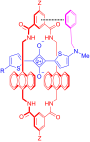
- photophysical property of a squaraine dye is improved when it is encapsulated by tetralactam A, B, or C, but squaraine fluorescence is quenched when the dye is encapsulated by tetralactam E whose structure has extremely electron-rich sidewalls [34]. The moderate flexibility of tetralactam A is one of the




Fabrication, characterization and adsorption properties of cucurbit[7]uril-functionalized polycaprolactone electrospun nanofibrous membranes
Beilstein J. Org. Chem. 2019, 15, 992–999, doi:10.3762/bjoc.15.97
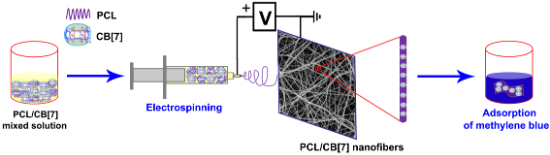
- blue (MB) is frequently used as a routine model dye molecule to test the adsorption capability of materials. More importantly, the binding constant of MB with CB[7] is as high as 107 M−1 in aqueous solution [33]. However, due to the considerable solubility of CB[7] in water, the adsorption experiment
- isotherm fitted the Langmuir isotherm model. Although the adsorption capability of the nanofibrous membranes was low due to weak binding between CB[7] and the dye molecule, it was greatly improved with the addition of CB[7]. Currently the fabrication of CB[n]s linked covalently on rigid polymeric matrices


Diaminoterephthalate–α-lipoic acid conjugates with fluorinated residues
Beilstein J. Org. Chem. 2019, 15, 981–991, doi:10.3762/bjoc.15.96
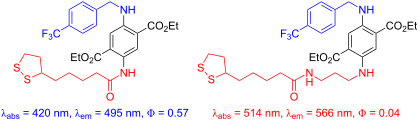
- sequence including one deprotection reaction. One functional unit is α-lipoic acid (ALA) for binding the dye to gold surfaces. It was introduced to the DAT scaffold by an amidation reaction. The other functional unit is a para-(trifluoromethyl)benzyl group for facile detection of the surface-bound material
- indicated that trifluoromethylation is an excellent tool for the detection of surface-bound materials by XPS. Keywords: chromophore; diaminoterephthalate; fluorine surface marker; fluorescence dye; lipoic acid; self-assembled monolayers; Introduction Diaminoterephthalates (DATs) are powerful fluorescence
- suitability for molecular surface labeling. Conclusion Two bifunctional diaminoterephthalate (DAT) fluorescence dyes have been prepared. One functional unit is α-lipoic acid (ALA) for binding the dye to gold surfaces. The other carries a trifluoromethyl group for facile detection of the surface-bound material


Synthesis of (macro)heterocycles by consecutive/repetitive isocyanide-based multicomponent reactions
Beilstein J. Org. Chem. 2019, 15, 906–930, doi:10.3762/bjoc.15.88
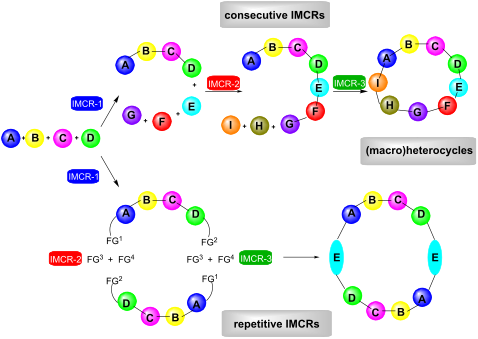
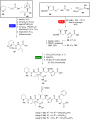
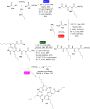
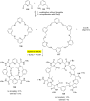
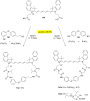
- -MiB. Functional macrocycles have been developed with dye-modified and photoswitchable moieties by MiBs [43]. The approach employed the use of bifunctionalized near-infrared (NIR) dyes containing two carboxylic acid moieties with diisocyanide building blocks providing the formation of somewhat flexible
- macrocycles [40]. Synthesis of cholane-based hybrid macrolactams by MiBs [41]. Synthesis of macrocyclic oligoimine-based DCL using the Ugi-4CR-based quenching approach [42]. Dye-modified and photoswitchable macrocycles by MiBs [43]. Synthesis of nonsymmetric cryptands by two sequential double Ugi-4CR-based









Design and synthesis of multivalent α-1,2-trimannose-linked bioerodible microparticles for applications in immune response studies of Leishmania major infection
Beilstein J. Org. Chem. 2019, 15, 623–632, doi:10.3762/bjoc.15.58
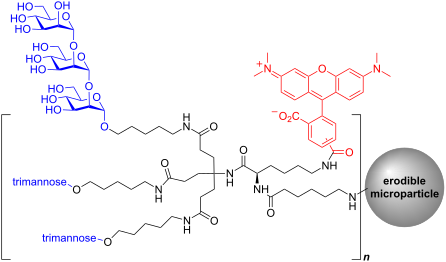
- of the commercially available rhodamine dye, TAMRA (555ex/580em), to the dendrimer would allow for standard immunofluorescence assays, to track the microparticle following cellular uptake and intracellular processing. TAMRA’s high photostability, low pH sensitivity and ease of incorporation through


Low-budget 3D-printed equipment for continuous flow reactions
Beilstein J. Org. Chem. 2019, 15, 558–566, doi:10.3762/bjoc.15.50
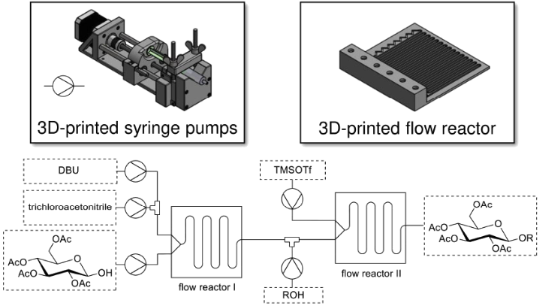
- . The shape of the channels is a square with 1.2 mm × 1.2 mm diameter and the reactor has a total volume of 1.05 mL. It was designed to have two initial inlets with a subsequent chaotic mixing zone [27] and one quench inlet. We chose two dye solutions in dichloromethane for mixing experiments as a model
- system. a) CAD drawing of the reactor R1. b) 3D-printed reactor R1 from the CAD drawing. The reactor is filled with a blue dye solution for better visibility of the channels. c) Early stage prototype of a 3D-printed flow reactor (R2). d) Mixing test of two dye solutions. a) L-shaped rail made of PLA with
- the mounted reactor R3. The small picture shows the fixed reactor in the rail. b) In-printed screw nuts during 3D-printing: The print was paused, the nuts inserted and the print resumed. a) Microreactor R4 with a reactor volume of 12 µL filled with a blue dye solution. b) Magnification of the reactor


Synthesis and SAR of the antistaphylococcal natural product nematophin from Xenorhabdus nematophila
Beilstein J. Org. Chem. 2019, 15, 535–541, doi:10.3762/bjoc.15.47
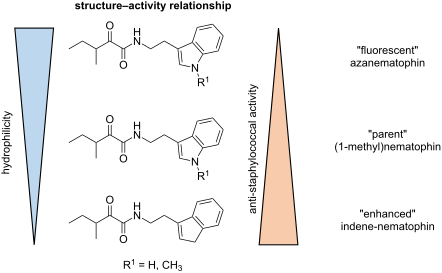
- relationship of the simple and antistaphylococcal amide nematophin from Xenorhabdus nematophila and synthetic derivatives are described. Moreover, the synthesis of intrinsic fluorescent derivatives, incorporating azaindole moieties was achieved for the first time. Keywords: azaindole; fluorescent dye; MRSA


New standards for collecting and fitting steady state kinetic data
Beilstein J. Org. Chem. 2019, 15, 16–29, doi:10.3762/bjoc.15.2
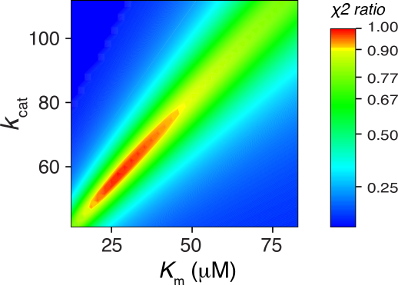
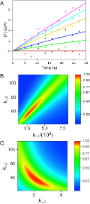
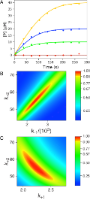
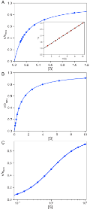
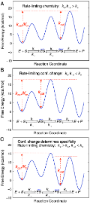
- concentration of active sites. There are significant systematic errors in measurements of protein concentrations using dye-binding assays or by absorbance measurements, and the fraction of protein that is active is not known without direct measurement. For these reasons, it is important to perform an active



Organometallic vs organic photoredox catalysts for photocuring reactions in the visible region
Beilstein J. Org. Chem. 2018, 14, 3025–3046, doi:10.3762/bjoc.14.282
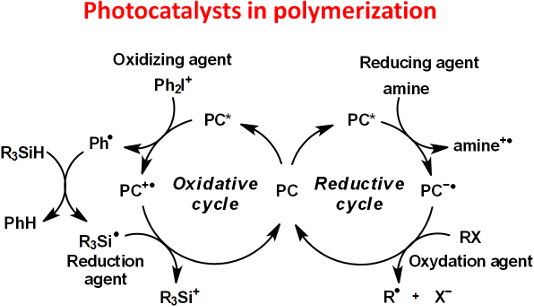
- )iridium(III) reported in ref [37] for photocontrolled radical polymerization of methacrylates. The use of a Fe complex or dye (for metal-free PC) is also possible to performed ATRP as described in reference [107]. A ROMP mechanism is also possible thanks to the photoredox catalyst. ROMP stands for ring



Novel solid-phase strategy for the synthesis of ligand-targeted fluorescent-labelled chelating peptide conjugates as a theranostic tool for cancer
Beilstein J. Org. Chem. 2018, 14, 2665–2679, doi:10.3762/bjoc.14.244
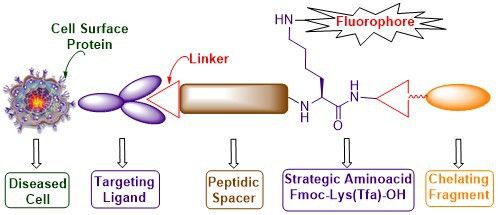
- affinity of the PSMA-targeting conjugate 13; it minimizes the repulsive interaction between the bulky dye molecule and the targeted folate protein active site in the case of folate receptor targeting bioconstruct 17, (iii) a fluorescent tag to track the cellular destination of bioconjugates and



Targeting the Pseudomonas quinolone signal quorum sensing system for the discovery of novel anti-infective pathoblockers
Beilstein J. Org. Chem. 2018, 14, 2627–2645, doi:10.3762/bjoc.14.241
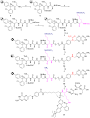
- facilitated the discovery of novel PqsD-targeting compounds through CuAAC-mediated conjugation of a fluorescent dye (Figure 9) [62]. Finally, Sangshetti et al. reported the discovery of linezolid-like Schiff bases, which showed promising anti-biofilm activity in the double-digit micromolar range [63]. Notably


Synthesis of aryl sulfides via radical–radical cross coupling of electron-rich arenes using visible light photoredox catalysis
Beilstein J. Org. Chem. 2018, 14, 2520–2528, doi:10.3762/bjoc.14.228
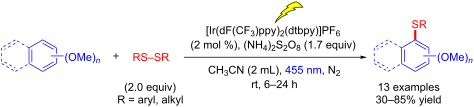
- ). The organic dye 9-mesityl-10-phenylacridinium tetrafluoroborate completely decomposed in the presence of excess disulfide within 30 minutes of irradiation. [Ir(dF(CF3)ppy)2(dtbpy)]PF6 was found to be the best photocatalyst and in this case, CH3CN was the best solvent compared to DMF, DMSO and DCE


Comparative cell biological study of in vitro antitumor and antimetastatic activity on melanoma cells of GnRH-III-containing conjugates modified with short-chain fatty acids
Beilstein J. Org. Chem. 2018, 14, 2495–2509, doi:10.3762/bjoc.14.226
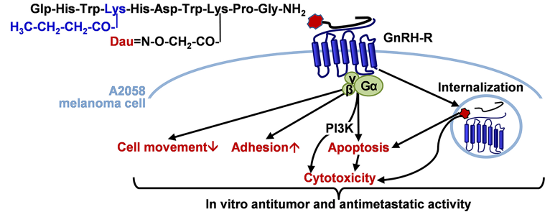
- -250TM, ChemoMetec A/S, Lillerød, Denmark) using Vitabright-48™ (ChemoMetec A/S, Lillerød, Denmark), a cell permeable dye that reacts with thiol groups to form a fluorescent product. An inverse correlation has been shown between the concentration of thiols and progression of apoptosis; the level of
- thiols, and hence the fluorescence intensity of this dye decrease in response to induction of apoptosis [44]. Based on the percentages of apoptotic cells shown in Table 4, there was a good match between the values provided by these two different methods. As expected, the maximum apoptotic effect was


Bioinspired cobalt cubanes with tunable redox potentials for photocatalytic water oxidation and CO2 reduction
Beilstein J. Org. Chem. 2018, 14, 2331–2339, doi:10.3762/bjoc.14.208
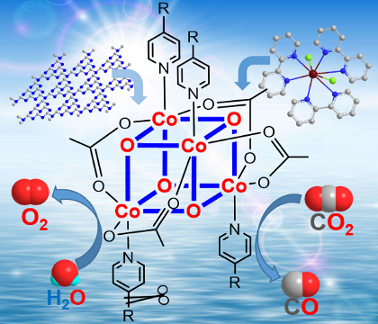
- after 3 h reaction in each case is due to photobleaching of the used dye photosensitizer. Moreover, after water oxidation and CO2 reduction reactions, the structures of 1-CN and 1-OMe were studied by 1H NMR spectroscopy, and no obvious changes were observed compared with the fresh samples (Supporting


Hydroarylations by cobalt-catalyzed C–H activation
Beilstein J. Org. Chem. 2018, 14, 2266–2288, doi:10.3762/bjoc.14.202
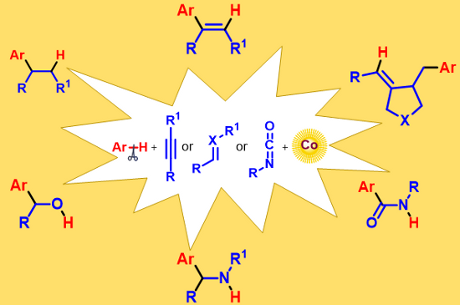
- limited to terminal alkynes. Additionally, they applied this methodology to design a mitochondria-targeted imaging dye from electron-withdrawing formyl-substituted indoles and alkynes. Later, Maji’s group reported an N-tert-butyl amide-directed mono- and di-alkenylation reactions using a cobalt catalyst








Synthesis of new p-tert-butylcalix[4]arene-based polyammonium triazolyl amphiphiles and their binding with nucleoside phosphates
Beilstein J. Org. Chem. 2018, 14, 1980–1993, doi:10.3762/bjoc.14.173
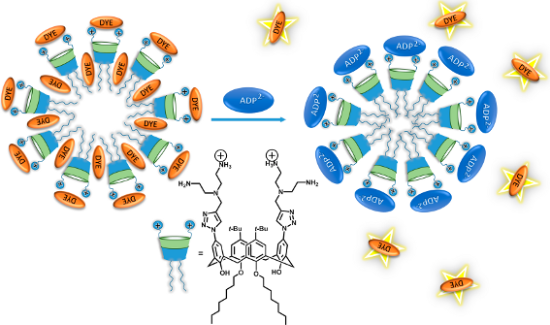
- pyrene and eosin Y as dye probes. The CAC values of tetraalkyl-substituted macrocycles 12a,b (5 µM for both) are significantly lower than those for dialkyl-substituted macrocycles 10a,b (790 and 160 µM, respectively). Premicellar aggregates of macrocycles 10a,b and 12a,b with the dye eosin Y were used
- for nucleotides sensing through a dye replacement procedure. It is unusual that disubstituted macrocycles 10a,b bind more effectively a less charged adenosine 5'-diphosphate (ADP) than adenosine 5'-triphosphate (ATP). A simple colorimetric method based on polydiacetylene vesicles decorated with 10b
- performed by the dye micellization method using pyrene and eosin Y (EY) as fluorescent and spectrophotometric probes, respectively (Table 1). The nonpolar pyrene can be incorporated into hydrophobic domains of the aggregates due to hydrophobic interactions. Pyrene insertion is measured by analyzing the


Rational design of boron-dipyrromethene (BODIPY) reporter dyes for cucurbit[7]uril
Beilstein J. Org. Chem. 2018, 14, 1961–1971, doi:10.3762/bjoc.14.171
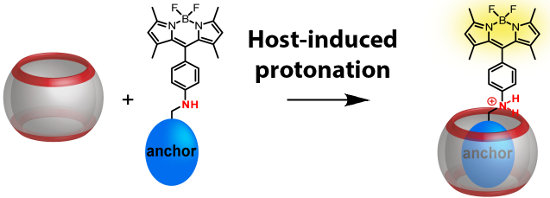
- host-induced protonation and thus to a fluorescence increase. The possibility to tune binding affinities and pKa values is demonstrated and it is shown that, in combination with the beneficial photophysical properties of BODIPYs, several new applications of host–dye reporter pairs can be implemented
- fluorescent dyes directly enables (bio)sensing applications through the indicator displacement principle [16][17]. Therein, the fluorescence properties of a dye are altered when encapsulated by the host, and when a competitive binder displaces the dye from the cavity, the properties of the non-encapsulated
- dye are regenerated. This principle has enabled, for example, real-time monitoring of enzymatic activity [18][19][20], the detection of membrane-transport activity [21] and membrane fusion [22], and even cellular imaging appears to be a potential future prospect [23][24]. However, most combinations of




Strong binding and fluorescence sensing of bisphosphonates by guanidinium-modified calix[5]arene
Beilstein J. Org. Chem. 2018, 14, 1840–1845, doi:10.3762/bjoc.14.157
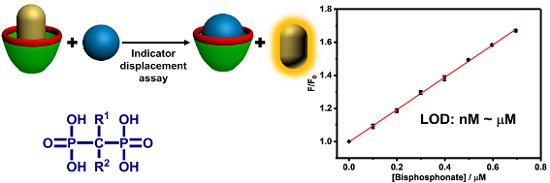
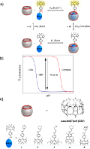
- , we employed fluorescein (Fl) as the reporter dye according to our previously published result [26]. Fl of high brightness is strongly encapsulated into the GC5A cavity (Ka = 5.0 × 10⁶ M−1), accompanied with a drastic complexation-induced fluorescence quenching (Ifree/Ibound = 37). Taken together
- , these factors make the GC5A·Fl reporter pair an ideal combination for the projected IDA application. IDA was implemented to determine the binding affinities between GC5A and BPs via competitive fluorescence titrations. More importantly, the displacement of the reporter dye, accompanied with fluorescence





