Search results
Search for "lifetime" in Full Text gives 174 result(s) in Beilstein Journal of Organic Chemistry.
Synthesis and photophysical characteristics of polyfluorene polyrotaxanes
Beilstein J. Org. Chem. 2015, 11, 2677–2688, doi:10.3762/bjoc.11.288
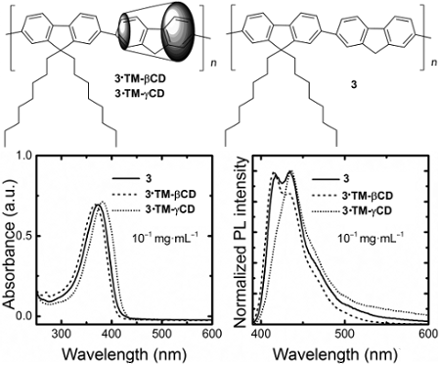
- lifetime τ = 0.7 ns and 0.8 ns, whereas the 3·TM-γCD polyrotaxane shows a bi-exponential decay consisting of a main component (with a weight of 98% of the total luminescence) with a relatively short decay constant of τ1 = 0.7 ns and a minor component with a longer lifetime of τ2 = 5.4 ns (2%). The
- weights of 98 and 2%, respectively. The longer τ for the 3·TM-γCD polyrotaxane is consistent with “interchain states”. While these do not dominate the luminescence of the materials (the longer lifetime only accounts for 2% of the total PL weight), they are plausible, considered the significantly bigger


Friedel–Crafts-type reaction of pyrene with diethyl 1-(isothiocyanato)alkylphosphonates. Efficient synthesis of highly fluorescent diethyl 1-(pyrene-1-carboxamido)alkylphosphonates and 1-(pyrene-1-carboxamido)methylphosphonic acid
Beilstein J. Org. Chem. 2015, 11, 2451–2458, doi:10.3762/bjoc.11.266
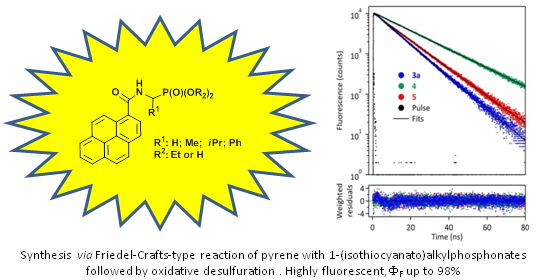
- species. Table 2 shows that 3a displays a slightly shorter excited state lifetime (10.6 ns) than its alkyl analogue 5 (12.3 ns). The higher emission quantum yield of 3a results from a ≈2.3 times higher value of kr and a concomitant ca. 1.8 times lower value of knr. Notably, compound 4 displays a kr value


Synthesis, structure, and mechanical properties of silica nanocomposite polyrotaxane gels
Beilstein J. Org. Chem. 2015, 11, 2194–2201, doi:10.3762/bjoc.11.238
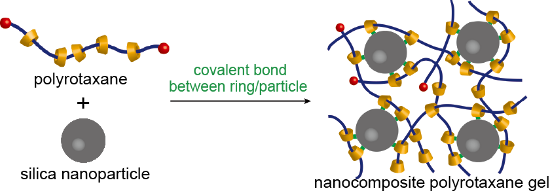
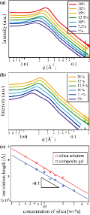
- -links that have finite lifetime. On the other hand, the infinite network exhibited an abnormally low Young’s modulus, ~1 kPa, which is not explainable by traditional rubber theory. In addition, the composite gels were tough enough to completely maintain the network structure under 80% compression strain
- independent of the strain. These results clearly indicate that the silica nanocomposite polyrotaxane gels form an infinite network structure with negligible physical cross-links that have finite lifetime to exhibit stress relaxation, similar to ideal chemical gels. At the same time, the negligible relaxation




Terminal lipophilization of a unique DNA dodecamer by various nucleolipid headgroups: Their incorporation into artificial lipid bilayers and hydrodynamic properties
Beilstein J. Org. Chem. 2015, 11, 913–929, doi:10.3762/bjoc.11.103
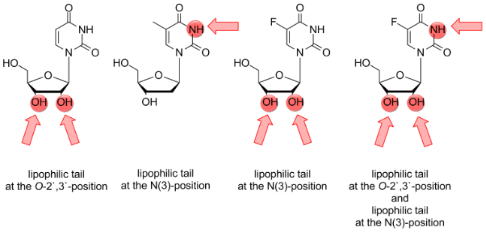
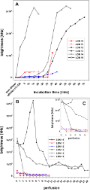
- residue within a nucleic acid [24][25]. This results in a hydration of 1 g of H2O per gram. However, Bloomfield et al. in 2000 [26] as well as Fernandes et al. in 2002 [23] reported hydration degrees of 0.35 [26] or 0.3 g of water per gram of nucleotide (Table 5). Confocal fluorescence lifetime analysis
- (cFLA) Next, the fluorescence lifetime values of the LONs 10–15 were measured and are listed in Figure 17A–C as well as in Table 6. The fluorescence lifetime of the free Cy5 dye is reported to be 0.91 ns [27], 1.0 ns [28][29], and 1.0–1.4 ns [30]. In the literature, fluorescence lifetimes of free Cy5
- dye attached to ssDNA as well as to dsDNA, respectively, also exist. The fluorescence lifetime, τF, of two 5’-Cy5-ssDNA conjugates were measured as 1.8 ± 0.1 ns [31] for a 36mer and a 23mer [32]. For a Cy5-labeled 25mer, a value of 1.26 ns [27] was reported. For the LONs 10–15 described here, longer






Design, synthesis and photochemical properties of the first examples of iminosugar clusters based on fluorescent cores
Beilstein J. Org. Chem. 2015, 11, 659–667, doi:10.3762/bjoc.11.74
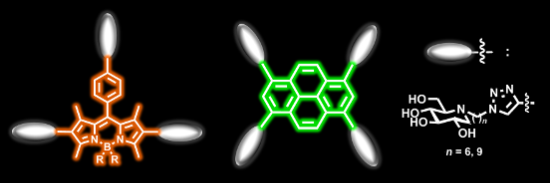
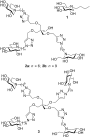
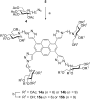
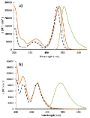
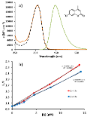
- the decrease of fluorescence versus the concentration of quencher. The Stern–Volmer equation facilitates the calculation of the rates of bimolecular collisional quenching kq = 1.8 × 10¹³ M−1·s−1 and 1.5 × 10¹³ M−1·s−1, respectively for 13a and 15a dyes using a lifetime τ = 5.31 ns for the 4



Photocatalytic nucleophilic addition of alcohols to styrenes in Markovnikov and anti-Markovnikov orientation
Beilstein J. Org. Chem. 2015, 11, 568–575, doi:10.3762/bjoc.11.62
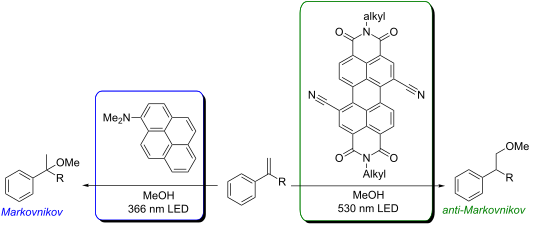
- . Spectroelectrochemistry measurements (see Supporting Information File 1) revealed that the blue colored intermediate could be assigned to the radical anion of PDI as photocatalyst whose half-lifetime was determined to be approximately 4 min (Figure 3). The appearance of this intermediate strongly supported the proposed


Come-back of phenanthridine and phenanthridinium derivatives in the 21st century
Beilstein J. Org. Chem. 2014, 10, 2930–2954, doi:10.3762/bjoc.10.312

- properties in comparison to other phenanthridinium analogues by means of signal brightness, signal-to-background noise and increased fluorescence half-lifetime. The same dye was also applied as convenient reporter for si-RNA (Figure 8, right) [84]. In parallel the designed and tested covalently linked
- ethidium bromide–ruthenium(II) complex also proved to be an imaging probe whose fluorescence intensity and lifetime changes substantially in the presence of RNA [85], thus supporting a strategy of phenanthridinium incorporation into the heterogenic two-chromophore system. Phenanthridines are rarely




The effect of permodified cyclodextrins encapsulation on the photophysical properties of a polyfluorene with randomly distributed electron-donor and rotaxane electron-acceptor units
Beilstein J. Org. Chem. 2014, 10, 2145–2156, doi:10.3762/bjoc.10.222
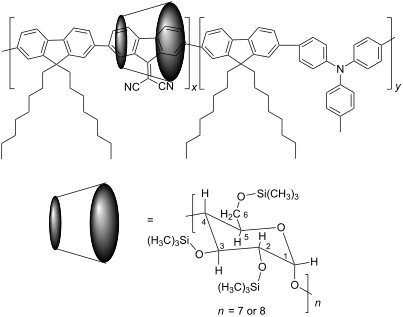
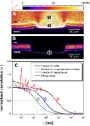
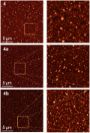
- lifetime of τ2 = 1.56 ns (42.92%) were determined. The optical and electrochemical band gaps (ΔEg) as well as the ionization potential and electronic affinity characterized by smaller values compared to the values of any of the constituents. AFM reveals that the film surface of 4a and 4b displays a
- interaction between macrocyclic molecules and conjugated cores [26][40]. The decay traces of 4 non-rotaxane counterpart obtained from the fluorescence lifetime measurements follow a bi-exponential decay, which consists of a main component with a relative short time of τ1 = 0.88 (57.08%) and a minor component
- with a longer lifetime of τ2 = 1.56 ns (42.92%) (Figure S7 in Supporting Information File 1 and Table 2). The observed behavior suggests that the bi-exponential decay of the non-rotaxane 4 may be caused by the intrachain emission and excitonic lifetime, whereas in the case of the polyrotaxanes it may


The Ugi four-component reaction as a concise modular synthetic tool for photo-induced electron transfer donor-anthraquinone dyads
Beilstein J. Org. Chem. 2014, 10, 1006–1016, doi:10.3762/bjoc.10.100
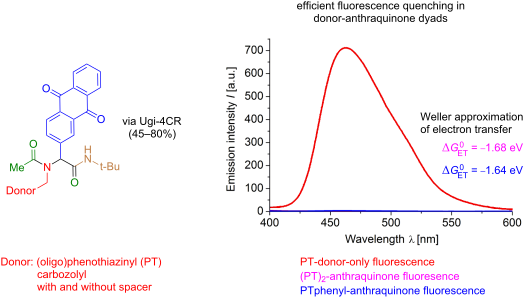
- anthraquinone-substituted aldehyde together with acetic acid and tert-butyl isocyanide for rapidly assembling a donor–acceptor conjugate 1 displaying a photo-induced electron transfer leading to a charge-separated state with a lifetime of >2 ns (Figure 1), as elucidated by femtosecond transient absorption




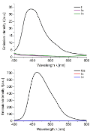
Tailoring of organic dyes with oxidoreductive compounds to obtain photocyclic radical generator systems exhibiting photocatalytic behavior
Beilstein J. Org. Chem. 2014, 10, 936–947, doi:10.3762/bjoc.10.92
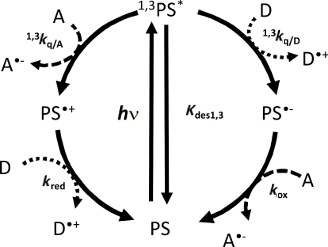
- . Intersystem crossing rate constant kISC was obtained from the triplet state quantum yield and singlet state lifetime according to [59]: which leads to: and to At this RB concentration, and in the absence of quencher, the triplet state lifetime was measured around 80 µs, leading to kdes3= 1.25·104 M−1s−1
- under argon bubbling at room temperature. The quenching rate constants kq of the excited states were obtained according to the Stern–Volmer analysis where the reciprocal lifetime is plotted as a function of quencher concentration: [57]. Chemicals: Rose Bengal extra (RB) and ethyl 4-(dimethylamino


![[Graphic 1]](/bjoc/content/inline/1860-5397-10-92-i10.png?max-width=637&scale=1.18182) ), b) excited state...
), b) excited state...


Metal and metal-free photocatalysts: mechanistic approach and application as photoinitiators of photopolymerization
Beilstein J. Org. Chem. 2014, 10, 863–876, doi:10.3762/bjoc.10.83
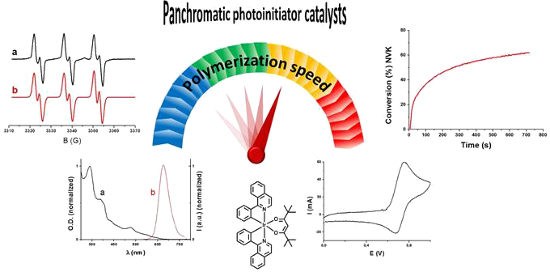
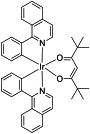
- panchromatic behavior in the 400–650 nm range. The PIC/Ph2I+/NVK system The photochemical properties of Ir(piq)2(tmd) A triplet-state lifetime of 1.1 μs has been determined for Ir(piq)2(tmd) by laser flash photolysis experiments. A relatively similar lifetime (1.3 μs) was previously measured for 3Ir(ppy)3 [68






One-pot three-component synthesis and photophysical characteristics of novel triene merocyanines
Beilstein J. Org. Chem. 2014, 10, 599–612, doi:10.3762/bjoc.10.51
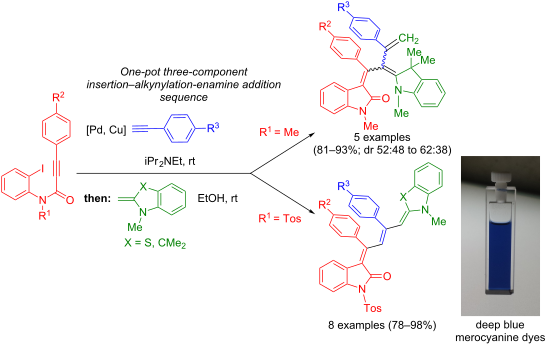
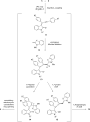
- the outcome of the sequence. The latter hypothesis of the iminium-ion stabilization obviously influences the lifetime of the zwitterion 13. Furthermore the enamine formed by deprotonation of 9 is a S,N-ketene acetal, which is significantly more nucleophilic than Fischer’s base (7). The higher




Flow synthesis of phenylserine using threonine aldolase immobilized on Eupergit support
Beilstein J. Org. Chem. 2013, 9, 2168–2179, doi:10.3762/bjoc.9.254
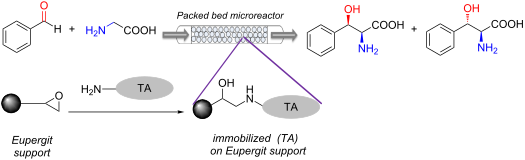
- . It was anticipated that at lower temperatures the lifetime of the immobilized enzyme would be extended and would allow long term operation of the flow system. Indeed, the product yield was almost constant at around 30–35% even after 10 hours of continuous operation (Figure 8). Here, the inhibitory


Studies on the photodegradation of red, green and blue phosphorescent OLED emitters
Beilstein J. Org. Chem. 2013, 9, 2088–2096, doi:10.3762/bjoc.9.245

- -thaw, then argon atmosphere). All compounds were irradiated in CH2Cl2 and toluene as mentioned above, but also in benzene and benzene-d6. Singlet oxygen has a significantly higher lifetime in deuterated solvents, resulting in an effective enhancement of the reaction rates of singlet oxygen. Processes
- shorter lifetime of the excited states and consequently a reduced degradation rate for processes induced via those states. The observations from the photodegradation experiments suggest strong differences in the contribution of these two pathways for the four examined compounds. We therefore discuss the
- structure is in good agreement with the course of the degradation curve of the experiments in benzene-d6 under ambient conditions. The increased lifetime of 1O2 in the deuterated solvent enhances the complex oxidation. Nonetheless, the observation that the degradation proceeds is fastest under inert


The chemistry of amine radical cations produced by visible light photoredox catalysis
Beilstein J. Org. Chem. 2013, 9, 1977–2001, doi:10.3762/bjoc.9.234
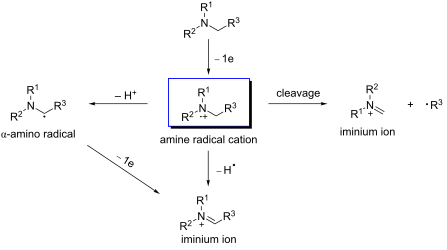
- share one common characteristic: a facile intersystem crossing (ISC) that allows the conversion of the initially formed singlet photoexcited state to the relatively long-lived triplet photoexcited state. The triplet photoexcited state’s long lifetime permits it to engage in single-electron transfer with




Damage of polyesters by the atmospheric free radical oxidant NO3•: a product study involving model systems
Beilstein J. Org. Chem. 2013, 9, 1907–1916, doi:10.3762/bjoc.9.225

- increasingly demanding applications, but their lifetime is strongly influenced by environmental conditions. In particular, weathering and ageing leads to dramatic changes in the properties of the polymers, which results in decreased service life and limited usage. Despite the heavy reliance of our society on
- intermediate radical cation has a lifetime on the nanosecond time scale [23]. It was further demonstrated that deprotonation of arylradical cations is accelerated by nitrate (NO3−) that is present in the reaction system as ‘byproduct’ of the oxidation process and as ligand in CAN, and which acts as a Brønsted


Topochemical control of the photodimerization of aromatic compounds by γ-cyclodextrin thioethers in aqueous solution
Beilstein J. Org. Chem. 2013, 9, 1858–1866, doi:10.3762/bjoc.9.217
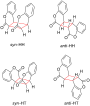
- < 10−3% and mainly leading to the anti-HH dimer [39]. In contrast, polar protic solvents, like water, increase both the quantum yield and the amount of the syn-HH dimer, exemplified in Table 3. The singlet state has a very short lifetime because of rapid intersystem crossing and self-quenching and it
- reacts to form the syn-HH dimer, while the triplet state, with a longer lifetime, furnishes the anti-HH isomer [38][40]. Because most often mixtures of syn and anti isomers were obtained after irradiation of COU, any supramolecular control of the dimerization was highly desirable. Photodimerization of a
- the dominant factor, but rather the pre-organization of the guest molecules in the CD cavity prior to excitation has the greatest effect. The distribution of the stereoisomers appears to be mainly topochemically [5] controlled because of the short lifetime of the excited state of COU. Quantum



Controlled synthesis of poly(3-hexylthiophene) in continuous flow
Beilstein J. Org. Chem. 2013, 9, 1492–1500, doi:10.3762/bjoc.9.170
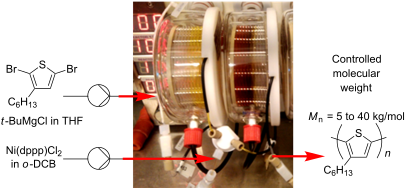
- with the emergence of organic electronic devices. In particular, large-area devices such as organic thin-film photovoltaics will require significant quantities of materials for device optimization, lifetime testing and commercialization. Sourcing large quantities of materials required for the



Electron self-exchange activation parameters of diethyl sulfide and tetrahydrothiophene
Beilstein J. Org. Chem. 2013, 9, 1448–1454, doi:10.3762/bjoc.9.164
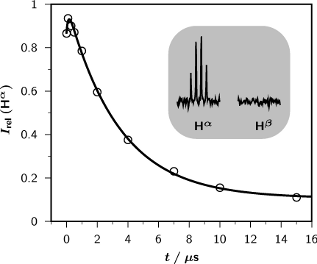
- triplet energy (222 kJ/mol [32]) is only lower by less than 90 kJ/mol. Its first excited singlet state has a lifetime of 2.9 ns [32], so reacts only marginally with the millimolar sulfide concentrations used in our experiments, but its triplet state (intrinsic intersystem-crossing efficiency, 0.48 [32
- ], with evidence for a noticeable increase in the presence of DES by an intermolecular heavy-atom effect [33]) is quenched [34] quantitatively (lifetime, 10 μs [32]; diffusion-controlled electron transfer from DES [35]) under our experimental conditions. Protonation of the pyranyl radical TPP• is unknown


Synthesis and spectroscopic properties of 4-amino-1,8-naphthalimide derivatives involving the carboxylic group: a new molecular probe for ZnO nanoparticles with unusual fluorescence features
Beilstein J. Org. Chem. 2013, 9, 1311–1318, doi:10.3762/bjoc.9.147

- (3H)-yl)benzoic acid (4) was found to be a sensitive molecular probe for ZnO nanoparticles. We investigated in detail one- and two-photon absorption properties of this fluorophore. In nonpolar solvents, the acid 4 absorbs at about 400 nm and fluoresces at 500 nm with a fluorescence lifetime of about 7
- Scheme 2. We exclude the possibility of participation of the amino group in the equilibrium since, according to our preliminary experiments, the parent compound prepared from 1,8-naphthalic anhydride behaves similarly. The fluorescence lifetime measurements were performed under 350–450 excitation and
- detection between 470 and 700 nm in toluene and ethanol. We observed a strong influence of the solvent on the photophysical properties of compound 4. In toluene, at 500 nm (corresponding to the fluorescence maximum), the fluorescence decay followed a mono-exponential law with a lifetime equal to 6.98 ns


Substituent effect on the energy barrier for σ-bond formation from π-single-bonded species, singlet 2,2-dialkoxycyclopentane-1,3-diyls
Beilstein J. Org. Chem. 2013, 9, 925–933, doi:10.3762/bjoc.9.106
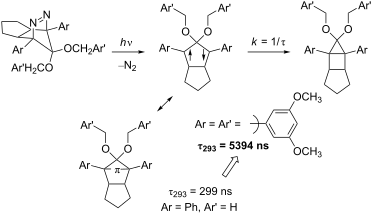
- and cyclopentane-1,3-diyls. Experimental investigation of the chemistry of singlet diradicals has become possible. The present study explores the substituents and the effect of their substitution pattern at the C(1)–C(3) positions on the lifetime of singlet octahydropentalene-1,3-diyls to understand
- formation process) were determined by the temperature-dependent change of the lifetime. The energy barrier was found to be largely dependent upon the substituents Ar and Ar’. The singlet diradical DRf (Ar = 3,5-dimethoxyphenyl, OCH2Ar’ = OCH2(3,5-dimethoxyphenyl)) was the longest-lived, τ293 = 5394 ± 59 ns
- , among the diradicals studied here. The lifetime of the parent diradical DR (Ar = Ph, OCH2Ar’ = OCH3) was 299 ± 2 ns at 293 K. Conclusion: The lifetimes of the singlet 1,3-diyls are found to be largely dependent on the substituent pattern of Ar and Ar’ at the C(1)–C(3) positions. Both the enthalpy and


New core-pyrene π structure organophotocatalysts usable as highly efficient photoinitiators
Beilstein J. Org. Chem. 2013, 9, 877–890, doi:10.3762/bjoc.9.101
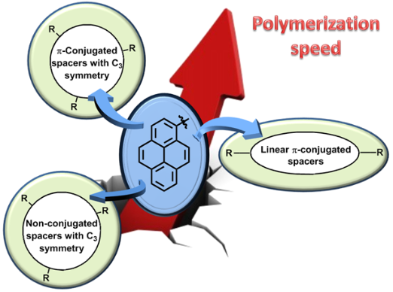
- to radical polymerization. Laser flash photolysis Upon laser excitation of Py_3 at 355 nm, a triplet state T1 characterized by a maximum absorption at ~420 nm and a rather long lifetime is formed (t > 4 μs) (Figure S2 in Supporting Information File 1). This T1 state is similar to that of Py_1 [31
- ]. The short S1 lifetime (e.g., ~55 ns under N2 for Py_3) and the diffusion controlled interactions of S1 with Iod, PBr or MDEA (see above) prevent a significant production of T1 in Co_Py/Iod (PBr or MDEA). Therefore, a triplet-state pathway can be neglected in the investigated systems. Thermal processes


Ring opening of 2-aza-3-borabicyclo[2.2.0]hex-5-ene, the Dewar form of 1,2-dihydro-1,2-azaborine: stepwise versus concerted mechanisms
Beilstein J. Org. Chem. 2013, 9, 761–766, doi:10.3762/bjoc.9.86
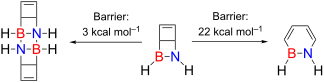
- roughly 10 kcal mol−1 lower than the lowest energy pathway for ring opening of Dewar benzene. Therefore, the lifetime of the Dewar form 3 is expected to be significantly lower than that of Dewar benzene. Nonetheless, with a barrier for isomerisation of about 22 kcal mol−1, 3 should be observable in
- one is lower in energy than the conrotatory ring opening by 9 kcal mol−1. 3. The lowest energy pathway for ring opening of 3 has a barrier of 22 kcal mol−1. 4. The lifetime of 3 in solution will not be limited by the ring opening to 4, but rather by dimerisation. This is a strongly exothermic process


Some aspects of radical chemistry in the assembly of complex molecular architectures
Beilstein J. Org. Chem. 2013, 9, 557–576, doi:10.3762/bjoc.9.61

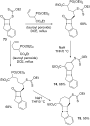
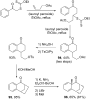
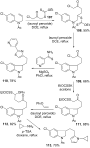
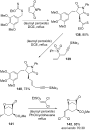
- of radical R· with its xanthate precursor 27 to give adduct 28 is fast but degenerate (path A). Radical R· is therefore continuously regenerated and acquires an extended effective lifetime. It can thus be readily captured intra- or intermolecularly, even by unactivated olefinic traps, to give finally
- -diol on one of the alkenes would in principle result in the formation of a cyclic ketal. Spiro and cyclic ketals are ubiquitous in pheromones and in marine natural products [51]. The comparatively long effective lifetime of radicals generated under the conditions of the xanthate transfer may be













Spin state switching in iron coordination compounds
Beilstein J. Org. Chem. 2013, 9, 342–391, doi:10.3762/bjoc.9.39
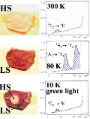
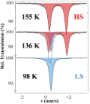
- peak, lifetime of the ortho-positronium) in different spin states, the technique will probably not attain the status of a widely employed method in SCO research. Magnetic resonance spectroscopy (NMR, EPR). Proton NMR measurements (Evans method) have been carried out to follow a temperature-dependent ST
- nonadiabatic multiphonon relaxation model proposed earlier by Buhks, Jortner et al. [152]. As an essential feature, it was found that the lifetime tHL0, i.e., the low temperature tunneling rate kHL0 = (tHL0)−1 of the LIESST state, is governed by the energy difference ΔEHL0 between the lowest vibronic energy







![[Graphic 1]](/bjoc/content/inline/1860-5397-9-39-i3.png?max-width=637&scale=1.18182) ) modes versus the anion volu...
) modes versus the anion volu...