


Search results
Search for "promoter" in Full Text gives 132 result(s) in Beilstein Journal of Organic Chemistry.
Synthesis of 6-PEtN-α-D-GalpNAc-(1–>6)-β-D-Galp-(1–>4)-β-D-GlcpNAc-(1–>3)-β-D-Galp-(1–>4)-β-D-Glcp, a Haemophilus influenzae lipopolysacharide structure, and biotin and protein conjugates thereof
Beilstein J. Org. Chem. 2010, 6, 704–708, doi:10.3762/bjoc.6.80
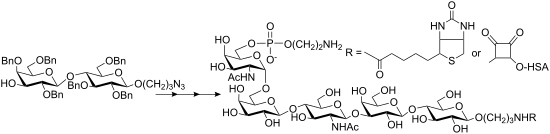
- -containing lactose derivative a suitably protected lacto-N-neotetraose tetrasaccharide structure was constructed through subsequential couplings with two thioglycoside donors, a glucosamine residue followed by a galactose derivative, using NIS/AgOTf as promoter. Removal of a silyl protecting group at the
- are often used as acceptors for regioselective glycosidations in the 3-position. However, the selectivity is dependent on the donor, promoter and conditions employed [15], e.g., it has been shown that donors containing a 4,6-O-benzylidene acetal can give a mixture of products [16]. Hence, the diol 7


Synthesis, electronic properties and self-assembly on Au{111} of thiolated (oligo)phenothiazines
Beilstein J. Org. Chem. 2010, 6, No. 72, doi:10.3762/bjoc.6.72
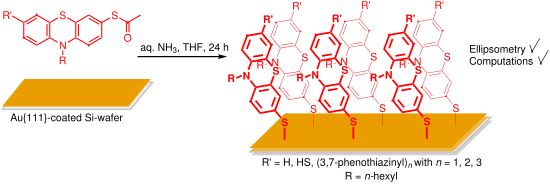
- thiols on Au{111}. The ability of the molecules to form SAMs was investigated by solution adsorption of different systems onto gold films of 100 nm thickness thermally evaporated onto Si wafers using 10 nm of Ti as adhesion promoter. This procedure is known to yield polycrystalline gold films with


Vinylogous Mukaiyama aldol reactions with 4-oxy-2-trimethylsilyloxypyrroles: relevance to castanospermine synthesis
Beilstein J. Org. Chem. 2007, 3, No. 38, doi:10.1186/1860-5397-3-38

- appropriate amine (PMBNH2 or BnNH2 respectively) with ethyl E-4-chloro-3-methoxybut-2-enoate.[11] Reaction of 4b with n-BuLi as before followed by TMSCl to generate 5b, and reaction with aldehyde 7 (0.7 equiv) as limiting reagent using SnCl4 (2 equiv) as the Lewis-acid promoter with rapid stirring of the
- would have presented steric hindrance at nitrogen towards the Lewis-acid. We have also previously reported on the use of 4-methoxy-2-trimethylsilyloxypyrroles for generating C-5 quaternary centres using trimethyl orthoformate as the electrophile and BF3·OEt2 as the promoter.[10] Together with the


The first organocatalytic carbonyl- ene reaction: isomerisation- free C-C bond formations catalysed by H-bonding thio- ureas
Beilstein J. Org. Chem. 2007, 3, No. 24, doi:10.1186/1860-5397-3-24
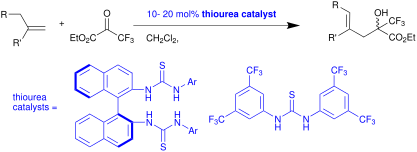
- was carried out (Scheme 2 and Table 1). N,N'-di [3,5-bis(trifluoromethyl)phenyl]thiourea 5,[18], emerged as by far the most active promoter for this reaction. The catalyst was used at 20 mol % loading and compared against a control reaction with no catalyst. Products were isolated by chromatography


The use of silicon- based tethers for the Pauson- Khand reaction
Beilstein J. Org. Chem. 2007, 3, No. 21, doi:10.1186/1860-5397-3-21
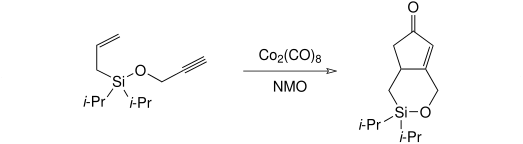
- (Scheme 3).[10][11] Finally, in a recent report, Porter has described the intramolecular Pauson-Khand reaction of allyldimethyl- and allyldiphenylsilyl propargyl ethers promoted by dicobalt octacarbonyl and n-butyl methyl sulphide as a promoter to give the bicycles in modest to good yields (Scheme 4).[12
- each compound were first prepared and characterised, prior to addition of the promoter. Unfortunately, none of the promoters gave any of the desired products but simply de-complexed starting materials were recovered in each case. Alternative metal carbonyls were also investigated, with compounds 1–4


Asymmetric aza-Diels- Alder reaction of Danishefsky's diene with imines in a chiral reaction medium
Beilstein J. Org. Chem. 2006, 2, No. 18, doi:10.1186/1860-5397-2-18
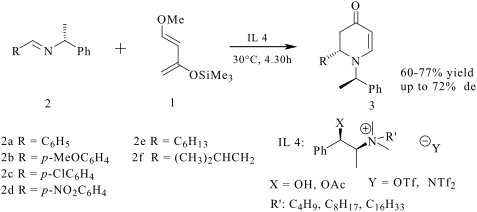
- )-(-)-methylbenzylamine chiral auxiliary. However, all reactions had to be performed in an organic solvent under an inert atmosphere and required stoichiometric loadings of Lewis acid promoter, the use of which is not recommended under 'green chemistry' conditions. Having established the high efficiency of chiral ILs is


Colchitaxel, a coupled compound made from microtubule inhibitors colchicine and paclitaxel
Beilstein J. Org. Chem. 2006, 2, No. 13, doi:10.1186/1860-5397-2-13
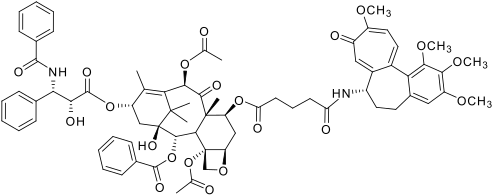
- transiently by promoter treatment [58]. The phenotype induced by the microtubule inhibitor combination is qualitatively similar to that of promoter-treated cells but differs in direction. Therefore, reversal of cancer cell phenotype suggested that the same downstream mechanisms, i.e. the activation or


Other Beilstein-Institut Open Science Activities



