


Search results
Search for "emission" in Full Text gives 493 result(s) in Beilstein Journal of Organic Chemistry. Showing first 200.
Synthesis of 10-O-aryl-substituted berberine derivatives by Chan–Evans–Lam coupling and investigation of their DNA-binding properties
Beilstein J. Org. Chem. 2021, 17, 991–1000, doi:10.3762/bjoc.17.81
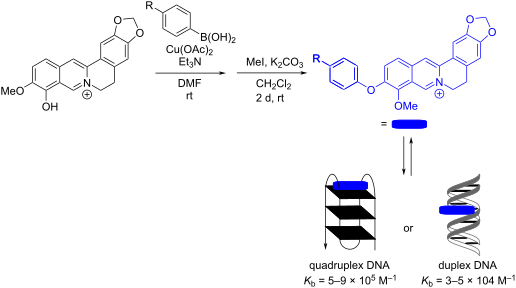
- compounds 4a–f and 5a–e were identified and fully characterized by NMR-spectroscopic analysis (1H, 13C, COSY, HSQC, HMBC), mass spectrometric data and elemental analyses. Absorption and emission properties The absorption properties of the derivatives 5a–e resemble the ones of the berberine chromophore with
- long wavelength maxima between 403 nm (5e in aqueous buffer) and 426 nm (5d in CHCl3) (Table 1, Table S2, Figure S1, Supporting Information File 1) [40]. The emission intensity of all compounds is very low (Φfl << 0.01) and mostly not detectable in the series of tested solvents. To examine whether the
- significantly higher, but still relatively low emission quantum yields in glycerol at room temperature (Φfl = 0.009–0.031, 20 °C, η = 1412 cP) [41], whereas the emission intensity decreased with increasing temperature (Φfl = 0.001–0.002, 80 °C, η = 32 cP) [41]. Such a behavior usually indicates a radiationless


Synthesis of dibenzosuberenone-based novel polycyclic π-conjugated dihydropyridazines, pyridazines and pyrroles
Beilstein J. Org. Chem. 2021, 17, 719–729, doi:10.3762/bjoc.17.61
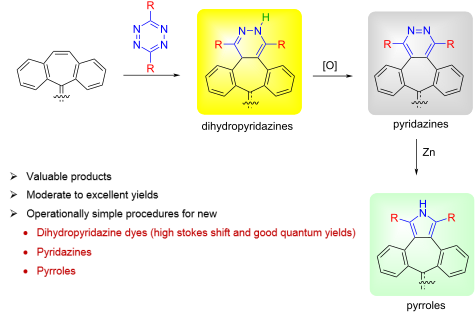
- obtained gave absorbance and emission at long wavelengths. Keywords: dibenzosuberenone; inverse electron-demand Diels–Alder cycloaddition reactions; p-quinone methide; polycyclic π-conjugated dihydropyridazines; pyridazines; pyrroles; Inroduction Dibenzosuberone and dibenzosuberenone derivatives are
- exhibit photophysical properties such as photosensitization [13], fluorescence, and aggregation-induced emission (AIE) [14][15][16]. π-Conjugated polycyclic hydrocarbons (CPHs) containing polycyclic heteroaromatic molecules (PHAs) and aza-polycyclic aromatic hydrocarbons (aza-PAHs) have been attracting
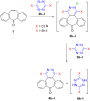
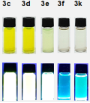
- fluorescent dyes 3a,b in detail. In the present study, the effects of functional groups with different conjugations on maximum absorbance (λmax, abs) and emission (λmax, ems), and wavelengths of dihydropyridazines 3c–f and 3k were investigated. Compounds 3c,d, with high conjugation, show the highest




Synthesis, structural characterization, and optical properties of benzo[f]naphtho[2,3-b]phosphoindoles
Beilstein J. Org. Chem. 2021, 17, 671–677, doi:10.3762/bjoc.17.56
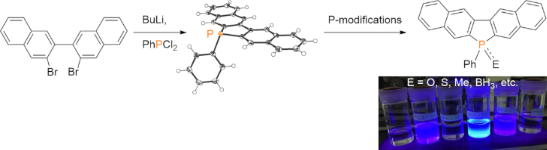
- approximately 50 nm longer than that of our oxide 3 [16]. The fluorescence wavelength, including the maximum emission (λem), and the quantum yield depend on the nature of the P-modification. Phosphine oxide 3, cation 5, and boron complex 6 emitted blue fluorescence in the visible-light region, with λem at 395


Valorisation of plastic waste via metal-catalysed depolymerisation
Beilstein J. Org. Chem. 2021, 17, 589–621, doi:10.3762/bjoc.17.53
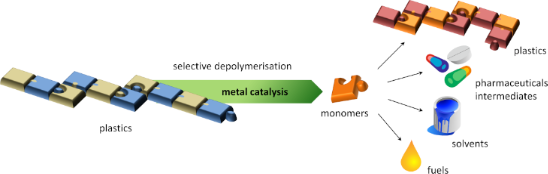
- material rather than the material itself, and it is usually achieved by combustion or incineration [61][62]. This method is generally used for plastics that cannot be economically recycled by other means [63][64]. However, it often entails the emission of toxic volatile compounds (furans, dioxins) [65










A new and efficient methodology for olefin epoxidation catalyzed by supported cobalt nanoparticles
Beilstein J. Org. Chem. 2021, 17, 519–526, doi:10.3762/bjoc.17.46

- confirming the heterogeneous nature of the catalytic method. The freshly prepared CoNPs/MgO catalyst was characterized by means of transmission electron microscopy (TEM), energy dispersive X-ray spectroscopy (EDX), inductively coupled plasma atomic emission spectroscopy (ICP-AES), X-ray diffraction (XRD) and
- , operated at an acceleration voltage of 100 kV. Approximately one hundred metal particles were measured to perform the particle size distribution. The cobalt content in the supported catalyst was determined by inductively coupled plasma atomic emission spectroscopy (ICP-AES), on a Spectro Arcos instrument


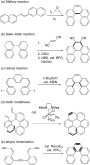
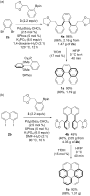
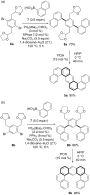
Helicene synthesis by Brønsted acid-catalyzed cycloaromatization in HFIP [(CF3)2CHOH]
Beilstein J. Org. Chem. 2021, 17, 396–403, doi:10.3762/bjoc.17.35
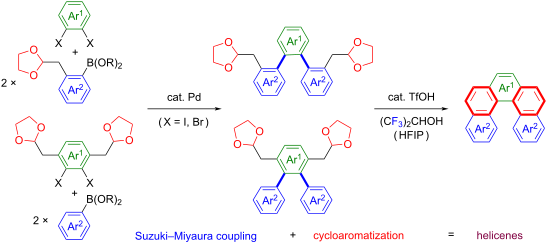
- manner [1][2][3][4][5][6]. Since helicenes possess chirality derived from their helical structure, optically active helicenes and their derivatives exhibit characteristic properties, such as huge optical rotation [7], nonlinear optical effects [8][9][10], and circularly polarized light emission [11




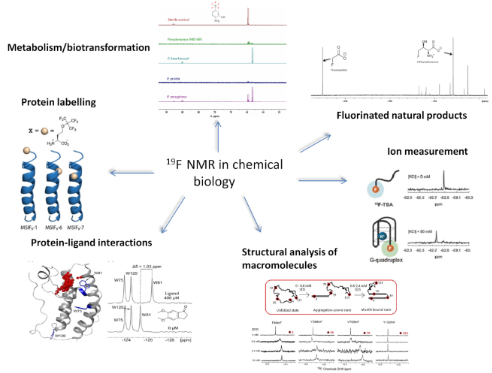
19F NMR as a tool in chemical biology
Beilstein J. Org. Chem. 2021, 17, 293–318, doi:10.3762/bjoc.17.28


Exploring the possibility of using fluorine-involved non-conjugated electron-withdrawing groups for thermally activated delayed fluorescence emitters by TD-DFT calculation
Beilstein J. Org. Chem. 2021, 17, 210–223, doi:10.3762/bjoc.17.21
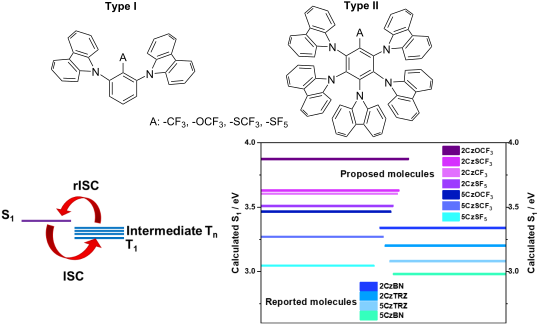
- carbazoles was disposed meta or para to the cyano acceptor [19]. OLEDs fabricated using 2,6-2CzBN as the emitter exhibited deep blue emission with λEL = 418 nm and CIE coordinate of (0.15, 0.05); however, due to the low photoluminescence quantum yields (ΦPLs) (28% in 10 wt % DPEPO films) and relatively slow
- based on 5CzCF3 exhibited sky-blue emission with CIE coordinates of (0.21, 0.33) and an EQEmax of 5.2% at 1 cd·m−2 [25]. The promising performance of emitters possessing a CF3 acceptor group prompted us to investigate other fluorinated weakly-conjugated acceptor units in order to assess their potential
- the use of the fluorinated acceptor groups in donor–acceptor TADF emitters should lead to a pronounced blue-shift in the emission, as reflected in the higher-energy singlet states of the model systems in Figure 2. We next modelled the Type I emitters (Figure 3 and Figure 4). The DFT-calculated


Tuning the solid-state emission of liquid crystalline nitro-cyanostilbene by halogen bonding
Beilstein J. Org. Chem. 2021, 17, 124–131, doi:10.3762/bjoc.17.13
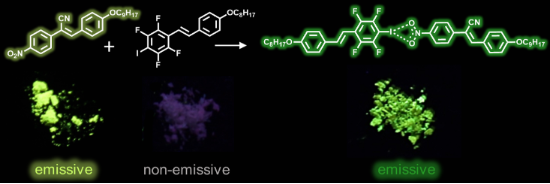
- fluoroiodoazobenzenes with varying fluorination degree at the iodobenzene moiety was used to investigate the impact of halogen bonding on the properties of the assemblies. Since cyanostilbene molecules are known to show aggregation-induced emission (AIE) behaviour the photophysical properties of the resulting
- -induced emission properties were combined with alkoxystilbazoles to form hydrogen-bonded mesogens. Since NO2-Cn is known to be fluorescent, we were curious how the formation of the halogen-bonded complexes affects the AIE behaviour of NO2-Cn. Therefore, we studied the photophysical properties of 1:1
- design of luminescent liquid crystals. In supramolecular liquid crystals, however, it did not find application so far [24]. We also studied the temperature dependence of the fluorescence behaviour. In the solid state at room temperature, NO2-C9∙∙∙F4St shows a high intensity emission at λ = 545 nm, which




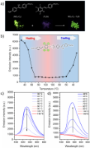


Circularly polarized luminescent systems fabricated by Tröger's base derivatives through two different strategies
Beilstein J. Org. Chem. 2021, 17, 52–57, doi:10.3762/bjoc.17.6
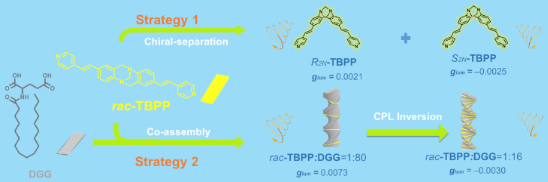
- ; inversion of CPL handedness; Tröger's base; Introduction Recently, much effort has been devoted to constructing luminescent materials with efficient high emission in the solid state [1][2][3]. More and more types of fluorophores with aggregation-induced emission (AIE) characteristics have been discovered
- construct CPL-active materials [19][20][21], so the fluorescent Tröger's base derivatives rac-TBPP fall into our sight as the candidate to construct CPL-active materials. Herein, we take two stratgies to construct rac-TBPP-based CPL material. One stratgy is to separate non-CPL emission rac-TBPP into CPL
- Cotton effect at the same wavelength, assigned to S2N-TBPP (Figure 1a) [23]. R2N-TBPP and S2N-TBPP were tested further by CPL spectroscopy, and the magnitude of the CPL emission was estimated by a luminescence dissymmetry factor (glum), defined as 2(IL − IR )/(IL + IR) where IL and IR are the intensity


Control over size, shape, and photonics of self-assembled organic nanocrystals
Beilstein J. Org. Chem. 2021, 17, 42–51, doi:10.3762/bjoc.17.5
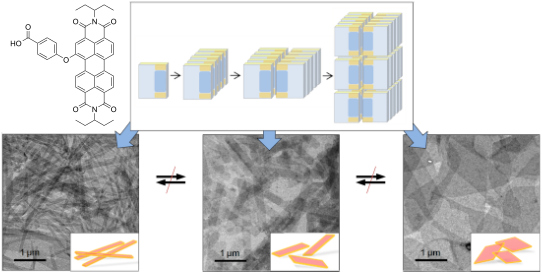
- microscopy measurements were carried out in order to further study the photonic behavior of the systems. Interestingly, the 5% THF system displayed an emission that was localized at regions that appeared to be matching the shape and dimensions of the crystal edges (Figure S13, Supporting Information File 1
- ), with a clear preference for emission at the crystal corners (the microscopy of the 10% THF system did not provide reliable superresolution images). This further underscores the influence of the crystal morphology on the photonic properties [58] and will be a subject of future studies. Conclusion We




The fluorescence of a mercury probe based on osthol
Beilstein J. Org. Chem. 2021, 17, 22–27, doi:10.3762/bjoc.17.3
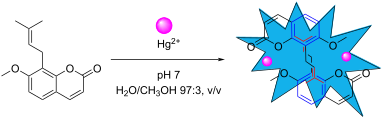
- irreversible nerve damage. Therefore, it is very important to develop a highly sensitive and selective method for mercury detection. At present, the detection of mercury mainly includes atomic absorption and atomic emission spectrometry [4], inductively coupled plasma mass spectrometry [5][6], and capillary


Synthesis, crystal structures and properties of carbazole-based [6]helicenes fused with an azine ring
Beilstein J. Org. Chem. 2021, 17, 11–21, doi:10.3762/bjoc.17.2
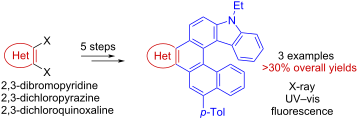
- ]helicenes 10 only weak fluorescence in the solution under UV irradiation was observed (Table 7, see also Supporting Information File 1, Figures S42–S45). Helicenes 10b and 10c exhibited blue emission with emission peaks at 481 and 440 nm, respectively. Quinoxaline-fused helicene 10a demonstrated a yellow
- emission with the highest in the series λem = 561 nm and Stokes shift 128 nm. Conclusion In summary, novel carbazole-based [6]helicenes fused with an azine ring (pyridine, pyrazine or quinoxaline) have been prepared from commercially available 2,3-dihaloazines via a five-step synthetic sequence. Two key



Deoxyfluorination of acyl fluorides to trifluoromethyl compounds by FLUOLEAD®/Olah’s reagent under solvent-free conditions
Beilstein J. Org. Chem. 2020, 16, 3052–3058, doi:10.3762/bjoc.16.254
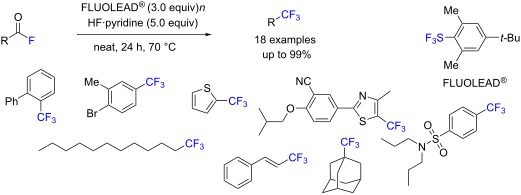
- the deoxyfluorination. FLUOLEAD® is a stable crystalline solid and has sufficient stability against moisture to be handled open to air without the emission of fumes, and it is available in quantities that can exceed 100 kg from Ube Industries, Ltd [31]. FLUOLEAD® is an attractive alternative to the


Metal-free synthesis of biarenes via photoextrusion in di(tri)aryl phosphates
Beilstein J. Org. Chem. 2020, 16, 3008–3014, doi:10.3762/bjoc.16.250
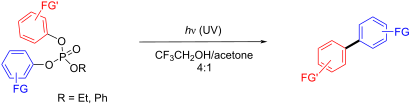
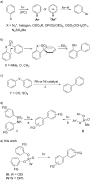
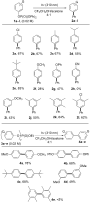
- phosphates examined were barely fluorescent in methanol, with an emission quantum yield (Φem) in the 0.005–0.06 range (see Table 2 and Supporting Information File 1 for further details). We thus focused on compounds 1e, 1h, 3a and 3c as the model substrates. In the case of compounds 1e and 1h, we observed
- that the fluorescence is significantly red shifted (about 30 nm) with respect to that of the corresponding diethyl aryl phosphates (see Figure 1 and Figure 2). On the other hand, when focusing on compound 3a, we noticed the presence of two emission bands located at 307 and 360 nm, respectively (see
- was observed with compound 3c, where a single emission band located at ca. 290 nm is observable in neat methanol, whereas the presence of TFE causes a lowering of that emission, in favor of a second band in the 330–350 nm region (Figure 4). These two emissions have been assigned, on the basis of our



Selected peptide-based fluorescent probes for biological applications
Beilstein J. Org. Chem. 2020, 16, 2971–2982, doi:10.3762/bjoc.16.247

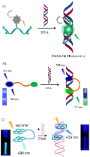
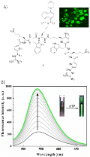
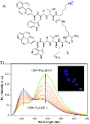
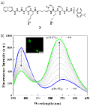
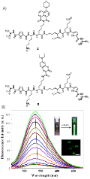
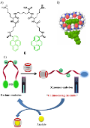
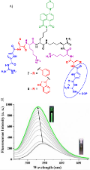
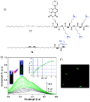
- intensity, lifetime or excitation/emission maxima. The fluorescence turn-on response offers a bright signal against a dark background, which maximizes spatial resolution than the fluorescence turn-off signal [19]. A shift in the absorption/emission spectrum is also advantageous as the changes in ratio of
- intensities of absorption or emission at two wavelengths minimizes the error from the physical or chemical fluctuations in the sample. Conventional peptide probes based on environment-sensitive fluorophores [20][21][22], fluorescence resonance energy transfer (FRET) pairs [13] and pyrene excimer/monomer [23
- use of pyrene as a fluorophore has two major disadvantages such as poor quantum yield and an emission in the blue region, which is unfavorable for potential applications in biological systems. The Schmuck group successfully developed several peptide-based probes using these approaches for targeting




Naphthalonitriles featuring efficient emission in solution and in the solid state
Beilstein J. Org. Chem. 2020, 16, 2960–2970, doi:10.3762/bjoc.16.246
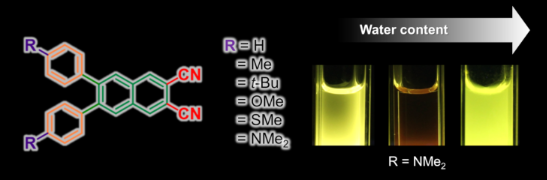
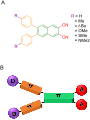
- ) and CENIDE, University of Duisburg-Essen, Universitätsstraße 7, 45117 Essen, Germany 10.3762/bjoc.16.246 Abstract In this work, a series of γ-substituted diphenylnaphthalonitriles were synthesized and characterized. They show efficient emission in solution and in the aggregated state and their
- scattering (DLS). The steady-state and time-resolved photoluminescence spectroscopy studies revealed that all the molecules show intense fluorescence both in solution and in the aggregated state. In THF solutions, a blue emission was observed for the unsubstituted (H), methyl- (Me) and tert-butyl- (t-Bu
- ) substituted γ-diphenylnaphthalonitriles, which can be attributed to a weak π-donor capability of these groups. On the other hand, the methoxy- (OMe), methylsulfanyl- (SMe) and dimethylamino- (NMe2) substituted compounds exhibit a progressive red-shift in emission compared to H, Me and t-Bu due to a growing π



A novel and robust heterogeneous Cu catalyst using modified lignosulfonate as support for the synthesis of nitrogen-containing heterocycles
Beilstein J. Org. Chem. 2020, 16, 2888–2902, doi:10.3762/bjoc.16.238
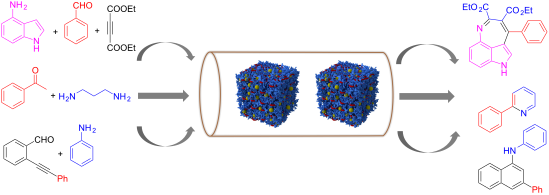
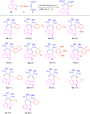
- results indicated that all prepared materials could remain stable in the system when used to catalyze organic reactions. FSEM (field emission scanning electron microscopy) and FTEM (field emission transmission electron microscopy) were used to observe the surface morphologies of different catalysts, and



Incorporation of a metal-mediated base pair into an ATP aptamer – using silver(I) ions to modulate aptamer function
Beilstein J. Org. Chem. 2020, 16, 2870–2879, doi:10.3762/bjoc.16.236
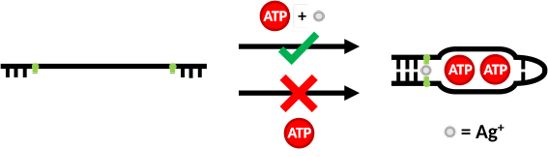
- addition of 1q with a 90% decrease in emission. Upon the addition of AMP, the emission increases again almost sevenfold, indicating a dissociation of the quencher-labeled oligonucleotide and subsequent formation of the AMP-bound structure. Adding 1 equiv of Ag(I) leads to no significant further change, as
- was expected for the imidazole-free derivative 1af. Nevertheless, the addition of 10 equiv of Ag(I) leads to a slight decrease in the emission. The oligonucleotides 1bf, 1cf, and 1df all show less efficient quenching upon the addition of 1q, which can be attributed to the presence of the destabilizing
- mismatches involving imidazole. This effect is least pronounced for oligonucleotide 1df, which is quenched almost as effectively as 1af. All imidazole-containing aptamer derivatives show an increased emission upon the addition of AMP with an approximately threefold increase in the intensity. In contrast to


Using multiple self-sorting for switching functions in discrete multicomponent systems
Beilstein J. Org. Chem. 2020, 16, 2831–2853, doi:10.3762/bjoc.16.233

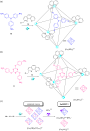
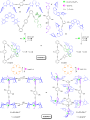
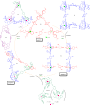
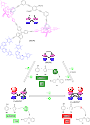
- ), the silver(I) ions were tightly captured within the cavity of the triangular nanoswitch 35 (“catch”) while the luminophore 36 was left uncoordinated exhibiting emission at 554 nm (Figure 13). Due to the firm complexation of the silver(I) ions in [Ag(35)]+ any catalysis was switched OFF. Upon the
- addition of zinc(II), the silver(I) ions were translocated as a second messenger from the nanoswitch [Ag(35)]+ to the anthracene-appended crown ether 36 in a 2-fold completive self-sorting, i.e., furnishing [Zn(35)]2+ and [Ag(36)]+ (state SelfSORT-II). In this state, SelfSORT-II, the emission emerged at
- catalytic behavior showed a full reversibility up to three cycles and provided 45%, 43%, and 41% yield, respectively, in subsequent cycles. The small decrease of the yield over three release/capture cycles was explained by a minor degradation of silver(I), a phenomenon equally seen in the emission channel









Synthesis and investigation of quadruplex-DNA-binding, 9-O-substituted berberine derivatives
Beilstein J. Org. Chem. 2020, 16, 2795–2806, doi:10.3762/bjoc.16.230
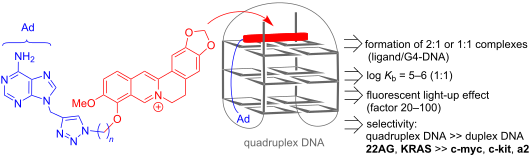
- end of the titration. The compounds 4a–e have a very low intrinsic emission intensity that increased significantly upon the addition of the G4-DNA 22AG and a2 (Table 1, Figure 1B; cf. Supporting Information File 1, Figure S2). Thus, the characteristic emission band of berberine at 520 nm developed and
- titrations with 22AG and a2 clearly revealed the association of the derivatives 4a–e with G4-DNA (Figure 1). Specifically, the red shift and hypochromism of the absorption band along with the pronounced increase of the emission intensity are typical for quadruplex-bound ligands [17][18][19][20][21][22
- additional hydrophobic effect is the main contribution of the different substituents of 4a–e to the overall binding affinity. It is well known that the emission of the parent berberine increases strongly upon the accommodation in sterically constrained binding sites in, e.g., nucleic acids, cucurbiturils


Encrypting messages with artificial bacterial receptors
Beilstein J. Org. Chem. 2020, 16, 2749–2756, doi:10.3762/bjoc.16.225
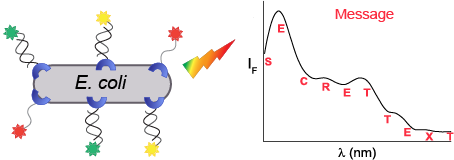
- bacteria continuously divide, the emission pattern generated by the modified bacteria dynamically changes, enabling the system to produce encryption keys that change with time. Thus, this development indicates the potential contribution of live-cell-based encryption systems to the emerging area of
- labeled bacteria during cell division (Figure 2B). Another research direction in our group, which also involves the development of unconventional fluorescent probes, is the information protection at the molecular level [4][5][6]. In such studies [4][5][6], the emission patterns generated by the probes are
- security systems that can generate (pseudo) random fluorescence patterns [4][5][6]. Originally, the pattern-generating probes (or ID-probes [24]) were designed to detect multiple different analytes and their combinations [24][25][26]. In a later stage, we showed that the unique emission fingerprints




Selective recognition of ATP by multivalent nano-assemblies of bisimidazolium amphiphiles through “turn-on” fluorescence response
Beilstein J. Org. Chem. 2020, 16, 2728–2738, doi:10.3762/bjoc.16.223
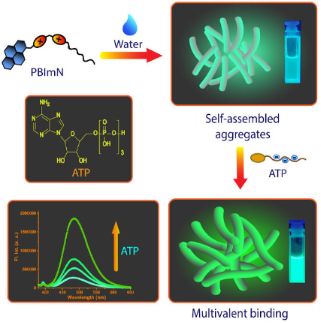
- to an n-alkyl chain at the other, underwent self-assembly in aqueous media depending on the length of the alkyl segment. The amphiphilic derivatives having n-decyl or longer chains, formed nano-assemblies with cyanic–green emission resulting from the stacked pyrene chromophores in the aggregates. The
- presence of positive surface charges on the multivalent aggregates led to ATP binding which was accompanied by a significant increase in the excimeric emission intensity. This provided a convenient way of monitoring ATP binding in a “turn-on” mode and an efficient detection of ATP was achieved in aqueous
- buffer and produced nanoaggregates with surface exposed positive charges. Interestingly, the aggregates displayed cyanic green luminescence which originated from the excimeric emission of the stacked pyrenes [57][58][59]. In a recent work, we have demonstrated that self-assembled nanofibrous aggregates


Synthesis and characterization of S,N-heterotetracenes
Beilstein J. Org. Chem. 2020, 16, 2636–2644, doi:10.3762/bjoc.16.214

- , gradually decreases with increasing number of pyrrole rings in the heteroacenes from 3.62 eV for TTA to 3.50 eV for 33 (Figure 2, left). The SN4-heteroacenes fluoresce, if at all, only very weakly and emission maxima lay in between 356 nm for TTA and 388 nm for 22 with the most extended conjugated π-system


Water-soluble host–guest complexes between fullerenes and a sugar-functionalized tribenzotriquinacene assembling to microspheres
Beilstein J. Org. Chem. 2020, 16, 2551–2561, doi:10.3762/bjoc.16.207
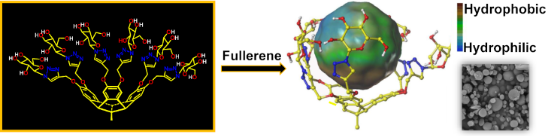
- exhibits an emission maximum peak at 329 nm upon excitation at 294 nm. This emission band is probably due to the formation of the ground-state dimer by interaction between the benzene rings upon excitation or excimer emission caused by the interaction between the aromatic rings [41][43]. As the
- concentration of the fullerenes C60 and C70 increase, the emission is significantly quenched, indicating the photoinduced energy transfer from TBTQ-(OG)6 to the fullerenes [47][48]. Molar ratio plots (see Figure S16, Supporting Information File 1) on the basis of the fluorescence titration experiments suggested


![[Graphic 2]](/bjoc/content/inline/1860-5397-16-207-i3.svg?max-width=637&scale=1.18182) C60 [TBTQ-(OG)6: 50 μM; C60: 50 μM] and (b) TBTQ-(OG)6
C60 [TBTQ-(OG)6: 50 μM; C60: 50 μM] and (b) TBTQ-(OG)6 





