Search results
Search for "photophysical properties" in Full Text gives 209 result(s) in Beilstein Journal of Organic Chemistry. Showing first 200.
Photorelease of phosphates: Mild methods for protecting phosphate derivatives
Beilstein J. Org. Chem. 2014, 10, 2038–2054, doi:10.3762/bjoc.10.212
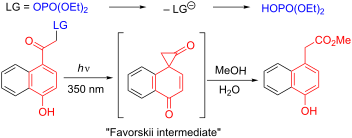
- propensity to undergo heterolytic photosolvolysis reactions, most notably o-nitrobenzyl (o-NB) [12], benzyl phenyl ketone (benzoin) [13][14], coumarin-4-ylmethyl [15], and, more recently, p-hydroxyphenacyl (pHP) [15] phosphate esters (Figure 1). While these chromophores exhibit a range of photophysical
- properties, all share a conjugated aromatic structural motif that facilitates UV–vis absorption and serves as a traceless reagents, orthogonal to common ground state deprotection processes and essentially independent of pH effects. Thus, the chromophores are particularly useful at neutral pH and no added


Influence of perylenediimide–pyrene supramolecular interactions on the stability of DNA-based hybrids: Importance of electrostatic complementarity
Beilstein J. Org. Chem. 2014, 10, 1589–1595, doi:10.3762/bjoc.10.164
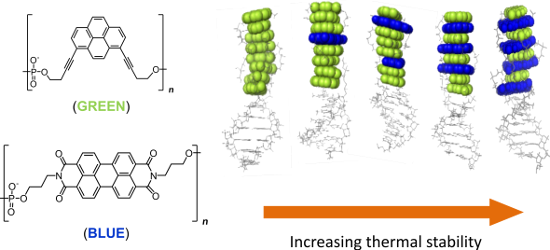
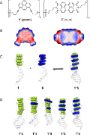
- stability and photophysical properties were investigated. Since the DNA duplex is identical in all hybrids, differences in stability must originate from the modified section. The sequence of the modified part is changed in such a way that annealing of different strands leads to a varying number of pyrene



Multichromophoric sugar for fluorescence photoswitching
Beilstein J. Org. Chem. 2014, 10, 1471–1481, doi:10.3762/bjoc.10.151
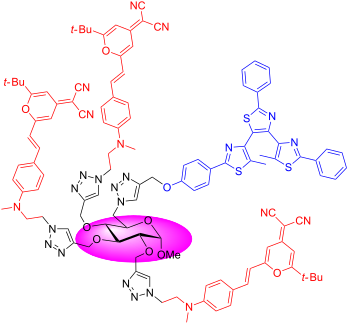
- ), associated with a fluorescence quantum yield ΦF = 0.12. These spectroscopic characteristics are rather comparable to the absorption and fluorescence features of the fluorophore 5 [4]. The photophysical properties of the photochromic model compound 9 have been described in a previous report [4]. Briefly, the
- 610 nm drops back to zero and the fluorescence of the sample is fully recovered (Figure 4c and d). As shown in Figure 4e and f, several UV–visible irradiation cycles were applied to the system without any degradation of its photophysical properties, revealing its excellent fatigue resistance. 1H NMR




Synthesis, characterization and DNA interaction studies of new triptycene derivatives
Beilstein J. Org. Chem. 2014, 10, 1290–1298, doi:10.3762/bjoc.10.130
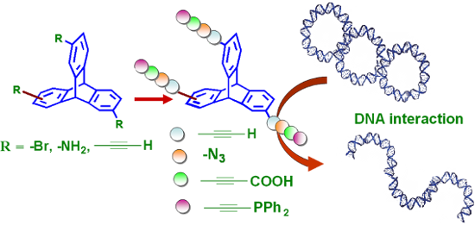
- multinuclear NMR spectroscopy, mass spectrometry, and elemental analyses techniques. We have also studied the photophysical properties of all triptycene derivatives. Furthermore, we have explored a new face of triptycene-based molecules, viz., interaction of tripodal triptycene-based molecules (with various


On the mechanism of photocatalytic reactions with eosin Y
Beilstein J. Org. Chem. 2014, 10, 981–989, doi:10.3762/bjoc.10.97
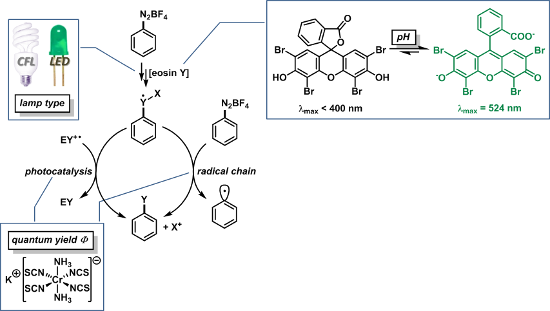
- -driven reactions that lie beyond the focus of this study. Eosin Y (and many other organic photocatalysts) undergo rapid acid–base equilibria which significantly alter the photophysical properties. It is therefore of pivotal importance to ascertain the actual nature of the employed dye under the reaction


Columnar/herringbone dual crystal packing of pyrenylsumanene and its photophysical properties
Beilstein J. Org. Chem. 2014, 10, 841–847, doi:10.3762/bjoc.10.80
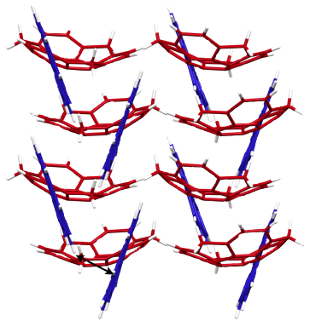
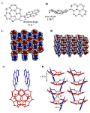
- incorporating both bowl and planar structures. Pyrene was selected as the planar substituent when studying solid-state photophysical properties [21][22] and herein we report the columnar/herringbone dual crystal packing of pyrenylsumanene (1) in addition to its photophysical properties. Results and Discussion




First synthesis of meso-substituted pyrrolo[1,2-a]quinoxalinoporphyrins
Beilstein J. Org. Chem. 2014, 10, 808–813, doi:10.3762/bjoc.10.76
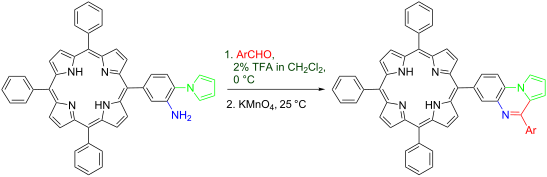
- been synthesized and their photophysical properties have not been evaluated yet. By considering the biological and fluorescent properties of these two classes of heterocycles, we envisaged to combine both porphyrin and pyrrolo[1,2-a]quinoxaline units in a single molecular framework to generate novel


Rapid pseudo five-component synthesis of intensively blue luminescent 2,5-di(hetero)arylfurans via a Sonogashira–Glaser cyclization sequence
Beilstein J. Org. Chem. 2014, 10, 672–679, doi:10.3762/bjoc.10.60
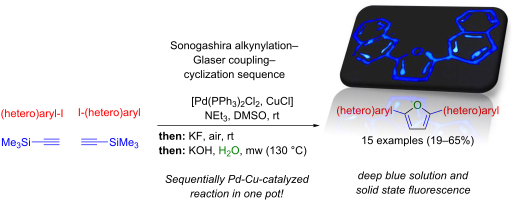
- African trypanosomiasis [18][19][20], and against human renal cancer cells [21][22][23]. Furthermore, 2,5-di(hetero)arylfurans have been reported as photonic chromophores [24]. However, the electronic and photophysical properties of 2,5-di(hetero)aryl furans have only been occasionally studied [25][26][27
- in a one-pot fashion, which opens a ready access to biologically active furan derivatives. In addition the investigation of the photophysical properties of these compounds reveals an intense blue luminescence in solution approaching unity for the fluorescence quantum yield Φf of distinct derivatives




One-pot three-component synthesis and photophysical characteristics of novel triene merocyanines
Beilstein J. Org. Chem. 2014, 10, 599–612, doi:10.3762/bjoc.10.51
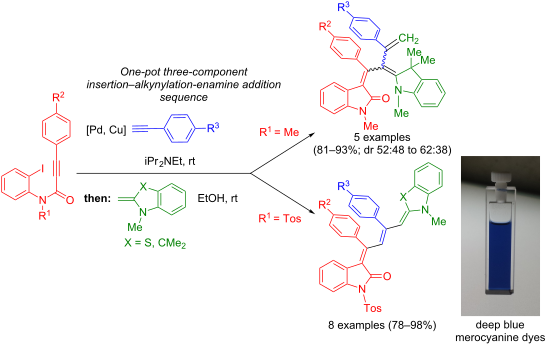
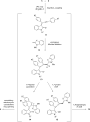
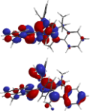
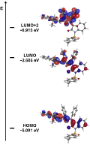
- -methyl (16a) and an N-tosyl intermediate (16b) clearly shows charge density differences at five distinct atoms (Table 3). All merocyanines 8 and 10 are expectedly deeply colored both in the solid state and in solution. For further investigation of the photophysical properties the absorption spectra were




The Flögel-three-component reaction with dicarboxylic acids – an approach to bis(β-alkoxy-β-ketoenamides) for the synthesis of complex pyridine and pyrimidine derivatives
Beilstein J. Org. Chem. 2014, 10, 394–404, doi:10.3762/bjoc.10.37
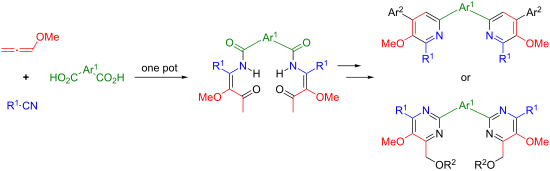
- light (253 nm) compound 22 shows fluorescence with a maximum intensity at 378 nm (see Supporting Information File 1 for details). The photophysical properties of structurally related pyridine–thiophene conjugates were recently investigated in detail [55][57][58]. Next, we investigated the


Flow synthesis of a versatile fructosamine mimic and quenching studies of a fructose transport probe
Beilstein J. Org. Chem. 2013, 9, 2022–2027, doi:10.3762/bjoc.9.238
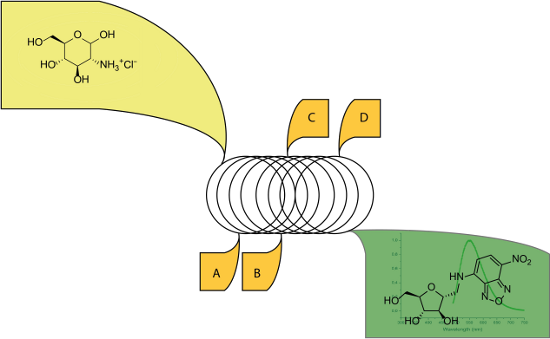
- NBDM, enabling us to measure key photophysical properties that will facilitate future uptake studies. Keywords: flow chemistry; fructose mimic; gluts; NBDM; Introduction The impact of dietary fructose on human health is not well-understood. A growing body of work suggests that those eating diets high
- of material. More NBDM is required to examine uptake across many cell lines and with access to amine 3, we can prepare analogues with different fluorophores or other types of tags. Finally, access to more NBDM will enable assessment of probe photophysical properties as a function of concentration and


Synthesis and spectroscopic properties of 4-amino-1,8-naphthalimide derivatives involving the carboxylic group: a new molecular probe for ZnO nanoparticles with unusual fluorescence features
Beilstein J. Org. Chem. 2013, 9, 1311–1318, doi:10.3762/bjoc.9.147

- . Photophysical properties The spectroscopic properties of 1,8-naphthalimides are strongly dependent on the substituent at C-4 of the naphthalene ring. In general, the derivatives with a halogen atom or alkoxy groups are colorless and exhibit blue fluorecence [15][16], while the amino-substituted 1,8
- detection between 470 and 700 nm in toluene and ethanol. We observed a strong influence of the solvent on the photophysical properties of compound 4. In toluene, at 500 nm (corresponding to the fluorescence maximum), the fluorescence decay followed a mono-exponential law with a lifetime equal to 6.98 ns


Incorporation of perfluorohexyl-functionalised thiophenes into oligofluorene-truxenes: synthesis and physical properties
Beilstein J. Org. Chem. 2013, 9, 1243–1251, doi:10.3762/bjoc.9.141
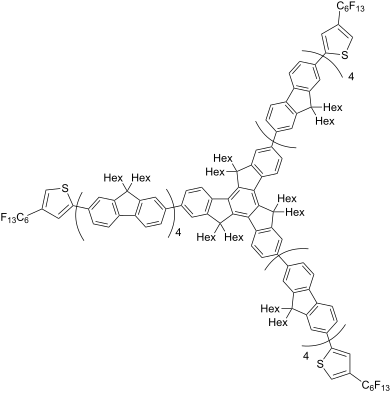
- photophysical properties of the resulting oligomer. There are also less common examples of functionalisation at the C3, C8 and C13 positions [9]. Alkyl substituents attached to hetero- and carbocyles, which make up the conjugated backbone of oligomers and polymers, can also affect the properties of the material


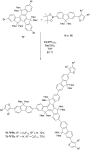
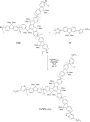


Synthesis of phenanthridines via palladium-catalyzed picolinamide-directed sequential C–H functionalization
Beilstein J. Org. Chem. 2013, 9, 891–899, doi:10.3762/bjoc.9.102
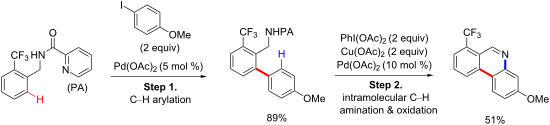
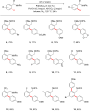
- the catalysis of Pd(OAc)2 affords phenanthridines in moderate to good yields. Applications of this method to the synthesis of more complex phenanthridines with novel photophysical properties are currently underway. Experimental General conditions: All commercial materials were used as received unless



Synthesis, photophysical and electrochemical characterization of terpyridine-functionalized dendritic oligothiophenes and their Ru(II) complexes
Beilstein J. Org. Chem. 2013, 9, 866–876, doi:10.3762/bjoc.9.100

- their photophysical properties is of great relevance, given the importance of oligothiophene and tpy-units as electro- and photoactive conjugated materials [21][28][29][30][31][32]. Besides these linear counterparts, various tpy-containing polymeric and dendritic structures have been developed and their
- photophysical properties studied [33][34][35][36][37][38]. However, to our knowledge, tpy-functionalized dendritic oligothiophenes have not been synthesized so far. The complexation of these dendrons could lead to interesting nanosized materials containing different chromophores to study electronic energy


Spin state switching in iron coordination compounds
Beilstein J. Org. Chem. 2013, 9, 342–391, doi:10.3762/bjoc.9.39








![[Graphic 1]](/bjoc/content/inline/1860-5397-9-39-i3.png?max-width=637&scale=1.18182) ) modes versus the anion volu...
) modes versus the anion volu...






Amino-substituted diazocines as pincer-type photochromic switches
Beilstein J. Org. Chem. 2013, 9, 1–7, doi:10.3762/bjoc.9.1
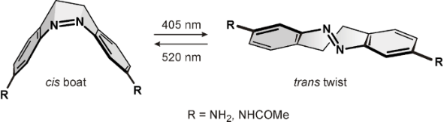
- ]diazocine (1), has been known for more than a hundred years [5]. However, only recently we discovered that the photophysical properties of 1 (quantum yields, photostationary states) are superior to those of parent azobenzene, and most of its derivatives [6][7][8]. In contrast to azobenzene, diazocine 1 is
- Discussion Synthesis Woolley et al. very recently published the synthesis of a 4,4’-diamino-2,2’-ethylene-bridged azobenzene (4,4’-diamino-EBAB), which exhibits excellent photophysical properties [9]. In planning our synthesis (and not yet being aware of the results of the above authors) we were concerned





Synthesis and characterization of low-molecular-weight π-conjugated polymers covered by persilylated β-cyclodextrin
Beilstein J. Org. Chem. 2012, 8, 1505–1514, doi:10.3762/bjoc.8.170
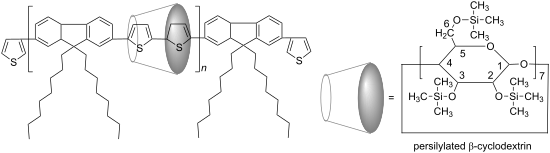
- wide emission band during operation [8]. Taking into account the relevant photophysical properties of these organic compounds, new synthetic approaches were developed. Copolymerization of fluorene with thiophene, bithiophene or other aromatic comonomers is an alternative method for tuning the optical
- photophysical properties of PFs by using persilylated γ-CD as a new host molecule [33]. Inclusion of bithiophene into persilylated β-cyclodextrin, randomly methylated β-cyclodextrin, or chemically modified CD derivatives, followed by copolymerization with fluorene monomers results in significant changes in the
- illustrated in Scheme 1. In order to analyse the influence of end-capping reagents on the photophysical properties we changed the termination of the growing chains to 3T instead of bromobenzene, as in previously reported results [12]. A noncomplexed PDOF-BT copolymer was also synthesized by polycondensation



Diarylethene-modified nucleotides for switching optical properties in DNA
Beilstein J. Org. Chem. 2012, 8, 905–914, doi:10.3762/bjoc.8.103
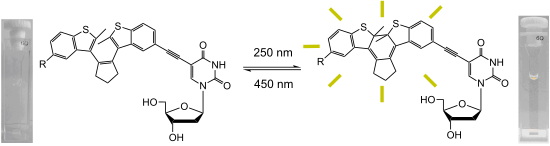
- with a variety of photophysical properties (mainly fluorescence) in DNA. It is important to mention here that guanine does not influence the photochromic properties of the diarylethene switch 4 as a DNA modification. In fact, the photoswitching behavior of 4 is maintained in all four different DNA





Molecular switches and cages
Beilstein J. Org. Chem. 2012, 8, 870–871, doi:10.3762/bjoc.8.97

- photoswitches continue to emerge and “old friends”, such as azobenzenes are constantly improved and optimized. This is not only true with respect to their photophysical properties but also with regard to their synthetic accessibility. Indeed, as molecular switches are applied in ever-increasing quantities, the
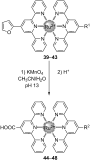
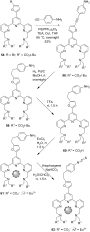
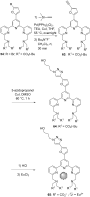
Syntheses and applications of furanyl-functionalised 2,2’:6’,2’’-terpyridines
Beilstein J. Org. Chem. 2012, 8, 379–389, doi:10.3762/bjoc.8.41

- photophysical properties, making them interesting in materials science [9][10][11][12]. Finally, the rich chemistry associated with five-membered heterocycles easily allows various chemical modifications. In this respect, the attachment of such heterocycles, directly or through a linker, to a tpy system appears
- electrochemical and photophysical properties of such compounds is therefore of crucial importance. In this context, the octahedral Ru(II) complex 43 was studied and compared with analogous pyrrolyl, thienyl and bithienyl-substituted compounds 66–68 (Figure 4) in order to obtain information about the influence of
- the pendant heterocycle on the physicochemical properties [56]. It appeared from this study that the bithienyl substituent has the most pronounced effect on the photophysical properties of this series of Ru complexes. Especially, 68 absorbs at a longer wavelength (Table 4), which constitutes an





Self-assembly of Ru4 and Ru8 assemblies by coordination using organometallic Ru(II)2 precursors: Synthesis, characterization and properties
Beilstein J. Org. Chem. 2012, 8, 313–322, doi:10.3762/bjoc.8.34
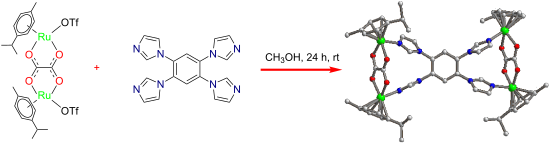
- having complementary binding sites. Large numbers of molecular polygons and polyhedra have been synthesized mostly from cis-blocked Pd(II)- and Pt(II)-based building units due to their rigid square-planar coordination geometry as well as to their interesting photophysical properties [3][4][5]. However


Fluorescent hexaaryl- and hexa-heteroaryl[3]radialenes: Synthesis, structures, and properties
Beilstein J. Org. Chem. 2012, 8, 71–80, doi:10.3762/bjoc.8.7
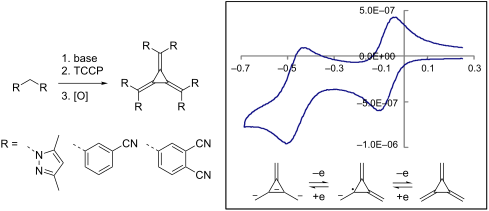
- deficient hexaaryl[3]radialene observed thus far, and studies of their electrochemical and photophysical properties. Results and Discussion The first new [3]radialene compound targeted was hexa(pyrazol-1-yl)[3]radialene. However, the required starting material, 1-[(1H-pyrazol-1-yl)methyl]-1H-pyrazole


Imidazole as a parent π-conjugated backbone in charge-transfer chromophores
Beilstein J. Org. Chem. 2012, 8, 25–49, doi:10.3762/bjoc.8.4
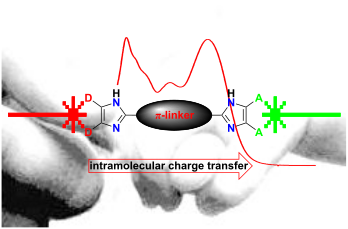
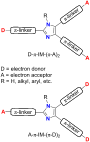
- be very efficient pH-triggered NLO switches. The fluorescent and photophysical properties of chromophores 88–93 were further studied [110][111]. The fluorescence was studied in various solvents and polymer matrices and at various temperatures. Intense fluorescence with quantum yields of 0.05 to 0.98




Sexithiophenes as efficient luminescence quenchers of quantum dots
Beilstein J. Org. Chem. 2011, 7, 1722–1731, doi:10.3762/bjoc.7.202

- , with retention of the photoluminescence behaviour of the quantum dot [24]. Herein, we present a comparative study on the photophysical properties of sexithiophenes 1 or 2 in varying concentrations, in the presence of a fixed concentration of CdSe(ZnS) core/shell quantum dots. Our choice of compounds
- charged species. This increase is a consequence of the resonance effect of the phenyldimethylamine group. Sexithiophene/quantum dot composites in solution A comparative study on the photophysical properties of sexithiophenes 1a,b and 2a,b, in varying concentrations, with a fixed concentration of CdSe(ZnS