Search results
Search for "quantum yield" in Full Text gives 209 result(s) in Beilstein Journal of Organic Chemistry. Showing first 200.
Synthesis and optical properties of pyrrolidinyl peptide nucleic acid carrying a clicked Nile red label
Beilstein J. Org. Chem. 2014, 10, 2166–2174, doi:10.3762/bjoc.10.224
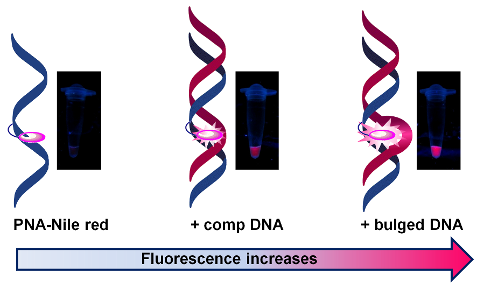
- label that can change its fluorescence in response to its altered micro-environment [7][8][9]. Nile red is a member of the benzophenoxazine dye family which exhibits several interesting features including a high photostability, high fluorescence quantum yield, broad working pH range, long excitation and
- purification. All Nile red-labeled acpcPNAs are freely soluble in water (>1 mM), providing a bright blue solution. The UV–vis spectrum of the free propargyl Nile red label 1 in acetonitrile (Figure 2a) showed absorption and fluorescence emission maxima at 538 nm and 620 nm, with a fluorescence quantum yield
- red in the acpcPNA 10mer-Nr was not quenched as indicated by the quantum yield value being similar to that of the free label (10mer-Nr: ΦF = 0.16; 1: ΦF = 0.14 in 20% MeCN). Unfortunately, the value can only be compared in an acetonitrile:water mixture as compound 1 is essentially insoluble in water


The effect of permodified cyclodextrins encapsulation on the photophysical properties of a polyfluorene with randomly distributed electron-donor and rotaxane electron-acceptor units
Beilstein J. Org. Chem. 2014, 10, 2145–2156, doi:10.3762/bjoc.10.222
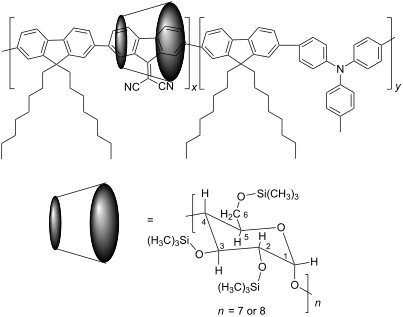
- the fit was estimated by the parameter χ2 (0.90 ≤ χ2 ≤ 1.10) and the symmetrical distribution of the residuals about the zero axis. All measurements were performed at room temperature. The fluorescence quantum yield was determined by using the FLS 980 fluorospectrometer with an integrating sphere and


Photorelease of phosphates: Mild methods for protecting phosphate derivatives
Beilstein J. Org. Chem. 2014, 10, 2038–2054, doi:10.3762/bjoc.10.212
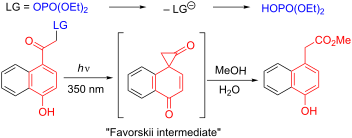
- esters were excellent, resulting in quantitative release of DEP based on conversion. The quantitative conversion and apparent good efficiency of the 1,4-derivative 14a prompted further investigation. The quantum yield for disappearance of 14a in 1% aq MeCN (Φdis = 0.021) is comparable to that observed in
- aq MeOH (Φdis = 0.028, Table 1 and Table 2) but the product mixture was more complex (vide infra). Interestingly, quantum yields for the disappearance for 14a are enhanced three-fold (Φdis = 0.067) when the photolysis solution was purged free of oxygen (Table 2). The quantum yield of 14a for the
- . Irradiation of 2,6-HNA DEP (10) at 350 nm in 1% aq MeCN under conditions comparable to those employed with 14a,b also released phosphate. The disappearance quantum yield for 10 (Φdis = 0.031) was nearly the same as that obtained for 14a but the conversion after a 10 min irradiation was only 67%. Unlike 14a,b


Photo, thermal and chemical degradation of riboflavin
Beilstein J. Org. Chem. 2014, 10, 1999–2012, doi:10.3762/bjoc.10.208

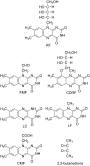
- RF preparations in order to alter the quantum yield of the photoreaction without quenching the fluorescence of RF [81]. Ascorbic acid and sodium azide are the two most studied external quenchers for RF photoreactions. Both these compounds reduce the photodegradation of RF with different quenching




Synthesis of new, highly luminescent bis(2,2’-bithiophen-5-yl) substituted 1,3,4-oxadiazole, 1,3,4-thiadiazole and 1,2,4-triazole
Beilstein J. Org. Chem. 2014, 10, 1596–1602, doi:10.3762/bjoc.10.165

- quinquethiophene by 1,3,4-oxadiazole leads to a substantial increase of the fluorescence quantum yield and a hypsochromic shift of the emission band [14], both features being technologically advantageous. They are, however, difficult to solution process due to strong intermolecular interactions, associated with
- completive heteroatom. Moderate to high fluorescence quantum efficiency yields are also observed, ranging from 0.59 for 18 to 0.21 for 15. Here, a clear heteroatom effect is observed, while the influence of the thiophene substituent seems negligible. The observed trend of decreasing quantum yield with
- crossing channels as well, making the thermal decay pathway accessible. The hindering of these decay modes in the oxadiazole derivatives 13 and 14 doubles their quantum yield. For the triazole derivative 18 the quantum yield is even nearly triple that of 15, but this enhancement should also be traced to


Pyrene-modified PNAs: Stacking interactions and selective excimer emission in PNA2DNA triplexes
Beilstein J. Org. Chem. 2014, 10, 1495–1503, doi:10.3762/bjoc.10.154
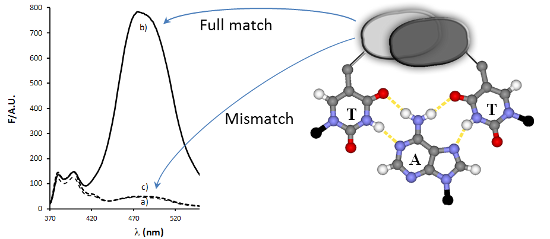
- fluorescence properties of these PNA in the absence and in the presence of DNA. The evaluation of the pyrene quantum yields showed that these probes are much less fluorescent than the 1-pyreneacetic acid precursor in water (23 times lower quantum yield for PNA2, see Supporting Information File 1, Figure S16


Multichromophoric sugar for fluorescence photoswitching
Beilstein J. Org. Chem. 2014, 10, 1471–1481, doi:10.3762/bjoc.10.151
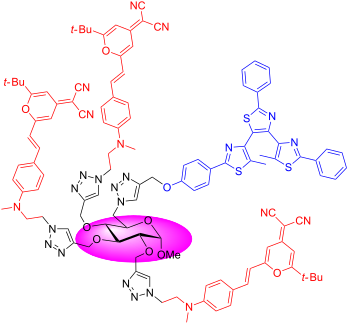
- ), associated with a fluorescence quantum yield ΦF = 0.12. These spectroscopic characteristics are rather comparable to the absorption and fluorescence features of the fluorophore 5 [4]. The photophysical properties of the photochromic model compound 9 have been described in a previous report [4]. Briefly, the




On the mechanism of photocatalytic reactions with eosin Y
Beilstein J. Org. Chem. 2014, 10, 981–989, doi:10.3762/bjoc.10.97
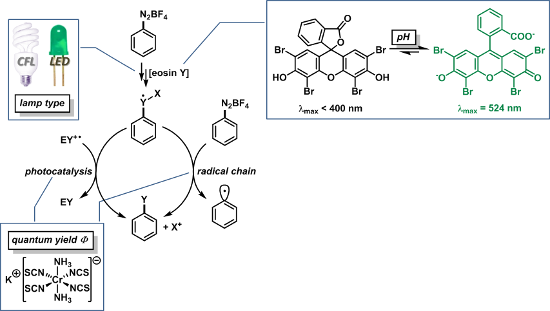
- of such processes. The magnitude of quantum yields Φ also describes how much energy is wasted into thermal dissipation in such systems, which is an especially critical parameter for the evaluation of sustainability of a photocatalytic process. The quantum yield is defined as the efficiency of a
- photochemical reaction in the studied system: Φ = (rate of substrate conversion)/(absorbed photon flux) Theoretically, if a simple photocatalytic process is considered, the quantum yield would be in the range 0 < Φ ≤ 1. It approaches unity as the efficiency of the photocatalytic step increases. In reality
- ][18][19][20][21]. For more details on the actinometry experiments and quantum yield determinations, see Supporting Information File 1. The observed quantum yields Φ of the studied reactions varied by almost two orders of magnitude, between 4.7 and 0.075. This already indicates the operation of


Tailoring of organic dyes with oxidoreductive compounds to obtain photocyclic radical generator systems exhibiting photocatalytic behavior
Beilstein J. Org. Chem. 2014, 10, 936–947, doi:10.3762/bjoc.10.92
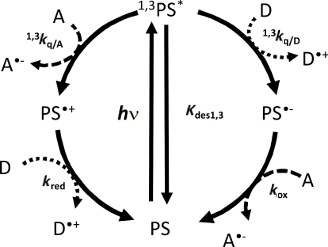
- dye (see insert Figure 1). It should be noted that in the same conditions, no photolysis occurs for an acetonitrile solution of neat RB. To quantify the consumption of the PS, the photolysis quantum yield (Φphotolysis) was determined. Φphotolysis is defined by the ratio of the initial number of
- photolysis quantum yield of 0.19 for RB/TA is obtained. Photocyclic initiating system A typical photocyclic initiating system (PCIS) consists of a light absorbing dye (PS), an electron acceptor (A) and an electron donor (D) (Scheme 3). In such systems, upon irradiation photoinduced electron transfer reaction
- compare clearly Type II and PCIS, the quantum yield of dye photolysis (Φphotolysis) was also determined for RB/TA/EDB. The total concentration of absorbed photons for the PCIS is 0.0139 mol·L−1. Dividing the initial RB concentration by this value leads to a photolysis quantum yield of 4.7·10−3. This


![[Graphic 1]](/bjoc/content/inline/1860-5397-10-92-i10.png?max-width=637&scale=1.18182) ), b) excited state...
), b) excited state...


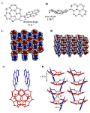
Columnar/herringbone dual crystal packing of pyrenylsumanene and its photophysical properties
Beilstein J. Org. Chem. 2014, 10, 841–847, doi:10.3762/bjoc.10.80
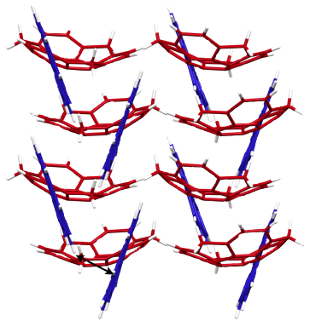
- emission with high quantum yield (0.82) was observed for pyrenylsumanene in solution, while excimer-type red-shifted emission was evident in the crystalline phase. Keywords: carbon nanomaterials; columnar crystal packing; fluorescence; herringbone; pyrenylsumanene; Introduction Buckybowls – bowl-shaped
- in the crystal is also assigned to the excimer state. The quantum yields of pyrene in solution and in the solid state are almost equal (0.64 and 0.68). In contrast, the quantum yield of 1 in the solid state (0.10) is decreased significantly from that in solution (0.82). This exciton quenching may be
- due to the effect of the sumanene moiety, since the quantum yield of 3 is low both in solution and in the solid state. Conclusion The ability to predict the crystal packing of organic molecules is important in the design of functional organic compounds but remains challenging. In this regard, the




Rapid pseudo five-component synthesis of intensively blue luminescent 2,5-di(hetero)arylfurans via a Sonogashira–Glaser cyclization sequence
Beilstein J. Org. Chem. 2014, 10, 672–679, doi:10.3762/bjoc.10.60
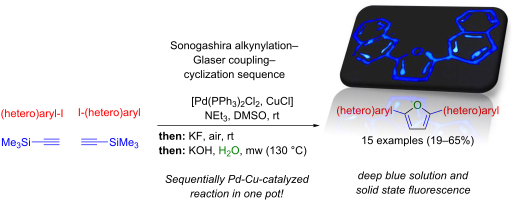
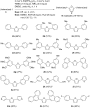
- quantum yield Φf. The same holds true for the comparison of the constitutional isomers 2i and 2j. Therefore, the twisted structure of 2j causes a larger Stokes shift and a much lower fluorescence quantum yield Φf. The huge Stokes shift originates from a considerable planarization in the excited state [42
- quantum yield Φf. This finding correlates well with the planar ground state structure and an associated low Stokes shift. All studied representatives are potentially interesting singlet bluelight emitters. In addition, the electronic properties of the furans 2 have been studied by cyclic voltammetry
- in a one-pot fashion, which opens a ready access to biologically active furan derivatives. In addition the investigation of the photophysical properties of these compounds reveals an intense blue luminescence in solution approaching unity for the fluorescence quantum yield Φf of distinct derivatives




Topochemical control of the photodimerization of aromatic compounds by γ-cyclodextrin thioethers in aqueous solution
Beilstein J. Org. Chem. 2013, 9, 1858–1866, doi:10.3762/bjoc.9.217
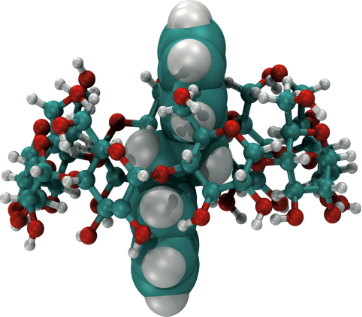
- -to-head dimer. The degree of complexation of coumarin could be increased by employing the salting out effect. Keywords: acenaphthylene; anthracene; coumarin; cyclodextrins; photodimerization; quantum yield; stereoselectivity; Introduction Photochemical reactions have been considered highly
- previously by fluorescence measurements [25]. The quantum yield Φ did not correlate with the binding constant K, possibly because dissolved ANT is mainly converted in the complexed state in presence of hosts 1–7. Only a small portion of ANT remains in the free state due to its low solubility (0.4 μM, [25
- ]). Instead, packing of the two ANT molecules within the complex seems to determine the quantum yield Φ. Stereoselective photodimerization of acenaphthylene The photodimerization of ACE generally leads to mixtures of two isomeric cyclobutane derivatives, namely the syn and the anti dimers, as shown in Scheme


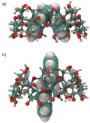
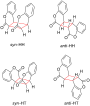

Synthesis and spectroscopic properties of 4-amino-1,8-naphthalimide derivatives involving the carboxylic group: a new molecular probe for ZnO nanoparticles with unusual fluorescence features
Beilstein J. Org. Chem. 2013, 9, 1311–1318, doi:10.3762/bjoc.9.147

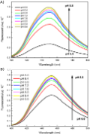
- quantum yield, but also gives rise to bathochromic shifts of both absorption and fluorescence and dual fluorescence with lifetimes of 0.2–0.3 ns and 6 ns ascribed to the formation of anionic complexes. The interaction with the ZnO surface brings about further considerable changes in the fluorescence
- concentration of 5 × 10⁻⁵ M increases and becomes the major band at lower concentrations as shown in Figure 3. The acid 4 and its ester 6 show strong fluorescence in nonpolar solvents such as cyclohexane and toluene (quantum yield for 4 is 75 ± 10%), while in polar solvents such as ethanol, the fluorescence
- intensity of 4 considerably diminishes (quantum yield ≈10%). This phenomenon can also be related to partial ionization: the formation of the nonfluorescent anionic species and fluorescent anionic complex in ethanol, as shown in a simplified form (the potential existence of the acid dimers is omitted) in


Substituent effect on the energy barrier for σ-bond formation from π-single-bonded species, singlet 2,2-dialkoxycyclopentane-1,3-diyls
Beilstein J. Org. Chem. 2013, 9, 925–933, doi:10.3762/bjoc.9.106
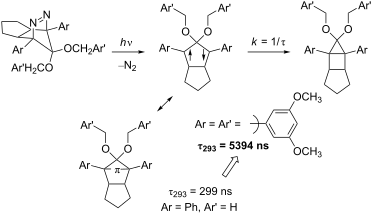
- yields of the denitrogenation of AZc–g were determined to be ≈0.90 by comparison with those reported for similar azoalkanes [33]. The quantitative formation of CPc–g and the high quantum yield of the denitrogenation process suggest the clean generation of DRc–g in the photoirradiation reaction of AZc–g


Synthesis, photophysical and electrochemical characterization of terpyridine-functionalized dendritic oligothiophenes and their Ru(II) complexes
Beilstein J. Org. Chem. 2013, 9, 866–876, doi:10.3762/bjoc.9.100

- , fluorescence and quantum yield data for the ligands and complexes in acetonitrile solution. Electrochemical properties of dendrons and dendrimers a. Acknowledgements The authors would like to acknowledge the Alexander von Humboldt foundation (grant for AM).


Spectroscopic characterization of photoaccumulated radical anions: a litmus test to evaluate the efficiency of photoinduced electron transfer (PET) processes
Beilstein J. Org. Chem. 2013, 9, 800–808, doi:10.3762/bjoc.9.91
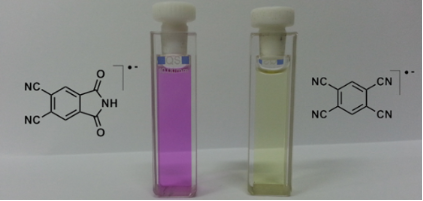
- silyl, stannyl, t-Bu group or a hydrogen [12][13][14][15][16][17][18][19][20][21][22][23][24][25][26][27]), unimolecular fragmentation was possible and gave neutral alkyl radicals (D•) with a reasonable (0.1 or higher) quantum yield (Scheme 1, step b) [5]. Addition to the aromatic radical anion and re
- after a few minutes, and readmitting air caused little change in the spectrum. Chromatographic examination confirmed the complete consumption of TCB and the formation of a single product, identified as 5-butyl-1,2,4-tricyanobenzene by comparison with an authentic sample [18]. The measured quantum yield
- . The final absorption was qualitatively and quantitatively close to that reported in the literature for the TCB radical anion (see Table 1). Thus, conversion was deemed to be complete, with a 0.15 quantum yield of formation of TCB•−. Readmitting air in this case caused the disappearance of the color




A new synthetic protocol for coumarin amino acid
Beilstein J. Org. Chem. 2013, 9, 254–259, doi:10.3762/bjoc.9.30
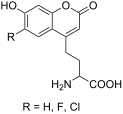
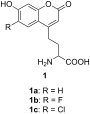
- applications related to it [2][3][4][5][6][7][8]. Compound 1a is of great interest to scientists because the 7-hydroxycoumarin moiety has a high fluorescence quantum yield and a large Stokes shift. Its excellent fluorescence properties make it a great candidate to substitute green fluorescent protein (GFP) in



A chemist and biologist talk to each other about caged neurotransmitters
Beilstein J. Org. Chem. 2013, 9, 64–73, doi:10.3762/bjoc.9.8
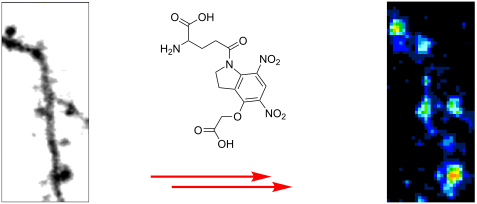
- called a rate. The former is simply a way of measuring the quantum yield by determining the half-time (hence “rate”) of photolysis under some set of defined irradiation conditions. However, even with the former measurement care must be taken. The chemical reactions of release can be quite complex, so the
- than MNI-Glu [27] (ε = 4,300/M/cm). The second property is the quantum yield of photolysis (chemists use the symbol Φ for this). This measures how many excited molecules give a product, with the normal maximum being 1. Photochemical efficiency is ε·Φ. So, to some extent, a large ε can make up for a


Hydrophobic analogues of rhodamine B and rhodamine 101: potent fluorescent probes of mitochondria in living C. elegans
Beilstein J. Org. Chem. 2012, 8, 2156–2165, doi:10.3762/bjoc.8.243
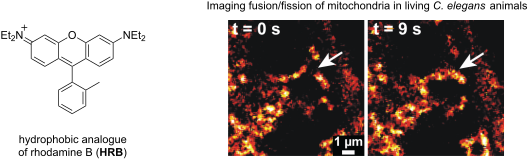
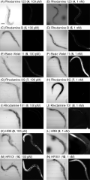
- -shifted absorbance and emission spectra (5–9 nm), modest reductions in molar extinction coefficent and quantum yield, and enhanced partitioning into octanol compared with aqueous buffer of 10-fold or more. Comparison of living C. elegans (nematode roundworm) animals treated with the classic fluorescent
- [43] molar extinction coefficient of rhodamine B (5) of 106,000 M−1 cm−1 (at 545 nm in ethanol) with HRB (9, 83,000 M−1 cm−1 at 555 nm in methanol). Additionally, a modest reduction in quantum yield of ~0.3 for both fluorophores was observed. Spectroscopic studies revealed that HRB 9 and HR101 10 are
- not as bright as the carboxylate-containing parent dyes. However, because the fluorescence intensity is directly proportional to the product of the extinction coefficient and the quantum yield at excitation levels below saturation, these analogues represent very bright fluorophores for imaging




Flow photochemistry: Old light through new windows
Beilstein J. Org. Chem. 2012, 8, 2025–2052, doi:10.3762/bjoc.8.229
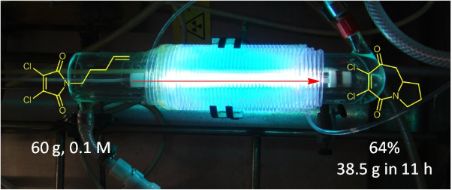
- -pressure lamp, if operating at 30% efficiency will have a total UV power of 4.5 W at 254 nm. According to Equation 3 this corresponds to a photon flux of 34 mmol photons per hour. When multiplied by the quantum yield of a reaction driven by 254 nm UV, a figure is obtained that represents the maximum
- described earlier. For example, when 80% of the available photons are delivered to the solution to drive a reaction with a quantum yield of just 10%, the productivity can be estimated as 2.7 mmol/h. The photons are acting as a “reagent” but not one that can be added all at once; rather, they are introduced
- as a stream (flux). As the reactant solution is also introduced as a stream, the flow rate can be precisely tailored to match the photon flux of the lamp and the quantum yield of the substrate. The main aim of this review is to illustrate the advances made in flow photochemistry over the last 10


A simple and efficient dual optical signaling chemodosimeter for toxic Hg(II)
Beilstein J. Org. Chem. 2012, 8, 1352–1357, doi:10.3762/bjoc.8.155

- a quantum yield (ФF) of 0.021, calculated with respect to anthracene (ФF = 0.27) [61]. Fluorimetric titration (Figure 3) revealed linear enhancements in the emission intensity with a significant 17-fold enhancement observed at a limiting 5.1 × 10⁻⁵ M of Hg2+ [60]. Based on the linear response


Interaction of cyclodextrins with pyrene-modified polyacrylamide in a mixed solvent of water and dimethyl sulfoxide as studied by steady-state fluorescence
Beilstein J. Org. Chem. 2012, 8, 1312–1317, doi:10.3762/bjoc.8.150
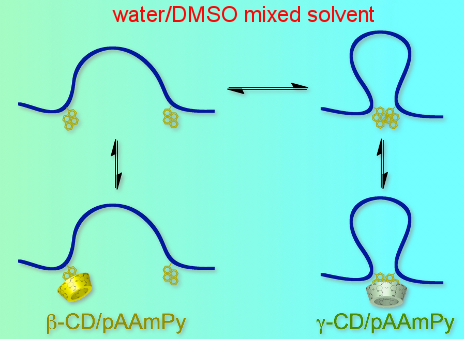
- one to construct functional systems that convert photo energy based on molecular recognition. Among aromatic compounds, pyrene is the most examined as a fluorescence probe or label because it shows a relatively high fluorescence quantum yield and a relatively long fluorescence lifetime in both monomer
- formation (KPy) can be calculated as where [Py]0 is the total concentration of Py residue and x as given in Equation 2. Here, A1,376, A1,480, A2,376, and A2,480 are constants corresponding to the products of the molar extinction coefficient and the fluorescence quantum yield (subscripts 1 and 2 indicate



Control over molecular motion using the cis–trans photoisomerization of the azo group
Beilstein J. Org. Chem. 2012, 8, 1071–1090, doi:10.3762/bjoc.8.119
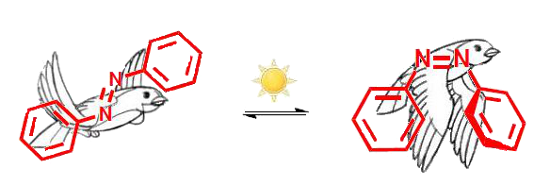
- and S2←S0 excitations and cis–trans isomerization by exciting into the S1 or S2 state [21]. The sum of the quantum yields is different to unity, which indicates multiple pathways for isomerization. In stilbene, the isomerization occurs exclusively by rotation and the quantum yield equals unity [22
- (azo-15) may be useful as a molecular switch, because the photoisomerization of azo-fullerene 14 leads to only 8% of the cis-isomer. Although, the quantum yield obtained for cis-14 is not very high, this proportion is significant, given the speed with which energy transfer to the fullerene unit occurs


The effect of the formyl group position upon asymmetric isomeric diarylethenes bearing a naphthalene moiety
Beilstein J. Org. Chem. 2012, 8, 1018–1026, doi:10.3762/bjoc.8.114
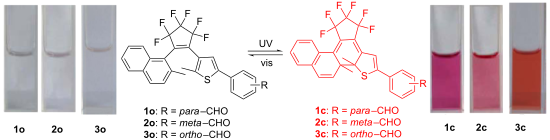
- fluorescence quantum yield. The cyclization quantum yields of these compounds increased in the order of para < ortho < meta, whereas their cycloreversion quantum yields decreased in the order of meta > para > ortho. Additionally, all of these diarylethenes functioned as effective fluorescent switches in both
- different from those with an electron-donating methoxy group [14][50][51]. The cycloreversion quantum yields of diarylethenes 1–3 increased in the order of ortho (Φc-o = 0.11) < para (Φc-o = 0.12) < meta substitution (Φc-o = 0.15) by the formyl group. However, the cyclization quantum yield of the para
- evidently increased. When anthracene was used as the reference, the fluorescence quantum yields of 1o–3o were determined to be 0.012, 0.018, and 0.059, respectively, indicating that the formyl group on the terminal benzene ring could notably enhance the fluorescence quantum yield and remarkably influence


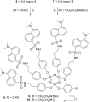
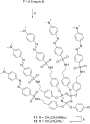
Synthesis of dye/fluorescent functionalized dendrons based on cyclotriphosphazene
Beilstein J. Org. Chem. 2011, 7, 1577–1583, doi:10.3762/bjoc.7.186
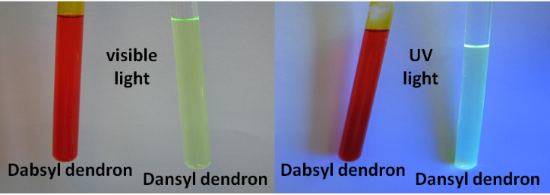
- fluorescence quantum yield is slightly sensitive to the nature of the A functionality (Table 1). Dendrons 8 and 9 are soluble in organic solvents, as is dendron 10, but in the case of 10 it is also soluble in water in contrast to the others, thus we also studied its fluorescence in water. We observed a notable
- decrease of its fluorescence quantum yield (Φ) in water upon going from pure dioxane (Φ = 51) to pure water (Φ = 17), which cannot be related to protonation, as indicated from the UV–vis spectrum [10]. An analogous phenomenon was already described for a dansyl derivative of adenosine in solution in water
- fluorescent dendrons were synthesized and their fluorescence properties studied. One of them, 10 is both soluble in organic solvents and in water, and displays novel behaviour in mixtures of solvent (dioxane/water). Variations in the fluorescence quantum yield of its dansyl groups must be related to