Search results
Search for "thermal stability" in Full Text gives 253 result(s) in Beilstein Journal of Organic Chemistry. Showing first 200.
Enhancing the reactivity of 1,2-diphospholes in cycloaddition reactions
Beilstein J. Org. Chem. 2015, 11, 169–173, doi:10.3762/bjoc.11.17
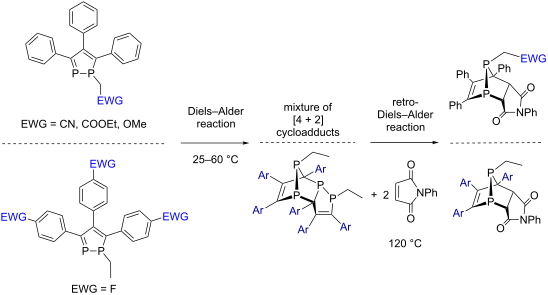
- (with thermal stability up to 190 °C) and 2H-phospholes (exhibiting high reactivity in the cycloaddition reaction at 25 °C) [9][10][11]. In the present work, attempts to increase the reactivity of the dienic system of 1,2-diphospholes using two different approaches are described: (a) by the introduction
- reaction mixtures showed many multiplets at 80 and −40 ppm with a coupling constant 1JPP ca. 200–210 Hz characteristic for the products of [4 + 2] cycloaddition reaction – 1,7-diphosphanorbornadienes [9][11]. Remarkably, 1-alkyl-1,2-diphospholes without EWGs reveal significant thermal stability and


First chemoenzymatic stereodivergent synthesis of both enantiomers of promethazine and ethopropazine
Beilstein J. Org. Chem. 2014, 10, 3038–3055, doi:10.3762/bjoc.10.322

- solvent could significantly influence the activity and selectivity of the enzymatic reaction as well as increase the thermal stability of enzymes [66]. The high sensitivity of lipases towards the medium environment mainly stems from experimental observations that different organic solvents had a different




A comparative study of the interactions of cationic hetarenes with quadruplex-DNA forming oligonucleotide sequences of the insulin-linked polymorphic region (ILPR)
Beilstein J. Org. Chem. 2014, 10, 2963–2974, doi:10.3762/bjoc.10.314
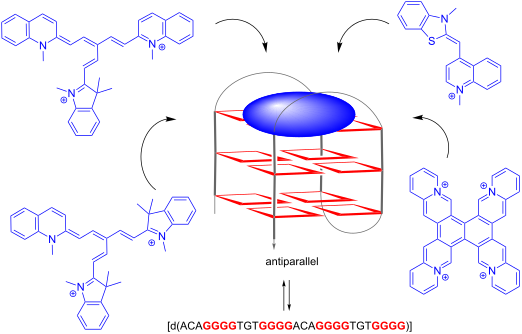
- thermal stability of the ILPR-DNA with respect to unfolding was also examined by emission spectroscopy in K+- and Na+-containing buffer, i.e., the melting temperature, Tm, of the dye-labelled quadruplex-forming ILPR sequence Fa2T [fluorescein-d(ACAG4TGTG4ACAG4TGTG4)-tetramethylrhodamine] was determined by




Synthesis and properties of novel star-shaped oligofluorene conjugated systems with BODIPY cores
Beilstein J. Org. Chem. 2014, 10, 2704–2714, doi:10.3762/bjoc.10.285

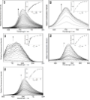
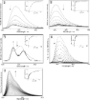
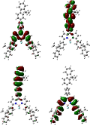
- oligofluorene arm length and substitution patterns of the central BODIPY core have been synthesised, leading to two families of compounds, T-B1–T-B4 and Y-B1–Y-B4, with T- and Y-shaped motifs, respectively. Thermal stability, cyclic voltammetry, absorption and photoluminescence spectroscopy of each member of
- molecular bromine which was used previously [33]. Thermal, electrochemical and optical properties TGA and DSC analyses All of the final target compounds showed good thermal stability. Thermogravimetric analysis (TGA) revealed decomposition temperatures in the range 396–442 °C (Table 1, Figure S1, Supporting



Encapsulation of biocides by cyclodextrins: toward synergistic effects against pathogens
Beilstein J. Org. Chem. 2014, 10, 2603–2622, doi:10.3762/bjoc.10.273
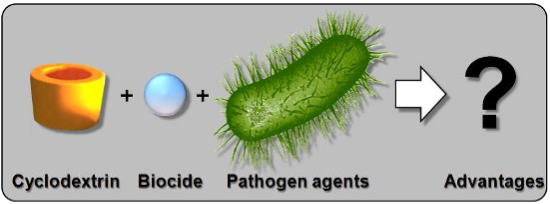
- -CD inclusion complexes greatly improves the thermal stability of the biocide with no negative influence on its activity and toxicity. In 2013, Hill et al. reported that β-CD can be used to encapsulate various essential oil constituents (e.g., trans-cinnamaldehyde, eugenol, etc.) for antimicrobial
- their high thermal stability, low toxicity to human cells and effective broad-spectrum antibacterial activity. The antibacterial activity of these nanoparticles is probably due to their rapid breakdown which releases ionic silver that interact with the thiol residues of bacterial enzymes [80]. As a


Synthesis and characterization of a hyper-branched water-soluble β-cyclodextrin polymer
Beilstein J. Org. Chem. 2014, 10, 2586–2593, doi:10.3762/bjoc.10.271
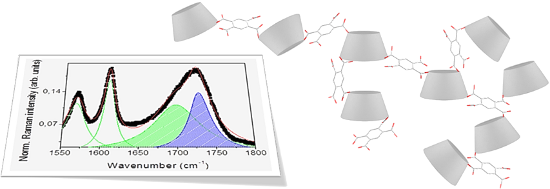
- 30000. Thermogravimetric analyses (Figure 3) clearly show that thermal stability increases by selecting molecular weights greater than 10000 Da (red line) and 30000 Da (green line), and these samples are characterized by a remarkable thermal stability. Degradation of such larger fractions starts at




Reversibly locked thionucleobase pairs in DNA to study base flipping enzymes
Beilstein J. Org. Chem. 2014, 10, 2293–2306, doi:10.3762/bjoc.10.239
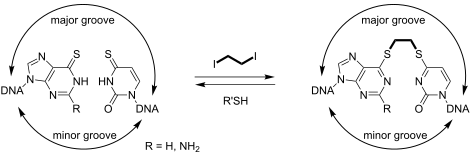
- absorption band above 300 nm in the UV spectrum (c, solid) compared to the spectrum of 1I6S∙2U4S (dashed). The thermal stability of the cross-linked duplex 1I6S-Et-S4U2 (d, solid) is drastically increased compared to 1I6S∙2U4S (dashed). Characterization of HPLC-purified cross-linked duplex 1G6S-Et-S4U2 (a
- ) by denaturing anion exchange HPLC (b). Alkylation at the sulfur atoms within the thionucleobases is confirmed by the strong reduction of the absorption band above 300 nm in the UV spectrum of 1G6S-Et-S4U2 (c, solid) compared to the spectrum of 1G6S∙2U4S (dashed). The thermal stability of the cross


The effect of permodified cyclodextrins encapsulation on the photophysical properties of a polyfluorene with randomly distributed electron-donor and rotaxane electron-acceptor units
Beilstein J. Org. Chem. 2014, 10, 2145–2156, doi:10.3762/bjoc.10.222
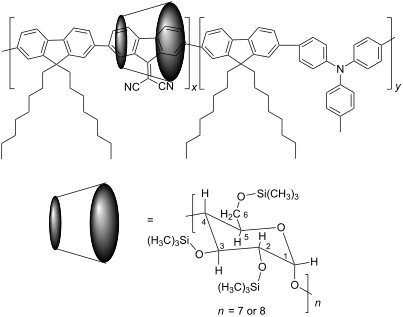
- -dioctylfluorene 3 and compared with those of the corresponding non-rotaxane 4 counterpart. Rotaxane formation results in improvements of the solubility, the thermal stability, and the photophysical properties. Polyrotaxanes 4a and 4b exhibited slightly red-shifted absorption bands with respect to the non-rotaxane
- “insulation” of the individual molecular wires. Moreover, recently reported results have shown improvements of the thermal stability, solubility, luminescence and surface characteristics of polyrotaxanes compared to those of non-rotaxane counterparts [8][13][19][20][21][22][23][24][25]. This approach has also
- polyrotaxanes exhibited a thermal decomposition temperature around 412 °C, whereas the thermal decomposition temperature of reference 4 was around 414 °C at 5% weight loss (Figure 4 and Table 1). It is noteworthy that the polyrotaxane formation increases the thermal stability of the macrocycle molecules


Second generation silver(I)-mediated imidazole base pairs
Beilstein J. Org. Chem. 2014, 10, 2139–2144, doi:10.3762/bjoc.10.221
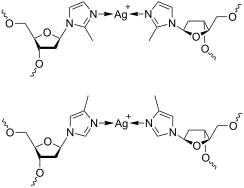
- artificial metal-mediated base pairs. We show here that its stability can be further improved by formally replacing the imidazole moiety by a 2-methylimidazole or 4-methylimidazole moiety. A comparison of the thermal stability of several double helices shows that the addition of one equivalent of Ag(I) leads
- absolute melting temperature. In the presence of one equivalent of Ag(I), the thermal stability of the duplexes increases significantly. Notably, the increase in Tm is larger by about 50% for the methylated imidazole nucleosides compared with the non-methylated one, amounting to about 8.5 °C per silver(I
- )-mediated base pair. The significantly increased thermal stability of the duplexes comprising either 2-methylimidazole or 4-methylimidazole therefore cannot be attributed to the above-mentioned hydrophobic interaction only but must also be a direct effect of the formation of the metal-mediated base pairs


Photo, thermal and chemical degradation of riboflavin
Beilstein J. Org. Chem. 2014, 10, 1999–2012, doi:10.3762/bjoc.10.208

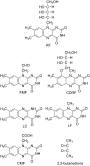
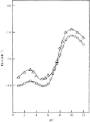
- stable complexes are formed with Zn and Ni, showing higher degradation temperatures as compared to pure RF whereas the remaining complexes showed similar or lower thermal stability to that of the pure RF with the Fe-complex found to be most rapidly degraded [161]. The presence of various metal ions




Efficient CO2 capture by tertiary amine-functionalized ionic liquids through Li+-stabilized zwitterionic adduct formation
Beilstein J. Org. Chem. 2014, 10, 1959–1966, doi:10.3762/bjoc.10.204
- . These efforts include the development of liquid and solid absorbents and membranes [2][3][4][5][6][7]. Ionic liquids (ILs), which have attractive properties such as negligible vapor pressure, a wide liquid temperature ranges, good thermal stability, high ionic conductivity, and versatile solvation
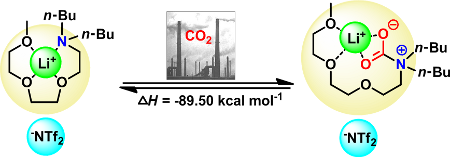
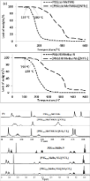
- . The thermal stability of the chelated ILs was strongly increased compared to the corresponding neutral ligands. The decomposition temperature increased by 90 °C and 60 °C for PEG150MeTMG and PEG150MeBu2N, respectively, after coordination with LiNTf2 (Figure 2a). In the 1H NMR spectrum, the proton
- . Indeed, the thermal stability and the CO2 capacity of the neutral ligands (e.g., PEG150MeBu2N) was highly increased after coordination with lithium salts to form chelated ILs (e.g., [PEG150MeBu2NLi][NTf2]). Experimental Materials All reagents used in this work were purchased from Sigma-Aldrich and used




Aryl substitution of pentacenes
Beilstein J. Org. Chem. 2014, 10, 1692–1705, doi:10.3762/bjoc.10.178
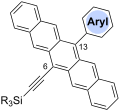
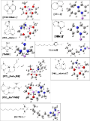
- (vide infra). Thermal analysis The thermal stability of selected aryl pentacenes has been explored by traditional melting point analysis (MPA) in open capillary tubes, thermal gravimetric analysis (TGA), and differential scanning calorimetry (DSC) measurements; the results are summarized in Table 2. TGA




Improving the reactivity of phenylacetylene macrocycles toward topochemical polymerization by side chains modification
Beilstein J. Org. Chem. 2014, 10, 1613–1619, doi:10.3762/bjoc.10.167
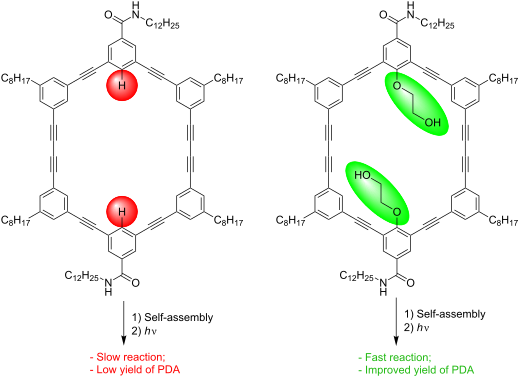
- groups lead to a significant decrease of solubility, even in hot solvents, limiting the formation of organogels. In order to investigate the crystallization temperature of solvents within the gel and to compare the influence of the 2-hydroxyethoxy side chains on the thermal stability of the gel, two gel




Photoswitchable precision glycooligomers and their lectin binding
Beilstein J. Org. Chem. 2014, 10, 1603–1612, doi:10.3762/bjoc.10.166
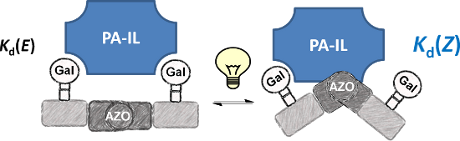
- phenylamine one for two reasons: first, its higher nucleophilicity allows for a smoother synthesis and second, the resulting Z-azobenzene exhibits a high thermal stability as compared to the fully conjugated push-pull azobenzene based on the phenylamine fragment. In total, five precision glycooligomers were
- , demonstrating the reversibility of the systems. Finally, the thermal stability of Z-Azo-Gal(1,3)-3 in the buffer solution is quite high. Indeed, after 48 h at 25 °C only 12% of the Z-isomers converted back to the E-isomer (see Supporting Information File 1). The thermal stability of the trivalent Azo-Gal(1,3,5


Influence of perylenediimide–pyrene supramolecular interactions on the stability of DNA-based hybrids: Importance of electrostatic complementarity
Beilstein J. Org. Chem. 2014, 10, 1589–1595, doi:10.3762/bjoc.10.164
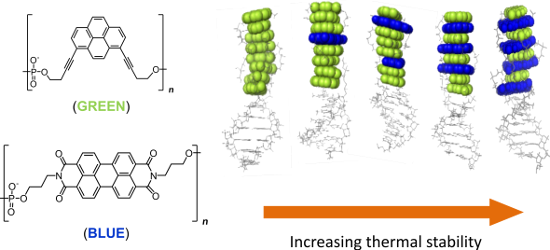
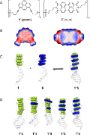
- pyrene–pyrene interactions, whereas duplex 1*6 has the maximum number pyrene–PDI interactions. Thermal denaturation experiments Thermal denaturation experiments revealed a clear trend in duplex stability (Figure 2). The thermal stability correlates with the number of pyrene–PDI interactions [56] and



Pyrene-modified PNAs: Stacking interactions and selective excimer emission in PNA2DNA triplexes
Beilstein J. Org. Chem. 2014, 10, 1495–1503, doi:10.3762/bjoc.10.154
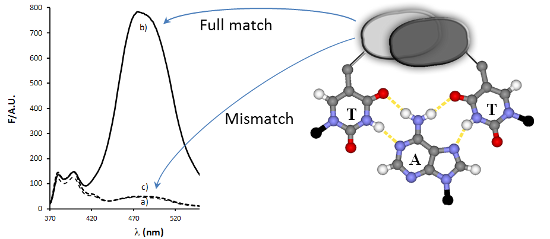
- using standard Fmoc-based manual solid phase protocol. The crude products were purified by RP-HPLC and characterized by HPLC–UV–MS (Supporting Information File 1, Figures S6–S11). Thermal stability of PNA:DNA complexes The introduction of a modification in a PNA stand can lead to different effects
- the presence of DNA was found to be in accordance with the UV melting measurements (Supporting Information File 1, Figure S15). Fluorescence studies Beside the modification of thermal stability and selectivity induced by the incorporation of pyrene moieties described above, we evaluated the
- hybridization, a property which is very important also in the case of more elaborated methods such as gated detection. These characteristics make PNA2 a very good fluorescent probe, with very high single-base selectivity in both thermal stability and excimer formation upon binding to target DNA. Thus, the


Multichromophoric sugar for fluorescence photoswitching
Beilstein J. Org. Chem. 2014, 10, 1471–1481, doi:10.3762/bjoc.10.151
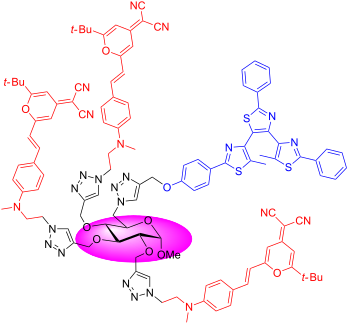
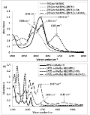
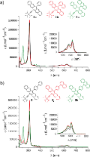
- photostationary state (PSS) under 335 nm illumination, isolated 9-CF; (d) emission spectrum of 9-OF (λexc = 325 nm); (e) absorption spectra of 2-OF, 2 at the photostationary state (PSS) under 335 nm illumination (no noticeable change has been observed over 5 days, indicating the thermal stability of 2), 2-CF




Solid-phase-supported synthesis of morpholinoglycine oligonucleotide mimics
Beilstein J. Org. Chem. 2014, 10, 1151–1158, doi:10.3762/bjoc.10.115
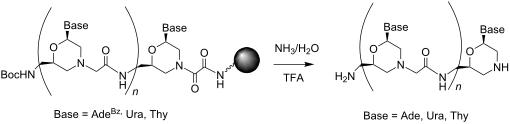
- positively charged centers in oligonucleotide analogues results in increased water solubility and higher thermal stability of complementary duplexes of such oligonucleotide mimics with nucleic acids [14][15]. Some conformationally restricted protonated PNA or pyrrolidine oligonucleotide mimics exhibit
- dependence of the thermal stability of complementary complexes formed by the MorGly oligomers on the heterocyclic base composition (uracil or adenine) of the modified chain. It was shown while studying their tandem complexes that the impact of cooperative interactions at oligomer junctions on the thermal
- stability was higher for modified oligomers than for native oligodeoxyriboadenylates. This result may indicate that the contribution of nucleobase stacking to the thermal stability of complementary complexes is more important for the oligonucleotide mimics than for native oligonucleotides. The substitution



The influence of intraannular templates on the liquid crystallinity of shape-persistent macrocycles
Beilstein J. Org. Chem. 2014, 10, 910–920, doi:10.3762/bjoc.10.89
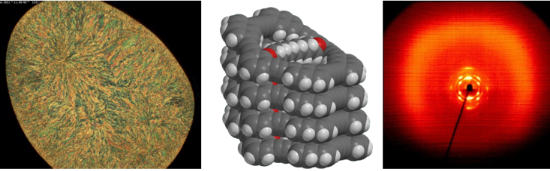
- substituents influence the thermal stability of the gel. As pointed out before, the ring interior can also have a dramatic effect on the mesophase stability of thermotropic liquid crystalline shape-persistent macrocycles [40][43][44][45]. However, more detailed studies on that issue are still scarcely found in


N-Alkylated dinitrones from isosorbide as cross-linkers for unsaturated bio-based polyesters
Beilstein J. Org. Chem. 2014, 10, 902–909, doi:10.3762/bjoc.10.88

- . Efforts have also been undertaken to employ nitrones in the realm of polymer chemistry. For instance, our former reports describe the cycloaddition of bis(N-methylnitrone)s and bis(N-phenylmaleimide)s , which yielded linear polymers bearing isoxazolidine units with high thermal stability [6]. The


Thermodynamically stable [4 + 2] cycloadducts of lanthanum-encapsulated endohedral metallofullerenes
Beilstein J. Org. Chem. 2014, 10, 714–721, doi:10.3762/bjoc.10.65
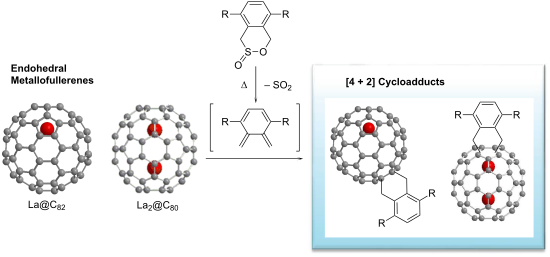
- demonstrated the boat-to-boat inversions of the addend. In addition, 5b revealed remarkable thermal stability in comparison with the reported [4 + 2] cycloadduct of pentamethylcyclopentadiene and La@C82 (6). These findings demonstrate the utility of sultines to afford thermodynamically stable endohedral
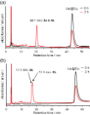
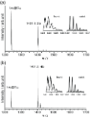
- , respectively, was achieved by the selective thermal decomposition of unstable isomers. The thermal stability of 5b was also evaluated in comparison with 6, and 5b shows remarkable thermal stability. The molecular structures of the resulting compounds were characterized by spectroscopic analyses. Dynamic 1H NMR






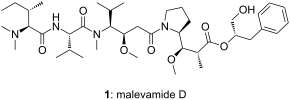
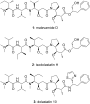
Total synthesis and cytotoxicity of the marine natural product malevamide D and a photoreactive analog
Beilstein J. Org. Chem. 2014, 10, 316–322, doi:10.3762/bjoc.10.29
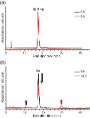
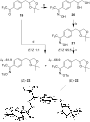
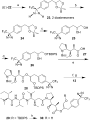
- ) and acidic deprotection afforded diazirine diol 25. Figure 2 shows the DSC (differential scanning calorimetry) profile of 25, which melts at 54 °C and starts to decompose above 80 °C, indicating sufficient thermal stability for biological studies. Monosilylation of the primary hydroxy group of 25




Cyclic phosphonium ionic liquids
Beilstein J. Org. Chem. 2014, 10, 271–275, doi:10.3762/bjoc.10.22

- synthesize ILs with improved properties (such as viscosity, thermal stability, melting point, etc.) to expand their applications into larger scale processes in diverse areas. Along that vein, phosphonium ILs have been observed to have favorable characteristics, including lower costs [2][3][4][5][6], lower
- viscosity (by ~50%) [7][8][9][10][11], greater thermal stability (by ~100 °C) [10][11][12], and wider electrochemical windows compared to their ammonium congeners. The family of ILs bearing cyclic cations (pyrrolidinium, piperidinium, and azepanium) [13][14] have been shown to have better transport and
- cations have greater thermal stability than the ammonium ones. One trend observed for both cation types is that the ILs with five-membered rings have greater thermal stability than those with six-membered rings. Further work will be required to determine if the observed TGA behaviors are due to actual


Synthesis, characterization and initial evaluation of 5-nitro-1-(trifluoromethyl)-3H-1λ3,2-benziodaoxol-3-one
Beilstein J. Org. Chem. 2014, 10, 1–6, doi:10.3762/bjoc.10.1
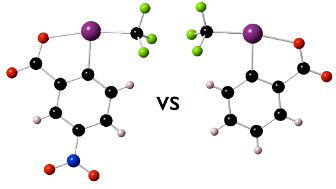
- . Consequently in light of these results, DSC measurements of 2 and 3 were carried out in order to assess the thermal stability of the new derivative. These measurements were performed in punctured Al2O3 pans with a heating rate of 10 K/min. For reagent 2, a decomposition energy of 138 kJ/mol (438 J/g, slightly
- lability of 3 was noted such that it decayed almost one order of magnitude faster than 2 under similar conditions. Therefore, the incorporation of an electron-withdrawing group into the reagent scaffold leads to an enhanced thermal stability that is paralleled by increased lability of the I–CF3 bond under


Charge-transfer interaction mediated organogels from 18β-glycyrrhetinic acid appended pyrene
Beilstein J. Org. Chem. 2013, 9, 2877–2885, doi:10.3762/bjoc.9.324
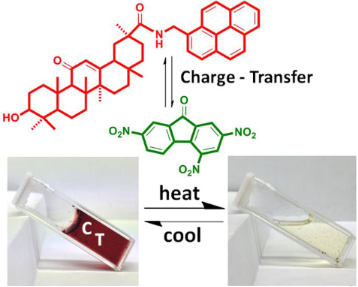
- in the formation of CT gels is demonstrated through the formation of gels in a variety of solvents. Thermal stability, stoichiometry, scanning electron microscopy (SEM), optical micrographs, and circular dichroism (CD) are performed on these CT gels to investigate their thermal and assembly
- observation suggested the presence of a CT complex in the gel system. Thermal stability Sol to gel transition temperature (Tgel) was measured as a function of the total concentration of the 1:1 (molar ratio) donor–acceptor mixture. These were done by inverted test tube experiments after gels were stabilized
- in sealed test tubes for 1–2 h [15][48][49][50]. It was observed that the thermal stability of these CT gels based on 3 and 4 increased with an increase in the total concentration (Figure 2), no matter in what kind of solvent. Based on the Tgel values at different concentrations, the thermodynamic