


Search results
Search for "triphenylphosphine" in Full Text gives 246 result(s) in Beilstein Journal of Organic Chemistry. Showing first 200.
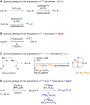
Deoxygenative gem-difluoroolefination of carbonyl compounds with (chlorodifluoromethyl)trimethylsilane and triphenylphosphine
Beilstein J. Org. Chem. 2014, 10, 344–351, doi:10.3762/bjoc.10.32
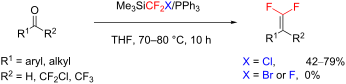
- )trimethylsilane (TMSCF2Cl) and triphenylphosphine (PPh3) can be used for the synthesis of gem-difluoroolefins from carbonyl compounds. Comparative experiments demonstrate that TMSCF2Cl is superior to (bromodifluoromethyl)trimethylsilane (TMSCF2Br) and (trifluoromethyl)trimethylsilane (TMSCF3) in this reaction
- TMSCF2Cl was used, TMSCl is not reactive enough to trap the betaine 3, thus the oxaphosphetane 5 could be formed to give olefins and triphenylphosphine oxide (Scheme 4). Finally, the olefination of aldehyde 1b with TMSCF3 as the difluoromethylene source was tested. The results showed that no desired


Diversity-oriented synthesis of dihydrobenzoxazepinones by coupling the Ugi multicomponent reaction with a Mitsunobu cyclization
Beilstein J. Org. Chem. 2014, 10, 209–212, doi:10.3762/bjoc.10.16

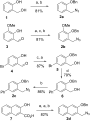
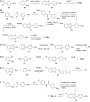
- –d were straightforwardly prepared in excellent yields from low cost starting materials 1, 3, 4, and 7, in all cases passing through the benzyl alcohols (Scheme 1). Apart from 2a [11], they are all new compounds. Initially we reduced azide 2a with PPh3 and separated the amine from triphenylphosphine
- triphenylphosphine oxide. We eventually found that the easiest and most efficient protocol involved reduction with Me3P, followed by evaporation of the solvent and by subsequent Ugi reaction on the crude. With Me3P, phosphazene hydrolysis was much faster and the phosphine oxide was much more easily separated by


Synthesis of five- and six-membered cyclic organic peroxides: Key transformations into peroxide ring-retaining products
Beilstein J. Org. Chem. 2014, 10, 34–114, doi:10.3762/bjoc.10.6
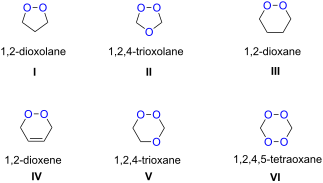
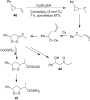
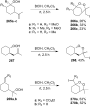
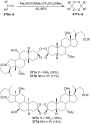
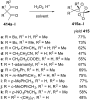
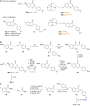
- 50) [93]. It should be emphasized that this method can be applied in spite of the use of triphenylphosphine, which is a strong reducing agent for peroxides. The alkylation of the sodium salt of alcohol 183 with 2-chloropyrimidine in dimethylformamide gave ozonide 189 (Scheme 51). In this reaction
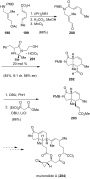
- azobisisobutyronitrile (AIBN) or ditert-butyl peroxalate (DBPO) as radical initiators. The resulting unstable hydroperoxides are reduced with triphenylphosphine to hydroxy derivatives 209 (Scheme 58, Table 15). The oxidation of acetophenones 210 produces bicyclic 1,2-dioxanes 212 (Scheme 59). It is hypothesized that the












Synthesis and determination of the absolute configuration of (−)-(5R,6Z)-dendrolasin-5-acetate from the nudibranch Hypselodoris jacksoni
Beilstein J. Org. Chem. 2013, 9, 2925–2933, doi:10.3762/bjoc.9.329
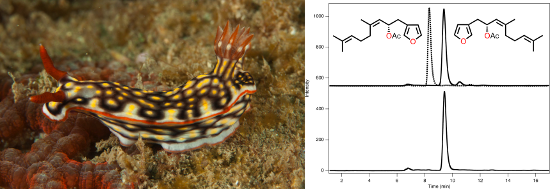
- triphenylphosphine in 90% yield. The 1H NMR spectrum of the geraniol sample used indicated the presence of traces of nerol, the Z-isomer of geraniol. Etherification of furan-3-ylmethanol (4) with the geranyl/neryl bromide mixture (5) in the presence of NaH furnished the 3-furylmethyl ether 6 (65% yield) as an E/Z


Synthesis of nucleotide–amino acid conjugates designed for photo-CIDNP experiments by a phosphotriester approach
Beilstein J. Org. Chem. 2013, 9, 2898–2909, doi:10.3762/bjoc.9.326

- ’-deoxyguanosine 5’-monophosphate (6.0 g, 10.0 mmol) was obtained as a glass-like residue. 2-N-Isobutyryl-3’-O-levulinyl-2’-deoxyguanosine 5’-monophosphate (6.0 g, 10.0 mmol) was dissolved in CH2Cl2 (45 mL). Triphenylphosphine (8.0 g, 30 mmol), 2,2′-dithiodipyridine (6.6 g, 30 mmol), and MeIm (4.8 mL, 60 mmol


Total synthesis of the endogenous inflammation resolving lipid resolvin D2 using a common lynchpin
Beilstein J. Org. Chem. 2013, 9, 2762–2766, doi:10.3762/bjoc.9.310
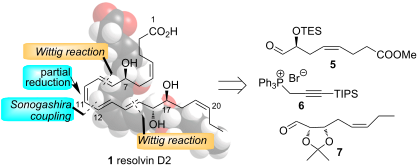
- with triphenylphosphine. Treatment of the salt 6 with n-BuLi gave the ylide and condensation with the aldehyde 7 afforded the desired E-enyne 11 along with the Z-isomer in a ratio of 2.2:1 which were easily separated by flash chromatography (Scheme 3). The minor Z-isomer could also provide novel


Advancements in the mechanistic understanding of the copper-catalyzed azide–alkyne cycloaddition
Beilstein J. Org. Chem. 2013, 9, 2715–2750, doi:10.3762/bjoc.9.308
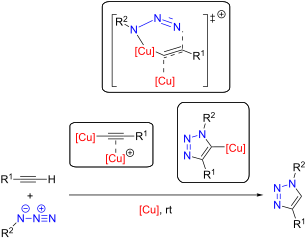
- under otherwise identical conditions (88% yield). The authors suggest a copper acetylide complex to be the active species, but such complexes have neither been isolated nor structurally characterized. The group of Novák added triphenylphosphine (2 mol %) to the catalyst precursor copper(II) salts with
- the aim of enabling CuAAC in organic media [86]. In this protocol, the triphenylphosphine additive (2 mol %) does not only act as ligand to increase the solubility of the copper species, but does also fulfil the role of the reducing agent to effect the conversion of Cu(II) to the catalytically active
- Cu(I) (similar to TCEP as reducing agent in biological applications [45][46][47][48][49][50][51][52][53][54][55]). However, Staudinger side reactions between the azide and the phosphine may take place as well, leading to the formation of the corresponding amine and triphenylphosphine oxide as




Ambient gold-catalyzed O-vinylation of cyclic 1,3-diketone: A vinyl ether synthesis
Beilstein J. Org. Chem. 2013, 9, 2537–2543, doi:10.3762/bjoc.9.288
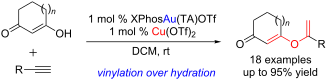
- acceptable yield (59%) of the desired vinyl addition product 3a. Thermally-stable Ph3PAu(TA)OTf (TA-Au, 5%) slightly improved the performance, yielding 63% of the desired product and less hydration byproduct 4. When changing the primary ligand from triphenylphosphine to a NHC, the yield slightly decreased


One-pot sequential synthesis of isocyanates and urea derivatives via a microwave-assisted Staudinger–aza-Wittig reaction
Beilstein J. Org. Chem. 2013, 9, 2378–2386, doi:10.3762/bjoc.9.274

- large number of functional groups and therefore has various uses in organic synthesis and can also be exploited for the preparation of heterocyclic compounds. Isocyanate derivatives can be generally obtained in good yields. However, it is necessary to avoid the traditional triphenylphosphine to obtain
- versatile and can be used for the synthesis of many products. However, the byproduct of this reaction is triphenylphosphine oxide, which is difficult to remove. It is known that this reaction can be performed in a heterogeneous system using PS-PPh2. Despite the higher costs for the reagent, the use of PS
- preparation of triphenylphosphine-loaded cross-liked cyclodextrin complexes as recyclable green catalyst [39]. The reactivity of polystyrene-supported reagents strongly depends on the choice of solvent that can influence polymer swelling [40]. Solvent choice is therefore an important issue as it must allow


An overview of the synthetic routes to the best selling drugs containing 6-membered heterocycles
Beilstein J. Org. Chem. 2013, 9, 2265–2319, doi:10.3762/bjoc.9.265


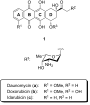
Flexible synthesis of anthracycline aglycone mimics via domino carbopalladation reactions
Beilstein J. Org. Chem. 2013, 9, 2194–2201, doi:10.3762/bjoc.9.258
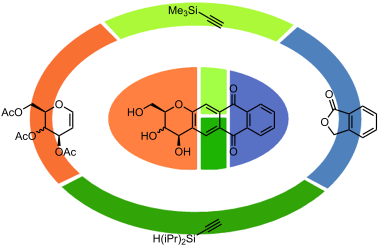
- chromatography afforded three fractions consisting of the starting material, the monoprotected and the diprotected product. The remaining alcohol moiety of compound 19 was converted into the respective iodide 20 by a Mukaiyama redox-condensation using elemental iodine, triphenylphosphine and imidazole [30]. The



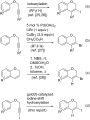
Gold(I)-catalyzed hydroarylation reaction of aryl (3-iodoprop-2-yn-1-yl) ethers: synthesis of 3-iodo-2H-chromene derivatives
Beilstein J. Org. Chem. 2013, 9, 2120–2128, doi:10.3762/bjoc.9.249
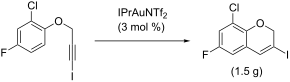
- triphenylphosphine (1.1 equiv, 5.5 mmol) are added successively. The solution was cooled to 0 °C and diethyl azodicarboxylate (1.2 equiv, 6 mmol) was added dropwise. The ice bath was removed and the reaction was stirred overnight. The solvents were removed under reduced pressure and the resulting crude was subjected



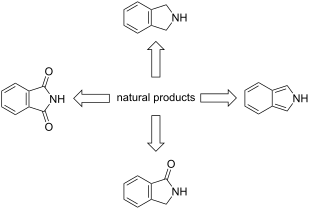
The chemistry of isoindole natural products
Beilstein J. Org. Chem. 2013, 9, 2048–2078, doi:10.3762/bjoc.9.243
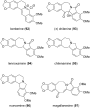
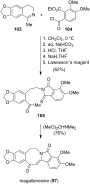
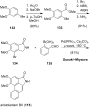
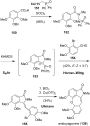
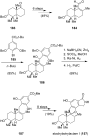
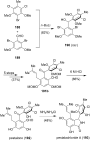
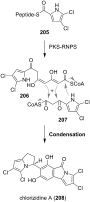
- chloride 110 gave 111, which upon sequential oxidation yielded enaminone 112. Finally, the isoindolinone moiety was generated via an intramolecular Heck reaction using tetrakis(triphenylphosphine)palladium(0) and thallium acetate, to give magallanesine (97) in excellent yield [85]. Aporphine alkaloids: The
















The application of a monolithic triphenylphosphine reagent for conducting Ramirez gem-dibromoolefination reactions in flow
Beilstein J. Org. Chem. 2013, 9, 1781–1790, doi:10.3762/bjoc.9.207
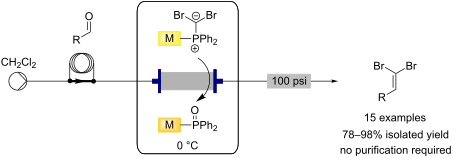
- application of a monolithic form of triphenylphosphine to the Ramirez gem-dibromoolefination reaction using flow chemistry techniques is reported. A variety of gem-dibromides were synthesised in high purity and excellent yield following only removal of solvent and no further off-line purification. It is also
- possible to perform the Appel reaction using the same monolith and the relationship between the mechanisms of the two reactions is discussed. Keywords: bromination; flow chemistry; Ramirez gem-dibromoolefination reaction; solid-supported reagent; triphenylphosphine monolith; Introduction The advantages
- using monolithic supports over traditional beads in flow chemistry protocols can greatly facilitate the synthesis of fine chemicals using these enabling technologies [36]. We have recently reported on the development of a monolithic triphenylphosphine reagent and its application to the Staudinger aza


Gold(I)-catalyzed formation of furans from γ-acyloxyalkynyl ketones
Beilstein J. Org. Chem. 2013, 9, 1774–1780, doi:10.3762/bjoc.9.206
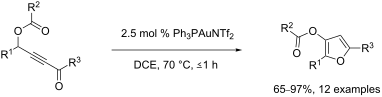
- -acyloxyalkynyl ketones were efficiently converted into highly substituted furans with 2.5 mol % of triflimide (triphenylphosphine)gold(I) as a catalyst in dichloroethane at 70 °C. Keywords: alkynyl ketones; cycloisomerization; furans; gold-catalysis; 1,2-migration; Introduction Furans are an important class of
- Gagosz’s catalyst [54], i.e. (triphenylphosphine)gold(I) triflimide, in dichloroethane at room temperature. In both cases, a fast consumption of the starting material 1a was observed compared to the copper(I) catalysis, but lower yields of furans, 44% and 65% respectively, were obtained mostly due to the


Gold-catalyzed cyclization of allenyl acetal derivatives
Beilstein J. Org. Chem. 2013, 9, 1751–1756, doi:10.3762/bjoc.9.202
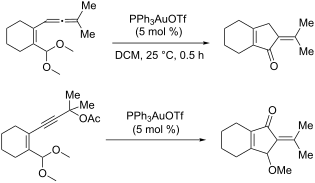
- . Experimental General procedure for the gold-catalyzed carbocyclization General procedure for the the gold(I)-catalyzed carbocyclization of vinylallenyl acetal: A two-necked flask was charged with chloro(triphenylphosphine)gold(I) (11.1 mg, 0.022 mmol) and silver triflate (5.8 mg, 0.022 mmol), and to this
- propargylic ester acetals: Chloro(triphenylphosphine)gold(I) (8.0 mg, 0.016 mmol) and silver triflate (4.2 mg, 0.016 mmol) were added to a dried Schlenk tube under an N2 atmosphere, and freshly distilled CH2Cl2 (1.0 mL) was introduced by a syringe. The resulting mixture was stirred at room temperature for 10


The preparation of several 1,2,3,4,5-functionalized cyclopentane derivatives
Beilstein J. Org. Chem. 2013, 9, 1705–1712, doi:10.3762/bjoc.9.195
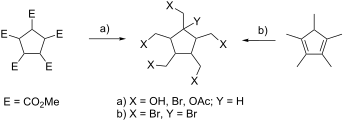
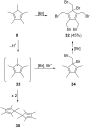
- failed so far, as is also shown in Scheme 3. Only in one case was a halogenated derivative obtained in poor yield: treatment of 16 with triphenylphosphine–bromine in carbon tetrachloride provided the tribromo ether derivative 19 as a minor component. Surprisingly, this had the cis,cis,cis,trans
- solvents). However, with the triphenylphosphine–bromine complex, a mixture of the pentabromides 29 was obtained in very good yield (73%). The superior results in comparison with 16 probably can be rationalized by a decreased steric shielding of the hydroxymethyl groups in 30, but are probably also



Organocatalyzed enantioselective desymmetrization of aziridines and epoxides
Beilstein J. Org. Chem. 2013, 9, 1677–1695, doi:10.3762/bjoc.9.192
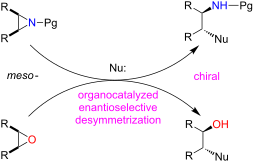
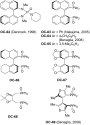
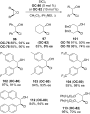
- catalytic amounts of tetra-n-butylammonium chloride or triphenylphosphine to afford trans O-protected vicinal chlorohydrins in quantitative yields. This pioneering work opened the possibility for desymmetrization of meso-epoxides by small organic molecules, but the exploration of organocatalysts for the








Bromination of hydrocarbons with CBr4, initiated by light-emitting diode irradiation
Beilstein J. Org. Chem. 2013, 9, 1663–1667, doi:10.3762/bjoc.9.190
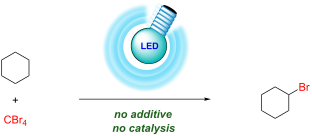
- useful bromide-containing precursors. For instance, alkyl alcohols can be converted to alkyl bromides in the presence of CBr4 and triphenylphosphine; this is known as the Appel reaction [28]. This combination can also be used to transform aldehydes into dibromoalkenes, which are useful precursors for the


True and masked three-coordinate T-shaped platinum(II) intermediates
Beilstein J. Org. Chem. 2013, 9, 1352–1382, doi:10.3762/bjoc.9.153
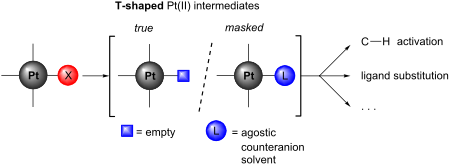
- coordinating agents, such as triethylamine and triphenylphosphine, clearly retard the process. Therefore, a dissociative mechanism has been proposed to generate the unsaturated species 31. Then, one methyl group of the coordinated tmtu can stabilize the open coordination site via agostic interaction, 32





Amyloid-β probes: Review of structure–activity and brain-kinetics relationships
Beilstein J. Org. Chem. 2013, 9, 1012–1044, doi:10.3762/bjoc.9.116





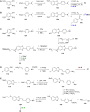

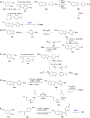


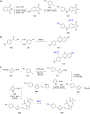


Appel-reagent-mediated transformation of glycosyl hemiacetal derivatives into thioglycosides and glycosyl thiols
Beilstein J. Org. Chem. 2013, 9, 974–982, doi:10.3762/bjoc.9.112

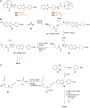
- thiols in a one-pot two-step reaction sequence mediated by Appel reagent (carbon tetrabromide and triphenylphosphine). 1,2-trans-Thioglycosides and β-glycosyl thiol derivatives were stereoselectively formed by the reaction of the in situ generated glycosyl bromides with thiols and sodium
- carbonotrithioate. The reaction conditions are reasonably simple and yields were very good. Keywords: Appel reagent; carbon tetrabromide; glycosyl hemiacetal; glycosyl thiol; thioglycoside; triphenylphosphine; Introduction Thioglycosides (1-thiosugar) are widely used glycosyl donors in glycosylation reactions [1
- agents (triphenylphosphine or combination of triethylsilane and BF3·OEt2) followed by the reaction of the in situ generated thiolate ions with glycosyl bromides under phase-transfer conditions [23] or in ionic liquids [24]; (b) reaction of glycosyl bromides with thiols under phase-transfer conditions [25


Synthesis of skeletally diverse alkaloid-like molecules: exploitation of metathesis substrates assembled from triplets of building blocks
Beilstein J. Org. Chem. 2013, 9, 775–785, doi:10.3762/bjoc.9.88
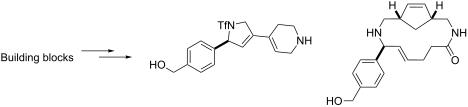
- propagating building block, DEAD and triphenylphosphine was used. In general, the crude product was directly deacetylated. At each stage, the required fluorous-tagged product was isolated by fluorous-solid-phase extraction (F-SPE), and its purity determined by analysis by 500 MHz 1H NMR spectroscopy. These
- results are summarised in Table 1. The metathesis substrates were prepared by subsequent attachment of a terminating building block (12a, 12b or 13) (see Table 2). In each case, an excess of the terminating building block, DEAD and triphenylphosphine was used; the required fluorous-tagged product was


Synthesis and structure of trans-bis(1,4-dimesityl-3-methyl-1,2,3-triazol-5-ylidene)palladium(II) dichloride and diacetate. Suzuki–Miyaura coupling of polybromoarenes with high catalytic turnover efficiencies
Beilstein J. Org. Chem. 2013, 9, 698–704, doi:10.3762/bjoc.9.79
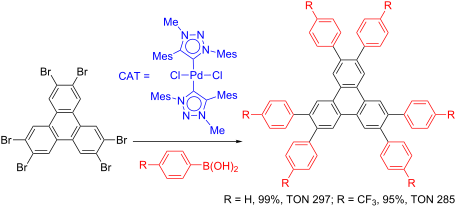
- %), triphenylphosphine (4 mg, 4 mol %), NaOH (62 mg, 1.54 mmol, 8 equiv) was heated under reflux in 4 mL of 1,4-dioxane under nitrogen atmosphere. The reaction was completed in 8 h (monitored by TLC). The reaction mixture was diluted with water (10 mL) and extracted with CH2Cl2 (3 × 5 mL). The organic layer was dried


Facile synthesis of benzothiadiazine 1,1-dioxides, a precursor of RSV inhibitors, by tandem amidation/intramolecular aza-Wittig reaction
Beilstein J. Org. Chem. 2013, 9, 503–509, doi:10.3762/bjoc.9.54

- synthesis of a benzothiadiazine 1,1-dioxide derivative using substrate 9b by intramolecular aza-Wittig reaction. To test this premise, 9b was treated with triphenylphosphine in THF at room temperature, but no desired product was obtained, and only the intermediate iminophosphorane 12b was isolated, even
- -boiling-point solvent, i.e., o-dichlorobenzene (DCB). The reaction was successful at higher temperature, affording the desired cyclized product 13b (54%) along with the by-product triphenylphosphine oxide (Table 1, entry 5). Subsequently, we turned our attention to develop a simpler one-step procedure by





