


Search results
Search for "1,2-diphenylethane-1,2-diamine" in Full Text gives 3 result(s) in Beilstein Journal of Organic Chemistry.
Synthesis of chiral cyclohexane-linked bisimidazolines
Beilstein J. Org. Chem. 2025, 21, 1786–1790, doi:10.3762/bjoc.21.140
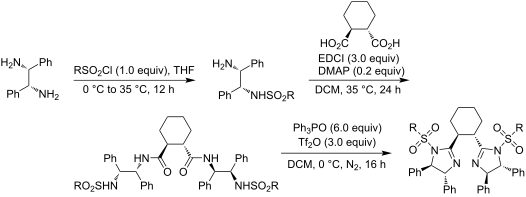
- , condensation of N-sulfonylated 1,2-diphenylethane-1,2-diamines and cyclohexane-1,2-dicarboxylic acid, and the final cyclization with the in situ generated Hendrickson reagent. Keywords: bisimidazoline; cyclohexane; cyclohexane-1,2-dicarboxylic acid; 1,2-diphenylethane-1,2-diamine; Introduction Chiral
- (1S,2S)-cyclohexane-1,2-dicarboxylic acid (3) and (1R,2R)-1,2-diphenylethane-1,2-diamine (1), hoping that the phenyl groups in the designed bisimidazoline ligands stemming from the vicinal diamine play an important role in the stereocontrol of catalytic asymmetric organic reactions [23][24][25][26
- ] (Scheme 1). The C2-symmetric (1R,2R)-1,2-diphenylethane-1,2-diamine (1) was selected as a suitable chiral vicinal diamine to prevent the generation of different isomeric sulfonamides in the reaction with sulfonyl chlorides. Diamine 1 was first reacted with different sulfonyl chlorides to prepare N-[(1R,2R


The enantioselective synthesis of (S)-(+)-mianserin and (S)-(+)-epinastine
Beilstein J. Org. Chem. 2015, 11, 1509–1513, doi:10.3762/bjoc.11.164

- highest enantiomeric excess 95%, but with only 26% chemical yield (Table 1, entry 6). Subsequently other catalysts were tested in order to improve the efficiency of the reduction. The catalyst 12, which is based on N-tosyl-(1S,2S)-1,2-diphenylethane-1,2-diamine (TsDPEN), gave amine 7 with 72–73% ee


Metal-mediated aminocatalysis provides mild conditions: Enantioselective Michael addition mediated by primary amino catalysts and alkali-metal ions
Beilstein J. Org. Chem. 2013, 9, 155–165, doi:10.3762/bjoc.9.18
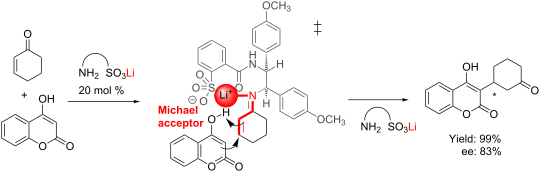
- vitamin K antagonist, and the dissimilar activity of the enantiomers is well documented in the literature [30][31][32]. The organocatalytic synthesis of warfarin has already been tested with several organocatalysts. Diphenylglycinol derivatives and derivatives of 1,2-diphenylethane-1,2-diamine provided
- of appropriate solvents. Bromine derivative 6, which is based on 1,2-diaminocyclohexane as well, exhibits a markedly higher solubility in THF and can also be dissolved in mixtures of alcohols and DCM. Precatalysts 7 and 8 are derived from 1,2-diphenylethane-1,2-diamine and the solubility of these
- liquids. Nevertheless, the ee could be improved up to 83% (Table 2, entry 7). The results shown in Table 2 indicate that the catalysts 7 and 8 based on 1,2-diphenylethane-1,2-diamine perform indeed better than 5 and 6, based on trans-1,2-diaminocyclohexane: The highest ee that could be obtained by 8 is 83



Other Beilstein-Institut Open Science Activities



