


Search results
Search for "Mukaiyama hydration" in Full Text gives 8 result(s) in Beilstein Journal of Organic Chemistry.
Synthesis of depressin, cryptomeridiol and 4-epi-cryptomeridiol enabled by a terpenoid chiral pool-producing platform
Beilstein J. Org. Chem. 2026, 22, 683–690, doi:10.3762/bjoc.22.53
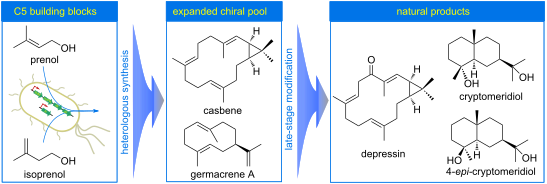
- (crossed) conformation during the transannular 5,10-cyclization process [66][67], albeit with the formation of two double bond isomers 17a/b that were difficult to be separated from each other. The mixture of the C3–C4 and C4–C15 double bond isomers 17a/b was then subjected to the Mukaiyama hydration


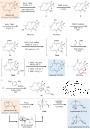
Chemoenzymatic synthesis of the cardenolide rhodexin A and its aglycone sarmentogenin
Beilstein J. Org. Chem. 2025, 21, 2637–2644, doi:10.3762/bjoc.21.204
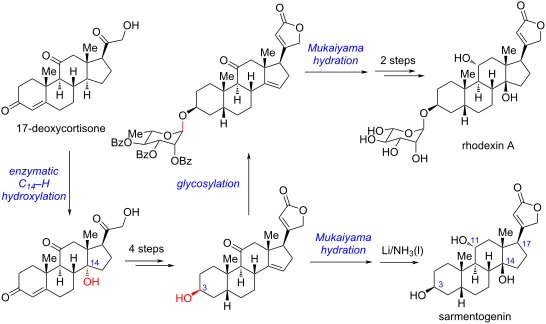
- aglycone sarmentogenin in 7 steps from 17-deoxycortisone. The synthesis features a scalable enzymatic C14–H α-hydroxylation, a Bestmann ylide-enabled one-step construction of the butenolide motif, a late stage Mukaiyama hydration, and a stereoselective C11 carbonyl reduction. Keywords: cardiac glycosides
- ; C–H hydroxylation; chemoenzymatic synthesis; Mukaiyama hydration; protecting-group-free synthesis; Introduction Cardiac glycosides (CGs) are widely distributed natural products, generated by plants and amphibians [1]. Structurally, they are composed of an aglycone-steroidal moiety, an unsaturated
- donor, through a late-stage glycosylation. The aglycon 2 can be derived from the Δ14 olefin intermediate 3 via Mukaiyama hydration and several functional group transformations. In turn, 3 would be generated from the key C14α-hydroxylated intermediate 4 via an elimination process. For the synthesis of 4



Recent advances in total synthesis of illisimonin A
Beilstein J. Org. Chem. 2025, 21, 2571–2583, doi:10.3762/bjoc.21.199
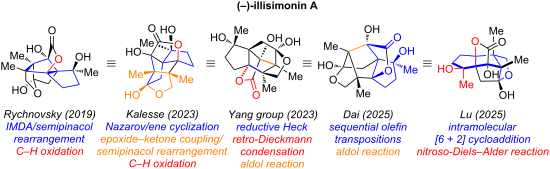
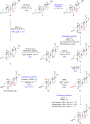
- reductive Heck reaction of 59 enabled the transannular connection between C4 and C5, generating key intermediate 60, which possesses the same carbon skeleton as the proposed biosynthetic key intermediate 50 and contains the suitable functional groups for further elaboration. Mukaiyama hydration of 60
- ]dec-5-ene)-catalyzed intramolecular aldol reaction connected C6 and C8, assembling the trans-pentalene ring and affording the core carbon framework of illisimonin A. The C1 hydroxy group was initially introduced by a Mukaiyama hydration reaction using O2 as the stoichiometric oxidant; however
- -catalyzed oxidative lactonization, yielding 76 with a newly established quaternary center at C1 and isomerization of the double bond to C2=C3. Photocatalyzed isomerization of the C2–C3 double bond in 76 to C3=C4 furnished 77 [39][40]. A Mukaiyama hydration introduced a hydroxy group at C4, accompanied by






Total syntheses of highly oxidative Ryania diterpenoids facilitated by innovations in synthetic strategies
Beilstein J. Org. Chem. 2025, 21, 2553–2570, doi:10.3762/bjoc.21.198
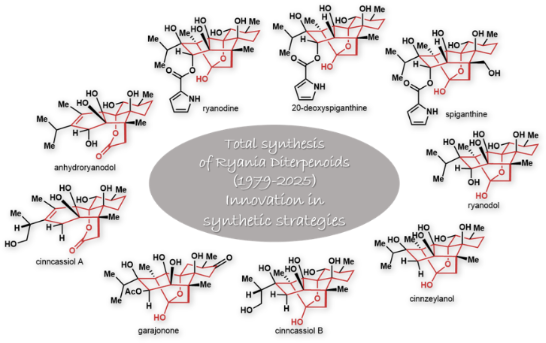
- follows: Commercially available compounds 31 and 32 were converted to the C2-symmetric 33 over 13 steps, enabling construction of the AB bicyclic skeleton in the target molecules. Compound 33 then underwent Mukaiyama hydration to adjust the C15 oxidation state, followed by water-promoted consecutive
- material. Key transformations included regioselective and stereoselective alkene epoxidation, organoselenium-mediated reductive cleavage of the α,β-epoxy ketone, and a hydroxy-directed stereospecific Mukaiyama hydration. These operations successfully introduced the C6 and C10 oxidation states, enabling the
- , the bis-epoxy ketone exhibited distinct reactivity under ring-opening conditions compared to mono-epoxy substrates, presumably due to steric constraints. Leveraging the directing ability of the C10 hydroxy group, stereospecific Mukaiyama hydration of the C6–C7 double bond was achieved, furnishing







The application of desymmetric enantioselective reduction of cyclic 1,3-dicarbonyl compounds in the total synthesis of terpenoid and alkaloid natural products
Beilstein J. Org. Chem. 2025, 21, 2085–2102, doi:10.3762/bjoc.21.164
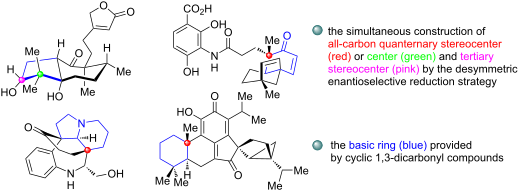
- underwent the 1,2-addition of isopropenyllithium reagent (prepared from n-BuLi/tetraisopropenyltin (67) [55]) and DMP oxidation to afford ketone 68. A three-step transformation including RCM, Mukaiyama hydration, and esterification, 68 was converted to methyl oxalate 69. Irradiation of the reaction mixture







Recent total synthesis of natural products leveraging a strategy of enamide cyclization
Beilstein J. Org. Chem. 2025, 21, 999–1009, doi:10.3762/bjoc.21.81
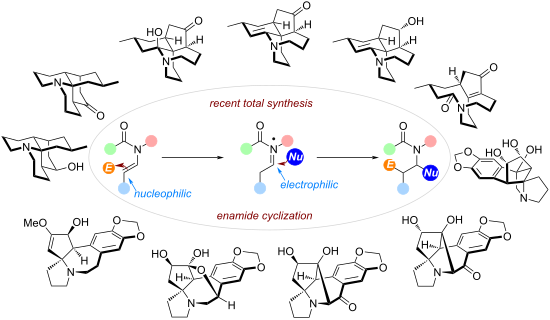
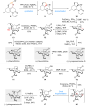
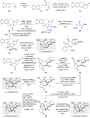
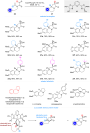
- the reduction of amide-generated ketone 12 after a subsequent Dess–Martin oxidation. Upon treatment of 12 with Co(acac)2 and PhSiH3 in iPrOH at 80 °C, the Mukaiyama hydration of enamide delivered hemiaminal 13. Despite the incorrect configuration of the newly formed hydroxy group, it is considered
- inconsequential due to the reversibility of hemiaminal. Consequently, further reduction of the amide could complete the total synthesis of (+)-fawcettimine with in situ adjustment of the hemiaminal configuration. The incorrect configuration observed in the Mukaiyama hydration also inspired the authors to develop
- a fragmentation process for the total synthesis of (−)-phlegmariurine B. A one-pot epoxidation/nucleophilic epoxide opening introduced both a hydroxy group and a chloride across the cyclopentene, producing 14 in 57% yield. After oxidation of alcohol 14 to ketone 15, the Mukaiyama hydration then





Combining the best of both worlds: radical-based divergent total synthesis
Beilstein J. Org. Chem. 2023, 19, 1–26, doi:10.3762/bjoc.19.1
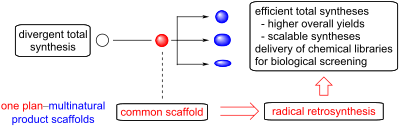
- reactions of transition metal hydrides (Fe, Co, Mn, etc) with alkenes (e.g., Mukaiyama hydration) [20]. The last decade saw the development of milder methods for generating carbon-centered radicals as the advancement of their reactivity in cross-coupling reactions, the concept of photoredox catalysis [21
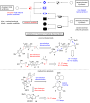
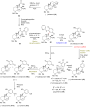
- Mukaiyama hydration [20] to furnish natural complexity. A similar approach was devised for the synthesis of modified meroterpenoids chevalone A (52), taondiol (53), decaturin E (54), and stypodiol (57, Scheme 4). For this purpose, tricycle 45 was prepared from compound 44 in gram-scale quantities by HAT
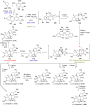
- (dba)3, SPhos, and Et3N in 86% yield. Reduction of the double bond with Pd/C followed by dual Stille coupling for the introduction of two methyl groups and Mukaiyama hydration utilizing Mn(dpm)3 and PhSiH3 furnished the misassigned structure for dysiherbol A (79). A revised structure was finally






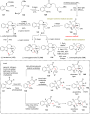


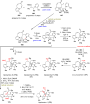

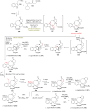

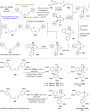

Total synthesis of grayanane natural products
Beilstein J. Org. Chem. 2022, 18, 1707–1719, doi:10.3762/bjoc.18.181
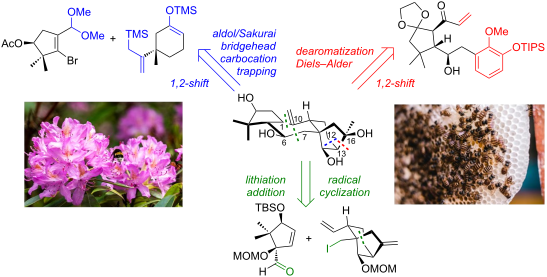
- carbonyl reduction and TBS deprotection afforded principinol E in 53% yield over 4 steps. For the synthesis of rhodomollein XX, addition of methyllithium to 54 followed by Mukaiyama hydration using Mn(dpm)3 afforded 62. To access rhodomollein XX, an additional oxidation state at the C2 position was





Other Beilstein-Institut Open Science Activities



