


Search results
Search for "azo dye" in Full Text gives 15 result(s) in Beilstein Journal of Organic Chemistry.
Photoswitches beyond azobenzene: a beginner’s guide
- Michela Marcon,
- Christoph Haag and
- Burkhard König
Beilstein J. Org. Chem. 2025, 21, 1808–1853, doi:10.3762/bjoc.21.143
- choice of aldehyde and amine will determine the direction of the imine bond and the geometry of the Z-isomer. Examples Non-ionic bithienylpyrrole push–pull azo dye 32 was successfully introduced in liquid-crystalline matrices with thermal relaxation in the µs order, making them among the fastest liquid

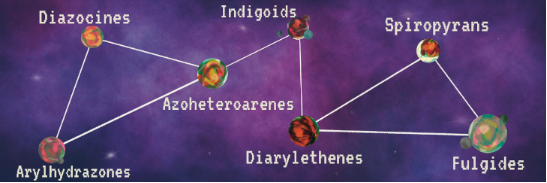
Graphical Abstract

Figure 1: Energy diagram of a two-state photoswitch. Figure 1 was redrawn from [2].

Figure 2: Example of the absorption spectra of the isomers of a photoswitch with most efficient irradiation w...
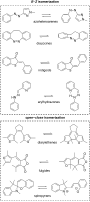
Scheme 1: Photoswitch classes described in this review.

Figure 3: Azoheteroarenes.

Scheme 2: E–Z Isomerisation (top) and mechanisms of thermal Z–E isomerisation (bottom).

Scheme 3: Rotation mechanism favoured by the electron displacement in push–pull systems. Selected examples of...

Figure 4: A) T-shaped and twisted Z-isomers determine the thermal stability and the Z–E-PSS (selected example...

Figure 5: Effect of di-ortho-substitution on thermal half-life and PSS.

Figure 6: Selected thermal lifetimes of azoindoles in different solvents and concentrations. aConcentration o...

Figure 7: Aryliminopyrazoles: N-pyrazoles (top) and N-phenyl (bottom).

Scheme 4: Synthesis of symmetrical heteroarenes through oxidation (A), reduction (B), and the Bayer–Mills rea...

Scheme 5: Synthesis of diazonium salt (A); different strategies of azo-coupling: with a nucleophilic ring (B)...

Scheme 6: Synthesis of arylazothiazoles 25 (A) and heteroaryltriazoles 28 (B).

Scheme 7: Synthesis of heteroarylimines 31a,b [36-38].

Figure 8: Push–pull non-ionic azo dye developed by Velasco and co-workers [45].

Scheme 8: Azopyridine reported by Herges and co-workers [46].

Scheme 9: Photoinduced phase transitioning azobispyrazoles [47].

Figure 9: Diazocines.

Scheme 10: Isomers, conformers and enantiomers of diazocine.

Scheme 11: Partial overlap of the ππ* band with electron-donating substituents and effect on the PSS. Scheme 11 was ada...

Figure 10: Main properties of diazocines with different bridges. aMeasured in n-hexane [56]. bMeasured in THF. cMe...

Scheme 12: Synthesis of symmetric diazocines.

Scheme 13: Synthesis of asymmetric diazocines.

Scheme 14: Synthesis of O- and S-heterodiazocines.

Scheme 15: Synthesis of N-heterodiazocines.

Scheme 16: Puromycin diazocine photoswitch [60].

Figure 11: Indigoids.

Figure 12: The main representatives of the indigoid photoswitch class.

Scheme 17: Deactivation process that prevents Z-isomerisation of indigo.

Figure 13: Stable Z-indigo derivative synthesised by Wyman and Zenhäusern [67].

Figure 14: Selected examples of indigos with aliphatic and aromatic substituents [68]. Dashed box: proposed π–π in...

Scheme 18: Resonance structures of indigo and thioindigo involving the phenyl ring.

Scheme 19: Possible deactivation mechanism for 4,4'-dihydroxythioindigo [76].

Scheme 20: Effect of different heteroaryl rings on the stability and the photophysical properties of hemiindig...

Figure 15: Thermal half-lives of red-shifted hemithioindigos in toluene [79]. aMeasured in toluene-d8.

Scheme 21: Structures of pyrrole [81] and imidazole hemithioindigo [64].

Figure 16: Examples of fully substituted double bond hemithioindigo (left), oxidised hemithioindigos (centre),...

Scheme 22: Structure of iminothioindoxyl 72 (top) and acylated phenyliminoindolinone photoswitch 73 (bottom). ...

Scheme 23: (top) Transition states of iminothioindoxyl 72. The planar transition state is associated with a lo...

Scheme 24: Baeyer–Drewsen synthesis of indigo (top) and N-functionalisation strategies (bottom).

Scheme 25: Synthesis of hemiindigo.

Scheme 26: Synthesis of hemithioindigo and iminothioindoxyl.

Scheme 27: Synthesis of double-bond-substituted hemithioindigos.

Scheme 28: Synthesis of phenyliminoindolinone.

Scheme 29: Hemithioindigo molecular motor [85].

Figure 17: Arylhydrazones.

Scheme 30: Switching of arylhydrazones. Note: The definitions of stator and rotor are arbitrary.

Scheme 31: Photo- and acidochromism of pyridine-based phenylhydrazones.

Scheme 32: A) E–Z thermal inversion of a thermally stable push–pull hydrazone [109]. B) Rotation mechanism favoured...

Scheme 33: Effect of planarisation on the half-life.

Scheme 34: The longest thermally stable hydrazone switches reported so far (left). Modulation of thermal half-...

Figure 18: Dependency of t1/2 on concentration and hypothesised aggregation-induced isomerisation.

Figure 19: Structure–property relationship of acylhydrazones.

Scheme 35: Synthesis of arylhydrazones.

Scheme 36: Synthesis of acylhydrazones.

Scheme 37: Photoswitchable fluorophore by Aprahamian et al. [115].

Scheme 38: The four-state photoswitch synthesised by the Cigáň group [116].

Figure 20: Diarylethenes.

Scheme 39: Isomerisation and oxidation pathway of E-stilbene to phenanthrene.

Scheme 40: Strategies adapted to avoid E–Z isomerisation and oxidation.
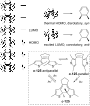
Scheme 41: Molecular orbitals and mechanism of electrocyclisation for a 6π system.

Figure 21: Aromatic stabilisation energy correlated with the thermal stability of the diarylethenes [127,129].

Figure 22: Half-lives of diarylethenes with increasing electron-withdrawing groups [128,129].

Scheme 42: Photochemical degradation pathway promoted by electron-donating groups [130].

Figure 23: The diarylethenes studied by Hanazawa et al. [134]. Increased rigidity leads to bathochromic shift.

Scheme 43: The dithienylethene synthesised by Nakatani's group [135].

Scheme 44: Synthesis of perfluoroalkylated diarylethenes.

Scheme 45: Synthesis of 139 and 142 via McMurry coupling.

Scheme 46: Synthesis of symmetrical derivatives 145 via Suzuki–Miyaura coupling.

Scheme 47: Synthesis of acyclic 148, malonic anhydride 149, and maleimide derivatives 154.

Figure 24: Gramicidin S (top left) and two of the modified diarylethene derivatives: first generation (bottom ...

Scheme 48: Pyridoxal 5'-phosphate and its reaction with an amino acid (top). The analogous dithienylethene der...

Figure 25: Fulgides.

Scheme 49: The three isomers of fulgides.

Scheme 50: Thermal and photochemical side products of unsubstituted fulgide [150].

Figure 26: Maximum absorption λc of the closed isomer compared with the nature of the aromatic ring and the su...

Scheme 51: Possible rearrangement of the excited state of 5-dimethylaminoindolylfulgide [153].

Figure 27: Quantum yields of ring closure (ΦE→C) and E–Z isomerisation (ΦE→Z) correlated with the increasing s...

Scheme 52: Active (Eα) and inactive (Eβ) conformers (left) and the bicyclic sterically blocked fulgide 169 (ri...

Scheme 53: Quantum yield of ring-opening (ΦC→E) and E–Z isomerisation (ΦE→Z) for different substitution patter...

Scheme 54: Stobbe condensation pathway for the synthesis of fulgides 179, fulgimides 181 and fulgenates 178.

Scheme 55: Alternative synthesis of fulgides through Pd-catalysed carbonylation.

Scheme 56: Optimised synthesis of fulgimides [166].

Scheme 57: Photoswitchable FRET with a fulgimide photoswitch [167].

Scheme 58: Three-state fulgimide strategy by Slanina's group.

Figure 28: Spiropyrans.

Scheme 59: Photochemical (left) and thermal (right) ring-opening mechanisms for an exemplary spiropyran with a...

Figure 29: Eight possible isomers of the open merocyanine according to the E/Z configurations of the bonds hig...

Scheme 60: pH-Controlled photoisomerisation between the closed spiropyran 191-SP and the open E-merocyanine 19...

Scheme 61: Behaviour of spiropyran in water buffer according to Andréasson and co-workers [180]. 192-SP in an aqueo...

Scheme 62: (left box) Proposed mechanism of basic hydrolysis of MC [184]. (right box) Introduction of electron-dona...

Scheme 63: Photochemical interconversion of naphthopyran 194 (top) and spirooxazine 195 (bottom) photoswitches...

Scheme 64: Synthesis of spiropyrans and spirooxazines 198 and the dicondensation by-product 199.

Scheme 65: Alternative synthesis of spiropyrans and spirooxazines with indolenylium salt 200.

Scheme 66: Synthesis of 4’-substituted spiropyrans 203 by condensation of an acylated methylene indoline 201 w...

Scheme 67: Synthesis of spironaphthopyrans 210 by acid-catalysed condensation of naphthols and diarylpropargyl...

Scheme 68: Photoswitchable surface wettability [194].

Figure 30: Some guiding principles for the choice of the most suitable photoswitch. Note that this guide is ve...
CO2 complexation with cyclodextrins
- Cecilie Høgfeldt Jessen,
- Jesper Bendix,
- Theis Brock Nannestad,
- Heloisa Bordallo,
- Martin Jæger Pedersen,
- Christian Marcus Pedersen and
- Mikael Bols
Beilstein J. Org. Chem. 2023, 19, 1021–1027, doi:10.3762/bjoc.19.78
- using a pressure cell and a UV–vis competition assay with an azo-dye (4-((4-hydroxyphenyl)azo)-1-naphthalenesulfonic acid (7) Figure 4) [15] as an indicator. The UV–vis spectrum of 7 changes on binding to cyclodextrins and we can thereby indirectly monitor the binding of CO2 to the CD by observing the
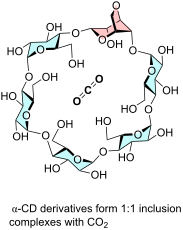
Graphical Abstract

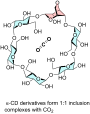
Figure 1: Structure of cyclodextrins 1–6 studied in this work.

Figure 2: X-ray crystal structure of CO2 bound to α-CD.

Figure 3: TGA curve (blue) and dTGA curve (red) for CO2-1 crystals. Two lumps are seen with the former predom...

Figure 4: Cell used to measure vis spectra under pressure (left), structure of 7 (middle) and spectrum of 7 (...

Figure 5: Binding of CO2 to 1 as a function of pressure.
Multiswitchable photoacid–hydroxyflavylium–polyelectrolyte nano-assemblies
- Alexander Zika and
- Franziska Gröhn
Beilstein J. Org. Chem. 2021, 17, 166–185, doi:10.3762/bjoc.17.17
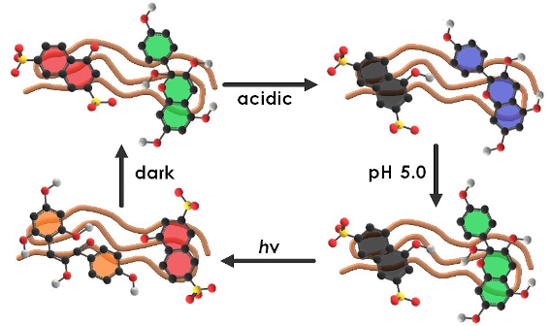
- combining a polyelectrolyte and an ionic azo dye [4]. Moreover, recently we have developed a switchable nano-assembly system based on photoacids [66][67]. Photoacids are molecules for which light irradiation leads to an enhanced proton dissociation and thus to a more highly charged molecule. Furthermore

Graphical Abstract

Scheme 1: The chemical network of reactions for 4-hydroxyflavylium (left) and the write-lock-erase cycle (rig...

Scheme 2: The building blocks used for the self-assembly in this study: pelargonidin chloride (Flavy), 1-naph...

Scheme 3: Overview of the different states of the multi-switchable system consisting of Flavy, 1N36S, and pol...
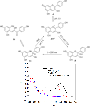
Figure 1: Top: pelargonidin cation (Flavy) and network of chemical reactions; bottom: corresponding UV–vis sp...

Figure 2: Characterization of Flavy: a) 1H NMR spectrum at pH 7.0 (form A) before and after irradiation; b) 13...

Scheme 4: Overview of the different states of the two main cycles switching the system consisting of 1N36S, F...

Figure 3: UV–vis spectroscopy of the ternary nano-assemblies for cycle I (a) and cycle II (b).

Figure 4: Dynamic light scattering: Electric field autocorrelation function g1(τ) and distribution of relaxat...

Figure 5: Static light scattering data from the assemblies of cycle I; a) A, non-irradiated, spherical partic...

Figure 6: Comparison of cycle I and cycle II in AFM.

Figure 7: a) ζ-Potential and b) effective surface charge density for cycle I; c) ζ-potential and d) effective...

Figure 8: Isothermal titration calorimetry of poly(allylamine) into the cell containing Flavy and 1N36S in aq...

Figure 9: Polar surface area of Flavy in form of A (left) and B (right).

Figure 10: Hydrodynamic radii of the nano-assemblies as function of the loading ratio: a) cycle I, b) cycle II....

Figure 11: UV–vis spectra of the nano-assemblies of cycle II at l = 0.75.

Figure 12: ζ-Potential of the nano-assemblies of cycle II depending on the concentration ratio.

Scheme 5: Different mixing orders of the assemblies. The major part of this study focuses on route i.
Tautomerism as primary signaling mechanism in metal sensing: the case of amide group
- Vera Deneva,
- Georgi Dobrikov,
- Aurelien Crochet,
- Daniela Nedeltcheva,
- Katharina M. Fromm and
- Liudmil Antonov
Beilstein J. Org. Chem. 2019, 15, 1898–1906, doi:10.3762/bjoc.15.185
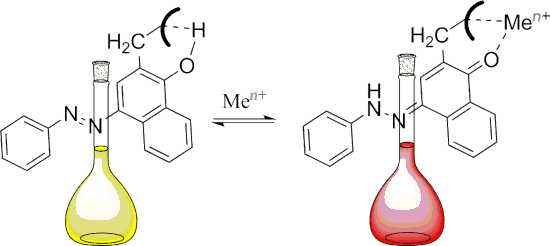
- solvents. Strong bathochromic and hyperchromic effects in the visible spectra accompany the 1:1 formation of complexes with some alkaline earth metal ions. Keywords: amide group; azo dye; molecular sensor; sidearm; tautomerism; Introduction The design of new organic sensing systems is an undividable part

Graphical Abstract

Scheme 1: Conceptual idea for tautomeric metal sensing.
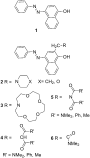
Scheme 2: 4-(Phenyldiazenyl)naphthalen-1-ol (1) and tautomeric ligands based on it.

Figure 1: The most stable tautomeric form of 6 in neutral state (left) and upon complexation with Mg(ClO4)2 (...
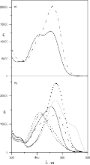
Figure 2: Absorption spectra of compounds 1 (a) and 6 (b) in acetonitrile (—), chloroform (− · −), dichlorome...

Figure 3: Left: Theoretically predicted structure of 6K (blue), overlaid with the X-ray structure (red). Righ...

Figure 4: Left: Absorption spectra of 6 with stepwise addition of Mg(ClO4)2 in acetonitrile (1 – neutral liga...

Figure 5: Normalized spectra of the free ligand 6 (c = 5 × 10⁻⁵ M) and its complexes obtained with Ba(ClO4)2,...

Scheme 3: Synthetic route of 6.
The effect of cyclodextrin complexation on the solubility and photostability of nerolidol as pure compound and as main constituent of cabreuva essential oil
- Joyce Azzi,
- Pierre-Edouard Danjou,
- David Landy,
- Steven Ruellan,
- Lizette Auezova,
- Hélène Greige-Gerges and
- Sophie Fourmentin
Beilstein J. Org. Chem. 2017, 13, 835–844, doi:10.3762/bjoc.13.84
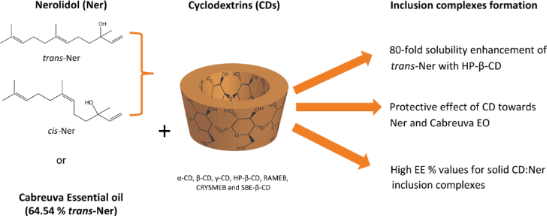
- Landy et al. [23] was used to determine the formation constants (Kf) of HP-β-CD/Ner inclusion complexes. Methylorange (MO), an azo dye, was used as a competitor. First, the Kf of the HP-β-CD/MO inclusion complex was calculated by a direct titration method. Then, a spectral displacement method was

Graphical Abstract

Figure 1: Chemical structure of β-CD (a) and β-CD derivatives (b).

Figure 2: Phase solubility diagrams of CD/trans-Ner inclusion complexes.

Figure 3: Phase solubility profile of cabreuva EO obtained by the TOC method.

Figure 4: a) 2D ROESY spectrum of β-CD/trans-Ner inclusion complex in D2O and b) representation of the most s...

Figure 5: Photodegradation kinetics of cis-Ner (a), trans-Ner (b), the isomer mixture Ner (c) in the absence ...
The in situ generation and reactive quench of diazonium compounds in the synthesis of azo compounds in microreactors
- Faith M. Akwi and
- Paul Watts
Beilstein J. Org. Chem. 2016, 12, 1987–2004, doi:10.3762/bjoc.12.186
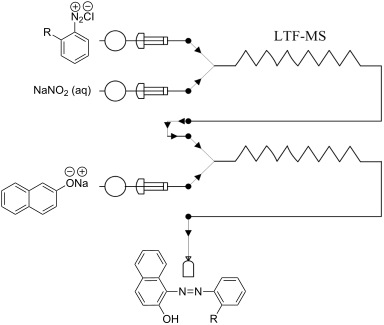
- II azo dye was used as a model reaction for the study. At found optimal azo coupling reaction temperature and pH an investigation of the optimum flow rates of the reactants for the diazotization and azo coupling reactions in Little Things Factory-MS microreactors was performed. A conversion of 98
- conjunction with the existing techniques. Microreactor technology is one such technology that can be used in the manufacture of these dyes. If used in conjunction with existing azo dye degradation techniques the amount of waste generated can easily be managed. Hisamoto et al., for example, used ‘phase
- documented in literature [26][27][28][29][30], the ease of reaction parameter optimization in the synthesis of azo compounds in microreactors is highlighted. In this study, the continuous flow synthesis of Sudan II azo dye (19, Scheme 6) constituting of the diazotization of 2,4-dimethylaniline (16) and its

Graphical Abstract

Scheme 1: PTSA-catalyzed diazotization and azo coupling reaction.

Scheme 2: Ferric hydrogen sulfate (FHS) catalyzed azo compound synthesis.

Scheme 3: Synthesis of azo compounds in the presence of silica supported boron trifluoride.

Scheme 4: Phase transfer catalyzed azo coupling of 5-methylresorcinol in microreactors.

Scheme 5: Synthesis of yellow pigment 12 in a micro-mixer apparatus.

Scheme 6: Continuous flow synthesis of Sudan II azo dye in LTF-MS microreactors.

Figure 1: pH profile plot at constant flow rate of 0.03 mL/min.

Figure 2: pH profile plot at a constant flow rate of 0.7 mL/min.

Scheme 7: Azo coupling reaction under acidic conditions.

Figure 3: pH profile plot at a constant flow rate of 0.03 mL/min.

Figure 4: pH profile plot at constant flow rate of 0.7 mL/min.

Figure 5: Temperature profile plot at constant pH 5.66.

Figure 6: Schematic representation of the microreactor set up.

Figure 7: Schematic representation of the microreactor set up.

Figure 8: Scaled up microreactor set up: PTFE tubing i.d. 1.5 mm a) Chemyx Fusion 100 classic syringe pump, b...
Determination of formation constants and structural characterization of cyclodextrin inclusion complexes with two phenolic isomers: carvacrol and thymol
- Miriana Kfoury,
- David Landy,
- Steven Ruellan,
- Lizette Auezova,
- Hélène Greige-Gerges and
- Sophie Fourmentin
Beilstein J. Org. Chem. 2016, 12, 29–42, doi:10.3762/bjoc.12.5
- inclusion complexes were determined by an UV–visible competitive method (or spectral displacement method) using the azo dye competitor MO [34]. This method requires a previous determination of Kf values of CD/MO inclusion complexes by a direct titration method. The competitive method was applied by adding 1

Graphical Abstract

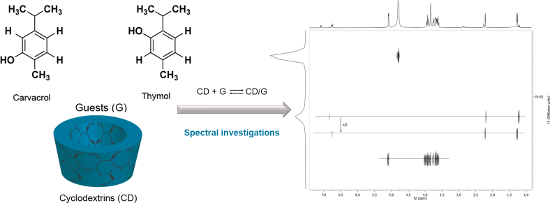
Figure 1: Chemical structures, logP values and molecular volumes (V) of carvacrol (1) and thymol (2). ahttp:/...
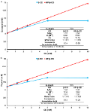
Figure 2: Phase solubility profiles of (a) CD/carvacrol (1) and (b) CD/thymol (2) inclusion complexes. Inset:...

Figure 3: 2D DOSY NMR spectra of (a) β-CD, carvacrol (1) and β-CD/carvacrol (1) inclusion complex and (b) β-C...

Figure 4: Representation of chemical shifts variations (Δδ) of a) carvacrol (1) and c) thymol (2) protons and...

Figure 5: 2D ROESY plots of β-CD/carvacrol (1) complex in D2O showing the NOEs between the H-3 and H-5 proton...

Figure 6: 2D ROESY plots of β-CD/thymol (2) complex in D2O showing the NOEs between the H-3 and H-5 protons o...

Figure 7: Representation of the most stable CD/guest inclusion complex conformers.

Figure 8: Effects of β-CD and HP-β-CD on the TEAC (μmol Trolox/ g of guest) of carvacrol (1) and thymol (2) b...
New palladium–oxazoline complexes: Synthesis and evaluation of the optical properties and the catalytic power during the oxidation of textile dyes
- Rym Hassani,
- Mahjoub Jabli,
- Yakdhane Kacem,
- Jérôme Marrot,
- Damien Prim and
- Béchir Ben Hassine
Beilstein J. Org. Chem. 2015, 11, 1175–1186, doi:10.3762/bjoc.11.132
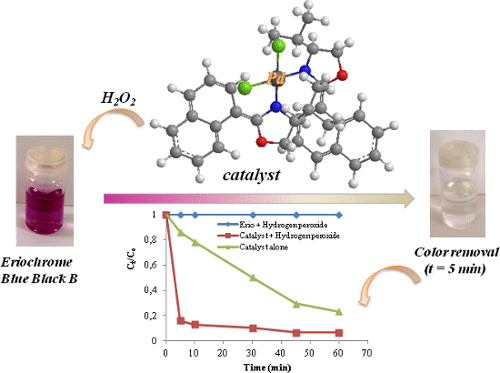
- 14% using the complex alone. The efficiency of the combination of catalysts/H2O2 for the degradation of the studied azo dye is so confirmed and catalyst 9 is able to decompose the reaction products completely by the cleavage of the azo linkage (chromophore structure: –N=N–, responsible for the color
- evidence of the kinetic studies and the literature data, we propose the mechanistic pathway depicted in Scheme 4. The first step involves the complexation of the azo dye to palladium(II) hydroperoxide 13, followed by a peroxymetalation of the azo moiety. This then affords the pseudocyclic five membered

Graphical Abstract

Figure 1: Structure of Eriochrome Blue Black B.

Scheme 1: Cyclopalladation reactions of (S)-4-isopropyl-2-(naphthalen-1-yl)oxazoline.

Scheme 2: Synthesis of cyclopalladated complex from bis-oxazoline.

Figure 2: ORTEP drawing of the complex 8.

Scheme 3: Synthesis of the bis(oxazoline) coordinated complexes.

Figure 3: ORTEP drawing of the complex 9.

Figure 4: Change in color removal in the presence of different catalysts within 10 min (before filtration). T...

Figure 5: Change in color removal in the presence of different catalysts (after filtration over 10 min).

Figure 6: Evolution of the color degradation against time using Eriochrome plus H2O2, the complex plus H2O2 o...

Figure 7: Change of the concentration of the Erio solution with the variation of H2O2 dose.

Figure 8: Evolution of the color removal against initial dye concentration.

Figure 9: Change of the color removal versus temperature.

Figure 10: Recycling experiments for Erio removal (C0 = 30 ppm, 20 mL) in the presence of catalyst 9 at pH 7 a...

Scheme 4: Proposed mechanism of decolorization.
Synthetic strategies for the fluorescent labeling of epichlorohydrin-branched cyclodextrin polymers
- Milo Malanga,
- Mihály Bálint,
- István Puskás,
- Kata Tuza,
- Tamás Sohajda,
- László Jicsinszky,
- Lajos Szente and
- Éva Fenyvesi
Beilstein J. Org. Chem. 2014, 10, 3007–3018, doi:10.3762/bjoc.10.319
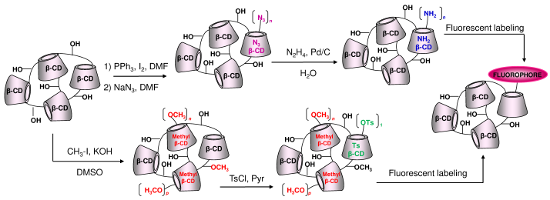
- randomly introduced into the polymeric matrix. Recently Mamba’s group [17] described an example of fluorescent tagging of epichlorohydrin branched β-CD polymer based on a pre-branching modification approach. In his work the β-CD was first modified with an azo dye making it less soluble in water. The
- modified β-CD was then copolymerized with epichlorohydrin in a ratio that resulted in the formation of a water-soluble copolymer. The azo dye modified β-CD epichlorohydrin copolymer was used as a molecular fluorescent sensor for the detection of chloroform, one of the chlorination byproducts in water. Here

Graphical Abstract

Scheme 1: Schematic representation of the various synthetic routes for the introduction of an anchoring group...

Scheme 2: Synthetic strategy for the rhodaminylation of β-CD polymer.

Figure 1: TLC study of β-CD iodination showing the proceeding of 6-monoiodination with increasing reaction ti...

Figure 2: HSQC-DEPT spectrum of compound 1 with partial assignment.

Figure 3: IR spectra of compound 1 (black line) and compound 2 (red line) showing the disappearance of the az...

Scheme 3: Schematic representation for the coumarinylation of methylated β-CD-polymer, n, m, p and q mean the...

Figure 4: HSQC-DEPT spectra of compound 4 with partial assignment; in the upper part the full spectrum is sho...

Scheme 4: Schematic representation for the introduction of NBF in a cationic β-CD-polymer.

Scheme 5: Schematic representation for the introduction of fluorescein into a β-CD-polymer.
Host–guest-driven color change in water: influence of cyclodextrin on the structure of a copper complex of poly((4-hydroxy-3-(pyridin-3-yldiazenyl)phenethyl)methacrylamide-co-dimethylacrylamide)
- Nils Retzmann,
- Gero Maatz and
- Helmut Ritter
Beilstein J. Org. Chem. 2014, 10, 2480–2483, doi:10.3762/bjoc.10.259
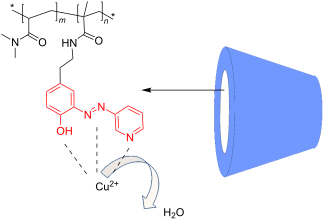
- of CD–dye hydrogels by addition of metal ions, as well as the sensing of copper ions using cyclodextrin–dye rotaxane [10][11]. Herewith we thus wish to describe our recent results about the synthesis of a water-soluble polymer bearing a novel azo dye and the presumed formation of complexes with Cu
- ions and CD in aqueous media under respect of color change. Findings The aim of this work was to synthesize the polymerizable azo dye N-(4-hydroxy-3-(pyridin-3-yldiazenyl)phenethyl)methacrylamide (5) which should potentially be able to form stable azo–metal complexes in aqueous solutions. Therefore
- tyramine (1) was selectively methacrylated at room temperature followed by a diazotation coupling with 3-aminopyridine (4) leading to N-(4-hydroxy-3-(pyridin-3-yldiazenyl)phenethyl)methacrylamide (5). Subsequently, the azo dye containing polymer 7 was synthesized through free radical copolymerization of 5

Graphical Abstract

Scheme 1: Synthesis of N-(4-hydroxy-3-(pyridin-3-yldiazenyl)phenethyl) methacrylamide (5) and preparation of ...

Figure 1: Color-changing effects of polymer 7 upon addition of A) CuSO4 and B) CuSO4 and γ-CD in a 50:50 vol ...

Figure 2: UV–vis absorption spectra of (orange) the solved copolymer 7 with the induced shifts by addition of...

Figure 3: Number average particle size distribution of 7 obtained by DLS experiments.
New syntheses of 5,6- and 7,8-diaminoquinolines
- Maroš Bella and
- Viktor Milata
Beilstein J. Org. Chem. 2013, 9, 2669–2674, doi:10.3762/bjoc.9.302

- -nitroaniline or 3-chloroaniline. Initially, 7,8-diaminoquinoline was prepared by Renshaw et al. [5] by coupling 7-aminoquinoline with benzenediazonium chloride followed by the reduction of the resulting azo-dye with SnCl2·2H2O. The second method relies on the Skraup reaction [6] of 3-nitroaniline affording 7

Graphical Abstract

Scheme 1: Synthesis of 7,8-diaminoquinoline hydrochloride (5).

Scheme 2: Application of hydrochloride 5 in the syntheses of nitrogen heterocycles.

Scheme 3: Synthesis of 4-chloro-5,6-diaminoquinoline (11).
Camera-enabled techniques for organic synthesis
- Steven V. Ley,
- Richard J. Ingham,
- Matthew O’Brien and
- Duncan L. Browne
Beilstein J. Org. Chem. 2013, 9, 1051–1072, doi:10.3762/bjoc.9.118
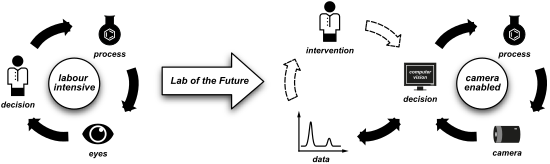
- transfer [78]. Initially we used the phenomenon of a simple colour-change reaction to observe the permeation of ozone gas through the AF-2400 tubing. By injecting solutions of the azo-dye Sudan Red into a section of this tubing housed within a jar that was purged with ozone, the red colour was visibly

Graphical Abstract

Figure 1: The evolution of computer-based monitoring and control within the laboratory of the future. (a) In ...

Figure 2: A selection of the wide range of digital camera devices available, focusing on those that can be at...

Figure 3: (a) Network cameras (Linksys WVC54GC) in operation in the Innovative Technology Centre laboratory. ...

Figure 4: Remote transmission of video imagery and reaction monitoring data.

Figure 5: A camera can assist the chemist in a number of ways. Digital video recordings of reactions can be u...

Figure 6: Suzuki–Miyaura reaction performed within a microfluidic system. The product is observed by high-spe...

Figure 7: Friedel–Crafts reactions performed by using solid-acid catalysis at high pressures. A camera allowe...

Figure 8: (a) The video camera setup providing a view of the reaction within the microwave cavity; (b) a pall...

Figure 9: (a) Buchwald–Hartwig coupling within a microchannel reactor. (b) Camera view of aggregate deposits ...

Figure 10: The key diprotected piperazic acid precursor in the synthesis of chloptosin.

Figure 11: (a) Piperazic acid mixture, and (b) apparatus for enantiomeric upgrading by recorded crystallisatio...

Figure 12: (a) Crystallisation of a Mn(II) polyoxometalate. (b) A bespoke reactor produced using additive fabr...

Figure 13: Computer processing of digital imagery produces numerical data for later processing.

Figure 14: (a) The Morphologi G3 particle image analyser, which uses images captured with a camera microscope ...

Figure 15: Use of the Python Imaging Library to analyse the proportion of an image consisting of red pixels. A...

Figure 16: (a) Arduino [73,75], a flexible open-source platform for rapidly prototyping electronic applications. (b) ...

Figure 17: Patented device incorporating a standard 96-well plate illuminated by a white-light source. The pla...

Figure 18: Simple colour-change experiments to assess a new AF-2400 gas permeable flow reactor. The reactor co...

Figure 19: (a) Ozonolysis of a series of alkenes using ozone in a bottle-reactor; (b) Glaser–Hay coupling usin...

Figure 20: (a) Camera-assisted titration of ammonia using bromocresol green. NH3 is dissolved in the gas-flow ...

Figure 21: (a) Bubble-counting setup. As the output of the gas-flow reactor (hydrogen dissolved in dichloromet...

Figure 22: Usage of digital cameras to enable remote control of reactions.

Figure 23: In-line solvent switching apparatus. The reactor output is directed into a bottle positioned on a h...

Figure 24: Catch and Release apparatus. (1) The amide intermediate is sequestered onto the central sulfonic ac...

Figure 25: Clips from video footage showing the silica reagent changing appearance; the arrows indicate the ed...

Figure 26: Combination of computer vision and automation to enable machine-assisted synthetic processes.

Figure 27: A coloured float at the interface between heavy and light solvents allows a camera to recognise the...

Figure 28: Graphical demonstration of the image-recognition process. At the start of the experiment, the colou...

Figure 29: Application of the computer-vision-enabled liquid–liquid extractor. The product mixture of a hydraz...

Figure 30: Application of a computer-vision technique to measure the dispersion of a plug of material passing ...

Figure 31: Multiple extractors in series controlled by a single camera.

Figure 32: Two-step synthesis of branched aldehydes from aryl iodides using two reactive gases. A liquid–liqui...
Cyclodextrin-induced host–guest effects of classically prepared poly(NIPAM) bearing azo-dye end groups
- Gero Maatz,
- Arkadius Maciollek and
- Helmut Ritter
Beilstein J. Org. Chem. 2012, 8, 1929–1935, doi:10.3762/bjoc.8.224
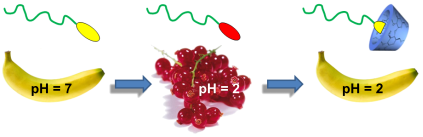
- observed. Additionally, this azo-dye-end-group-labeled polymer was complexed with hyperbranched polyglycerol (HPG) decorated with β-CD to generate hedgehog-like superstructures. Keywords: azo-dye; cyclodextrins; end-group functionalization; host–guest interaction; supramolecular aggregation; Introduction
- functionalization by condensation with an azo dye. We also investigated the host–guest interaction of the azo-dye-labeled end group with randomly methylated β-cyclodextrin (RAMEB-CD), and with HPG bearing β-CD on top. Thus, the focus of the present study was directed towards the preparation and superstructure
- formation of a thermo- and pH-responsive polymer bearing an azo dye at the end group. In a first step, a chain-transfer polymerization (CTP) of N-isopropylacrylamide (1) was carried out in the presence of 3-mercaptopropionic acid (2) and with 4,4’-azobis(4-cyanovaleric acid) as initiator, to achieve a high

Graphical Abstract

Scheme 1: CTP of 1 and end-group functionalization with 5 yielding the azo-dye-end-group-labeled polymer 6.

Figure 1: Absorption spectra of 6 in water in a pH range from 7 to 2 (A). Absorption spectra of 6 in water de...

Figure 2: LCST measurements of 6, the complex of 6 and RAMEB-CD, and in comparison to pure PNIPAM.

Figure 3: Hydrodynamic diameters of 6, 7 and 8 (1 mg/mL) at 20 °C.

Figure 4: z-Average diameter (DZ) of the complex 8 in water as a function of temperature (0.5 mg/mL, heating ...
Recent advances towards azobenzene-based light-driven real-time information-transmitting materials
- Jaume García-Amorós and
- Dolores Velasco
Beilstein J. Org. Chem. 2012, 8, 1003–1017, doi:10.3762/bjoc.8.113
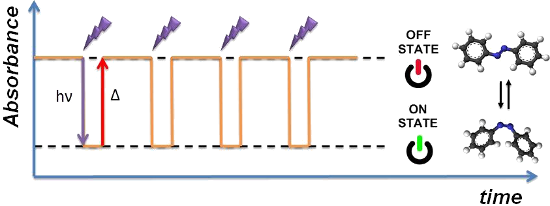
- directly related with the thermal isomerisation rate of the photo-sensitive azo-dye in the dark, that is, with the relaxation time of the cis isomer of the azo-moiety. Slow thermally back-isomerising azoderivatives are valuable photoactive basic materials for information storage (memory) purposes. A
- photochromic switches reported heretofore require temperatures substantially above 298 K to achieve a rapid thermal isomerisation of the azo-dye [42][43]. This fact limits substantially the usefulness of the final device. In this way, finding new azoderivatives exhibiting fast isomerisation rates at room
- azobenzene core. This structural variation produces a red shift of the π→π* transition to 375 nm with respect to that of the parent nonsubstituted azo-dye 4 (355 nm). In azoderivatives 5 and especially 6, their π→π* transition is very close or directly overlapped with the n→π* one, due to an increase in the

Graphical Abstract

Figure 1: Some important families of photochromic compounds and their photochromic reactions.

Figure 2: Photochromism of azobenzene derivatives and energetic profile for the switching process.
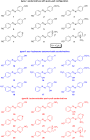
Figure 3: General overview of the different types of azoderivatives presented in this review.

Figure 4: Changes in the electronic spectrum of a 3 cis-to-trans isomerising ethanol solution at 45 °C (Δt = ...

Figure 5: Chemical structure and thermal relaxation time in ethanol at 298 K, τ, for the slow thermally-isome...

Figure 6: Rotation and inversion mechanisms proposed for the thermal cis-to-trans isomerisation processes of ...

Figure 7: Effect of the presence of the electron-withdrawing cyano and nitro groups on the thermal relaxation...

Figure 8: Transient absorption generated by UV irradiation (λ = 355 nm) for azo-dyes 8 (right) and 9 (left) i...

Figure 9: Effect of the presence of a positively charged nitrogen as an electron-withdrawing group on the the...

Figure 10: Mechanism proposed for the thermal cis-to-trans isomerisation process for the push–pull azopyridini...

Figure 11: Comparison between the thermal relaxation time at 298 K, τ, for the azoderivative 4 (type-I) and th...

Figure 12: Solvent effect on the thermal relaxation time at 298 K, τ, for the type-II azophenols 11–13.

Figure 13: Transient generated by irradiation with UV-light (λ = 355 nm) for the type-II azophenol 12 in ethan...
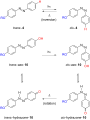
Figure 14: Proposed isomerisation mechanisms for the thermal cis-to-trans isomerisation of the alkoxy-substitu...

Figure 15: Solvent effect on the thermal relaxation time at 298 K, τ, for the type-II ortho-substituted azophe...
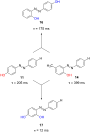
Figure 16: Cooperative effect of the para- and ortho-hydroxyl groups in azophenol 17.

Figure 17: Effect of the poly-hydroxylation of the azobenzene core on the thermal relaxation time at 298 K, τ,...

Figure 18: Transients generated by irradiation with UV-light (λ = 355 nm) for the poly-substituted azophenol 18...

Figure 19: Effect of the introduction of electron-withdrawing groups in the position 4’ of the azophenol struc...

Figure 20: Transient absorptions generated by UV irradiation (λ = 355 nm) of azo-dyes 11 (type-II), 19 (type-I...

Figure 21: Effect of the introduction of the hydroxyl group in the position 2’ of the push–pull azo-dye on the...

Figure 22: Effect of the substitution of a benzene ring by a pyridine one on the thermal relaxation time in et...

Figure 23: Influence of the introduction of additional electron-withdrawing nitro groups in the pyridine ring ...

Figure 24: Chemical structure and thermal relaxation time in ethanol at 298 K, τ, for the type-III azoderivati...

Figure 25: Oscillation of the optical density of an ethanol solution of azo-dye 26 generated by UV-light irrad...
Molecular recognition of organic ammonium ions in solution using synthetic receptors
- Andreas Späth and
- Burkhard König
Beilstein J. Org. Chem. 2010, 6, No. 32, doi:10.3762/bjoc.6.32

Graphical Abstract

Figure 1: Biologically important amines and quaternary ammonium salts: histamine (1), dopamine (2) and acetyl...

Figure 2: Crown ether 18-crown-6.

Figure 3: Conformations of 18-crown-6 (4) in solvents of different polarity.

Figure 4: Binding topologies of the ammonium ion depending on the crown ring size.
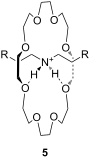
Figure 5: A “pseudorotaxane” structure consisting of 24-crown-8 and a secondary ammonium ion (5); R = Ph.

Figure 6: Typical examples of azacrown ethers, cryptands and related aza macrocycles.

Figure 7: Binding of ammonium to azacrown ethers and cryptands [111-113].

Figure 8: A 19-crown-6-ether with decalino blocking groups (11) and a thiazole-dibenzo-18-crown-6-ether (12).

Figure 9: 1,3-Bis(6-oxopyridazin-1-yl)propane derivatives 13 and 14 by Campayo et al.

Figure 10: Fluorescent azacrown-PET-sensors based on coumarin.

Figure 11: Two different pyridino-cryptands (17 and 18) compared to a pyridino-crown (19); chiral ammonium ion...

Figure 12: Pyridino-18-crown-6 ligand (21), a similar acridino-18-crown-6 ligand (22) and a structurally relat...

Figure 13: Ciral pyridine-azacrown ether receptors 24.

Figure 14: Chiral 15-crown-5 receptors 26 and an analogue 18-crown-6 ligand 27 derived from amino alcohols.

Figure 15: C2-symmetric chiral 18-crown-6 amino alcohol derivatives 28 and related macrocycles.

Figure 16: Macrocycles with diamide-diester groups (30).

Figure 17: C2-symmetric chiral aza-18-crown-6 ethers (31) with phenethylamine residues.

Figure 18: Chiral C-pivot p-methoxy-phenoxy-lariat ethers.

Figure 19: Chiral lariat crown ether 34.

Figure 20: Sucrose-based chiral crown ether receptors 36.
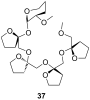
Figure 21: Permethylated fructooligosaccharide 37 showing induced-fit chiral recognition.

Figure 22: Biphenanthryl-18-crown-6 derivative 38.

Figure 23: Chiral lariat crown ethers derived from binol by Fuji et al.

Figure 24: Chiral phenolic crown ether 41 with “aryl chiral barriers” and guest amines.
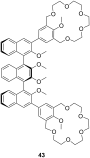
Figure 25: Chiral bis-crown receptor 43 with a meso-ternaphthalene backbone.

Figure 26: Chromogenic pH-dependent bis-crown chemosensor 44 for diamines.

Figure 27: Triamine guests for binding to receptor 44.

Figure 28: Chiral bis-crown phenolphthalein chemosensors 46.

Figure 29: Crown ether amino acid 47.

Figure 30: Luminescent receptor 48 for bis-alkylammonium guests.

Figure 31: Luminescent CEAA (49a), a bis-CEAA receptor for amino acids (49b) and the structure of lysine bindi...

Figure 32: Luminescent CEAA tripeptide for binding small peptides.

Figure 33: Bis crown ether 51a self assembles co-operatively with C60-ammonium ion 51b.

Figure 34: Triptycene-based macrotricyclic dibenzo-[24]-crown-8 ether host 52 and guests.

Figure 35: Copper imido diacetic acid azacrown receptor 53a and the suggested His-Lys binding motif; a copper ...

Figure 36: Urea (54) and thiourea (55) benzo crown receptor for transport and extraction of amino acids.

Figure 37: Crown pyryliums ion receptors 56 for amino acids.

Figure 38: Ditopic sulfonamide bridged crown ether receptor 57.

Figure 39: Luminescent peptide receptor 58.

Figure 40: Luminescent receptor 59 for the detection of D-glucosamine hydrochloride in water/ethanol and lumin...

Figure 41: Guanidinium azacrown receptor 61 for simple amino acids and ditopic receptor 62 with crown ether an...

Figure 42: Chiral bicyclic guanidinium azacrown receptor 63 and similar receptor 64 for the enantioselective t...

Figure 43: Receptors for zwitterionic species based on luminescent CEAAs.

Figure 44: 1,10-Azacrown ethers with sugar podand arms and the anticancer agent busulfan.

Figure 45: Benzo-18-crown-6 modified β-cyclodextrin 69 and β-cyclodextrin functionalized with diaza-18-crown-6...

Figure 46: Receptors for colorimetric detection of primary and secondary ammonium ions.

Figure 47: Porphyrine-crown-receptors 72.

Figure 48: Porphyrin-crown ether conjugate 73 and fullerene-ammonium ion guest 74.

Figure 49: Calix[4]arene (75a), homooxocalix[4]arene (75b) and resorcin[4]arene (75c) compared (R = H, alkyl c...

Figure 50: Calix[4]arene and ammonium ion guest (R = H, alkyl, OAcyl etc.), possible binding sites; A: co-ordi...

Figure 51: Typical guests for studies with calixarenes and related molecules.
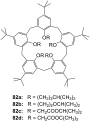
Figure 52: Lower rim modified p-tert-butylcalix[5]arenes 82.

Figure 53: The first example of a water soluble calixarene.

Figure 54: Sulfonated water soluble calix[n]arenes that bind ammonium ions.
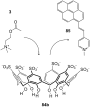
Figure 55: Displacement assay for acetylcholine (3) with a sulfonato-calix[6]arene (84b).

Figure 56: Amino acid inclusion in p-sulfonatocalix[4]arene (84a).

Figure 57: Calixarene receptor family 86 with upper and lower rim functionalization.

Figure 58: Calix[6]arenes 87 with one carboxylic acid functionality.
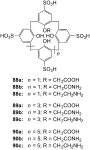
Figure 59: Sulfonated calix[n]arenes with mono-substitution at the lower rim systematically studied on their r...

Figure 60: Cyclotetrachromotropylene host (91) and its binding to lysine (81c).

Figure 61: Calixarenes 92 and 93 with phosphonic acids groups.

Figure 62: Calix[4]arene tetraphosphonic acid (94a) and a double bridged analogue (94b).
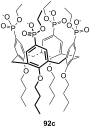
Figure 63: Calix[4]arene tetraphosphonic acid ester (92c) for surface recognition experiments.

Figure 64: Calixarene receptors 95 with α-aminophosphonate groups.

Figure 65: A bridged homocalix[3]arene 95 and a distally bridged homocalix[4]crown 96.

Figure 66: Homocalix[3]arene ammonium ion receptor 97a and the Reichardt’s dye (97b) for colorimetric assays.

Figure 67: Chromogenic diazo-bridged calix[4]arene 98.

Figure 68: Calixarene receptor 99 by Huang et al.
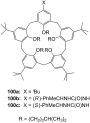
Figure 69: Calixarenes 100 reported by Parisi et al.

Figure 70: Guest molecules for inclusion in calixarenes 100: DAP × 2 HCl (101a), APA (101b) and Lys-OMe × 2 HC...

Figure 71: Different N-linked peptido-calixarenes open and with glycol chain bridges.

Figure 72: (S)-1,1′-Bi-2-naphthol calixarene derivative 104 published by Kubo et al.

Figure 73: A chiral ammonium-ion receptor 105 based on the calix[4]arene skeleton.

Figure 74: R-/S-phenylalaninol functionalized calix[6]arenes 106a and 106b.

Figure 75: Capped homocalix[3]arene ammonium ion receptor 107.

Figure 76: Two C3 symmetric capped calix[6]arenes 108 and 109.

Figure 77: Phosphorous-containing rigidified calix[6]arene 110.

Figure 78: Calix[6]azacryptand 111.

Figure 79: Further substituted calix[6]azacryptands 112.

Figure 80: Resorcin[4]arene (75c) and the cavitands (113).

Figure 81: Tetrasulfonatomethylcalix[4]resorcinarene (114).
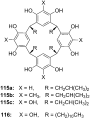
Figure 82: Resorcin[4]arenes (115a/b) and pyrogallo[4]arenes (115c, 116).
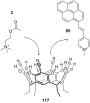
Figure 83: Displacement assay for acetylcholine (3) with tetracyanoresorcin[4]arene (117).

Figure 84: Tetramethoxy resorcinarene mono-crown-5 (118).

Figure 85: Components of a resorcinarene based displacement assay for ammonium ions.

Figure 86: Chiral basket resorcin[4]arenas 121.

Figure 87: Resorcinarenes with deeper cavitand structure (122).

Figure 88: Resorcinarene with partially open deeper cavitand structure (123).
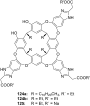
Figure 89: Water-stabilized deep cavitands with partially structure (124, 125).
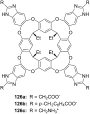
Figure 90: Charged cavitands 126 for tetralkylammonium ions.

Figure 91: Ditopic calix[4]arene receptor 127 capped with glycol chains.

Figure 92: A calix[5]arene dimer for diammonium salt recognition.

Figure 93: Calixarene parts 92c and 129 for the formation molecular capsules.
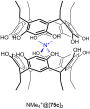
Figure 94: Encapsulation of a quaternary ammonium cation by two resorcin[4]arene molecules (NMe4+@[75c]2 × Cl−...

Figure 95: Encapsulation of a quaternary ammonium cation by six resorcin[4]arene molecules (NMe3D+@[130]6 × Cl−...

Figure 96: Structure and schematic of cucurbit[6]uril (CB[6], 131a).
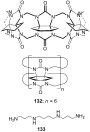
Figure 97: Cyclohexanocucurbit[6]uril (CB′[6], 132) and the guest molecule spermine (133).

Figure 98: α,α,δ,δ-Tetramethylcucurbit[6]uril (134).

Figure 99: Structure of the cucurbituril-phthalhydrazide analogue 135.

Figure 100: Organic cavities for the displacement assay for amine differentiation.

Figure 101: Displacement assay methodology for diammonium- and related guests involving cucurbiturils and some ...

Figure 102: Nor-seco-Cucurbituril (±)-bis-ns-CB[6] (140) and guest molecules.

Figure 103: The cucurbit[6]uril based complexes 141 for chiral discrimination.
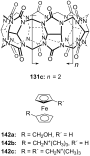
Figure 104: Cucurbit[7]uril (131c) and its ferrocene guests (142) opposed.

Figure 105: Cucurbit[7]uril (131c) guest inclusion and representative guests.

Figure 106: Cucurbit[7]uril (131c) binding to succinylcholine (145) and different bis-ammonium and bis-phosphon...

Figure 107: Paraquat-cucurbit[8]uril complex 149.
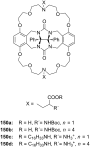
Figure 108: Gluconuril-based ammonium receptors 150.
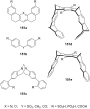
Figure 109: Examples of clefts (151a), tweezers (151b, 151c, 151d) and clips (151e).

Figure 110: Kemp’s triacid (152a), on example of Rebek’s receptors (152b) and guests.

Figure 111: Amino acid receptor (154) by Rebek et al.

Figure 112: Hexagonal lattice designed hosts by Bell et al.

Figure 113: Bell’s amidinium receptor (156) and the amidinium ion (157).
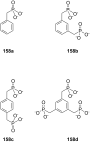
Figure 114: Aromatic phosphonic acids.

Figure 115: Xylene phosphonates 159 and 160a/b for recognition of amines and amino alcohols.
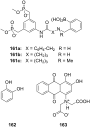
Figure 116: Bisphosphonate recognition motif 161 for a colorimetric assay with alizarin complexone (163) for ca...

Figure 117: Bisphosphonate/phosphate clip 164 and bisphosphonate cleft 165.

Figure 118: N-Methylpyrazine 166a, N-methylnicotinamide iodide (166b) and NAD+ (166c).

Figure 119: Bisphosphate cavitands.
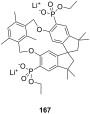
Figure 120: Bisphosphonate 167 of Schrader and Finocchiaro.
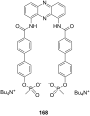
Figure 121: Tweezer 168 for noradrenaline (80b).

Figure 122: Different tripods and heparin (170).
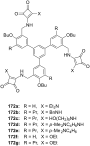
Figure 123: Squaramide based receptors 172.
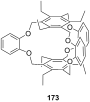
Figure 124: Cage like NH4+ receptor 173 of Kim et al.

Figure 125: Ammonium receptors 174 of Chin et al.

Figure 126: 2-Oxazolin-based ammonium receptors 175a–d and 176 by Ahn et al.

Figure 127: Racemic guest molecules 177.

Figure 128: Tripods based on a imidazole containing macrocycle (178) and the guest molecules employed in the st...

Figure 129: Ammonium ion receptor 180.

Figure 130: Tetraoxa[3.3.3.3]paracyclophanes 181 and a cyclophanic tetraester (182).

Figure 131: Peptidic bridged paraquat-cyclophane.
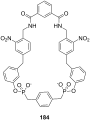
Figure 132: Shape-selective noradrenaline host.

Figure 133: Receptor 185 for binding of noradrenaline on surface layers from Schrader et al.

Figure 134: Tetraphosphonate receptor for binding of noradrenaline.

Figure 135: Tetraphosphonate 187 of Schrader and Finocchiaro.

Figure 136: Zinc-Porphyrin ammonium-ion receptors 188 and 189 of Mizutani et al.
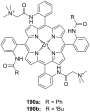
Figure 137: Zinc porphyrin receptor 190.

Figure 138: Zinc porphyrin receptors 191 capable of amino acid binding.

Figure 139: Zinc-porphyrins with amino acid side chains for stereoinduction.

Figure 140: Bis-zinc-bis-porphyrin based on Tröger’s base 193.

Figure 141: BINAP-zinc-prophyrin derivative 194 and it’s guests.

Figure 142: Bisaryl-linked-zinc-porphyrin receptors.
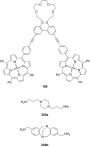
Figure 143: Bis-zinc-porphyrin 199 for diamine recognition and guests.

Figure 144: Bis-zinc-porphyrin crown ether 201.

Figure 145: Bis-zinc-porphyrin 202 for stereodiscrimination (L = large substituent; S = small substituent).

Figure 146: Bis-zinc-porphyrin[3]rotaxane and its copper complex and guests.

Figure 147: Dien-bipyridyl ligand 206 for co-ordination of two metal atoms.

Figure 148: The ligand and corresponding tetradentate co-complex 207 serving as enantioselective receptor for a...

Figure 149: Bis(oxazoline)–copper(II) complex 208 for the recognition of amino acids in aqueous solution.

Figure 150: Zinc-salen-complexes 209 for the recognition tertiary amines.

Figure 151: Bis(oxazoline)–copper(II) 211 for the recognition of amino acids in aqueous solution.

Figure 152: Zn(II)-complex of a C2 terpyridine crown ether.

Figure 153: Displacement assay and receptor for aspartate over glutamate.

Figure 154: Chiral complex 214 for a colorimetric displacement assay for amino acids.

Figure 155: Metal complex receptor 215 with tripeptide side arms.

Figure 156: A sandwich complex 216 and its displaceable dye 217.

Figure 157: Lanthanide complexes 218–220 for amino acid recognition.
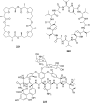
Figure 158: Nonactin (221), valinomycin (222) and vancomycin (223).

Figure 159: Monesin (224a) and a chiral analogue for enantiodiscrimination of ammonium guests (224b).

Figure 160: Chiral podands (226) compared to pentaglyme-dimethylether (225) and 18-crown-6 (4).

Figure 161: Lasalocid A (228).

Figure 162: Lasalocid derivatives (230) of Sessler et al.

Figure 163: The Coporphyrin I tetraanion (231).

Figure 164: Linear and cyclic peptides for ammonium ion recognition.

Figure 165: Cyclic and bicyclic depsipeptides for ammonium ion recognition.
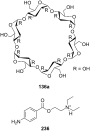
Figure 166: α-Cyclodextrin (136a) and novocaine (236).
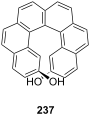
Figure 167: Helical diol receptor 237 by Reetz and Sostmann.

Figure 168: Ammonium binding spherand by Cram et al. (238a) and the cyclic[6]metaphenylacetylene 238b in compar...

Figure 169: Receptor for peptide backbone and ammonium binding (239).

Figure 170: Anion sensor principle with 3-hydroxy-2-naphthanilide of Jiang et al.

Figure 171: 7-bromo-3-hydroxy-N-(2-hydroxyphenyl)naphthalene 2-carboxamide (241) and its amine binding.

Figure 172: Naturally occurring catechins with affinity to quaternary ammonium ions.

Figure 173: Spiropyran (244) and merocyanine form (244a) of the amino acid receptors of Fuji et al.

Figure 174: Coumarin aldehyde (245) and its iminium species with amino acid bound (245a) by Glass et al.
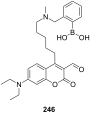
Figure 175: Coumarin aldehyde appended with boronic acid.

Figure 176: Quinolone aldehyde dimers by Glass et al.

Figure 177: Chromogenic ammonium ion receptors with trifluoroacetophenone recognition motifs.

Figure 178: Chromogenic ammonium ion receptor with trifluoroacetophenone recognition motif bound on different m...



