


Search results
Search for "continuous-flow reaction" in Full Text gives 12 result(s) in Beilstein Journal of Organic Chemistry.
Continuous-flow carbonyl hydrogenation under subatmospheric to atmospheric hydrogen pressure enabled by robust heterogeneous Pt–Fe catalysts
Beilstein J. Org. Chem. 2026, 22, 575–582, doi:10.3762/bjoc.22.43
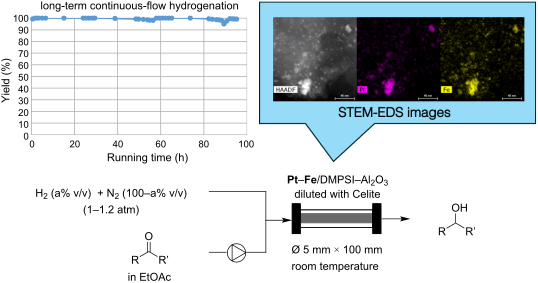
- : bimetallic nanostructure; carbonyl reduction; continuous-flow reaction; heterogeneous catalyst; subatmospheric hydrogen; Introduction The reduction of carbonyl compounds, ketones and aldehydes to alcohols is a fundamental and important reaction in organic synthesis that can provide valuable chemicals such
- bulky and sterically hindered substrates, were smoothly hydrogenated at room temperature under subatmospheric to atmospheric hydrogen pressure with a wide substrate scope. The high durability of the heterogeneous catalyst was confirmed by a long-term continuous-flow reaction, and the catalytic activity


Homogeneous continuous flow nitration of O-methylisouronium sulfate and its optimization by kinetic modeling
Beilstein J. Org. Chem. 2024, 20, 2408–2420, doi:10.3762/bjoc.20.205
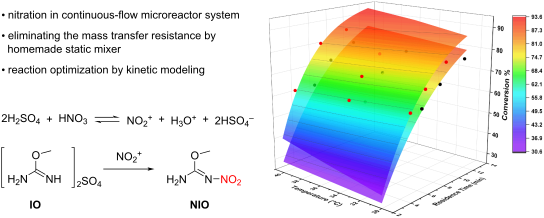
- understanding of the nitrification mechanism and optimization of the reaction. Luo et al. have carried out extensive research on this topic and obtained accurate kinetic data for the nitration of chlorobenzene [17], o-nitrotoluene [18], and p-nitrotoluene [19] by constructing a homogeneous continuous flow
- reaction system. Therefore, it is feasible to model homogeneous nitrification and optimize the reaction in a continuous flow system based on NO2+. An important prerequisite for kinetic modeling is the elimination of issues related to mass and heat transfer. The effect of mass transfer resistance is greater


![[Graphic 1]](/bjoc/content/inline/1860-5397-20-205-i17.svg?max-width=637&scale=1.18182)



C3-Alkylation of furfural derivatives by continuous flow homogeneous catalysis
Beilstein J. Org. Chem. 2023, 19, 582–592, doi:10.3762/bjoc.19.43
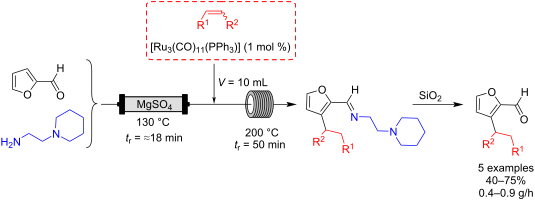
- of [Ru3(CO)12] indicates that comp1 is slightly less active than [Ru3(CO)12]. Beside these three catalysts, a fourth one [Ru3(CO)11(PPh3)] comp4, was also used for this study. For the continuous flow reaction, we observed, for the same residence time, a slight decrease in performance with comp1


Low-budget 3D-printed equipment for continuous flow reactions
Beilstein J. Org. Chem. 2019, 15, 558–566, doi:10.3762/bjoc.15.50
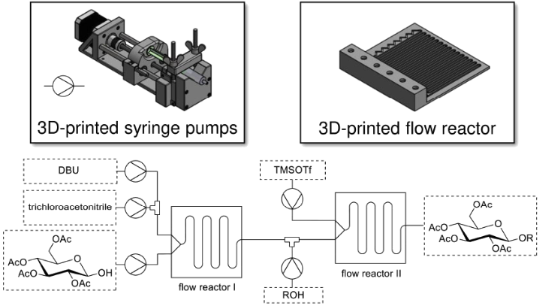
- ]. 3D-printing, also known as additive manufacturing, is a process, where the object is created layer by layer directly from the computer-aided design (CAD) model. There are different technologies available for printing continuous flow reaction devices like fused deposition modeling (FDM) [13][14
- synthesis of acetobromo-α-D-glucose 2. b) Photograph of a typical setting for continuous flow reaction. Preparation of acetobromo-α-D-glucose 2. Flow Koenigs–Knorr reaction to methyl glycoside 3 with silver triflate. Preparation of glycosyl donor 5. Two-step glycosylation reactions starting from pyranose 3


Diels–Alder reactions of myrcene using intensified continuous-flow reactors
Beilstein J. Org. Chem. 2017, 13, 120–126, doi:10.3762/bjoc.13.15
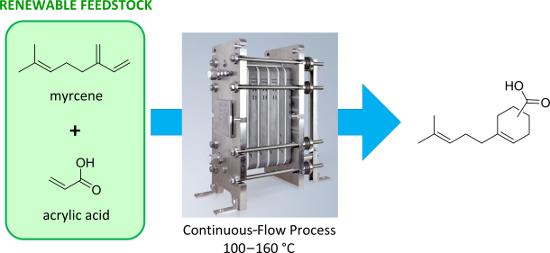
- results for the continuous-flow reaction of myrcene (1) with acrylic acid (2b) in a tubular flow reactor (reactor volume: 20 mL) and a plate flow reactor (reactor volume: 105 mL); all entries were reacted with a myrcene to dienophile ratio, R, of 0.9, and cMYR,0 of 2.8 mol/L. Supporting Information


Continuous-flow synthesis of primary amines: Metal-free reduction of aliphatic and aromatic nitro derivatives with trichlorosilane
Beilstein J. Org. Chem. 2016, 12, 2614–2619, doi:10.3762/bjoc.12.257
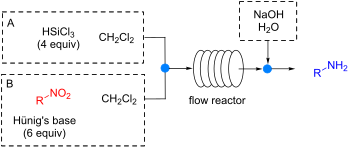
- attractive also for future industrial applications. Experimental General procedure for the continuous-flow reaction using a 0.5 mL PTFE reactor: Syringe A was filled with a solution of HSiCl3 (2.4 mmol) in dry CH2Cl2 (1.5 mL). Syringe B was loaded with a solution of the nitro compound (0.6 mmol) and Hünig’s


Development of a continuous process for α-thio-β-chloroacrylamide synthesis with enhanced control of a cascade transformation
Beilstein J. Org. Chem. 2016, 12, 2511–2522, doi:10.3762/bjoc.12.246
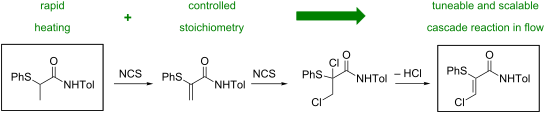
- key α-thio-β-chloroacrylamide casade as a continuous flow reaction on a multi-gram scale is described, while the tuneable nature of the cascade, facilitated by continuous processing, is highlighted by selective generation of established intermediates and byproducts. Keywords: α-thio-β


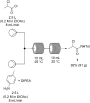


Continuous-flow Heck synthesis of 4-methoxybiphenyl and methyl 4-methoxycinnamate in supercritical carbon dioxide expanded solvent solutions
Beilstein J. Org. Chem. 2013, 9, 2886–2897, doi:10.3762/bjoc.9.325
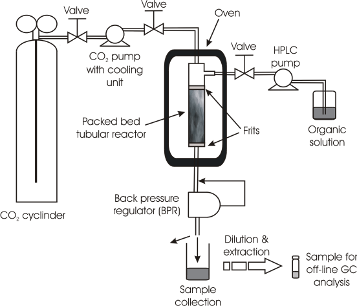
- catalysts also lend themselves particularly well to continuous processing. One such example is reported by Karbass et al. [26], who carried out continuous flow reaction using Pd(0) derived from [Pd3(OAc)6] supported on polymeric monoliths containing methylimidazole, an ionic-liquid (IL) moiety in near
- investigated corresponding to the concentrations in the continuous flow reaction set for a scCO2/organic solution ratio of 5:1. The pressure of the autoclave was set as close to 200 bar as possible, however because no back pressure regulator was present this was achieved by setting the applied pressure at 167
- rate and reaction rate. Increasing the pressure from 200 to 250 bar had a dramatic effect on conversion. The continuous flow reaction was repeated at 145 °C and flow rate of 0.12 mL min−1 but at 250 bar scCO2 pressure. The results are shown in Figure 5. While the conversion increased to 48% at 200 bar


Hypervalent iodine/TEMPO-mediated oxidation in flow systems: a fast and efficient protocol for alcohol oxidation
Beilstein J. Org. Chem. 2013, 9, 1437–1442, doi:10.3762/bjoc.9.162
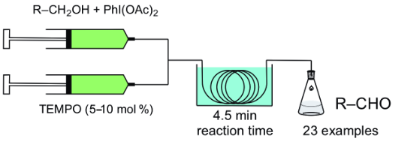
- synthetic steps, without the need for isolation or purification of the intermediate aldehyde or ketone. Conclusion In conclusion, a highly efficient and selective continuous-flow reaction for the oxidation of different alcohols was developed. Apart from short reaction times, high conversions and excellent


Continuous-flow hydration–condensation reaction: Synthesis of α,β-unsaturated ketones from alkynes and aldehydes by using a heterogeneous solid acid catalyst
Beilstein J. Org. Chem. 2011, 7, 1680–1687, doi:10.3762/bjoc.7.198
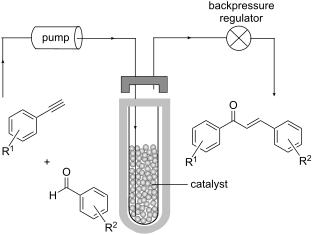
- . Our initial reaction development was focussed on finding the optimal conditions for the continuous-flow reaction of phenylacetylene (1a) with benzaldehyde (2a) applying the ion-exchange resin amberlyst-15 [85] as heterogeneous solid acid catalyst. The effects of the substrate concentration, the


Koch–Haaf reaction of adamantanols in an acid-tolerant hastelloy-made microreactor
Beilstein J. Org. Chem. 2011, 7, 1288–1293, doi:10.3762/bjoc.7.149
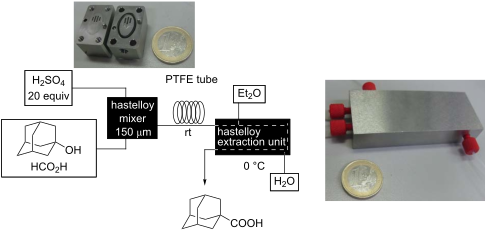
- % total yield (2c:2c':2c'' = 23:53:24). The batch reaction resulted in an inferior yield with more of the rearranged products (83% yield, 2c:2c':2c'' = 19:62:19). All results are summarized in Table 1. Multigram scale synthesis of 2a from 1a was carried out in a continuous flow reaction. When the reaction


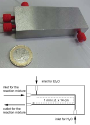


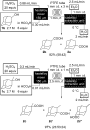

Controlling hazardous chemicals in microreactors: Synthesis with iodine azide
Beilstein J. Org. Chem. 2009, 5, No. 30, doi:10.3762/bjoc.5.30
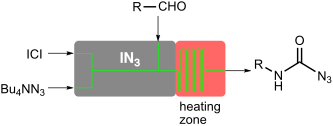
- Johan C. Brandt Thomas Wirth Cardiff University, School of Chemistry, Park Place, Cardiff CF10 3AT, UK. 10.3762/bjoc.5.30 Abstract Aromatic aldehydes have been converted into the corresponding carbamoyl azides using iodine azide. These reactions have been performed safely under continuous flow
- reaction conditions in microreactors. Keywords: azide; flow chemistry; hazardous reagents; microreactor; rearrangement; Introduction Microstructured devices have already found their way into organic synthesis, because they offer various advantages over traditional large-scale chemistry performed in





