Search results
Search for "fluorescent sensors" in Full Text gives 17 result(s) in Beilstein Journal of Organic Chemistry.
Synthesis and uranyl(VI) extraction performance of a calix[4]pyrrole–tetrahydroxamic acid receptor
Beilstein J. Org. Chem. 2026, 22, 486–494, doi:10.3762/bjoc.22.36
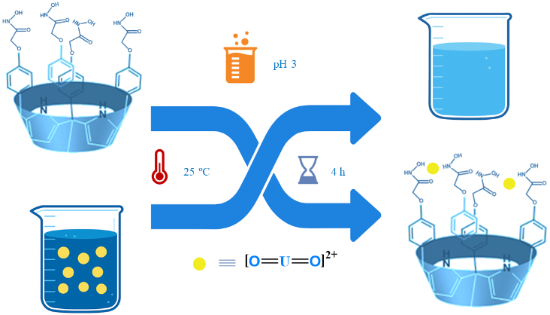
- matrices for a broad range of applications [9]. Notable examples include catalysis, chromogenic sensors and fluorescent sensors, as well as heavy metals extraction [12][13][14][15][16]. One CP molecule that has attracted the attention of several research groups is the meso-tetra-methyltetrakis(4


On the aromaticity and photophysics of 1-arylbenzo[a]imidazo[5,1,2-cd]indolizines as bicolor fluorescent molecules for barium tagging in the study of double-beta decay of 136Xe
Beilstein J. Org. Chem. 2025, 21, 1627–1638, doi:10.3762/bjoc.21.126
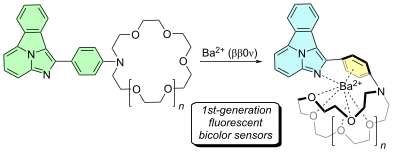
- decoupling between the para-phenylene and benzo[a]imidazo[5,1,2-cd]indolizine components that results in a blue shift upon Ba2+ coordination. Keywords: aromaticity; DFT-TDDFT calculations; double-beta decay; fluorescent sensors; polycyclic arenes; Introduction Double beta-decay [1] is a radioactive decay
- functionals being quite similar among them. Therefore, we concluded that M06-2X, whose calculated geometry is almost coincident with that computed with B3LYP-D3BJ, is the most precise functional to predict the two-color behavior of these fluorescent sensors. Computational Methods All the DFT [32] and TDDFT





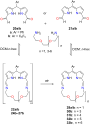
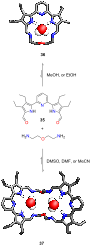
Tying a knot between crown ethers and porphyrins
Beilstein J. Org. Chem. 2023, 19, 1630–1650, doi:10.3762/bjoc.19.120
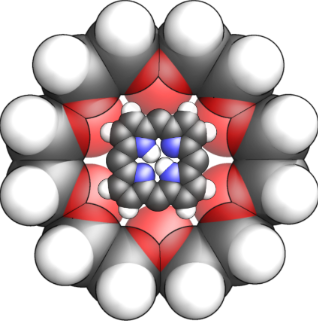
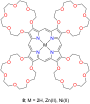
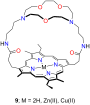
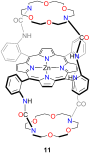
- ether systems, where the catechol unit of the crown ether was fused to two β-pyrrolic positions of the porphyrin periphery. The systems presented intriguing intramolecular electron-transfer properties. Additionally, they were investigated as fluorescent sensors for various organic and metal cations [51









Synthesis, optical and electrochemical properties of (D–π)2-type and (D–π)2Ph-type fluorescent dyes
Beilstein J. Org. Chem. 2022, 18, 1047–1054, doi:10.3762/bjoc.18.106
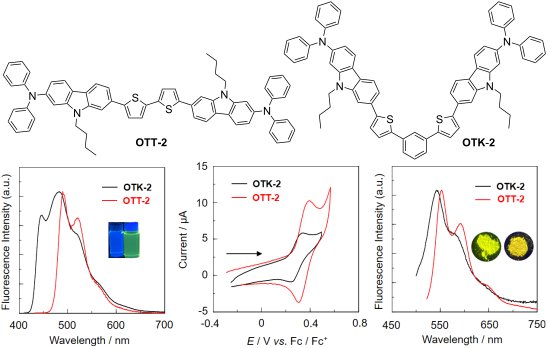
- ][16][17][18][19][20][21][22], as well as fluorescent probes [23][24][25][26][27][28] for bioimaging and fluorescent sensors for specific target species [29][30][31][32]. Among many kinds of organic fluorescent dyes, much efforts have been made on the development of donor–π–acceptor (D–π–A)-type


Selected peptide-based fluorescent probes for biological applications
Beilstein J. Org. Chem. 2020, 16, 2971–2982, doi:10.3762/bjoc.16.247

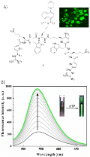
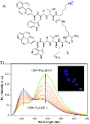
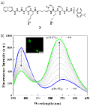
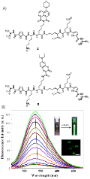
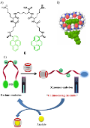
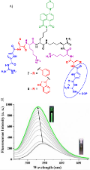
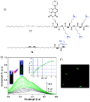
- for biomolecule detection [27][28]. Being intrinsically modular, peptide scaffolds also allow the attachment of multiple fluorophores simultaneously [29]. It provides the opportunity of developing ratiometric fluorescent sensors from the interaction between multiple fluorophores (Figure 1B

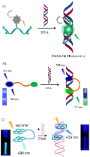



Targeted photoswitchable imaging of intracellular glutathione by a photochromic glycosheet sensor
Beilstein J. Org. Chem. 2019, 15, 2380–2389, doi:10.3762/bjoc.15.230
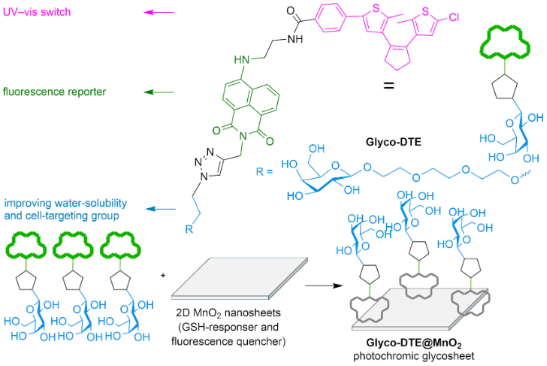
- fluorescent sensors for detecting intracellular GSH or discriminative sensing of GSH with other common biothiols (e.g., Cys and Hcy) [45][46]. In this work, the highly accessible 2D MnO2 nanosheet is used as the GSH responsive site instead of traditional functional groups that require elaborate design for



Pyrene–nucleobase conjugates: synthesis, oligonucleotide binding and confocal bioimaging studies
Beilstein J. Org. Chem. 2017, 13, 2521–2534, doi:10.3762/bjoc.13.249
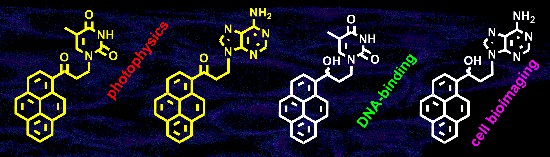
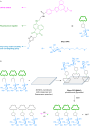
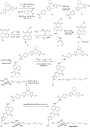
- mechanism of sensing involves Hg(II) ion coordination to two thymine moieties followed by pyrene excimer formation [19]. Furthermore, compound A2 and adenine derivative A3 were reported to act as fluorescent sensors for thymine and adenine [23]. To the best of our knowledge, pyrene–nucleobases have not been




Regioselective (thio)carbamoylation of 2,7-di-tert-butylpyrene at the 1-position with iso(thio)cyanates
Beilstein J. Org. Chem. 2017, 13, 1032–1038, doi:10.3762/bjoc.13.102

- ; pyrene; thioamide; Introduction Direct functionalization of pyrene 1 has attracted a great deal of attention in recent years because it is the most straightforward route to novel organic molecular materials for optoelectronic devices (OLEDs, field-effect transistors, fluorescent sensors, dye lasers, etc




Self and directed assembly: people and molecules
Beilstein J. Org. Chem. 2016, 12, 391–405, doi:10.3762/bjoc.12.42
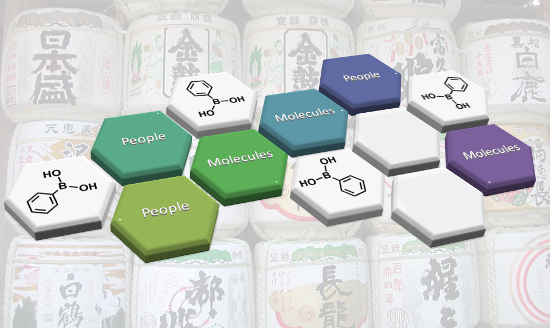
- . Independent research – Bath One of the first things I did at Bath was to expand and develop the modular saccharide selective fluorescent sensors which was part of the project with Beckmann-coulter started as a Royal Society University Research Fellow at the University of Birmingham [54][55]. My family also
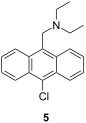
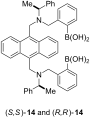
- resulted in an eight fold contrast ratio, which was much better than the two fold obtained for the carbazole-based d-PET fluorescent sensors. Using sensor 18 with the largest spacing between the boronic acid receptors resulted in excellent enantioselective discrimination of D- and L-tartaric acid (Figure






Fluoride-driven ‘turn on’ ESPT in the binding with a novel benzimidazole-based sensor
Beilstein J. Org. Chem. 2015, 11, 563–567, doi:10.3762/bjoc.11.61
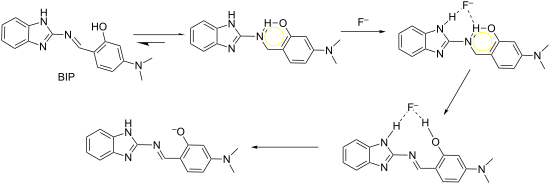
- anions involved in biological, industrial and environmental processes have drawn a lot of attention [1][2][3]. In recent years, much effort has been devoted to the development of anion fluorescent sensors [4]. Of particular interest concerning anion recognition and sensing was fluoride [5][6][7], as it
- is important to human health (for example, dental care, osteoporosis and osteosarcoma). To realize the high selectivity and sensitivity to fluoride, many anion fluorescent sensors have been designed based upon numerous signal mechanisms [4][8][9][10]. However, excited-state intra/intermolecular


Synthesis and spectroscopic properties of 4-amino-1,8-naphthalimide derivatives involving the carboxylic group: a new molecular probe for ZnO nanoparticles with unusual fluorescence features
Beilstein J. Org. Chem. 2013, 9, 1311–1318, doi:10.3762/bjoc.9.147

- to be efficient fluorescent molecular probes [7][8]. Recently, the potential of amino-1,8-naphthalimides as fluorescent sensors in living cells has been reviewed [9]. Dendrimers involving the amino-1,8-naphthalimide moieties were showed to be promising active nondoping emitters [10]. 4-Amino


Imidazole as a parent π-conjugated backbone in charge-transfer chromophores
Beilstein J. Org. Chem. 2012, 8, 25–49, doi:10.3762/bjoc.8.4
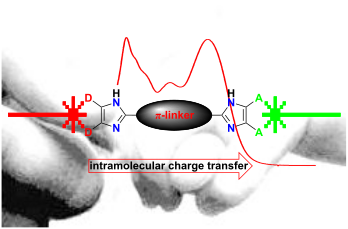
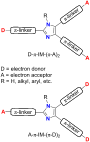
- (Figure 5, Table 3). Imidazoles 12 (DIYSP, δ = 41 GM, [38][39]) and 13 (FD3, δ = 1556 GM, [40]) were developed as two-photon absorbing and fluorescent A-π-A’ chromophores, which undergo photopolymerization or can be applied as fluorescent sensors for (homo)cysteine. Donor 4,5-disubstituted imidazole




An easy assembled fluorescent sensor for dicarboxylates and acidic amino acids
Beilstein J. Org. Chem. 2011, 7, 75–81, doi:10.3762/bjoc.7.11
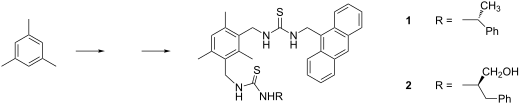
- for sensing dicarboxylates. Their binding affinities toward dicarboxylates, aspartate and glutamate have been investigated in acetonitrile solution by fluorescence titration experiments. Both fluorescent sensors exhibited some ability to discriminate the antipodal forms of aspartate and glutamate


Anthracene coupled adenine for the selective sensing of copper ions
Beilstein J. Org. Chem. 2010, 6, No. 44, doi:10.3762/bjoc.6.44

- gastrointestinal disturbance, while long-term exposure can lead to liver or kidney damage [10][11][12][13][14][15][16]. For these reasons, the past few years have witnessed a number of reports on the design and synthesis of fluorescent sensors for the detection of Cu2+ ions [17][18][19][20][21][22][23][24


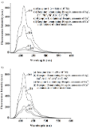


Control of stilbene conformation and fluorescence in self-assembled capsules
Beilstein J. Org. Chem. 2009, 5, No. 79, doi:10.3762/bjoc.5.79
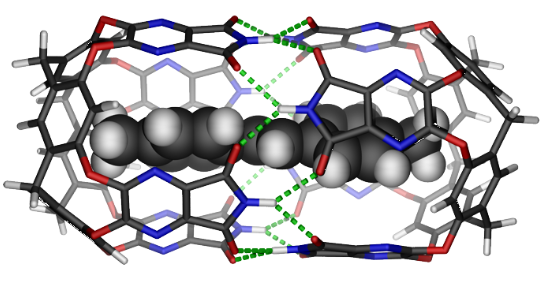
- a fully reversible process with long chain alkane guests. We are currently pursuing this application with stilbenes and studying the exchange of subunits in the process [12][13]. Many fluorescent sensors have been reported in the literature [14][15][16][17], however they usually respond to chemical


Quinoline based receptor in fluorometric discrimination of carboxylic acids
Beilstein J. Org. Chem. 2008, 4, No. 52, doi:10.3762/bjoc.4.52

- for online and real-time analyses [4]. A large number of examples of fluorescent sensors capable of sensing ions and molecules have appeared over the past few years [5][6][7]. In this context, fluorescent sensors, which rely on guest-induced folding of flexible receptors bringing the fluorophore


Synthesis of deep- cavity fluorous calix[4]arenes as molecular recognition scaffolds
Beilstein J. Org. Chem. 2008, 4, No. 36, doi:10.3762/bjoc.4.36
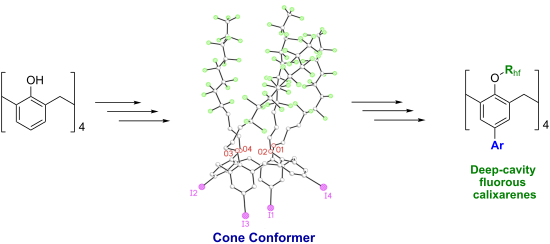
- are locked in the cone conformation have been synthesized. These molecules are soluble in several fluorous solvents, and show promise as fluorescent sensors. Introducing the hydroxyl functionality onto these molecules provides a scaffold with a deep cavity and hydrogen bonding functional groups for