Search results
Search for "propiolic acid" in Full Text gives 13 result(s) in Beilstein Journal of Organic Chemistry.
Multicomponent syntheses of pyrazoles via (3 + 2)-cyclocondensation and (3 + 2)-cycloaddition key steps
Beilstein J. Org. Chem. 2024, 20, 2024–2077, doi:10.3762/bjoc.20.178
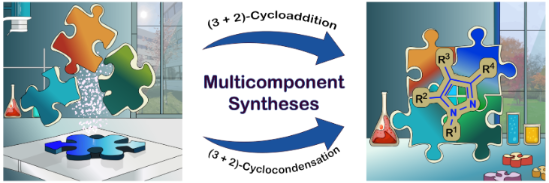
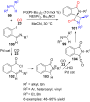
- heteroaryls other than thiophene under standard conditions. Schreiner et al. established a further protocol for the one-pot synthesis of pyrazoles, where the alkynoyl moiety is generated by copper-catalyzed carboxylation of terminal alkynes followed by alkylation with methyl iodide, forming propiolic acid




Access to 2-oxoazetidine-3-carboxylic acid derivatives via thermal microwave-assisted Wolff rearrangement of 3-diazotetramic acids in the presence of nucleophiles
Beilstein J. Org. Chem. 2024, 20, 1894–1899, doi:10.3762/bjoc.20.164

- cyclization [15][16]. Additionally, the manganese(III)-promoted cyclization of N-alkenyl malonamides [17][18] and the Cu(I)-catalyzed reaction of propiolic acid derivatives with nitrones (Kinugasa reaction) [19][20][21] should also be mentioned, as well as intramolecular C–H insertion using


Entry to new spiroheterocycles via tandem Rh(II)-catalyzed O–H insertion/base-promoted cyclization involving diazoarylidene succinimides
Beilstein J. Org. Chem. 2024, 20, 561–569, doi:10.3762/bjoc.20.48
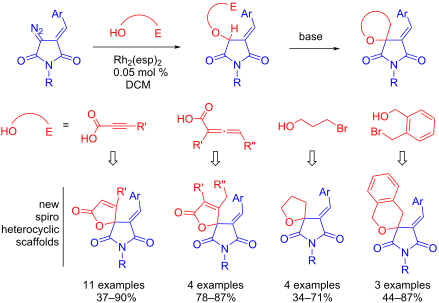
- obtained when unsubstituted propiolic acid was used as OH-substrate (2g). The reasons for this result may be due to the increased reactivity of the terminal triple bond of the propiolic moiety, which favors the participation of the OH-insertion intermediate in side processes. However, we were unable to


Selective synthesis of α-organylthio esters and α-organylthio ketones from β-keto esters and sodium S-organyl sulfurothioates under basic conditions
Beilstein J. Org. Chem. 2021, 17, 234–244, doi:10.3762/bjoc.17.24
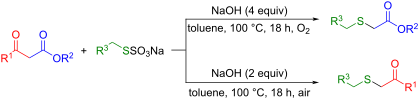
- -rich N-heterocycles [2][3][4], decarboxylative cross-coupling reactions with propiolic acid derivatives [5], Michael addition reaction [6], cross-couplings catalyzed by Pd [7] and Cu salts [8][9], the preparation of symmetrical and nonsymmetrical disulfides [10][11], and the synthesis of β-acetamido


1,5-Phosphonium betaines from N-triflylpropiolamides, triphenylphosphane, and active methylene compounds
Beilstein J. Org. Chem. 2019, 15, 2603–2611, doi:10.3762/bjoc.15.253

- in transamidation reactions with nucleophilic amines [18][22]. Therefore, it was interesting to know the performance of propiolic acid chlorides in the same betaine syntheses. We found that acid chlorides 4 indeed underwent the three-component reaction with N,N’-dimethylbarbituric acid and furnished
- betaines 3b, 3j and 3k, respectively, with about the same E/Z ratios as in Figure 1 (Scheme 5). However, the products were obtained in low yield, because unidentified side-reactions occurred and purification was cumbersome. Thus, propiolic acid chlorides are not well suited for these three-component
- the reaction course, because analogous three-component reactions using propiolic acid esters as Michael acceptors are known to furnish another type of betaines in which the ester group (COOR) is retained. Questions on some mechanistic details, in particular at which stage of the reaction sequence the


Multicomponent reactions (MCRs): a useful access to the synthesis of benzo-fused γ-lactams
Beilstein J. Org. Chem. 2019, 15, 1065–1085, doi:10.3762/bjoc.15.104
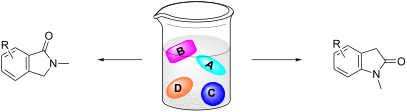
- reaction of propiolic acid and aryl halides [78]. Furthermore, the authors have been able to carry out the reaction in a sequential manner starting from propiolic acid and aryl iodides in the presence of caesium carbonate and a palladium catalyst. Next, addition of 2-iodobenzoic acid and ammonium acetate










Volatiles from the tropical ascomycete Daldinia clavata (Hypoxylaceae, Xylariales)
Beilstein J. Org. Chem. 2018, 14, 135–147, doi:10.3762/bjoc.14.9
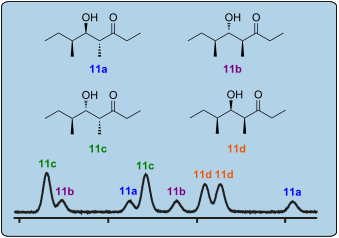
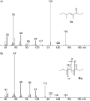
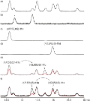
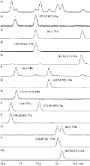
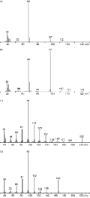
- structure of 6-nonyl-2H-pyran-2-one (17). For comparison a synthetic reference compound was prepared from undec-1-yne (34) and propiolic acid (35) in a gold-catalysed reaction developed by Schreiber and co-workers [40] (Scheme 8). Synthetic 17 and the volatile from D. clavata showed the same mass spectrum








One-pot syntheses of blue-luminescent 4-aryl-1H-benzo[f]isoindole-1,3(2H)-diones by T3P® activation of 3-arylpropiolic acids
Beilstein J. Org. Chem. 2017, 13, 2340–2351, doi:10.3762/bjoc.13.231
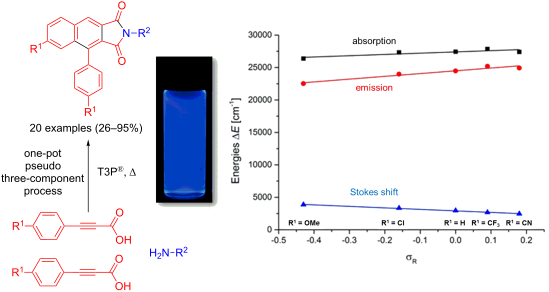
- , entry 3). The addition of T3P® as an activation agent is a prerequisite for achieving the transformation (Table 1, entry 4). With these conditions in hand, 3-(4-methoxyphenyl)propiolic acid (1b) was also chosen as a model substrate (Table 1, entries 5 and 6). The optimized reaction conditions for the
- ), an electron-rich (1b) and electron-poor (1c) propiolic acid substrate (Scheme 4, Table 4). Although the electroneutral and electron-rich substrates give good to excellent yields in the sequence (Table 4, entries 1–3), even higher (Table 4, entry 1) than for a stepwise synthesis furnishing an overall




Clicked and long spaced galactosyl- and lactosylcalix[4]arenes: new multivalent galectin-3 ligands
Beilstein J. Org. Chem. 2014, 10, 1672–1680, doi:10.3762/bjoc.10.175
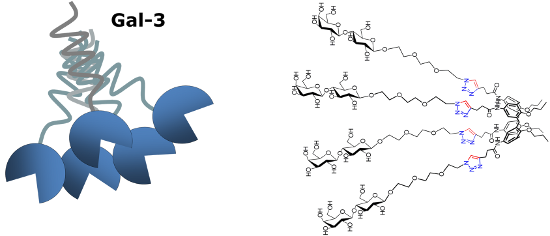
- higher yield (66%). Any attempts to connect the alkyne functionality in closer proximity to the calixarene core by decreasing the number of carbon atoms between the carboxylic group and the triple bond did not give fruitful results. Reactions between amino-calix[4]arene 6 and propiolic acid were carried


Synthesis, characterization and DNA interaction studies of new triptycene derivatives
Beilstein J. Org. Chem. 2014, 10, 1290–1298, doi:10.3762/bjoc.10.130
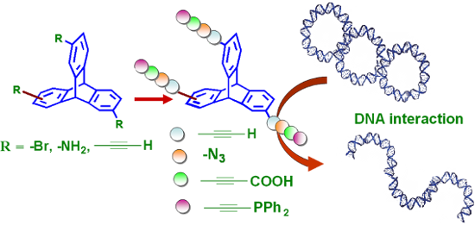
- . Subsequently, derivatization of ethynyl-substituted triptycenes was studied to yield the respective propiolic acid and ethynylphosphine derivatives. Characterization of the newly functionalized triptycene derivatives and their regioisomers were carried out using FTIR and multinuclear NMR spectroscopy, mass
- -triptycenetripropiolic acid as sole isolated product in high yield (70%). Using similar reaction conditions, 2,7,14-triptycenetripropiolic acid (6) was obtained in 68% yield. In FTIR spectrum of 5, bands at 1700 cm−1 (s, ν C=O str.) and 2206 cm−1 (w, ν C≡C str.) indicate the formation of the desired propiolic acid


Practical synthesis of aryl-2-methyl-3-butyn-2-ols from aryl bromides via conventional and decarboxylative copper-free Sonogashira coupling reactions
Beilstein J. Org. Chem. 2014, 10, 384–393, doi:10.3762/bjoc.10.36

- bromides rather than expensive iodides and using 4 or propiolic acid rather than TMS-acetylene as inexpensive alkyne sources are described. Keywords: alkynes; decarboxylative couplings; Erlotinib; palladium; propiolic acid; Introduction The Sonogashira coupling reaction of aryl or alkenyl halides with
- have also been reported as an efficient synthetic tool for the synthesis of disubstituted alkynes. In fact, the use of propiolic acid as an alkyne source has opened new possibilities in the synthesis of acetylenic compounds, since many examples leading to diaryl- (sp–sp2 coupling), benzyl- (sp–sp3
- coupling) and diaryl diacetylenes (sp–sp coupling) in addition to examples of carbon-heteroatom couplings have been reported in the recent literature [47][48][49][50][51][52][53][54][55][56][57][58][59][60][61][62][63][64][65]. The convenience in using propiolic acid as the alkyne source in the synthesis


Cascade radical reaction of substrates with a carbon–carbon triple bond as a radical acceptor
Beilstein J. Org. Chem. 2013, 9, 1148–1155, doi:10.3762/bjoc.9.128
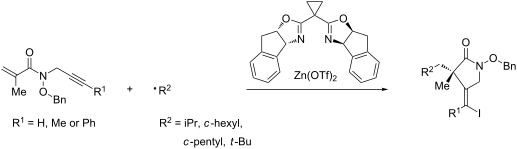
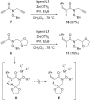
- cascade process, the reactions of propiolic acid derivatives 7 and 8 were tested (Scheme 4). At first, the reaction of 7 was evaluated under asymmetric reaction conditions. However, the cascade addition–cyclization–trapping reaction did not proceed, and the simple adduct 10 was formed in 57% yield by the
- addition–trapping process. Next, the reaction of propiolic acid derivative 8 was tested, because we expected the [1,5]-hydrogen shift from 1,3-dioxolane ring into the reactive vinyl radical as shown as D. However, the simple adduct 11 was only obtained in 78% yield. The results from these studies show that
- 6A–C. Enantioselective cascade reaction of 6A–C. Reaction of propiolic acid derivatives 7 and 8. Opposite regiochemical cyclization using substrate 12. Cascade reaction of 14. Enantioselective cascade reaction of 14 and 16. Reaction of 6A–C in the presence of chiral ligand. Reaction of 14 and 16 in




Asymmetric total synthesis of smyrindiol employing an organocatalytic aldol key step
Beilstein J. Org. Chem. 2012, 8, 1112–1117, doi:10.3762/bjoc.8.123
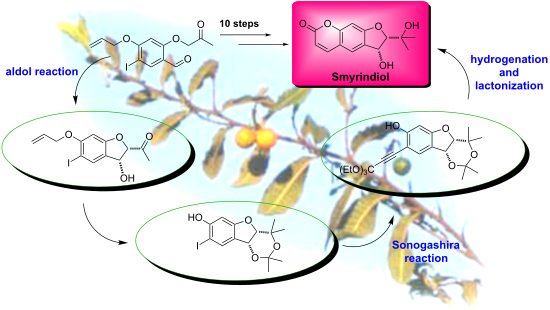
- benzofuran system; thus, for further modifications it was protected as acetonide 16 in a moderate yield (66%) using 2,2-dimethoxypropane under PPTA catalysis. As we turned towards the Sonogashira reaction of the iodide 16 with a propiolic acid derivative, we found that the allyl protecting group was cleaved
- protected ketoaldehyde 8 (PG = TBS) in the proline catalyzed aldol reaction led to complete condensation to the corresponding benzofuran. Propiolic acid esters are known to be problematic substrates for Sonogashira reactions, due to side reactions [15]. For this reason, we used an orthoester, which coupled