Search for "retro-Diels–Alder reaction" in Full Text gives 20 result(s) in Beilstein Journal of Organic Chemistry.
Beilstein J. Org. Chem. 2024, 20, 287–305, doi:10.3762/bjoc.20.30
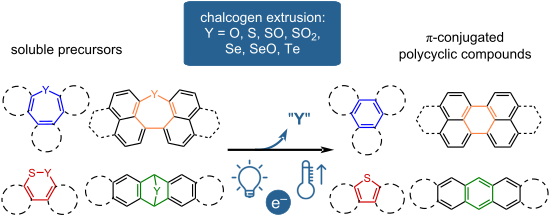
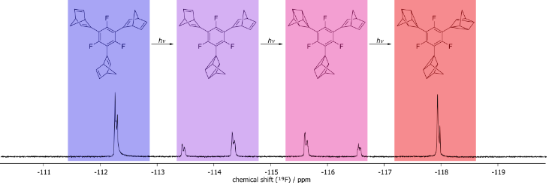
Graphical Abstract
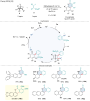
Scheme 1: “Precursor approach” for the synthesis of π-conjugated polycyclic compounds, with the thermally- or...
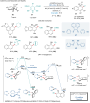
Scheme 2: Valence isomerization of chalcogen heteropines and subsequent cheletropic extrusion in the case of ...
Scheme 3: Early example of phenanthrene synthesis via a chemically-induced S-extrusion (and concomitant decar...
Scheme 4: Top: Conversion of dinaphthothiepine bisimides 3a,b and their sulfoxide analogues 4a,b into PBIs 6a,...
Figure 1: Top view (a) and side view (b) of the X-ray crystal structure of thiepine 3b showing its bent confo...
Scheme 5: Modular synthetic route towards dinaphthothiepines 3a–f and the corresponding S-oxides 4a–d, incorp...
Scheme 6: Top: Conversion of dithienobenzothiepine monomeric units into dithienonaphthalenes, upon S-extrusio...
Scheme 7: Synthesis of S-doped extended triphenylene derivative 22 from 3-bromothiophene (17) with the therma...
Scheme 8: Top: Synthesis of thermally-stable O-doped HBC 26a. Bottom: Synthesis of S- and Se-based soluble pr...
Scheme 9: Synthesis of dinaphthooxepine bisimide 33 and conversion into PBI 6f by O-extrusion triggered by el...
Figure 2: Cyclic voltammogram of dinaphthooxepine 33, evidencing the irreversibility of the reduction process...
Scheme 10: Top: Early example of 6-membered ring contraction with concomitant S-extrusion leading to dinaphtho...
Scheme 11: Examples of S-extrusion from annelated 1,2-dithiins under photoactivation (top) or thermal activati...
Scheme 12: Synthesis of dibenzo[1,4]dithiapentalene upon photoextrusion of SO2 [78].
Scheme 13: Extrusion of SO in naphthotrithiin-2-oxides for the synthesis of 2,5-dihydrothiophene 1-oxides [79].
Scheme 14: SO-extrusion as a key step in the synthesis of fullerenes (C60 and C70) encapsulating H2 molecules [80,82]....
Scheme 15: Synthesis of diepoxytetracene precursor 56 and its on-surface conversion into tetracene upon O-extr...
Scheme 16: Soluble precursors of hexacene, decacene and dodecacene incorporating 1,4-epoxides in their hydroca...
Scheme 17: Synthesis of tetraepoxide 59 as soluble precursor of decacene [85].
Figure 3: Constant-height STM measurement of decacene on Au(111) using a CO-functionalized tip (sample voltag...
Beilstein J. Org. Chem. 2023, 19, 700–718, doi:10.3762/bjoc.19.51
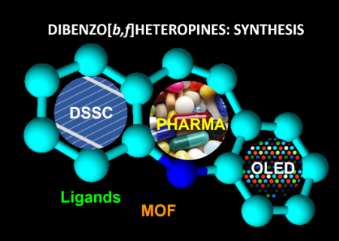
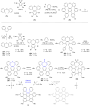
Graphical Abstract
Figure 1: Dibenzo[b,f]azepine (1a), -oxepine (1b) and -thiepine (1c) as examples of dibenzo[b,f]heteropines (1...
Figure 2: Selected pharmaceuticals with the dibenzo[b,f]azepine skeleton.
Figure 3: Examples of 10,11-dihydrodibenzo[b,f]azepine-based ligands.
Figure 4: The dibenzo[b,f]azepine moiety in dyes with properties suitable for the use in organic light emitti...
Figure 5: Selective bioactive natural products (13–18) containing the dibenzo[b,f]oxepine scaffold and Novart...
Scheme 1: Retrosynthetic approach to 5H-dibenzo[b,f]azepine (1a) from nitrotoluene (22).
Scheme 2: Oxidative coupling of o-nitrotoluene (22) and reduction of 2,2'-dinitrobibenzyl (21) to form 2,2'-d...
Scheme 3: Synthesis of 10,11-dihydro-5H-dibenzo[b,f]azepine (2a) via amine condensation.
Scheme 4: Catalytic reduction of 10,11-dihydro-5H-dibenzo[b,f]azepine (2a).
Scheme 5: The Wagner–Meerwein rearrangement of acridin-9-ylmethanol (23) into 5H-dibenzo[b,f]azepine (1a).
Scheme 6: Oxidative ring expansion of 2-(9-xanthenyl)malonates 24.
Scheme 7: Ring expansion via C–H functionalisation.
Scheme 8: The synthesis of fluorinated 5H-dibenzo[b,f]azepine 38 from isatin (32).
Scheme 9: The synthesis of substituted dibenzo[b,f]azepines 43 from indoles 39.
Scheme 10: Retrosynthetic pathways to dibenzo[b,f]azepines via Buchwald–Hartwig amination.
Scheme 11: Synthesis of dibenzo[b,f]oxepine 54 and -azepine 55 derivatives via (i) Heck reaction and (ii) Buch...
Scheme 12: Double Buchwald–Hartwig amination and thioetherification in the synthesis of tricyclic azepines 60 ...
Scheme 13: Double Buchwald–Hartwig amination towards substituted dibenzoazepines 62.
Scheme 14: Double Buchwald–Hartwig amination towards 10,11-dihydro-5H-dibenzo[b,f]azepine derivatives 71.
Scheme 15: One-pot Suzuki coupling–Buchwald–Hartwig amination.
Scheme 16: One-pot Rh/Pd-catalysed synthesis of dihydropyridobenzazepines.
Scheme 17: A retrosynthetic pathway to dibenzo[b,f]azepines via Mizoroki–Heck reaction.
Scheme 18: One-pot domino Pd-catalyzed Mizoroki–Heck–Buchwald–Hartwig synthesis of dibenzo[b,f]azepines.
Scheme 19: Dibenzo[b,f]thiapine and -oxepine synthesis via SNAr (thio)etherification, Wittig methylenation and...
Scheme 20: A retrosynthetic pathway to dibenzo[b,f]oxepines via Ullmann coupling.
Scheme 21: Ullmann-type coupling in dibenzo[b,f]oxepine synthesis.
Scheme 22: Wittig reaction and Ullmann coupling as key steps in dihydrobenz[b,f]oxepine synthesis.
Scheme 23: Pd-catalysed dibenzo[b,f]azepine synthesis via norbornene azepine intermediate 109.
Scheme 24: A simple representation of olefin metathesis resulting in transalkylidenation.
Scheme 25: Ring-closing metathesis as key step in the synthesis of dibenzo[b,f]heteropines.
Scheme 26: Alkyne–aldehyde metathesis in the synthesis of dibenzo[b,f]heteropines.
Scheme 27: Hydroarylation of 9-(2-alkynylphenyl)-9H-carbazole derivatives.
Scheme 28: Oxidative coupling of bisphonium ylide intermediate to give pacharin (13).
Scheme 29: Preparation of 10,11-dihydrodibenzo[b,f]heteropines via intramolecular Wurtz reaction.
Scheme 30: Phenol deprotonation and intramolecular etherification in the synthesis of bauhinoxepine J.
Figure 6: Functionalisation of dibenzo[b,f]azepine.
Scheme 31: Palladium-catalysed N-arylation of dibenzo[b,f]azepine.
Scheme 32: Cu- and Ni-catalysed N-arylation.
Scheme 33: N-Alkylation of dibenzo[b,f]azepine (1a) and dihydrodibenzo[b,f]azepine (2a).
Scheme 34: Preparation of methoxyiminosilbene.
Scheme 35: Synthesis of oxcarbazepine (153) from methoxy iminostilbene 151.
Scheme 36: Ring functionalisation of dihydrodibenzo[b,f]azepine.
Beilstein J. Org. Chem. 2023, 19, 487–540, doi:10.3762/bjoc.19.38
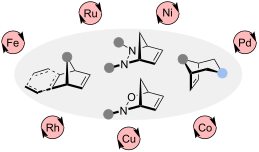
Graphical Abstract
Figure 1: Ring-strain energies of homobicyclic and heterobicyclic alkenes in kcal mol−1. a) [2.2.1]-Bicyclic ...
Figure 2: a) Exo and endo face descriptions of bicyclic alkenes. b) Reactivity comparisons for different β-at...
Scheme 1: Ni-catalyzed ring-opening/cyclization cascade of heterobicyclic alkenes 1 with alkyl propiolates 2 ...
Scheme 2: Ni-catalyzed ring-opening/cyclization cascade of heterobicyclic alkenes 8 with β-iodo-(Z)-propenoat...
Scheme 3: Ni-catalyzed two- and three-component difunctionalizations of norbornene derivatives 15 with alkyne...
Scheme 4: Ni-catalyzed intermolecular three-component difunctionalization of oxabicyclic alkenes 1 with alkyn...
Scheme 5: Ni-catalyzed intermolecular three-component carboacylation of norbornene derivatives 15.
Scheme 6: Photoredox/Ni dual-catalyzed coupling of 4-alkyl-1,4-dihydropyridines 31 with heterobicyclic alkene...
Scheme 7: Photoredox/Ni dual-catalyzed coupling of α-amino radicals with heterobicyclic alkenes 30.
Scheme 8: Cu-catalyzed rearrangement/allylic alkylation of 2,3-diazabicyclo[2.2.1]heptenes 47 with Grignard r...
Scheme 9: Cu-catalyzed aminoboration of bicyclic alkenes 1 with bis(pinacolato)diboron (B2pin2) (53) and O-be...
Scheme 10: Cu-catalyzed borylalkynylation of oxabenzonorbornadiene (30b) with B2pin2 (53) and bromoalkynes 62.
Scheme 11: Cu-catalyzed borylacylation of bicyclic alkenes 1.
Scheme 12: Cu-catalyzed diastereoselective 1,2-difunctionalization of oxabenzonorbornadienes 30 for the synthe...
Scheme 13: Fe-catalyzed carbozincation of heterobicyclic alkenes 1 with arylzinc reagents 74.
Scheme 14: Co-catalyzed addition of arylzinc reagents of norbornene derivatives 15.
Scheme 15: Co-catalyzed ring-opening/dehydration of oxabicyclic alkenes 30 via C–H activation of arenes.
Scheme 16: Co-catalyzed [3 + 2] annulation/ring-opening/dehydration domino reaction of oxabicyclic alkenes 1 w...
Scheme 17: Co-catalyzed enantioselective carboamination of bicyclic alkenes 1 via C–H functionalization.
Scheme 18: Ru-catalyzed cyclization of oxabenzonorbornene derivatives with propargylic alcohols for the synthe...
Scheme 19: Ru-catalyzed coupling of oxabenzonorbornene derivatives 30 with propargylic alcohols and ethers 106...
Scheme 20: Ru-catalyzed ring-opening/dehydration of oxabicyclic alkenes via the C–H activation of anilides.
Scheme 21: Ru-catalyzed of azabenzonorbornadiene derivatives with arylamides.
Scheme 22: Rh-catalyzed cyclization of bicyclic alkenes with arylboronate esters 118.
Scheme 23: Rh-catalyzed cyclization of bicyclic alkenes with dienyl- and heteroaromatic boronate esters.
Scheme 24: Rh-catalyzed domino lactonization of doubly bridgehead-substituted oxabicyclic alkenes with seconda...
Scheme 25: Rh-catalyzed domino carboannulation of diazabicyclic alkenes with 2-cyanophenylboronic acid and 2-f...
Scheme 26: Rh-catalyzed synthesis of oxazolidinone scaffolds 147 through a domino ARO/cyclization of oxabicycl...
Scheme 27: Rh-catalyzed oxidative coupling of salicylaldehyde derivatives 151 with diazabicyclic alkenes 130a.
Scheme 28: Rh-catalyzed reaction of O-acetyl ketoximes with bicyclic alkenes for the synthesis of isoquinoline...
Scheme 29: Rh-catalyzed domino coupling reaction of 2-phenylpyridines 165 with oxa- and azabicyclic alkenes 30....
Scheme 30: Rh-catalyzed domino dehydrative naphthylation of oxabenzonorbornadienes 30 with N-sulfonyl 2-aminob...
Scheme 31: Rh-catalyzed domino dehydrative naphthylation of oxabenzonorbornadienes 30 with arylphosphine deriv...
Scheme 32: Rh-catalyzed domino ring-opening coupling reaction of azaspirotricyclic alkenes using arylboronic a...
Scheme 33: Tandem Rh(III)/Sc(III)-catalyzed domino reaction of oxabenzonorbornadienes 30 with alkynols 184 dir...
Scheme 34: Rh-catalyzed asymmetric domino cyclization and addition reaction of 1,6-enynes 194 and oxa/azabenzo...
Scheme 35: Rh/Zn-catalyzed domino ARO/cyclization of oxabenzonorbornadienes 30 with phosphorus ylides 201.
Scheme 36: Rh-catalyzed domino ring opening/lactonization of oxabenzonorbornadienes 30 with 2-nitrobenzenesulf...
Scheme 37: Rh-catalyzed domino C–C/C–N bond formation of azabenzonorbornadienes 30 with aryl-2H-indazoles 210.
Scheme 38: Rh/Pd-catalyzed domino synthesis of indole derivatives with 2-(phenylethynyl)anilines 212 and oxabe...
Scheme 39: Rh-catalyzed domino carborhodation of heterobicyclic alkenes 30 with B2pin2 (53).
Scheme 40: Rh-catalyzed three-component 1,2-carboamidation reaction of bicyclic alkenes 30 with aromatic and h...
Scheme 41: Pd-catalyzed diarylation and dialkenylation reactions of norbornene derivatives.
Scheme 42: Three-component Pd-catalyzed arylalkynylation reactions of bicyclic alkenes.
Scheme 43: Three-component Pd-catalyzed arylalkynylation reactions of norbornene and DFT mechanistic study.
Scheme 44: Pd-catalyzed three-component coupling N-tosylhydrazones 236, aryl halides 66, and norbornene (15a).
Scheme 45: Pd-catalyzed arylboration and allylboration of bicyclic alkenes.
Scheme 46: Pd-catalyzed, three-component annulation of aryl iodides 66, alkenyl bromides 241, and bicyclic alk...
Scheme 47: Pd-catalyzed double insertion/annulation reaction for synthesizing tetrasubstituted olefins.
Scheme 48: Pd-catalyzed aminocyclopropanation of bicyclic alkenes 1 with 5-iodopent-4-enylamine derivatives 249...
Scheme 49: Pd-catalyzed, three-component coupling of alkynyl bromides 62 and norbornene derivatives 15 with el...
Scheme 50: Pd-catalyzed intramolecular cyclization/ring-opening reaction of heterobicyclic alkenes 30 with 2-i...
Scheme 51: Pd-catalyzed dimer- and trimerization of oxabenzonorbornadiene derivatives 30 with anhydrides 268.
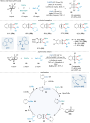
Scheme 52: Pd-catalyzed Catellani-type annulation and retro-Diels–Alder of norbornadiene 15b yielding fused xa...
Scheme 53: Pd-catalyzed hydroarylation and heteroannulation of urea-derived bicyclic alkenes 158 and aryl iodi...
Scheme 54: Access to fused 8-membered sulfoximine heterocycles 284/285 via Pd-catalyzed Catellani annulation c...
Scheme 55: Pd-catalyzed 2,2-bifunctionalization of bicyclic alkenes 1 generating spirobicyclic xanthone deriva...
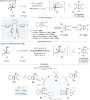
Scheme 56: Pd-catalyzed Catellani-type annulation and retro-Diels–Alder of norbornadiene (15b) producing subst...
Scheme 57: Pd-catalyzed [2 + 2 + 1] annulation furnishing bicyclic-fused indanes 281 and 283.
Scheme 58: Pd-catalyzed ring-opening/ring-closing cascade of diazabicyclic alkenes 130a.
Scheme 59: Pd-NHC-catalyzed cyclopentannulation of diazabicyclic alkenes 130a.
Scheme 60: Pd-catalyzed annulation cascade generating diazabicyclic-fused indanones 292 and indanols 294.
Scheme 61: Pd-catalyzed skeletal rearrangement of spirotricyclic alkenes 176 towards large polycyclic benzofur...
Scheme 62: Pd-catalyzed oxidative annulation of aromatic enamides 298 and diazabicyclic alkenes 130a.
Scheme 63: Accessing 3,4,5-trisubstituted cyclopentenes 300, 301, 302 via the Pd-catalyzed domino reaction of ...
Scheme 64: Palladacycle-catalyzed ring-expansion/cyclization domino reactions of terminal alkynes and bicyclic...
Scheme 65: Pd-catalyzed carboesterification of norbornene (15a) with alkynes, furnishing α-methylene γ-lactone...
Beilstein J. Org. Chem. 2022, 18, 746–753, doi:10.3762/bjoc.18.75
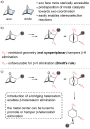
Graphical Abstract
Figure 1: Highly reactive dienophiles.
Figure 2: Dibromide substrates and product 12.
Scheme 1: Mechanochemical reaction of 10 with anthracene.
Figure 3: Scope of the Zn/Cu reaction with dibromide 10 (dienes are colored in red).
Scheme 2: Mechanochemical reaction of 11 with furan.
Scheme 3: Reactivity of bicyclo[2.2.2] dibromide 42 with dienes.
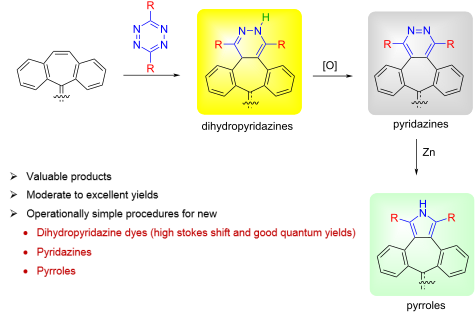
Beilstein J. Org. Chem. 2021, 17, 719–729, doi:10.3762/bjoc.17.61
Graphical Abstract
Figure 1: Structures of dibenzosuberenone 1 and pyridazine and pyrrole derivatives.
Figure 2: Structures of s-tetrazines 2a–l.
Scheme 1: Inverse electron-demand Diels–Alder reactions of dibenzosuberenone (1) with tetrazines 2a–l.
Scheme 2: Inverse electron-demand Diels–Alder reactions between dibenzosuberenone 1 and tetrazines 2ka and 2lb...
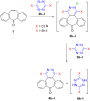
Scheme 3: Proposed reaction mechanism for the formation of dibenzosuberenone derivatives 3 and 4.
Scheme 4: Proposed mechanism for the formation of 5l.
Scheme 5: Oxidation of dihydropyridazines 3a–f. All reactions were carried in CH2Cl2 at room temperature (4e:...
Scheme 6: Synthesis of pyrrole 10a. a1.34 mmol 4a, Zinc (for 10aa: 6.68 mmol, for 10ab: 13.36 mmol), 10 mL gl...
Scheme 7: Synthesis of pyrrole 10b. a1.21 mmol 4b, 12.10 mmol Zinc, 118 °C, 2 h. b1.13 mmol 10ba, 1.69 mmol K...
Scheme 8: Synthesis of p-quinone methides 13–16. a1.77 mmol 11, 1.77 mmol 2, 5 mL toluene, 80 °C (13a: overni...
Scheme 9: Proposed mechanism for the formation of 13.
Figure 3: UV–vis spectra of 3c–f and 3k in CH3CN at rt (c = 5 μM).
Figure 4: Fluorescence spectra of 3c–f and 3k in CH3CN at rt (c = 5 μM).
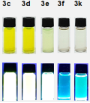
Figure 5: Ambient (top) and fluorescence (bottom, under 365 nm UV light) images of 3c–f and 3k in CH3CN.
Beilstein J. Org. Chem. 2020, 16, 1662–1682, doi:10.3762/bjoc.16.138
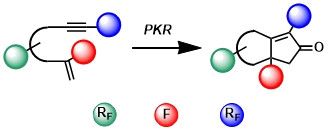
Graphical Abstract
Scheme 1: Schematic representation of the Pauson–Khand reaction.
Scheme 2: Substrates included in this review.
Scheme 3: Commonly accepted mechanism for the Pauson–Khand reaction.
Scheme 4: Regioselectivity of the PKR.
Scheme 5: Variability at the acetylenic and olefinic counterpart.
Scheme 6: Pauson–Khand reaction of fluoroolefinic enynes reported by the group of Ishizaki [46].
Scheme 7: PKR of enynes bearing fluorinated groups on the alkynyl moiety, reported by the group of Ishizaki [46]....
Scheme 8: Intramolecular PKR of 1,7-enynes reported by the group of Billard [47].
Scheme 9: Intramolecular PKR of 1,7-enynes reported by the group of Billard [48].
Scheme 10: Intramolecular PKR of 1,7-enynes by the group of Bonnet-Delpon [49]. Reaction conditions: i) Co(CO)8 (1...
Scheme 11: Intramolecular PKR of 1,6-enynes reported by the group of Ichikawa [50].
Scheme 12: Intramolecular Rh(I)-catalyzed PKR reported by the group of Hammond [52].
Scheme 13: Intramolecular PKR of allenynes reported by the group of Osipov [53].
Scheme 14: Intramolecular PKR of 1,7-enynes reported by the group of Osipov [53].
Scheme 15: Intramolecular PKR of fluorine-containing 1,6-enynes reported by the Konno group [54].
Scheme 16: Diastereoselective PKR with enantioenriched fluorinated enynes 34 [55].
Scheme 17: Intramolecular PKR reported by the group of Martinez-Solorio [56].
Scheme 18: Fluorine substitution at the olefinic counterpart.
Scheme 19: Synthesis of fluorinated enynes 37 [59].
Scheme 20: Fluorine-containing substrates in PKR [59].
Scheme 21: Pauson Khand reaction for fluorinated enynes by the Fustero group: scope and limitations [59].
Scheme 22: Synthesis of chloro and bromo analogues [59].
Scheme 23: Dimerization pathway [59].
Scheme 24: Synthesis of fluorine-containing N-tethered 1,7-enynes [61].
Scheme 25: Intramolecular PKR of chiral N-tethered fluorinated 1,7-enynes [61].
Scheme 26: Examples of further modifications to the Pauson−Khand adducts [61].
Scheme 27: Asymmetric synthesis the fluorinated enynes 53.
Scheme 28: Intramolecular PKR of chiral N-tethered 1,7-enynes 53 [64].
Scheme 29: Intramolecular PKR of chiral N-tethered 1,7-enyne bearing a vinyl fluoride [64].
Scheme 30: Catalytic intramolecular PKR of chiral N-tethered 1,7-enynes [64].
Scheme 31: Model fluorinated alkynes used by Riera and Fustero [70].
Scheme 32: PKR with norbornadiene and fluorinated alkynes 58 [71].
Scheme 33: Nucleophilic addition/detrifluoromethylation and retro Diels-Alder reactions [70].
Scheme 34: Tentative mechanism for the nucleophilic addition/retro-aldol reaction sequence.
Scheme 35: Catalytic PKR with norbornadiene [70].
Scheme 36: Scope of the PKR of trifluoromethylalkynes with norbornadiene [72].
Scheme 37: DBU-mediated detrifluoromethylation [72].
Scheme 38: A simple route to enone 67, a common intermediate in the total synthesis of α-cuparenone.
Scheme 39: Effect of the olefin partner in the regioselectivity of the PKR with trifluoromethyl alkynes [79].
Scheme 40: Intermolecular PKR of trifluoromethylalkynes with 2-norbornene reported by the group of Konno [54].
Scheme 41: Intermolecular PKR of diarylalkynes with 2-norbornene reported by the group of Helaja [80].
Scheme 42: Intermolecular PKR reported by León and Fernández [81].
Scheme 43: PKR reported with cyclopropene 73 [82].
Beilstein J. Org. Chem. 2019, 15, 291–298, doi:10.3762/bjoc.15.26
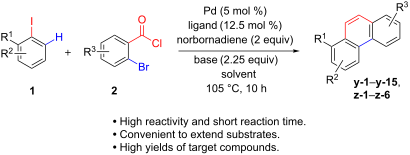
Graphical Abstract
Figure 1: Representative natural products containing a phenanthrene moiety.
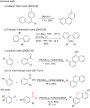
Scheme 1: Different methods for the synthesis of phenanthrene derivatives.
Scheme 2: Substrate scope with various aryl iodides. Reaction conditions: 1 (0.3 mmol, 1.0 equiv), 2a (0.36 m...
Scheme 3: Scope of the reaction in terms of ortho-bromobenzoyl chlorides. Reaction conditions: 1a (0.3 mmol, ...
Scheme 4: Gram scale synthesis of z-6.
Scheme 5: Proposed mechanism for the formation of phenanthrene derivatives.
Beilstein J. Org. Chem. 2019, 15, 30–43, doi:10.3762/bjoc.15.3
Graphical Abstract
Figure 1: Charge-tagged L-proline-derived catalyst 1∙Cl [18].
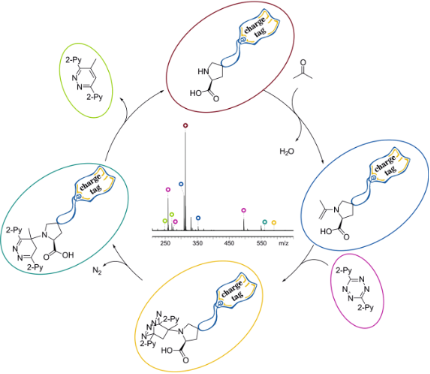
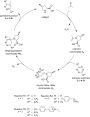
Scheme 1: Putative catalytic cycle [51] for the L-proline-catalyzed Diels–Alder reaction with inverse electron de...
Scheme 2: Synthesis of the charge-tagged tetrazine 4∙Br as a reactant for the proline-catalyzed Diels–Alder r...
Scheme 3: Reaction R1: L-proline-catalyzed reaction between 2 and acetone.
Figure 2: NMR monitoring of reaction R1 in deuterated DMSO (concentration of tetrazine 0.005 mmol/mL).
Scheme 4: Equilibrium of oxazolidinone and enamine formation.
Figure 3: a) ESI mass spectrum of reaction R1 after 26 min. b) ESIMS monitoring of reaction R1. To better vis...
Figure 4: ESI mass spectrum of reaction R1 with preformed I1 8 minutes after adding substrate 2.
Scheme 5: Reaction R2: L-proline-catalyzed reaction between charge-tagged substrate 4∙Br and acetone. The reg...
Figure 5: ESI mass spectrum of reaction R2 using a continuous-flow setup with a calculated reaction time of 8...
Figure 6: a) Reaction R2 after two hours (syringe setup). b) ESIMS monitoring of reaction R2. Signal intensit...
Scheme 6: Reaction R3: substrate 2, acetone and charge-tagged catalyst 1∙Cl.
Figure 7: ESI mass spectrum of reaction R3 at 60 °C after 1.5 h.
Scheme 7: General catalytic cycle for reactions R1–R3.
Figure 8: ESIMS monitoring of reaction R3. The plotted intensity values for each molecule are a sum of all co...
Figure 9: Isomeric forms in equilibrium: enamine [I3a]+, oxazolidinone [I3b]+ and iminium [I3c]+.
Figure 10: ESI(+) CID spectrum of mass-selected [I3]+ (m/z 353); collision energy voltage 1 V.
Figure 11: ESI(+) CID spectrum of mass selected [II3]+ (m/z 589); collision energy voltage 5 V.
Figure 12: ESI(+) CID spectrum of mass selected [III3]+ (m/z 561); collision energy voltage 10 V.
Beilstein J. Org. Chem. 2018, 14, 318–324, doi:10.3762/bjoc.14.20
Graphical Abstract
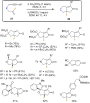
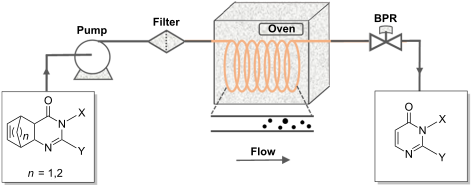
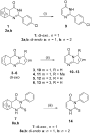
Scheme 1: Flow synthesis for the preparation of fused pyrimidinones 9–14 by rDA reaction. Solvent and conditi...
Figure 1: Schematic outline of the continuous-flow reactor.
Scheme 2: Synthesis of tricyclic ethanoquinazolin-4(3H)-one 15b; (i) MeCN, FR = 0.5 mL min−1, 220–250 °C; (ii...
Beilstein J. Org. Chem. 2017, 13, 2659–2662, doi:10.3762/bjoc.13.263
Graphical Abstract
Scheme 1: Diels–Alder reaction of isobenzofuran and formation of a benzene ring in the cycloadduct.
Scheme 2: Different approaches for the synthesis of IBF (1).
Scheme 3: Reaction of in situ prepared IBF (1) with DMAD (9).
Beilstein J. Org. Chem. 2016, 12, 2181–2188, doi:10.3762/bjoc.12.208
Graphical Abstract
Scheme 1: Distribution of products in the Diels–Alder reaction between cyclopentadiene and p-benzoquinone.
Figure 1: Conversion in the DAR catalysed by silica Beta zeolites and Aerosil.
Figure 2: Effect of Lewis and Brønsted acid sites in the conversion (a) and selectivity (b) of the DAR.
Figure 3: Effect of pore size in the conversion (a) and selectivity (b) of the DAR.
Figure 4: Comparison of conversion (a) and selectivity (b) of the DAR catalysed by Al-Beta zeolite and MCM-41....
Figure 5: Comparison of conversion (a) and selectivity (b) of the DAR catalysed extra-large pore 3D zeolites.
Figure 6: Effect of the Si/Al ratio in the conversion (a) and selectivity (b) of the DAR.
Figure 7: Effect of the reutilization of the catalysts in the conversion (a) and selectivity (b) of the DAR.
Beilstein J. Org. Chem. 2016, 12, 1380–1394, doi:10.3762/bjoc.12.132
Graphical Abstract
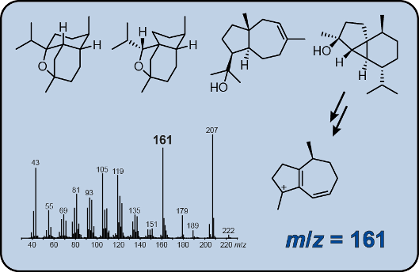
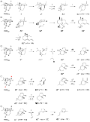
Scheme 1: Structures of corvol ethers A (1) and B (2), epi-cubebol (3), and isodauc-8-en-11-ol (4). Carbon nu...
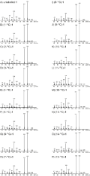
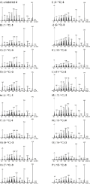
Figure 1: Mass spectra of unlabelled 1 and all fifteen positional isomers of (13C1)-1.
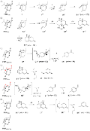
Scheme 2: PMAs and EIMS fragmentation mechanisms for the fragment ions A) m/z = 179, B) m/z = 161, C) m/z = 1...
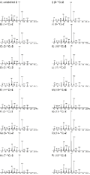
Figure 2: Mass spectra of unlabelled 2 and all fifteen positional isomers of (13C1)-2.
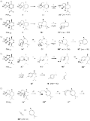
Scheme 3: PMAs and EIMS fragmentation mechanisms for the fragment ions A) m/z = 179, B) m/z = 161, C) m/z = 1...
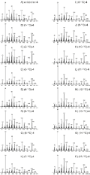
Figure 3: Mass spectra of unlabelled 3 and all fifteen positional isomers of (13C1)-3.
Scheme 4: PMAs and EIMS fragmentation mechanisms for the fragment ions A) m/z = 207, B) m/z = 179, C) m/z = 1...
Figure 4: Mass spectra of unlabelled 4 and all fifteen positional isomers of (13C1)-4.
Scheme 5: PMAs and EIMS fragmentation mechanisms for the fragment ions A) m/z = 207, B) m/z = 189, C) m/z = 1...
Beilstein J. Org. Chem. 2016, 12, 154–165, doi:10.3762/bjoc.12.17
Graphical Abstract
Scheme 1: Synthesis of 1-4; only the isolated and characterized complexes are shown.
Figure 1: Solid state structure of complexes 2a and 2b as retrieved from single crystal X-ray diffraction.
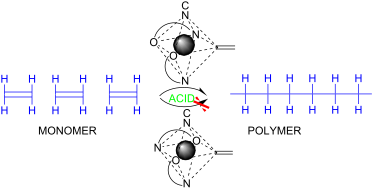
Figure 2: Time/conversion plot for the polymerization of 5 by preinitiators 1–4 in the presence of HCl ([5]:[...
Figure 3: 1H NMR spectrum in the low-field region of the active species for complexes 4 and M32.
Scheme 2: Energetics of 2a and 2b protonation in kcal/mol.
Figure 4: Reaction pathway of the transformation of 2b to HovII (energies in kcal/mol; main distances in Å).
Figure 5: DTA-TGA measurements for polymerizations of DCPD with catalysts 1b and 2b; Reaction conditions: [ca...
Beilstein J. Org. Chem. 2015, 11, 1469–1474, doi:10.3762/bjoc.11.159
Graphical Abstract
Figure 1: DCPD (1) and ruthenium benzylidene catalyst 2.
Scheme 1: ROMP of dicyclopentadiene by a ruthenium alkylidene initiator.
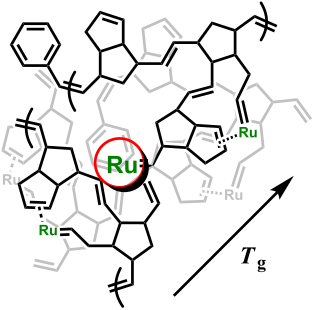
Figure 2: Top: DSC plot of PDCPD 24 hours after polymerization. Blue line: 1st heating–cooling cycle. Black l...
Figure 3: Change in Tg for a representative PDCPD sample as a function of time.
Figure 4: Intensity of exothermic peak as a function of rest time at room temperature for different samples.
Figure 5: Peak intensity as function of age. Samples were analyzed every two weeks. The abnormal low intensit...
Figure 6: Resting temperature effect. Blue columns: resting at room temperature. Orange columns: resting at −...
Figure 7: Top: Sample after 1 week with ethyl vinyl ether. Bottom: Sample after 1 week with diethyl ether.
Beilstein J. Org. Chem. 2015, 11, 1458–1468, doi:10.3762/bjoc.11.158
Graphical Abstract
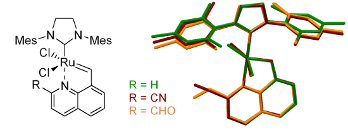
Figure 1: Selected ruthenium-based complexes.
Scheme 1: trans–cis Isomerization.
Scheme 2: Synthesis of the ligand precursors.
Scheme 3: Synthesis of the ruthenium complexes.
Figure 2: ADPs (atomic displacement parameters) and atoms labeling of the first molecule in the asymmetric pa...
Figure 3: Superposition of the asymmetric parts of units’ cells in both investigated structures: an example o...
Figure 4: Energy profile of trans–cis isomerization, modelled in CH2Cl2, (ΔE in kcal/mol). Geometry optimizat...
Scheme 4: Possible reaction pathways of 16.
Figure 5: Time/conversion plots for the transformation of 16 catalyzed by 5 mol % of the trans isomers of tra...
Figure 6: Composition of a reaction mixture after subjecting 16 to 5 mol % cis-5a in xylene, 140 °C. Lines ar...
Figure 7: Monomers utilized in model ROMP reactions.
Figure 8: Number-average molecular weight (Mn) of poly-21 prepared with initiators 5a, 14 and 15 plotted agai...
Figure 9: STA analysis of polymerization of 22 (left) and 23 (right), initiated by 5a, 14 and 15. Reaction co...
Beilstein J. Org. Chem. 2015, 11, 169–173, doi:10.3762/bjoc.11.17
Graphical Abstract
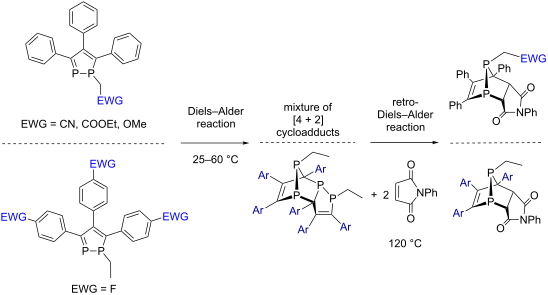
Scheme 1: Synthesis of 1-alkyl-1,2-diphospholes 1a–e.
Scheme 2: The cycloaddition reactions of 1-alkyl-1,2-diphospholes 1a–e.
Figure 1: ORTEP view of 2,3,4,4a,5,6-hexa(p-fluorophenyl)-1-ethyl-1,7,7a-triphospha-4,7-(ethylphosphinidene)i...
Scheme 3: The retro-Diels–Alder reactions of the cycloadducts 2a–с, and 2e.
Beilstein J. Org. Chem. 2012, 8, 1936–1998, doi:10.3762/bjoc.8.225
Graphical Abstract
Figure 1: Loschmidt’s structure proposal for benzene (1) (Scheme 181 from [3]) and the corresponding modern stru...
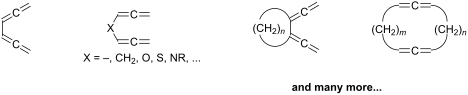
Figure 2: The first isolated bisallenes.
Figure 3: Carbon skeletons of selected bisallenes discussed in this review.
Scheme 1: The preparation of 1,2,4,5-hexatetraene (2).
Scheme 2: The preparation of a conjugated bisallene by the DMS-protocol.
Scheme 3: Preparation of the 3-deuterio- and 3,4-dideuterio derivatives of 24.
Scheme 4: A versatile method to prepare alkylated conjugated bisallenes and other allenes.
Scheme 5: A preparation of 3,4-dimethyl-1,2,4,5-hexatetraene (38).
Scheme 6: A (C6 + 0)-approach to 1,2,4,5-hexatetraene (2).
Scheme 7: The preparation of a fully alkylated bisallenes from a 2,4-hexadiyne-1,6-diol diacetate.
Scheme 8: The preparation of the first phenyl-substituted conjugated bisallenes 3 and 4.
Scheme 9: Selective hydrogenation of [5]cumulenes to conjugated bisallenes: another (C6 + 0)-route.
Scheme 10: Aryl-substituted conjugated bisallenes by a (C3 + C3)-approach.
Scheme 11: Hexaphenyl-1,2,4,5-hexatetraene (59) by a (C3 + C3)-approach.
Scheme 12: An allenation route to conjugated bisallenes.
Scheme 13: The preparation of 3,4-difunctionalized conjugated bisallenes.
Scheme 14: Problems during the preparation of sulfur-substituted conjugated bisallenes.
Scheme 15: The preparation of 3,4-dibromo bisallenes.
Scheme 16: Generation of allenolates by an oxy-Cope rearrangement.
Scheme 17: A linear trimerization of alkynes to conjugated bisallenes: a (C2 + C2 + C2)-protocol.
Scheme 18: Preparation of a TMS-substituted conjugated bisallene by a C3-dimerization route.
Scheme 19: A bis(trimethylsilyl)bisallene by a C3-coupling protocol.
Scheme 20: The rearrangement of highly substituted benzene derivatives into their conjugated bisallenic isomer...
Scheme 21: From fully substituted benzene derivatives to fully substituted bisallenes.
Scheme 22: From a bicyclopropenyl to a conjugated bisallene derivative.
Scheme 23: The conversion of a bismethylenecyclobutene into a conjugated bisallene.
Scheme 24: The preparation of monofunctionalized bisallenes.
Scheme 25: Preparation of bisallene diols and their cyclization to dihydrofurans.
Scheme 26: A 3,4-difunctionalized conjugated bisallene by a C3-coupling process.
Scheme 27: Preparation of a bisallenic diketone by a coupling reaction.
Scheme 28: Sulfur and selenium-substituted bisallenes by a [2.3]sigmatropic rearrangement.
Scheme 29: The biallenylation of azetidinones.
Scheme 30: The preparation of a fully ferrocenylated conjugated bisallene.
Scheme 31: The first isomerization of a 1,5-hexadiyne to a 1,2,4,5-hexatetraene.
Scheme 32: The preparation of alkynyl-substituted bisallenes by a C3-dimerization protocol.
Scheme 33: Preparation of another completely ferrocenylated bisallene.
Scheme 34: The cyclization of 1,5-hexadiyne (129) to 3,4-bismethylenecyclobutene (130) via 1,2,4,5-hexatetraen...
Scheme 35: Stereochemistry of the thermal cyclization of bisallenes to bismethylenecyclobutenes.
Scheme 36: Bisallene→bismethylenecyclobutene ring closures in the solid state.
Scheme 37: A bisallene cyclization/dimerization reaction.
Scheme 38: A selection of Diels–Alder additions of 1,2,4,5-hexatetraene with various double-bond dienophiles.
Scheme 39: The stereochemistry of the [2 + 4] cycloaddition to conjugated bisallenes.
Scheme 40: Preparation of azetidinone derivatives from conjugated bisallenes.
Scheme 41: Cycloaddition of heterodienophiles to a conjugated bisallene.
Scheme 42: Addition of triple-bond dienophiles to conjugated bisallenes.
Scheme 43: Sulfur dioxide addition to conjugated bisallenes.
Scheme 44: The addition of a germylene to a conjugated bisallene.
Scheme 45: Trapping of conjugated bisallenes with phosphinidenes.
Scheme 46: The cyclopropanantion of 1,2,4,5-hexatetraene (2).
Scheme 47: Photochemical reactions involving conjugated bisallenes.
Scheme 48: Base-catalyzed isomerizations of conjugated bisallenes.
Scheme 49: Ionic additions to a conjugated bisallene.
Scheme 50: Oxidation reactions of a conjugated bisallene.
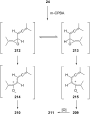
Scheme 51: The mechanism of oxidation of the bisallene 24.
Scheme 52: CuCl-catalyzed cyclization of 1,2,4,5-hexatetraene (2).
Scheme 53: The conversion of conjugated bisallenes into cyclopentenones.
Scheme 54: Oligomerization of a conjugated bisallene by nickel catalysts.
Scheme 55: Generation of 1,2,5,6-heptatetraene (229) as a reaction intermediate.
Scheme 56: The preparation of a stable derivative of 1,2,5,6-heptatetraene.
Scheme 57: A bisallene with a carbonyl group as a spacer element.
Scheme 58: The first preparation of 1,2,6,7-octatetraene (242).
Scheme 59: Preparation of 1,2,6,7-octatetraenes by (C4 + C4)-coupling of enynes.
Scheme 60: Preparation of 1,2,6,7-octatetraenes by (C4 + C4)-coupling of homoallenyl bromides.
Scheme 61: Preparation of 1,2,6,7-octatetraenes by alkylation of propargylic substrates.
Scheme 62: Preparation of two highly functionalized 1,2,6,7-octatetraenes.
Scheme 63: Preparation of several higher α,ω-bisallenes.
Scheme 64: Preparation of different alkyl derivatives of α,ω-bisallenes.
Scheme 65: The preparation of functionalized 1,2,7,8-nonatetraene derivatives.
Scheme 66: Preparation of functionalized α,ω-bisallenes.
Scheme 67: The preparation of an α,ω-bisallene by direct homologation of an α,ω-bisalkyne.
Scheme 68: The gas-phase pyrolysis of 4,4-dimethyl-1,2,5,6-heptatetraene (237).
Scheme 69: Gas-phase pyrolysis of 1,2,6,7-octatetraene (242).
Scheme 70: The cyclopropanation of 1,2,6,7-octatetraene (242).
Scheme 71: Intramolecular cyclization of 1,2,6,7-octatetraene derivatives.
Scheme 72: The gas-phase pyrolysis of 1,2,7,8-nonatetraene (265) and 1,2,8,9-decatetraene (266).
Scheme 73: Rh-catalyzed cyclization of a functionalized 1,2,7,8-nonatetraene.
Scheme 74: A triple cyclization involving two different allenic substrates.
Scheme 75: Bicyclization of keto derivatives of 1,2,7,8-nonatetraene.
Scheme 76: The preparation of complex organic compounds from functionalized bisallenes.
Scheme 77: Cycloisomerization of an α,ω-bisallene containing a C9 tether.
Scheme 78: Organoborane polymers from α,ω-bisallenes.
Scheme 79: Preparation of trans- (337) and cis-1,2,4,6,7-octapentaene (341).
Scheme 80: The preparation of 4-methylene-1,2,5,6-heptatetraene (349).
Scheme 81: The preparation of acetylenic bisallenes.
Scheme 82: The preparation of derivatives of hydrocarbon 351.
Scheme 83: The construction of macrocyclic alleno-acetylenes.
Scheme 84: Preparation and reactions of 4,5-bismethylene-1,2,6,7-octatetraene (365).
Scheme 85: Preparation of 1,2-bis(propadienyl)benzene (370).
Scheme 86: The preparation of 1,4-bis(propadienyl)benzene (376).
Scheme 87: The preparation of aromatic and heteroaromatic bisallenes by metal-mediated coupling reactions.
Scheme 88: Double cyclization of an aromatic bisallene.
Scheme 89: Preparation of an allenic [15]paracyclophane by a ring-closing metathesis reaction of an aromatic α...
Scheme 90: Preparation of a macrocyclic ring system containing 1,4-bis(propadienyl)benzene units.
Scheme 91: Preparation of copolymers from 1,4-bis(propadienyl)benzene (376).
Scheme 92: A boration/copolymerization sequence of an aromatic bisallene and an aromatic bisacetylene.
Scheme 93: Formation of a layered aromatic bisallene.
Figure 4: The first members of the semicyclic bisallene series.
Scheme 94: Preparation of the first bis(vinylidene)cyclobutane derivative.
Scheme 95: Dimerization of strain-activated cumulenes to bis(vinylidene)cyclobutanes.
Scheme 96: Photodimerization of two fully substituted butatrienes in the solid state.
Scheme 97: Preparation of the two parent bis(vinylidene)cyclobutanes.
Scheme 98: The preparation of 1,3-bis(vinylidene)cyclopentane and its thermal isomerization.
Scheme 99: The preparation of the isomeric bis(vinylidene)cyclohexanes.
Scheme 100: Bi- and tricyclic conjugated bisallenes.
Scheme 101: A selection of polycyclic bisallenes.
Scheme 102: The first endocyclic bisallenes.
Figure 5: The stereochemistry of 1,2,6,7-cyclodecatetraene.
Scheme 103: The preparation of several endocyclic bisallenes.
Scheme 104: Synthesis of diastereomeric derivatives of 1,2,6,7-cyclodecatetraene.
Scheme 105: Preparation of a derivative of 1,2,8,9-cyclotetradecatetraene.
Scheme 106: The preparation of keto derivatives of cyclic bisallenes.
Scheme 107: The preparation of cyclic biscumulenic ring systems.
Scheme 108: Cyclic bisallenes in natural- and non-natural-product chemistry.
Scheme 109: The preparation of iron carbonyl complexes from cyclic bisallenes.
Figure 6: A selection of unknown exocyclic bisallenes that should have interesting chemical properties.
Scheme 110: The thermal isomerization of 1,2-diethynylcyclopropanes and -cyclobutanes.
Scheme 111: Intermediate generation of a cyclooctapentaene.
Scheme 112: Attempted preparation of a cyclodecahexaene.
Scheme 113: The thermal isomerization of 1,5,9-cyclododecatriyne (511) into [6]radialene (514).
Scheme 114: An isomerization involving a diketone derived from a conjugated bisallene.
Scheme 115: Typical reaction modes of heteroorganic bisallenes.
Scheme 116: Generation and thermal behavior of acyclic hetero-organic bisallenes.
Scheme 117: Generation of bis(propadienyl)thioether.
Scheme 118: The preparation of a bisallenic sulfone and its thermal isomerization.
Scheme 119: Bromination of the bisallenic sulfone 535.
Scheme 120: Metalation/hydrolysis of the bisallenic sulfone 535.
Scheme 121: Aromatic compounds from hetero bisallenes.
Scheme 122: Isomerization/cyclization of bispropargylic ethers.
Scheme 123: The preparation of novel aromatic systems by base-catalyzed isomerization of bispropargyl ethers.
Scheme 124: The isomerization of bisacetylenic thioethers to bicyclic thiophenes.
Scheme 125: Aromatization of macrocyclic bispropargylic sulfides.
Scheme 126: Preparation of ansa-compounds from macrocyclic bispropargyl thioethers.
Scheme 127: Alternate route for cyclization of a heterorganic bisallene.
Scheme 128: Multiple isomerization/cyclization of “double” bispropargylic thioethers.
Scheme 129: Preparation of a bisallenyl disulfide and its subsequent bicyclization.
Scheme 130: Thermal cyclization of a bisallenyl thiosulfonate.
Scheme 131: Some reactions of heteroorganic bisallenes with two sulfur atoms.
Scheme 132: Further methods for the preparation of heteroorganic bisallenes.
Scheme 133: Cyclization reactions of heteroorganic bisallenes.
Scheme 134: Thermal cycloadditions of bisallenic tertiary amines.
Scheme 135: Cyclization of a bisallenic tertiary amine in the presence of a transition-metal catalyst.
Scheme 136: A Pauson–Khand reaction of a bisallenic ether.
Scheme 137: Formation of a 2:1adduct from two allenic substrates.
Scheme 138: A ring-forming silastannylation of a bisallenic tertiary amine.
Scheme 139: A three-component cyclization involving a heterorganic bisallene.
Scheme 140: Atom-economic construction of a complex organic framework from a heterorganic α,ω-bisallene.
Beilstein J. Org. Chem. 2011, 7, 278–289, doi:10.3762/bjoc.7.37
Graphical Abstract
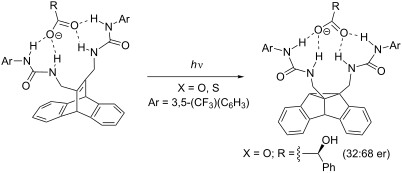
Scheme 1: Photorearrangements of dibenzobarrelenes 1a and 1b.
Scheme 2: Stereoselective DPM rearrangement of chiral salts in the solid-state.
Scheme 3: Synthesis of ureido- and thioureido-substituted dibenzobarrelene derivatives 1e–i.
Scheme 4: Di-π-methane rearrangements of ureido- and thioureido-substituted dibenzobarrelene derivatives 1h a...
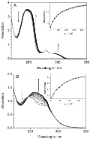
Figure 1: Photometric titration of A) tetrabutylammonium chloride (TBAC) to 1h (c1h = 50 µM) and of B) tetrab...
Figure 2: Structures of chiral additives employed in DPM rearrangements.
Figure 3: Structure of anthracene–thiourea conjugate 4.
Figure 4: Proposed structure of the complex between 1h and mandelate SMD.
Beilstein J. Org. Chem. 2009, 5, No. 20, doi:10.3762/bjoc.5.20
Graphical Abstract
Figure 1: Schematic representation of a photochromic system. The reverse reaction can be a photochemical or t...
Figure 2: Photochromic reaction of pseudo-gem disubstituted tetraene [2.2]cyclophane 1 in acetonitrile, conc....
Figure 3: Molecular structure of 4,13-bis[(1E,3E)-4-(9-anthracenyl)-buta-1,3-dienyl][2.2]paracyclophane (2).
Scheme 1: Preparation of 2 (last step), using the Wittig reaction. The preparation of 3 has been described in...
Figure 4: Molecular structure of 2 in the crystal. Radii are arbitrary; only selected H atoms are shown.
Figure 5: Projection of the molecular structure of 2 exhibiting the closest internuclear distances (distances...
Figure 6: Electronic absorption spectra of 2 (conc. ca 10−4 M) in MCH (full line) and CH3CN (dotted line) at ...
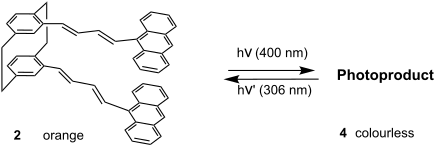
Figure 7: Irradiation of 2 (2.6 × 10⁻⁵ M) in CH3CN at 400 nm at 20 °C. The spectra were recorded at various t...
Figure 8: Irradiation at 306 nm of the photoproduct 4 obtained at 400 nm in the same setup; the spectra were ...
Figure 9: Reversibility of the formation of the photoproduct 4 at 400 nm (40 min) and photodissociation of 4 ...
Figure 10: 1H NMR spectra (400 MHz, CDCl3). A: Compound 2, B: Compound 4.
Figure 11: Proposed structure of 4 (1,4 : 2′,3′-cycloadduct).
Beilstein J. Org. Chem. 2008, 4, No. 31, doi:10.3762/bjoc.4.31
Graphical Abstract
Figure 1: Therapeutic antifungal agents.
Figure 2: Structure of sordarin (1) and sordaricin (2).
Scheme 1: Kato’s retrosynthetic plan.
Scheme 2: Synthesis of cyclopentadiene 13.
Scheme 3: Synthesis of sordaricin methyl ester.
Scheme 4: Mander’s retrosynthetic plan.
Scheme 5: Synthesis of iodo compound 27.
Scheme 6: Synthesis of sordaricin (2).
Scheme 7: Retrosynthesis of sordarin and sordaricin.
Scheme 8: Synthesis of ketone 43.
Scheme 9: Synthesis of β-keto ethyl ester 45.
Scheme 10: Synthesis of tetracyclic framework 52.
Scheme 11: Synthesis of sordaricin and sordarin.
Figure 3: Modifications of glycosyl part.
Scheme 12: Simplified model of sordarin.
Scheme 13: Synthesis of cyclopentane analog precursors.
Scheme 14: Synthesis of six cyclopentane analogs.
Scheme 15: Retrosynthetic plan of sordarin analog.
Scheme 16: Synthesis of sordarin analog 98.
Scheme 17: Synthesis of sordarin analog 103.