


Search results
Search for "room-temperature phosphorescence" in Full Text gives 8 result(s) in Beilstein Journal of Organic Chemistry.
Configuration–packing synergy enabling integrated crystalline-state RTP and amorphous-state TADF
Beilstein J. Org. Chem. 2026, 22, 224–236, doi:10.3762/bjoc.22.16
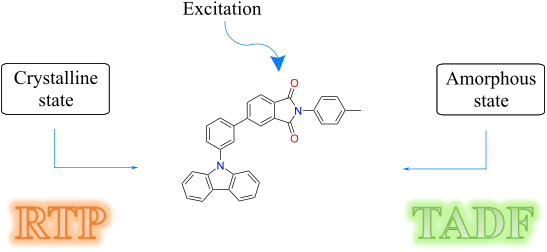
- at 550/600 nm and a lifetime of ≈0.39 s that undergoes strong thermal quenching, diagnostic of room-temperature phosphorescence. In contrast, amorphous films show no RTP; their delayed component grows with temperature and shares the same peak position as the prompt emission, consistent with thermally
- the excitons within the crystal, thus facilitating the generation of room-temperature phosphorescence. The presence of these intermolecular π–π interactions enhances the efficiency of phosphorescence by providing a stable environment for the triplet excitons, which are otherwise prone to non-radiative
- , facilitated by the π–π interactions between adjacent molecules, plays a key role in the stabilization of the triplet state, which in turn contributes to the observed room-temperature phosphorescence. This finding underscores the critical role that molecular arrangement and packing have in governing the


Rotaxanes with integrated photoswitches: design principles, functional behavior, and emerging applications
Beilstein J. Org. Chem. 2025, 21, 2345–2366, doi:10.3762/bjoc.21.179
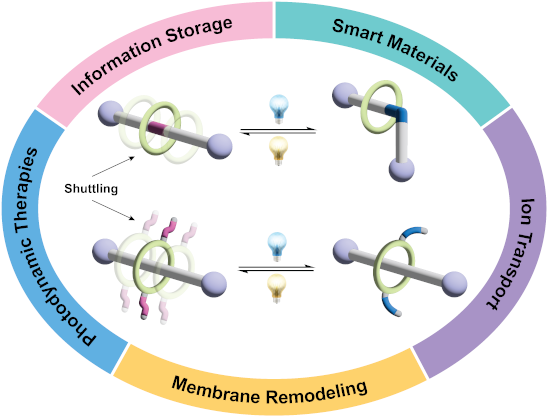
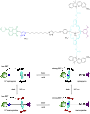
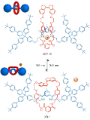
- stiff-stilbene facilitated the formation of aggregates, resulting in organic room-temperature phosphorescence. The phosphorescent properties can be modulated by inducing macrocycle translation through acid–base stimuli or by disrupting the aggregates via stiff-stilbene photoisomerization. The authors





Substituent effect on TADF properties of 2-modified 4,6-bis(3,6-di-tert-butyl-9-carbazolyl)-5-methylpyrimidines
Beilstein J. Org. Chem. 2022, 18, 497–507, doi:10.3762/bjoc.18.52
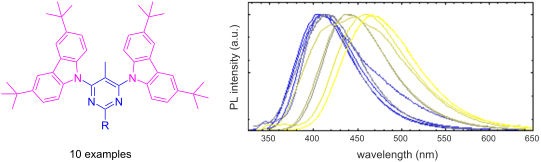
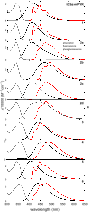
- rest of compounds with low-energy shoulder. More detailed analysis (see Figure S30 in Supporting Information File 1) revealed the presence of room-temperature phosphorescence (RTP), perturbing the lineshape of PL spectra. The estimated singlet–triplet energy gaps (ΔEST) of carbazole–pyrimidine TADF




Clickable azide-functionalized bromoarylaldehydes – synthesis and photophysical characterization
Beilstein J. Org. Chem. 2020, 16, 1683–1692, doi:10.3762/bjoc.16.139
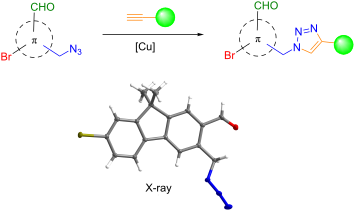
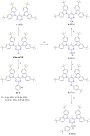
- emission behavior. Keywords: bromoarylaldehydes; click-chemistry; fluorenes; fluorescence; phosphorescence; Introduction Small organic luminophores exhibiting room-temperature phosphorescence (RTP) have attracted great attention due to promising applications in optoelectronic devices [1][2][3][4][5][6][7



Development of fluorinated benzils and bisbenzils as room-temperature phosphorescent molecules
Beilstein J. Org. Chem. 2020, 16, 1154–1162, doi:10.3762/bjoc.16.102
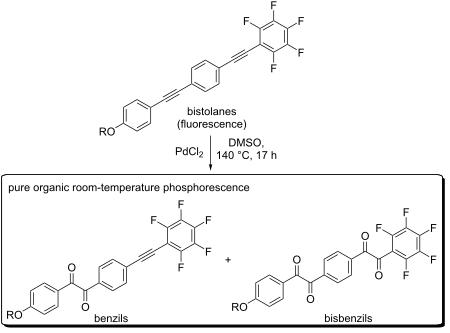
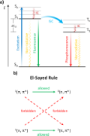
- fluorescence via radiative deactivation from the S1 excited state to the S0 state and phosphorescence via electronic transition from the T1 excited state to the S0 state, respectively. Accordingly, fluorinated benzils and bisbenzils show room-temperature phosphorescence in the solution state. To understand the
- photophysical behavior of the benzils and bisbenzils through several PL measurements under N2 and O2 flow conditions probed the successful room-temperature phosphorescence of the compounds in toluene solution. A fuller understanding of the excited-state dynamics of these benzil and bisbenzil derivatives will

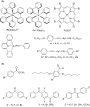


Two novel blue phosphorescent host materials containing phenothiazine-5,5-dioxide structure derivatives
Beilstein J. Org. Chem. 2018, 14, 869–874, doi:10.3762/bjoc.14.73
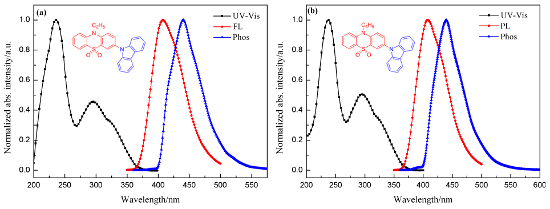
- materials for PhOLEDs. Structures and molecular orbitals of (a) CEPDO and (b) CBPDO. UV–vis absorption and photoluminescence spectra in DCM solution (1 × 10⁻⁵ M and 1 × 10⁻⁶ M, respectively) at room temperature, phosphorescence spectra in 2-MeTHF solution (1 × 10⁻³ M) at 77 K of CEPDO (a) and CBPDO (b


Supramolecular polymer assembly in aqueous solution arising from cyclodextrin host–guest complexation
Beilstein J. Org. Chem. 2016, 12, 50–72, doi:10.3762/bjoc.12.7

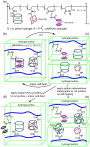
- interesting aspect is that because the α-bromonaphthalene substituents occupy the hydrophobic β-CD annuli in the hydrogel, UV radiation induces room temperature phosphorescence which, in combination with the self-healing properties of the hydrogel, may lead to some interesting applications. The change of


Topochemical control of the photodimerization of aromatic compounds by γ-cyclodextrin thioethers in aqueous solution
Beilstein J. Org. Chem. 2013, 9, 1858–1866, doi:10.3762/bjoc.9.217
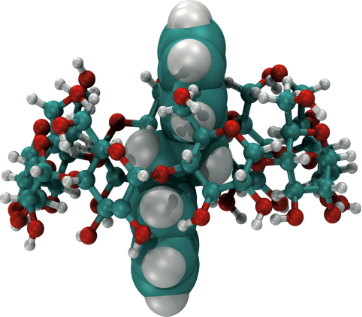
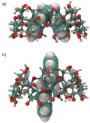
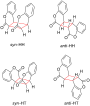
- with heavy atoms attached, e.g., 6-deoxy-iodo-CDs, are known to even enable room temperature phosphorescence of an excited guest [36]. (b) Moreover, according to the results of the quantum mechanical calculations [25][34] the preferential anti-parallel alignment of the ACE dimer within the CD cavity



Other Beilstein-Institut Open Science Activities



