


Search results
Search for "unsaturated C–C bonds" in Full Text gives 9 result(s) in Beilstein Journal of Organic Chemistry.
Electrochemical reduction of unsaturated carbon–carbon bonds via 3d transition-metal catalysis
Beilstein J. Org. Chem. 2026, 22, 955–981, doi:10.3762/bjoc.22.75
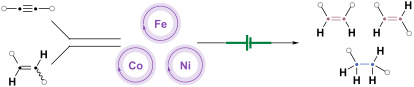
- unsaturated C–C bonds, enabling precise control without molecular hydrogen or stoichiometric reductants. This review summarizes recent advances in iron-, cobalt-, and nickel-catalyzed electroreduction of alkynes and alkenes, highlighting how electrochemical parameters and catalyst design unlock distinct
- ; electroorganic synthesis; reaction mechanism; 3d transition metals; unsaturated C–C bonds; Introduction Reductions of unsaturated C–C bonds Reduction of unsaturated C–C bonds, most notably, alkynes and alkenes, is a synthetic method that has been widely and extensively discussed with a long and rich history
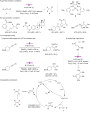
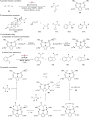
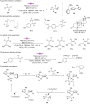
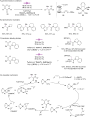
- a divided cell. Modes for the reduction of C–C bonds Electrochemical reduction of unsaturated C–C bonds is dictated by the mode of electron and proton delivery, and the identity of the metal catalyst or redox mediator (Figure 2). Within this framework, the underlying mechanistic modes for the


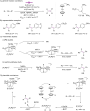

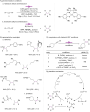

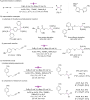




Radical ligand transfer: a general strategy for radical functionalization
Beilstein J. Org. Chem. 2023, 19, 1225–1233, doi:10.3762/bjoc.19.90
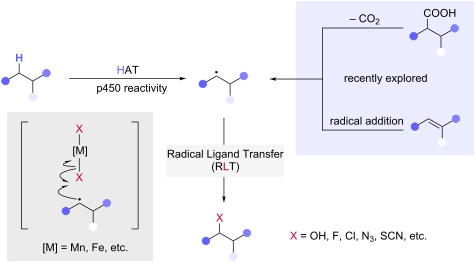
- elimination-like pathway to afford unsaturated C–C bonds in the presence of copper(II) sulfate, presumably via competitive RPC to the carbocation followed by E1 olefination. Kochi also demonstrated that RLT can be combined with other radical generation strategies to enable new, non-biomimetic reactions to be


Highly regio- and stereoselective phosphinylphosphination of terminal alkynes with tetraphenyldiphosphine monoxide under radical conditions
Beilstein J. Org. Chem. 2021, 17, 866–872, doi:10.3762/bjoc.17.72
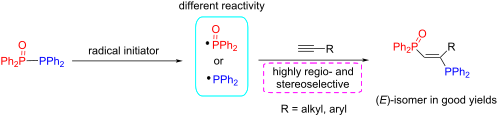
- (X)PPh2 to unsaturated C–C bonds. The addition of Ph2P(O)PPh2 (1) to 1-octyne (2a). Phosphinylphosphination of various terminal alkynes 2 with 1. aIsolated yields. V-40 = 1,1’-azobis(cyclohexane-1-carbonitrile). bRepeated 2 times. Attempted radical addition to internal alkynes and insight into the



Hypervalent iodine-guided electrophilic substitution: para-selective substitution across aryl iodonium compounds with benzyl groups
Beilstein J. Org. Chem. 2018, 14, 1039–1045, doi:10.3762/bjoc.14.91
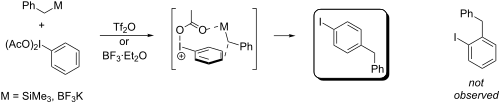
- transmetallation with an appropriate metalloid substrate. This concept is counter to previous mechanisms in which the electrophilic hypervalent iodine reagent is attacked by unsaturated C–C bonds [18][19][20][21][22]. To show evidence for this transmetallation event, benzyl metalloid groups were used under the


Continuous formation of N-chloro-N,N-dialkylamine solutions in well-mixed meso-scale flow reactors
Beilstein J. Org. Chem. 2015, 11, 2408–2417, doi:10.3762/bjoc.11.262
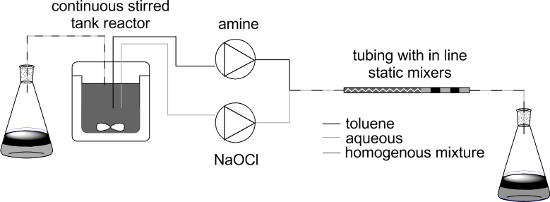
- -Chloramines provide a versatile and reactive class of reagents for use in electrophilic amination and other reactions. N-Chloro-N,N-dialkylamines have been shown to offer a broad range of products from reactions with i) unsaturated C–C bonds to give amines [1][2][3] and heterocycles [1][4]; ii) Grignard and


Homolytic substitution at phosphorus for C–P bond formation in organic synthesis
Beilstein J. Org. Chem. 2013, 9, 1269–1277, doi:10.3762/bjoc.9.143

- . This article deals with two transformations, radical phosphination by addition across unsaturated C–C bonds and substitution of organic halides. Keywords: addition; free radical; homolysis; phosphine; radical; substitution; Introduction Organophosphorus compounds constitute an important class of
- literature [19][20][21]. This review deals with two transformations, radical phosphination by addition across unsaturated C–C bonds and substitution of organic halides. Review Radical addition of phosphination agents Stannylphosphines of the type R3Sn–PR’2 are known to undergo radical addition to carbon


Efficient gold(I)/silver(I)-cocatalyzed cascade intermolecular N-Michael addition/intramolecular hydroalkylation of unactivated alkenes with α-ketones
Beilstein J. Org. Chem. 2011, 7, 1100–1107, doi:10.3762/bjoc.7.126
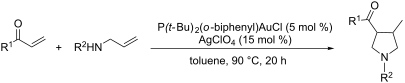
- acid to activate unsaturated C–C bonds towards nucleophilic attack [1][2][3][4][5][6][7][8][9][10] (for selected reviews on gold-catalyzed reactions see [1][2][3][4][5][6][7][8][9]). Based on this mode of activation, several methods for the gold-catalyzed inter- and intramolecular addition of oxygen


Gold-catalyzed oxidation of arylallenes: Synthesis of quinoxalines and benzimidazoles
Beilstein J. Org. Chem. 2011, 7, 860–865, doi:10.3762/bjoc.7.98

- ; oxidation; quinoxaline; Introduction Recently, several research groups have developed gold-catalyzed homogeneous catalytic reactions [1]. A variety of organic transformations have been shown to be mediated by gold(I) or gold(III) complexes in solution. In addition to its ability to activate unsaturated C–C
- bonds, the catalysis of nucleophilic addition by gold complexes for the formation of carbon–carbon and carbon–heteroatom bonds has been one of the most investigated reactions in recent organometallic catalysis [1][2][3][4][5][6][7][8][9][10][11][12][13][14][15][16][17][18][19][20][21][22][23][24]. In


Continuous flow hydrogenation using polysilane-supported palladium/alumina hybrid catalysts
Beilstein J. Org. Chem. 2011, 7, 735–739, doi:10.3762/bjoc.7.83
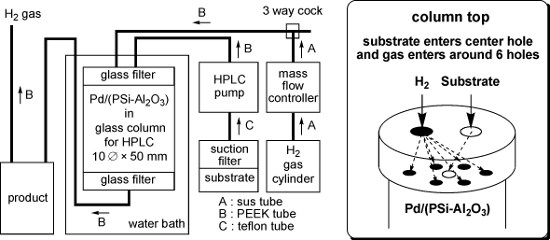
- palladium/alumina (Pd/(PSi–Al2O3)) hybrid catalysts were developed. Our original Pd/(PSi–Al2O3) catalysts were used successfully in these systems and the hydrogenation of unsaturated C–C bonds and a nitro group, deprotection of a carbobenzyloxy (Cbz) group, and a dehalogenation reaction proceeded smoothly
- ., the reduction of unsaturated C–C bonds and a nitro group, deprotection of a Cbz group, and a dehalogenation reaction, all proceeded smoothly. The catalysts could be used for a long time, with high activity being retained for at least 8 h under neat conditions. It is noted that in all cases no Pd


Other Beilstein-Institut Open Science Activities



