Search results
Search for "deconvolution" in Full Text gives 96 result(s) in Beilstein Journal of Nanotechnology.
Nanoporous water oxidation electrodes with a low loading of laser-deposited Ru/C exhibit enhanced corrosion stability
Beilstein J. Nanotechnol. 2019, 10, 157–167, doi:10.3762/bjnano.10.15
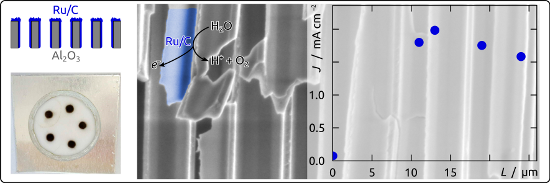
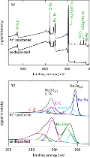
- (“bulk”). The overview XPS spectrum of an as-prepared nanostructured sample features only Ru, O and C (Figure 8a) from the Ru/C layer, whereas the Al2O3 substrate is completely covered and reveals no Al signal. Deconvolution of the Ru 3d region, which is superimposed with C 1s (Figure 8b), reveals two




Zn/F-doped tin oxide nanoparticles synthesized by laser pyrolysis: structural and optical properties
Beilstein J. Nanotechnol. 2019, 10, 9–21, doi:10.3762/bjnano.10.2

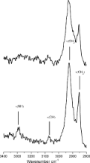
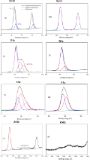
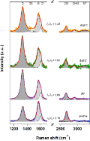
- SnO2 nanoparticles is also revealed. For samples presented in this article, the double doping with F/Zn of SnO2 nanoparticles leads to different dependencies. In Figure 4a the Raman spectra and the corresponding bands after their deconvolution with a Pearson 7 function are presented. After the
- deconvolution, a correlation can be made between the fluorine doping atomic percent (from the XPS analysis) and the Raman shift value of the A1g band or the B2g peak area as shown in Figure 4b. Thus, with the increase of fluorine content in the powders, the A1g position shifts toward lower wave numbers, whereas



Disorder in H+-irradiated HOPG: effect of impinging energy and dose on Raman D-band splitting and surface topography
Beilstein J. Nanotechnol. 2018, 9, 2708–2717, doi:10.3762/bjnano.9.253

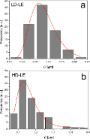
- baseline. From the deconvolution of the D band (Figure 2a), we verify that it is a doublet (D1 and D2). Positions of D, D′ and 2D components, as well as the ID1/ID2 ratio, are summarized in Table 1, in order to emphasize the intensity changes in the D1 and D2 contributions. The doublet of the D band is
- , HD-LE and HD-HE). Pristine HOPG is shown for comparison. a) D band and D′ band and b) 2D band. Experimental points are shown as circles while the solid lines correspond to the fits. Deconvolution of a) D band and b) 2D band. The dotted vertical lines are drawn as a guide to the eye, at the peak


Defect formation in multiwalled carbon nanotubes under low-energy He and Ne ion irradiation
Beilstein J. Nanotechnol. 2018, 9, 1951–1963, doi:10.3762/bjnano.9.186
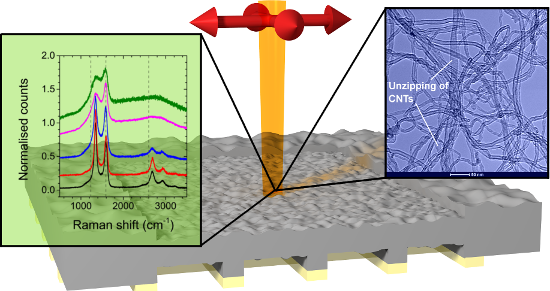
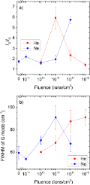
- ). For deconvolution of the Raman spectra, the method by Ribeiro-Soares et al. has been used [58]. The peaks for the D band at 1345 cm−1, the G band at 1585 cm−1 and the D’ band at 1615 cm−1 have been fitted by Lorentzian functions while Gaussian functions have been used to fit the contribution from
- ion current and changes of the latter during ion irradiation. Supporting Information Supporting Information File 228: Additional information on deconvolution of Raman spectra, TEM imaging and numerical simulations. Acknowledgements This project was supported by the National Research Fund (FNR



SO2 gas adsorption on carbon nanomaterials: a comparative study
Beilstein J. Nanotechnol. 2018, 9, 1782–1792, doi:10.3762/bjnano.9.169

- summarized in Table S1 (Supporting Information File 1) and the detailed C 1s deconvolution is given in Table S2 (Supporting Information File 1). The SO2 adsorption isotherm of the six adsorbents at 25 °C is shown in Figure 5a. The experimental measurement errors are ±5% for the loading and the pressure



Effect of annealing treatments on CeO2 grown on TiN and Si substrates by atomic layer deposition
Beilstein J. Nanotechnol. 2018, 9, 890–899, doi:10.3762/bjnano.9.83
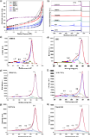
- ][32][33]. The “v” labels refer to the 3d5/2 spin–orbit split component, while the “u” labels mark the 3d3/2 signals. The figures also show the fit obtained from the deconvolution of the spectra into the different components, similarly to that reported in [6][9][10][13]. In Table 2, we reported the


Ultralight super-hydrophobic carbon aerogels based on cellulose nanofibers/poly(vinyl alcohol)/graphene oxide (CNFs/PVA/GO) for highly effective oil–water separation
Beilstein J. Nanotechnol. 2018, 9, 508–519, doi:10.3762/bjnano.9.49

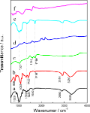
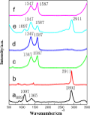
- , (c) GO, (d) rGO, and (e) CNF/PVA/GO aerogels and the (f) CNF/PVA/GO carbon aerogel. X-ray photoelectron spectrometry spectra and deconvolution of (a) survey scans, and C 1s high-resolution spectra of (b) GO and (c) rGO. Thermogravimetric analysis (TGA) curves of the CNFs, pure PVA, GO, CNF/PVA/GO




Robust nanobubble and nanodroplet segmentation in atomic force microscope images using the spherical Hough transform
Beilstein J. Nanotechnol. 2017, 8, 2572–2582, doi:10.3762/bjnano.8.257
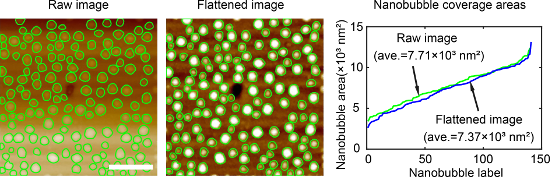
- contact angle measurement is illustrated in Figure 3. From the figure, one can see that the tip radius results in the overestimation of the width D. The deconvolution of the AFM tip gives a corrected expression of radius Rc′, width D′ and contact angle θ′, as where Rtip is the radius of AFM tip


Substrate and Mg doping effects in GaAs nanowires
Beilstein J. Nanotechnol. 2017, 8, 2126–2138, doi:10.3762/bjnano.8.212
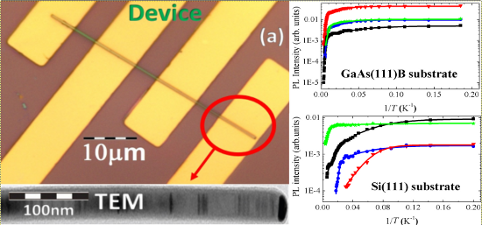
- . The deconvolution of the PL spectra was made with Gaussian components assuming a model consisting in the lower number of components needed to describe the whole measured spectra for each sample. The peak positions of C4 and C5 are approximately the same in the two samples whereas their relative


Identifying the nature of surface chemical modification for directed self-assembly of block copolymers
Beilstein J. Nanotechnol. 2017, 8, 1972–1981, doi:10.3762/bjnano.8.198

- deposited on top of grafted brush layers that have been unexposed and exposed to oxygen plasma, respectively, without prior EBL modification. Figure 5a,b shows the C 1s HAXPES spectra acquired with 3000 eV photons together with the deconvolution using least-square fits after background subtraction. Both
- sections are shown below both images. HAXPES spectra corresponding to the C 1s region of (a) unmodified and (b) modified samples, respectively, taken with 3000 eV photons including a deconvolution of the components using a least-square fit after background subtraction. Comparison of spectra taken with 2700


Measuring adhesion on rough surfaces using atomic force microscopy with a liquid probe
Beilstein J. Nanotechnol. 2017, 8, 813–825, doi:10.3762/bjnano.8.84
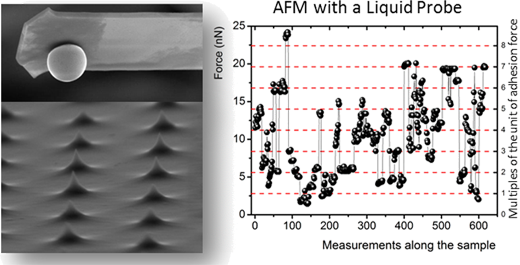
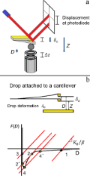
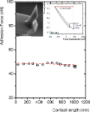
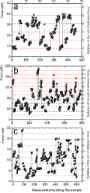
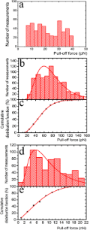
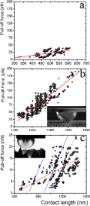
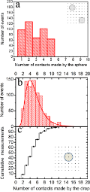
- tips: As mentioned in the introduction, we first measure the adhesion force between standard Si3N4 tips in contact with freshly cleaved mica to validate our general method. The radius of these tips was obtained using the tip–shape deconvolution method [28][29] on a test grating (TGT1 from NDT-MDT Co

Influence of hydrofluoric acid treatment on electroless deposition of Au clusters
Beilstein J. Nanotechnol. 2017, 8, 183–189, doi:10.3762/bjnano.8.19

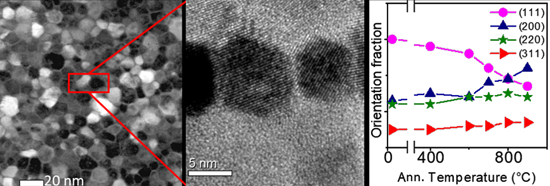
- , showed the presence of randomly oriented Au clusters coexisting with the heteroepitaxial regions on the Si substrate. Moreover, the shape of the (200) diffraction peak indicates that two families of grains, both exhibiting texturing in the [001] crystallographic direction, are present. The deconvolution



Nitrogen-doped twisted graphene grown on copper by atmospheric pressure CVD from a decane precursor
Beilstein J. Nanotechnol. 2017, 8, 145–158, doi:10.3762/bjnano.8.15

- scale of the system was calibrated with respect to Au 4f7/2, Ag 3d5/2 and Cu 2p3/2 peak positions. ESCALAB 250Xi Avantage software was used for the peak deconvolution and fitting procedure using a sum of Lorentzian–Gaussian (70:30) functions. The samples were analyzed as received and no surface cleaning


Fundamental properties of high-quality carbon nanofoam: from low to high density
Beilstein J. Nanotechnol. 2016, 7, 2065–2073, doi:10.3762/bjnano.7.197
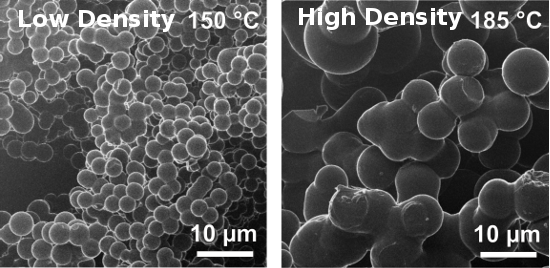
- (Multiprobe, Omicron) at a pressure <10−9 mbar, as applied in our previous work on carbon nanofoams [24]. The combination of monochromatic Al Kα irradiation, an electron analyzer (Sphera) with a resolution of 0.9 eV, and an emission angle of 20° was used. The deconvolution of XPS peaks was performed by
- these foams. XPS In Figure 3, the XPS spectra of low- and high-density carbon nanofoams are shown. The deconvolution of the C1s peaks leads to the C1 and C2 peaks which are assigned to sp2- and sp3-type carbons, corresponding to electron binding energies of 284.4 and 285.4 eV, respectively [54]. An
- distribution (Figure 3b,d) is also different for the two types of foams. Two-curve deconvolution for the low-density foam yields an O1 peak at 532.3 eV and an O2 peak at 533.8 eV, with corresponding relative areas of 62% and 38%. We assign these peaks to C=O and C–O bonded carbon atoms, respectively [60][61


A dioxaborine cyanine dye as a photoluminescence probe for sensing carbon nanotubes
Beilstein J. Nanotechnol. 2016, 7, 1991–1999, doi:10.3762/bjnano.7.190
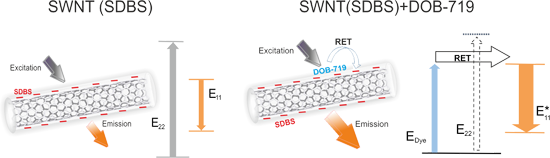
- SWNT in comparison with its components. To understand the nature of the new PL features (in the range of λEX = 650–780 nm) we have estimated the absorption peak positions using Gaussian deconvolution. The absorption of the neat SWNT in the range of 300–800 nm (Figure 3a, curve 1) exhibits low intensity
- the aged mixture (measured 24 h after mixing, Figure 3a, curve 4) has only one maximum at 742 nm (1.67 eV) and a short wavelength shoulder (peak after Gaussian deconvolution at 700 nm (1.77 eV)). Thus, the relative contribution of absorption for the dye–SWNT complexes in the aged mixtures is much


Microwave synthesis of high-quality and uniform 4 nm ZnFe2O4 nanocrystals for application in energy storage and nanomagnetics
Beilstein J. Nanotechnol. 2016, 7, 1350–1360, doi:10.3762/bjnano.7.126

- deconvolution of the O 1s spectrum identified three different oxygen bonding states. The main peak at (529.60 ± 0.05) eV corresponds to lattice oxygen and the minor peaks at higher binding energies of (531.11 ± 0.05) eV and (532.07 ± 0.05) eV can be assigned to hydroxyl oxygen/oxygen from C–O and C=O


Photocurrent generation in carbon nanotube/cubic-phase HfO2 nanoparticle hybrid nanocomposites
Beilstein J. Nanotechnol. 2016, 7, 1075–1085, doi:10.3762/bjnano.7.101
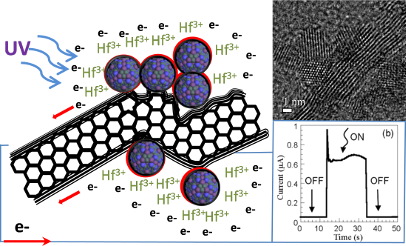
- the PL emission from nanocomposites and free-standing HfO2 nanoparticles was analyzed in more detail. As evident from Figure 3, the key constituents of the broad emission bands in both cases are represented by the same Gaussian deconvolution components centered at around 3.1, 2.8, 2.5 and 2.2 eV
- nanoparticles. Grey curves represent the Gaussian deconvolution components. Note different the photoluminescence intensity scales in (a) and (b). (a) HAADF-STEM image of the area of interest where EELS was performed, (b) C K-edge core loss EELS spectra on the area of interest indicated in Figure 2a. (a) I–V


Assembling semiconducting molecules by covalent attachment to a lamellar crystalline polymer substrate
Beilstein J. Nanotechnol. 2016, 7, 784–798, doi:10.3762/bjnano.7.70

- [14]. The area coverage of the nanocrystal monolayer was calculated using Gwyddion software [15]. The AFM image was corrected for the AFM tip shape using a deconvolution algorithm. The tip shape was characterized by parameters provided by the manufacturer. In order to deduce the packing density of a


Plasma fluorination of vertically aligned carbon nanotubes: functionalization and thermal stability
Beilstein J. Nanotechnol. 2015, 6, 2263–2271, doi:10.3762/bjnano.6.232

- binding energies higher than 285 eV. The deconvolution of the carbon peak is complex due to the uncertain assignment of fitting components; however, a satisfactory example is reported in Supporting Information File 1 for the as-functionalized sample (Supporting Information File 1, Figure S1). The analysis


Kelvin probe force microscopy for local characterisation of active nanoelectronic devices
Beilstein J. Nanotechnol. 2015, 6, 2193–2206, doi:10.3762/bjnano.6.225
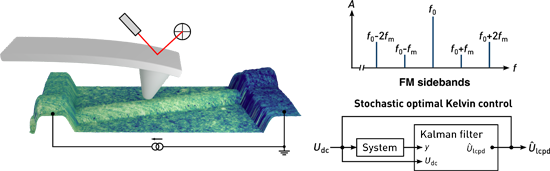
- surface potential measurements include deconvolution techniques [11][12] or the use of slightly blunt tips supported by a cantilever of minimal surface area [9]. However, deconvolution techniques require a detailed model of the AFM tip to be accurate and usually neglect the sample topography [12], whereas


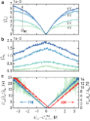
![[Graphic 33]](/bjnano/content/inline/2190-4286-6-225-i48.png?max-width=637&scale=1.18182) for different modulation amplitu...
for different modulation amplitu...




Nitrogen-doped graphene films from chemical vapor deposition of pyridine: influence of process parameters on the electrical and optical properties
Beilstein J. Nanotechnol. 2015, 6, 2028–2038, doi:10.3762/bjnano.6.206
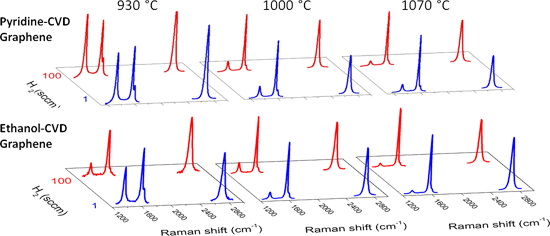
- this case, the N atom usually bonds with one O and two C atoms. It should be noted that the curve deconvolution of the N1s spectra does not seem to show trace of pyrrolic N, i.e., N atoms contributing two p electrons to the π system (e.g., the kind of coordination an N atom has in the five-membered C


Conformal SiO2 coating of sub-100 nm diameter channels of polycarbonate etched ion-track channels by atomic layer deposition
Beilstein J. Nanotechnol. 2015, 6, 472–479, doi:10.3762/bjnano.6.48
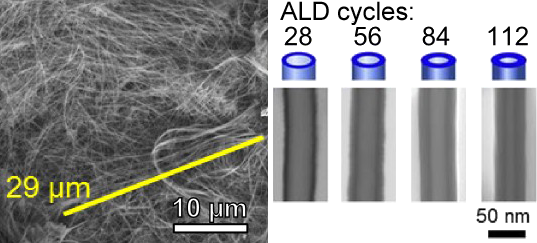
- -bonded oxygen [(O–(C=O)–O), 66%] in polycarbonate, respectively, in agreement with the literature [40]. After 28 ALD cycles the polycarbonate-related XPS peaks are strongly suppressed due to SiO2 film formation. After deconvolution of C 1s species for every sample, O 1s species with respect to the PC


Electrical properties of single CdTe nanowires
Beilstein J. Nanotechnol. 2015, 6, 444–450, doi:10.3762/bjnano.6.45

- corresponds to the template pore characteristics. EDX spectra deconvolution was employed to determine the composition of the nanowires for different working electrode voltages and the dependence of the composition on the working electrode potential is presented in Figure 2b. A quasi-plateau of the potential


X-ray photoelectron spectroscopy of graphitic carbon nanomaterials doped with heteroatoms
Beilstein J. Nanotechnol. 2015, 6, 177–192, doi:10.3762/bjnano.6.17
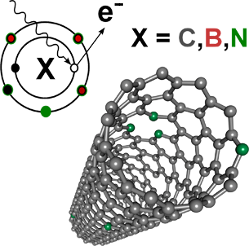
- three clear explanations for such a large range of values: inaccuracies in either the measurement or the spectral deconvolution; the assignment of correctly measured binding energies to incorrect atomic configurations; or the effect of differences in core hole screening. A level of variability could be


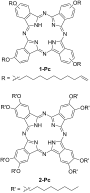
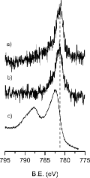
In situ metalation of free base phthalocyanine covalently bonded to silicon surfaces
Beilstein J. Nanotechnol. 2014, 5, 2222–2229, doi:10.3762/bjnano.5.231

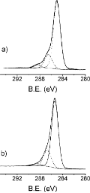
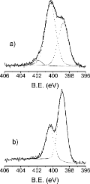
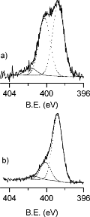
- obtained from high-resolution spectra of the relevant photoemission bands. Figure 2 reports the C 1s photoelectron spectra of Si-1-Pc (a) and PSi-1-Pc (b). The observed bands do not show significant differences between flat and porous samples. For both samples, a careful deconvolution of the band envelope