


Search results
Search for "annealing" in Full Text gives 501 result(s) in Beilstein Journal of Nanotechnology. Showing first 200.
Plasmon-enhanced photoluminescence from TiO2 and TeO2 thin films doped by Eu3+ for optoelectronic applications
Beilstein J. Nanotechnol. 2021, 12, 1271–1278, doi:10.3762/bjnano.12.94
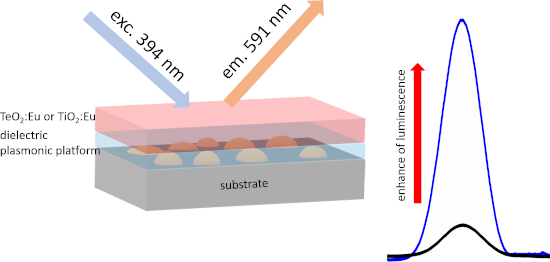
- thermal annealing of the gold thin film. Thermal dewetting of gold film results in spherical gold nanostructures with average dimensions of 50 nm. Both, luminescent TiO2:Eu and TeO2:Eu films were deposited by RF magnetron sputtering from mosaic targets. The morphology of the gold nanostructures was
- thin films can be implemented in many ways. The change of deposition parameters and working gasses, doping with various elements, or annealing at an elevated temperature are the most commonly used procedures [17][18]. It gives enormous possibilities for manufacturing thin films with novel properties


Irradiation-driven molecular dynamics simulation of the FEBID process for Pt(PF3)4
Beilstein J. Nanotechnol. 2021, 12, 1151–1172, doi:10.3762/bjnano.12.86
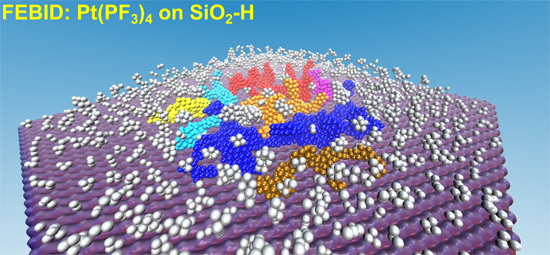
- and thermalization simulations for each new layer are performed in the same way as for the initial precursor layer. Step 5. Post-deposition processing Additional processing of the FEBID-grown structures, namely post-deposition electron irradiation or high-temperature annealing with or without
- removed, and remaining metal deposits are reorganized into more compact and dense structures. Both types of post-deposition processing, that is, annealing and further electron irradiation, can be simulated by means of MD as the last step of the computational protocol shown in Figure 1. MD simulation of
- the annealing includes heating of the deposited structures to high temperature and subsequent slow cooling. During annealing structural and topological changes in the deposit take place. The typical time scale for annealing in experiments varies from minutes to several hours [55][56][57]. Therefore








A Au/CuNiCoS4/p-Si photodiode: electrical and morphological characterization
Beilstein J. Nanotechnol. 2021, 12, 984–994, doi:10.3762/bjnano.12.74
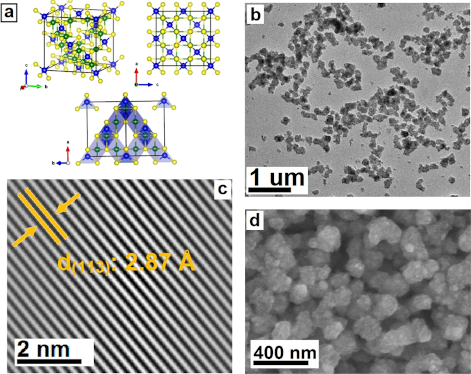
- thermal annealing at 400 °C for 2 min in N2 atmosphere. Top contacts were prepared on the film by evaporating gold with a thickness of 150 nm at 5 × 10⁻⁶ Torr through a metal shadow mask (Au, 99.99% from Kurt J. Lesker). High-purity Al and Au metal contacts were thermally evaporated from a tungsten filament



A review of defect engineering, ion implantation, and nanofabrication using the helium ion microscope
Beilstein J. Nanotechnol. 2021, 12, 633–664, doi:10.3762/bjnano.12.52
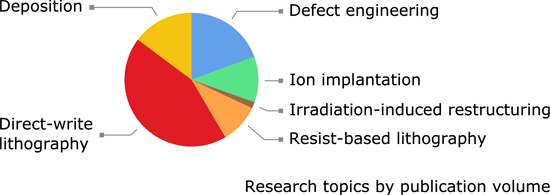
- nitrogen, the focused helium ion beam was used to create lattice vacancies at predefined locations (in a similar manner to the related electron beam-based methods). After annealing to allow for diffusion of the vacancies, the presence of nitrogen-vacancy centers was confirmed by photoluminescence
- ]. Here, neon line irradiation of an Si(25 nm)/SiO2(6.5 nm)/Si(bulk) stack was used to induce collisional mixing of silicon atoms into the buried SiO2 layer. Upon subsequent thermal annealing, 1D chains of silicon nanocrystals of 2.2 nm diameter self-assembled in the center of the SiO2 layer. A TEM-based


Local stiffness and work function variations of hexagonal boron nitride on Cu(111)
Beilstein J. Nanotechnol. 2021, 12, 559–565, doi:10.3762/bjnano.12.46
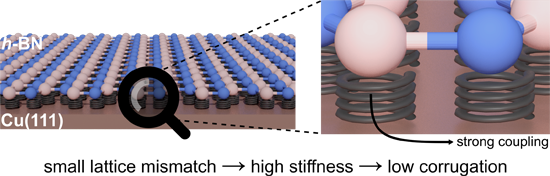
- acquisition. Sample preparation: A Cu(111) single crystal (MaTeck GmbH) is cleaned via repeated cycles of Ar-ion sputtering at room temperature followed by annealing to 1020 K in an ultrahigh-vacuum preparation chamber. A partial layer of h-BN is grown by chemical vapour deposition by heating the Cu(111


Influence of electrospray deposition on C60 molecular assemblies
Beilstein J. Nanotechnol. 2021, 12, 552–558, doi:10.3762/bjnano.12.45

- molecular trapping and their creation is therefore studied for those reasons [32][43][45][46]. In HV-ESD deposition, their presence can be reduced but not inhibited without annealing of the surface [44]. C60 on NiO(001) surface NiO is a wide-bandgap metal oxide with potential applications in organic
- structures are needed, a gentle annealing eliminates the spray influence. Additionally, when focusing on single molecules, small aggregates, or islands, the HV-ESD method is well suited and could open new possibilities to stabilize single molecules at room temperature. Experimental Sample preparation Au(111
- ) single crystals (Mateck GmbH) were prepared under UHV conditions by several cycles of Ar+ sputtering and annealing at 750 K. KBr(001) crystals (Mateck GmbH) were prepared either by cleavage in air and quick introduction in UHV or by cleavage under UHV conditions. Subsequently, annealing at 350 K for 2 h


Determining amplitude and tilt of a lateral force microscopy sensor
Beilstein J. Nanotechnol. 2021, 12, 517–524, doi:10.3762/bjnano.12.42

- , Germany) operating in ultra-high vacuum at 5.6 K equipped with a qPlus sensor [25]. The sensor was equipped with an etched tungsten tip, which was repeatedly poked into a Cu(111) surface to generate well-defined tip apex configurations. Cu(111) was cleaned by standard sputtering and annealing cycles


Interface interaction of transition metal phthalocyanines with strontium titanate (100)
Beilstein J. Nanotechnol. 2021, 12, 485–496, doi:10.3762/bjnano.12.39
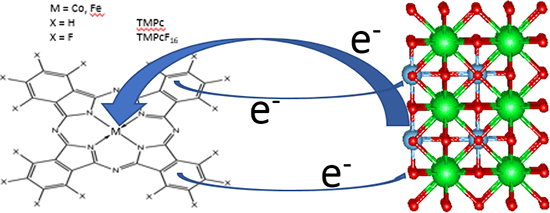
- treatments [12][13] or water leaching [14][15]. The SrO termination is often achieved via thermal Sr segregation [16][17][18] or by deposition of SrO in vacuo [19][20]. Due to the thermal Sr segregation effect, sputtering and annealing procedures result commonly in SrO-terminated surfaces [21]. The detailed
- × 10 × 0.5 mm3, 0.5 wt % Nb). The surfaces were typically prepared in vacuo by repeated cycles of Ar ion sputtering (0.5 kV, p(Ar) = 5 × 10⁻⁵ mbar, 30 min) and annealing (900 K, p(O2) = 4 × 10⁻⁵ mbar, 30 min). This method is called “preparation I” in the following. We note that this procedure results
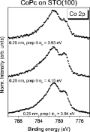
- (preparation II, experiment 2) and 4.15 eV (preparation II, experiment 1), although a very similar annealing procedure was applied. The work function variations indicate that different fractions of mixed terminations were prepared. The highest value of 4.15 eV points to a predominantly TiO2-terminated STO(100


Reconstruction of a 2D layer of KBr on Ir(111) and electromechanical alteration by graphene
Beilstein J. Nanotechnol. 2021, 12, 432–439, doi:10.3762/bjnano.12.35

- . Methods Sample preparation The Ir(111) single crystal (MaTeck GmbH, Germany) was cleaned by alternating cycles of Ar+ sputtering and annealing at 1400 K under ultrahigh vacuum (UHV) conditions with a base pressure of less than 1 × 10⁻¹⁰ mbar. Graphene was prepared by dosing ethylene with a chamber


Solution combustion synthesis of a nanometer-scale Co3O4 anode material for Li-ion batteries
Beilstein J. Nanotechnol. 2021, 12, 424–431, doi:10.3762/bjnano.12.34
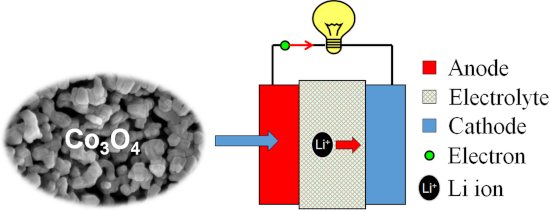
- , annealing or calcination. The SCS method has been successfully used to produce spinel-structured Co3O4 nanomaterials [48][49][50][51][52]. Taking advantage of these reports, we decided to design a new SCS synthesis path in which we applied for the first time ᴅ-(+)-glucose as the reducing agent instead of


Spontaneous shape transition of MnxGe1−x islands to long nanowires
Beilstein J. Nanotechnol. 2021, 12, 366–374, doi:10.3762/bjnano.12.30
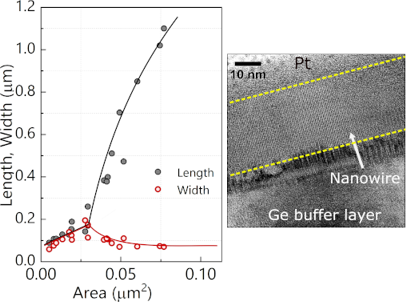
- spontaneous shape transition, from regular islands to elongated nanowires, upon high-temperature annealing of a thin Mn wetting layer evaporated on Ge(111). We demonstrate that 4.5 monolayers is the critical thickness of the Mn layer, governing the shape transition to wires. A small change around this value
- tend to ≃80 nm of width. We found that tuning the annealing process allows one to extend the wire length up to ≃1.5 μm with a minor rise of the lateral size to ≃100 nm. The elongation process of the nanostructures is in agreement with a strain-driven shape transition mechanism proposed in the
- formation of quantum wires [35]. In this method, wires are obtained via epitaxial growth of a strained wetting layer followed by annealing at high temperature. However, only few studies have been dedicated to strain-induced elongation mechanisms leading to the formation of semiconducting nanowires, such as


Differences in surface chemistry of iron oxide nanoparticles result in different routes of internalization
Beilstein J. Nanotechnol. 2021, 12, 270–281, doi:10.3762/bjnano.12.22

- primer (5′-CTAAGCAGTTGGTGGTGCAG-3′), on a CFX96TM Real-Time PCR Detection System cycler (Bio-Rad). Specifically, samples were denatured at 95 °C for 10 min, and the quantification program had 40 repeats (30 s annealing at 60 °C, 30s amplification at 72 °C). GAPDH was used as a “housekeeping” gene for the



Extended iron phthalocyanine islands self-assembled on a Ge(001):H surface
Beilstein J. Nanotechnol. 2021, 12, 232–241, doi:10.3762/bjnano.12.19

- annealing. Here, we obtain islands composed of upright-standing molecules already at room temperature, which indicates a dominant role of intermolecular forces compared to interactions between molecules and hydrogenated surface. In order to analyze in more detail the properties of the FePc islands, we
TiOx/Pt3Ti(111) surface-directed formation of electronically responsive supramolecular assemblies of tungsten oxide clusters
Beilstein J. Nanotechnol. 2021, 12, 203–212, doi:10.3762/bjnano.12.16
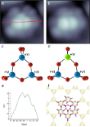
- , respectively. After the annealing at 600 K, hardly any single nanocluster can be found on the surface. In return, the step edges are now highly decorated with clusters, while the terraces are covered by up to 1 nm high and 5 nm wide cluster agglomerations. This indicates a high lateral mobility of the clusters
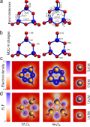
- at elevated temperatures, which allows for an energy contact by agglomeration due to strong intermolecular interactions. After annealing the sample at 900 K, the formation of larger islands is observed. The thickness of these islands is always approx. 0.6 nm, which indicates the formation of a WO3
- structures with a low influence of molecular electronic features. Thus, annealing a surface covered with W3O9 may also be used as a gentle way to grow well-defined WO3 islands or thin films. In that context, the observed thickness limitation of two WO3 unit cells could be of special interest since the height



Direct observation of the Si(110)-(16×2) surface reconstruction by atomic force microscopy
Beilstein J. Nanotechnol. 2020, 11, 1750–1756, doi:10.3762/bjnano.11.157

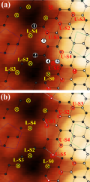
- reliable production of nanowires and other nanostructures [7][10][11][12][13]. By annealing below 700 °C [14], the Si(110)-(16×2) reconstruction is formed over large areas on the Si(110) surface. It has been widely investigated by reflection high-energy electron diffraction (RHEED) analysis [14][15
- 1200 °C for 3 s and annealing at 650 °C for 30 min. The sample was heated by flowing an electric current in the direction; thereby, a single-domain surface can be easily formed on the Si(110) surface [10]. Results and Discussion Figure 1 shows a typical AFM image of a Si(110) surface. The



The influence of an interfacial hBN layer on the fluorescence of an organic molecule
Beilstein J. Nanotechnol. 2020, 11, 1663–1684, doi:10.3762/bjnano.11.149
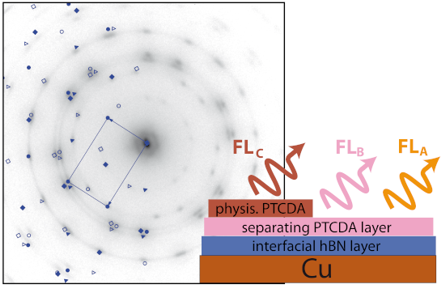
- of borazine that is known to occur even when stored at low temperatures, m/z 2) and borazine (m/z 80) showed a ratio of approximately 1:1. The clean Cu(111) surface was prepared by consecutive steps of sputtering for 30 min with Ar+ ions (1000 eV, 4 μA) and annealing at 1010 K for 30 min. After the
- ) surface, the hBN layers, and the PTCDA layers was checked by LEED. We used a SPA-LEED instrument as described in [30]. An additional annealing step between the last sputter cycle and the borazine deposition was omitted here in order to prevent segregation of chemical impurities from the Cu bulk to the
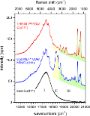
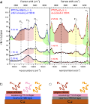
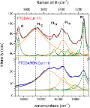
- minute. During deposition, the sample was held at a constant temperature. PTCDA layers on Cu(111) were prepared by keeping the sample at a temperature of either 20 or 300 K during deposition. PTCDA layers on hBN/Cu(111) were prepared by deposition at a sample temperature of 20 K and subsequent annealing





Amorphized length and variability in phase-change memory line cells
Beilstein J. Nanotechnol. 2020, 11, 1644–1654, doi:10.3762/bjnano.11.147
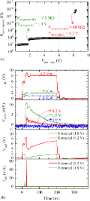
- approx. 1 mTorr at a temperature of 675 K for 10 min to reach the crystalline phase (annealing profile shown in Figure 2a). The electrical measurements were performed at room temperature. Electrical pulses, generated by an arbitrary function generator (Tektronix AFG 3102), were applied to the cells; a
- profile used for annealing the as-fabricated amorphous devices to the crystalline phase, with a constant temperature of 675 K for the last 10 min. Inset shows the SEM image of an untested annealed GST line cell, with metal-to-metal LGST ≈ 470 nm, WGST ≈ 130 nm, and tGST ≈ 50 nm. (b) Electrical measurement




Adsorption and self-assembly of porphyrins on ultrathin CoO films on Ir(100)
Beilstein J. Nanotechnol. 2020, 11, 1516–1524, doi:10.3762/bjnano.11.134

- molecules were carefully outgassed for 2 to 5 h prior to deposition at ±10 K of the evaporation temperature. CoO was prepared on an Ir(100) single crystal surface cleaned by ion sputtering and annealing. The Ir(100)-(1 × 1) surface was prepared according to [31]. We employ thin films of two distinct
- ) at 320 K substrate temperature followed by annealing in 2 × 10⁻⁹ mbar O2 at 520 K. To improve ordering, the films were flash-heated to 670 K in UHV. The cleanliness, quality and thickness of the prepared substrates was verified by comparison to low-energy electron diffraction intensity data of
- keeping the substrate at that temperature during deposition or by short time (5 min) annealing. Either choice of thermal treatment resulted in the same molecular structures. Higher temperatures could not be applied to 2 without changing the appearance of the molecules. This is attributed to metalation of




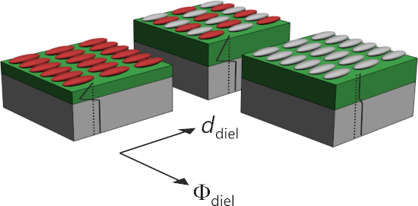
Controlling the electronic and physical coupling on dielectric thin films
Beilstein J. Nanotechnol. 2020, 11, 1492–1503, doi:10.3762/bjnano.11.132
- (100) crystal was cleaned by cycles of Ar+ sputtering and annealing at 500 °C. MgO(100) films were grown by Mg evaporation in an oxygen environment. The Mg fluxes used were on the order of 1 Å/min as monitored by a quartz microbalance. The MgO deposition was done at a temperature of 270 °C and at an O2
- thickness of 2.105 Å. Work functions, measured from the secondary electron cutoff in the photoemission, could be reduced by annealing in UHV or further Mg exposure while annealing. The work function could be increased by O2 exposure (5 × 10⁻⁷–2 × 10⁻⁴ mbar) at moderate temperatures. Monitoring the work




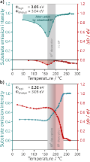
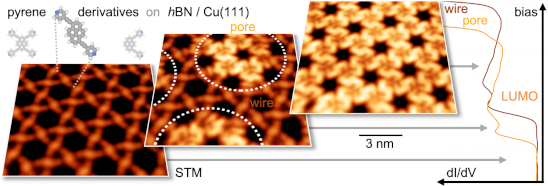
Self-assembly and spectroscopic fingerprints of photoactive pyrenyl tectons on hBN/Cu(111)
Beilstein J. Nanotechnol. 2020, 11, 1470–1483, doi:10.3762/bjnano.11.130
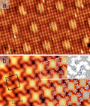
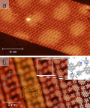
- was cleaned by repeated Ar+ sputtering cycles at an energy of 800–1000 eV, followed by annealing at 1070 K. Monolayer hBN was grown via chemical vapor deposition using borazine ((HBNH)3, Katchem spol s.r.o, www.katchem.cz), following a protocol described previously [25]. Subsequently, a submonolayer




Wafer-level integration of self-aligned high aspect ratio silicon 3D structures using the MACE method with Au, Pd, Pt, Cu, and Ir
Beilstein J. Nanotechnol. 2020, 11, 1439–1449, doi:10.3762/bjnano.11.128
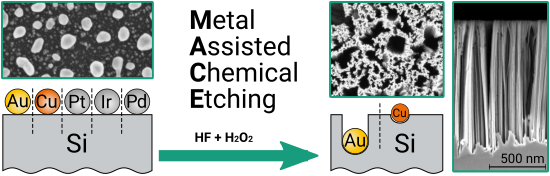
- discussed in detail. Particle formation The surface of the deposited noble metal films has been analysed before and after the thermal annealing using a scanning electron microscope (SEM). The generated particles have been analysed using “ImageJ” [24] with the package collection “Fiji” [25]. For the analysis
- nanometre scale. The target film thickness was 5 nm and was adjusted using the sputtering rate. Figure 1 shows SEM images after the annealing process (Figure 1a–d) and the results of the particle distribution analysis (Figure 1f–j). Figure 1e shows the surface of the Ir sample directly after the ALD process
- , we were able to cover the whole wafer surface homogeneously with nanoparticles. The particle size distribution can easily be modified by varying film thickness and annealing conditions or, correspondingly, the number of ALD cycles for the Ir particles. Silicon etching The wafers with noble metal


Impact of fluorination on interface energetics and growth of pentacene on Ag(111)
Beilstein J. Nanotechnol. 2020, 11, 1361–1370, doi:10.3762/bjnano.11.120

- [60] and vacuum-sublimed on clean metal surfaces (prepared by repeated Ar+ ion sputtering and annealing cycles [up to 550 °C]), with deposition rates of about 0.5 Å/min. The film mass thickness was monitored with a quartz crystal microbalance (QCM) near the sample, and a nominal thickness of 4 Å is


Atomic defect classification of the H–Si(100) surface through multi-mode scanning probe microscopy
Beilstein J. Nanotechnol. 2020, 11, 1346–1360, doi:10.3762/bjnano.11.119

- concentration of dihydrides can be controlled by lowering the annealing temperature during sample preparation [19][70]. While the two varieties of dihydride look unique overall in STM empty states topography (Figure 2d-1 and Figure 2e-1), the side of the pair that the dihydride unit(s) appear on consistently
- ” (Figure 2h-6). A defect of similar appearance was reported in a prior work exploring chlorine-terminated silicon [80] which was linked to water contamination in the vacuum chamber (observed as H and OH bonded to the unterminated surface [15][16][17]). A mild annealing followed by halogen-termination
- (100). Samples were degassed at 600 °C overnight followed by multiple cycles of flash annealing at 1250 °C. The samples were then terminated with hydrogen by exposing them to molecular hydrogen (10−6 Torr) while the Si sample was held at 330 °C for 2 min. The molecular hydrogen was cracked from H2 gas



Growth of a self-assembled monolayer decoupled from the substrate: nucleation on-command using buffer layers
Beilstein J. Nanotechnol. 2020, 11, 1291–1302, doi:10.3762/bjnano.11.113

- nm by carrying out systematic concentration-dependent measurements since lower solution concentrations are known to favor large domain sizes. Annealing of the samples was also carried out. We noticed that at lower solution concentrations, the n-C50 monolayers exhibit a highly dynamic behavior with


Hybridization vs decoupling: influence of an h-BN interlayer on the physical properties of a lander-type molecule on Ni(111)
Beilstein J. Nanotechnol. 2020, 11, 1168–1177, doi:10.3762/bjnano.11.101
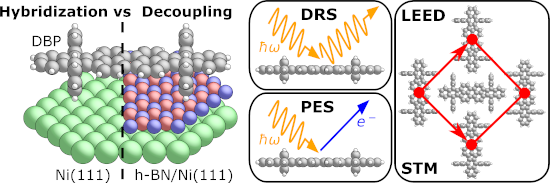
- LEED pattern due to a post-growth annealing process in a temperature range from 100 °C to 300 °C was not visible. In fact, at a temperature of 300 °C the desorption of DBP molecules was observed by a decrease of the C 1s intensity measured by XPS (not shown). Therefore, we conclude that a post-growth
- annealing process does not lead to an increase of the lateral order. However, a highly ordered film was achieved by depositing at a substrate temperature of 170 °C. The LEED image in Figure 3a shows the corresponding diffraction pattern induced by a highly ordered molecular film. For this reason, we labeled
- Ar+ sputtering at room temperature and annealing at 800 °C. The h-BN layer was grown by thermal dehydrogenation of borazine molecules at a substrate temperature of 800 °C similar to [19]. We purchased borazine from Katchem Ltd. (Czech Republic) with a specified purity of >98%. The quality of the h-BN





