

Search results
Search for "hysteresis" in Full Text gives 292 result(s) in Beilstein Journal of Nanotechnology. Showing first 200.
A Josephson junction based on a highly disordered superconductor/low-resistivity normal metal bilayer
Beilstein J. Nanotechnol. 2020, 11, 858–865, doi:10.3762/bjnano.11.71

- are characterized by small critical current densities (significantly smaller than the depairing current density of superconducting electrodes) and a hysteretic IVC (the latter is related with the large capacitance of the insulator layer), which restricts their applicability. Elimination of hysteresis
- temperature Tc the hysteresis is absent because of the low Ic and, therefore, small dissipation, but this leads to a small voltage Vc. Therefore, eliminating the thermal hysteresis without sacrificing the voltage Vc is important, albeit a nontrivial problem. One solution is a normal metal shunt either on top
- and Ic increases too. Finally, Figure 4d illustrates that a decrease of the ratio ρS/ρN to a third of the initial value hardly changes the current–phase relation. Both the critical current and the shape of the CPR vary only little. Effect of Joule heating in SN-S-SN junctions The absence of hysteresis


Light–matter interactions in two-dimensional layered WSe2 for gauging evolution of phonon dynamics
Beilstein J. Nanotechnol. 2020, 11, 782–797, doi:10.3762/bjnano.11.63

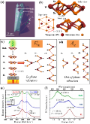
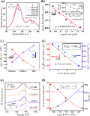
- ramped down to 298 K. This indicates irreversible changes that may have transpired in the WSe2 as a result of the thermal cycle. In contrast, in the cooling down cycle from 298 to 79 K, and the subsequent warming back up cycle to 298 K, the Raman data was analyzed for any hysteresis effects. This data is
- shown in Section 5 of the Supporting Information File 1, Figure S5a and S5b for the and A1g modes in 1L WSe2, respectively in Section 5 of Supporting Information File 1. The largest difference in the Raman shift arising from hysteresis was found to be ≈0.21 cm−1 (T = 173 K) and 0.15 cm−1 (T = 248 K
- ) for and A1g modes, respectively, suggesting that hysteresis is negligible for measurements at 298 K and below. Temperature-dependent Raman shifts in WSe2 Figure 3a shows the temperature-dependent Raman spectra for 1L WSe2 for the and A1g modes. The observed changes in phonon frequencies with T in 1L
Nickel nanoparticles supported on a covalent triazine framework as electrocatalyst for oxygen evolution reaction and oxygen reduction reactions
Beilstein J. Nanotechnol. 2020, 11, 770–781, doi:10.3762/bjnano.11.62
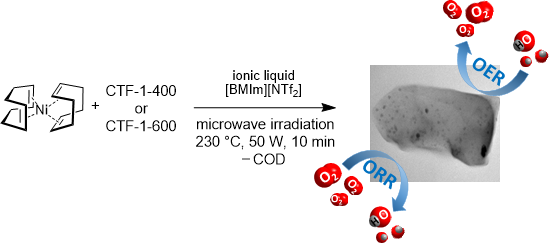
- Brunauer–Emmett–Teller (BET) surface area, whereas CTF-1-600 showed a mixture of type-I and type-IV isotherms (H2-type hysteresis) with a BET surface area of 1796 m2/g (Figure S2, Supporting Information File 1). The total pore volume (at p/p0 = 0.95) increased from 0.45 cm3/g for CTF-1-400 to 1.06 cm3/g


Observation of unexpected uniaxial magnetic anisotropy in La2/3Sr1/3MnO3 films by a BaTiO3 overlayer in an artificial multiferroic bilayer
Beilstein J. Nanotechnol. 2020, 11, 651–661, doi:10.3762/bjnano.11.51

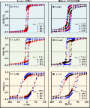
- (central plots), and LAO (plots at the bottom) substrates. Hysteresis loops were measured by applying the magnetic field in the plane of the film along the three high-symmetry axes: [100] (black squares), [110] (blue circle), and [010] (red triangles) directions. We observe that the magnetization loop
- shape depends on both substrate and the applied field direction. For the LSMO film grown on STO, there is almost no difference among the three narrow hysteresis loops (Figure 3a). For the LSMO film grown on LSAT, a narrow and nearly square-shaped loop is observed along the [110] direction (blue circles
- layers, a maximum value of Mr is found in the hysteresis loops taken along the [110] direction (blue circles), revealing that such direction constitutes either a magnetization easy axis, for a given in-plane anisotropy, or a magnetization intermediate axis for an out-of-plane anisotropy. For BTO/LSMO



High-performance asymmetric supercapacitor made of NiMoO4 nanorods@Co3O4 on a cellulose-based carbon aerogel
Beilstein J. Nanotechnol. 2020, 11, 240–251, doi:10.3762/bjnano.11.18
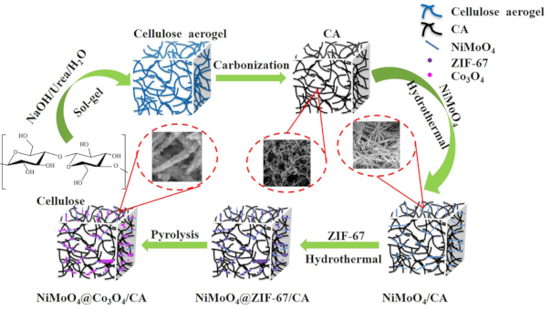
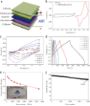
- typical type-IV curves with distinct H3-type hysteresis loops suggesting the existence of mesopores. The calculated Brunauer–Emmett–Teller (BET) specific surface areas (SBET), total pore volumes and average diameters are listed in Table 1. From Figure 5c, it can be clearly seen that the NiMoO4@Co3O4/CA




Recent progress in perovskite solar cells: the perovskite layer
Beilstein J. Nanotechnol. 2020, 11, 51–60, doi:10.3762/bjnano.11.5

- reached 20.08% under standard AM1.5G illumination, while the hysteresis of the devices was reduced and the reproducibility of the properties was enhanced. Finally, this report reinforces recent expectations for further improvements of the stability and the efficiency of 2D/3D PSCs. However, the 2D/3D


Synthesis of amorphous and graphitized porous nitrogen-doped carbon spheres as oxygen reduction reaction catalysts
Beilstein J. Nanotechnol. 2020, 11, 1–15, doi:10.3762/bjnano.11.1
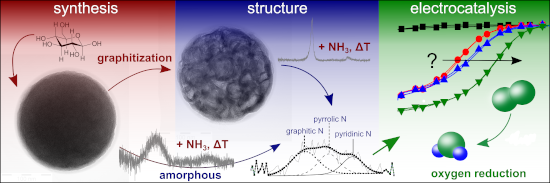
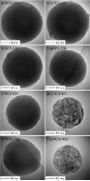
- counterparts regarding porosity and surface areas. With the onset of graphitization, however, the g-NCS-850 and g-NCS-1000 samples develop a distinct mesoporosity (type-IV isotherms and a H2 hysteresis loop, Figure 7), concomitant with a loss of microporosity of about 66%. The formation of mesopores can be




Self-assembly of a terbium(III) 1D coordination polymer on mica
Beilstein J. Nanotechnol. 2019, 10, 2440–2448, doi:10.3762/bjnano.10.234
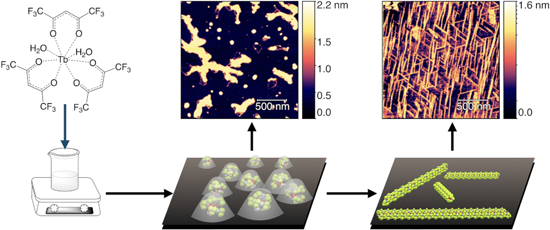
- embedded in a suitable electrostatic environment. Indeed, mononuclear single-molecule magnets (SMMs), which are objects showing magnetic hysteresis at the molecular level comprising only one metallic ion (instead of a collective assembly of ions), have been initially observed for a Tb-based molecule [13




Design of a nanostructured mucoadhesive system containing curcumin for buccal application: from physicochemical to biological aspects
Beilstein J. Nanotechnol. 2019, 10, 2304–2328, doi:10.3762/bjnano.10.222
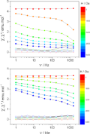
- thermoresponsive properties of the preparations. Low hysteresis areas and different yield values could be observed in a prominent way at 37 °C, in comparison to systems investigated at 25 °C. Consequently, these systems showed shear thinning behavior flow, which is considered to be a desirable characteristic for
- significantly decreased the n values (p < 0.05), whereas the presence of CUR had no significant influence on the n values (p = 0.138912). The yield value and hysteresis area results are shown in Table 2. The yield value demonstrates the ability of the formulations to withstand a significant shear stress without
- structuring can be explained by the transition from liquid to gel. However, the increase of CUR led to a significant decrease in the yield value, probably due to the higher exposure of the hydrophilic portion to water [62][63]. The hysteresis area of the formulations was investigated by RheoWin 4.10.0000


Design and facile synthesis of defect-rich C-MoS2/rGO nanosheets for enhanced lithium–sulfur battery performance
Beilstein J. Nanotechnol. 2019, 10, 2251–2260, doi:10.3762/bjnano.10.217

- are almost completely removed during the hydrothermal synthesis and annealing process [41]. Full nitrogen sorption isotherms of the composites were measured to obtain the specific surface area and the pore size distribution. A type-IV isotherm with a type-H3 hysteresis loop in the relative pressure


Targeted therapeutic effect against the breast cancer cell line MCF-7 with a CuFe2O4/silica/cisplatin nanocomposite formulation
Beilstein J. Nanotechnol. 2019, 10, 2217–2228, doi:10.3762/bjnano.10.214
- adsorption technique (Figure 2). HYPS particles show a type IV isotherm corresponding to the presence of mesopores. The silica hysteresis loop tends to be present at a higher relative pressure of P/P0 > 0.8. The HYPS texture exhibited a surface area of 170 m2/g, pore volume of 0.35 cm3/g with an intermediate
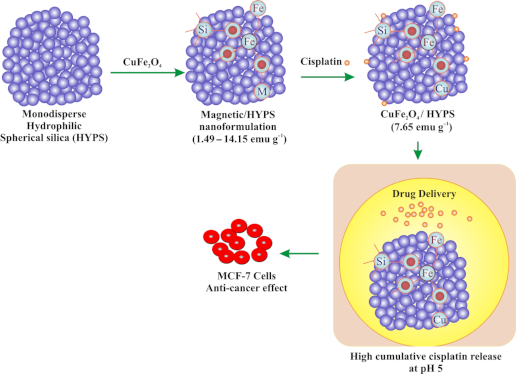
- presence of small-sized nanoclusters at the walls of hexagonal-shaped MCM-41 tends to form superparamagnetic interactions among Fe3+ species, while large nanoclusters contribute to ferromagnetic properties [17]. In our study, paramagnetic behavior with narrow hysteresis demonstrates the formation of small


The influence of porosity on nanoparticle formation in hierarchical aluminophosphates
Beilstein J. Nanotechnol. 2019, 10, 1952–1957, doi:10.3762/bjnano.10.191

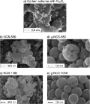
- -SAPO-5 in the region of 20–350 Å, but HP-SAPO-5 shows a discerning hysteresis, indicating mesopores which are 60 Å in size (Figure S3, Supporting Information File 1). This is also highlighted as both systems possess similar micropore pore volumes, though HP-SAPO-5 has a much larger mesopore pore volume
Oblique angle deposition of nickel thin films by high-power impulse magnetron sputtering
Beilstein J. Nanotechnol. 2019, 10, 1914–1921, doi:10.3762/bjnano.10.186

- microscope. The acceleration voltage of the electron beam was set to 20 kV and the working distance was kept at 3.5 mm for all images presented here. Magnetic hysteresis was characterized using a custom-made high-sensitivity magneto-optical Kerr effect (MOKE) looper using a laser source with 632.8 nm
- angles of 35° (Figure 5i) and 70° (Figure 5e). Thus, for both deposition methods there is an intermediate tilt angle (ca. 50° for HiPIMS and ca. 20° for dcMS) at which the films present hysteresis loops with different values of Hc when magnetic field is applied parallel and perpendicular to the incoming


The impact of crystal size and temperature on the adsorption-induced flexibility of the Zr-based metal–organic framework DUT-98
Beilstein J. Nanotechnol. 2019, 10, 1737–1744, doi:10.3762/bjnano.10.169

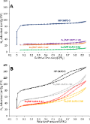
- and adsorption-induced flexibility, N2 adsorption–desorption isotherms at 77 K were recorded on DUT-98(2)–(4) and compared to the initial isotherm of DUT-98(1) (Figure 3e–h). Interestingly, only DUT-98(1) exhibits a flexible behavior evident by the stepped isotherm and wide hysteresis. DUT-98(2
- Information File 1, Figure S10) compared to DUT-98(3), which further supports the observations made by PXRD and HRTEM. In fact, neither of the isotherms of DUT-98(Hf) nor DUT-98(2)–(4) show any indication of adsorption-induced flexible behavior, evident by steps or hysteresis in the isotherm. Thus, nitrogen
- again at around a relative pressure of 0.5, however the uptake is found to be almost three times higher compared to DUT-98(2). DUT-98(4) exhibits the same steep increase but a wide hysteresis at higher pressure, indicating the dominant contribution of interparticle mesoporosity over the microporosity of


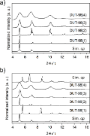

TiO2/GO-coated functional separator to suppress polysulfide migration in lithium–sulfur batteries
Beilstein J. Nanotechnol. 2019, 10, 1726–1736, doi:10.3762/bjnano.10.168

- water. The remainder after the heating process was regarded as the TiO2, which accounts for 45.6 wt % of the whole. The N2 adsorption–desorption isotherm of the TiO2/GO composite is shown in Figure 2d. A distinct hysteresis loop can be identified, indicating the microporous structure of the TiO2/GO


Selective gas detection using Mn3O4/WO3 composites as a sensing layer
Beilstein J. Nanotechnol. 2019, 10, 1423–1433, doi:10.3762/bjnano.10.140

- in the figure, the curves are type II isotherms with a H3 hysteresis loop, suggesting non-porous structures. The specific surface area of all samples are 14.82, 14.66, 14.23 and 13.98 m2/g, respectively, which slightly reduce with increasing Mn concentration. This result might be related to the


BiOCl/TiO2/diatomite composites with enhanced visible-light photocatalytic activity for the degradation of rhodamine B
Beilstein J. Nanotechnol. 2019, 10, 1412–1422, doi:10.3762/bjnano.10.139

- and pore volume are shown in Table 1. Density functional theory (DFT) mode was undertaken to characterize the porosity of these samples. According to the N2 adsorption–desorption isotherms, we can see that all four samples belong to IV-type isotherms. BiOCl has an H2-type hysteresis loop, while
- diatomite, TiO2/diatomite and BTD have an H4-type hysteresis loop, indicating that all samples have a mesoporous structure. At the same time, the pore size distribution and average pore size also confirm that the samples have mesoporous structure. Figure 2b shows that the pore size distribution of BTD has a


The effect of magneto-crystalline anisotropy on the properties of hard and soft magnetic ferrite nanoparticles
Beilstein J. Nanotechnol. 2019, 10, 1348–1359, doi:10.3762/bjnano.10.133
- to destroy cancer cells through the elevated temperatures [16][17]. The heating efficiency of the NPs as heat sources under ac magnetic fields is often denominated as specific absorption rate (SAR), which is directly related to the area of the magnetic hysteresis loop of the nanoparticles by the
- following formula [18][19]: where f is the field frequency, c is the weight concentration of the material and A is the area of the hysteresis loop. Size and shape of the particles, saturation magnetization and magnetic anisotropy, as well as field amplitude and frequency strongly affect the hyperthermia
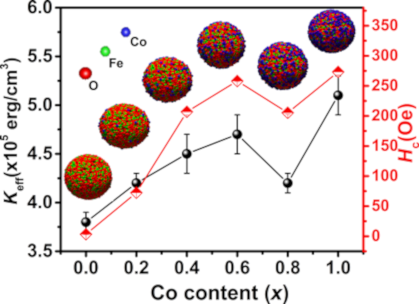
- characterization Figure 8 shows the room-temperature magnetic hysteresis curves of the samples. The inset of Figure 8 shows that the magnetic behavior of the samples changes from soft ferrite (Fe3O4) to hard ferrite (CoFe2O4) as the cobalt content increases. The values of saturation magnetization (Ms), remanent




On the relaxation time of interacting superparamagnetic nanoparticles and implications for magnetic fluid hyperthermia
Beilstein J. Nanotechnol. 2019, 10, 1280–1289, doi:10.3762/bjnano.10.127
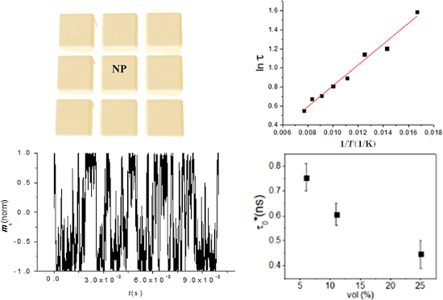
- in the static regime, P* can be simply expressed by multiplying the area of the hysteresis loop developed under the amplitude of the AC field with its frequency. However, according to Equation 1, the experimentally obtained SAR values should increase linearly with φ under the condition that P* does
- nanoparticle size can be large enough to open a hysteresis loop), so it becomes really difficult to compare experimental results on SAR with the above-mentioned approach. On the other hand, according to the above-mentioned theory, the out-of-phase component of the susceptibility of interacting nanoparticles



Molecular attachment to a microscope tip: inelastic tunneling, Kondo screening, and thermopower
Beilstein J. Nanotechnol. 2019, 10, 1243–1250, doi:10.3762/bjnano.10.124

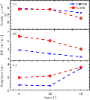
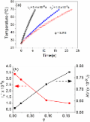
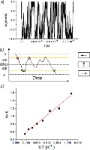
- tips. Interestingly, when the gap resistance is decreased from 2.1 to 0.90 GΩ (blue arrow in Figure 4d), the Kondo temperature TK decreases from 60 to 47 K. Following the hysteresis, when the gap resistance is increased from 2.1 to 2.5 GΩ (red arrow in Figure 4d), the Kondo temperature TK also


Playing with covalent triazine framework tiles for improved CO2 adsorption properties and catalytic performance
Beilstein J. Nanotechnol. 2019, 10, 1217–1227, doi:10.3762/bjnano.10.121
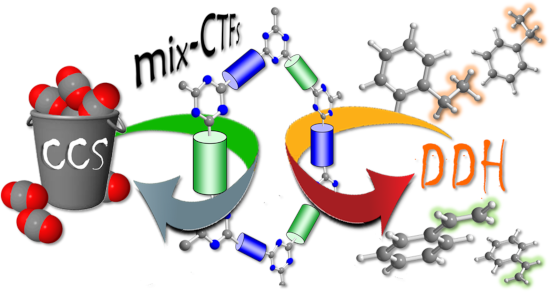
- profile with a distinctive H2 hysteresis loop in the range of p/p0 = 0.4–0.6. As expected from its longer linker, CTF2 shows an increase of mesoporosity with respect to CTF1 (mesopore volume from 60% to 75% of the total pore volume). Both samples present a high and comparable specific surface area and a


Tailoring the magnetic properties of cobalt ferrite nanoparticles using the polyol process
Beilstein J. Nanotechnol. 2019, 10, 1166–1176, doi:10.3762/bjnano.10.116
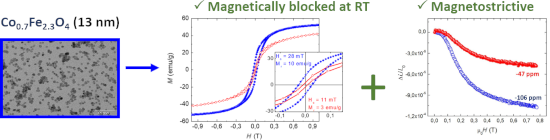
- confirm the high crystalline quality of the produced NPs. We pursued our investigations by plotting the variation of the magnetization of these particles as a function of the magnetic field at RT, typically T = 300 K (Figure 6). Low-temperature (T = 10 K) hysteresis behavior is not reported, as it is


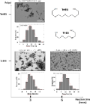


Quantitative analysis of annealing-induced instabilities of photo-leakage current and negative-bias-illumination-stress in a-InGaZnO thin-film transistors
Beilstein J. Nanotechnol. 2019, 10, 1125–1130, doi:10.3762/bjnano.10.112

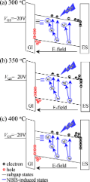
- . The hysteresis after negative-bias-illumination-stress (NBIS) is quantitatively investigated by using the double-scan mode and a positive gate pulse. Despite the abnormal transfer properties in the low-temperature-treated device, the excited holes are identically trapped at the front interface
- adjacent interfaces. The incident photon energy (>2.7 eV) excites the defect generation and the leakage current increases in the devices regardless of heating temperature. By means of the double-scan mode and a positive gate pulse, the NBIS-caused hysteresis of the TFTs annealed at different temperatures
- formation of the metal-oxide atomic framework, improving the channel layer quality. The notorious I–V hysteresis is regarded as an indicator for the quality of the GI/semiconductor interface. The values of the hysteresis, i.e., the difference of VGS at IDS = 1 pA scanned in the forward and reverse


Scavenging of reactive oxygen species by phenolic compound-modified maghemite nanoparticles
Beilstein J. Nanotechnol. 2019, 10, 1073–1088, doi:10.3762/bjnano.10.108
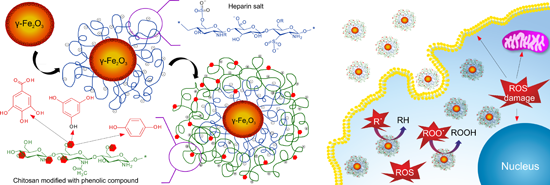
- . The superparamagnetism of the γ-Fe2O3 colloid was confirmed by SQUID magnetometry through the absence of remanence and coercivity in the magnetic hysteresis curve (Figure 3c,d). The saturation magnetization of the γ-Fe2O3 colloid (4.4 mg/mL was 0.307 A·m2·kg−1 at 260 K. The critical parameter for the
- stretching vibrations of the amine groups and polysaccharides, respectively. The similarity between the magnetic hysteresis of neat and heparin-modified nanoparticles indicated that the polymer-coated nanoparticles retained the same superparamagnetic behavior. However, a small decrease in the saturation
- temperature and magnetic field showed a typical superparamagnetic behavior of the γ-Fe2O3 nanoparticles with a saturation magnetization of 0.307 A∙m2·kg−1 at 260 K. The similarity of the magnetic hysteresis and ZF-C/F-C curves of the neat and modified nanoparticles indicated that the coatings did not affect





Periodic Co/Nb pseudo spin valve for cryogenic memory
Beilstein J. Nanotechnol. 2019, 10, 833–839, doi:10.3762/bjnano.10.83

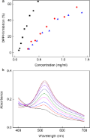
- shown by solid lines in Figure 3a. (b) Hysteresis loop measured by SQUID magnetometry (solid line). The black dot indicates the magnetic moment of the sample which is obtained by the integration of the depth profiles depicted in (a). The red dot shows the magnetic moment at H = 30 Oe expected if one P