


Search results
Search for "structural properties" in Full Text gives 181 result(s) in Beilstein Journal of Nanotechnology.
Hierarchically structured 3D carbon nanotube electrodes for electrocatalytic applications
Beilstein J. Nanotechnol. 2019, 10, 1475–1487, doi:10.3762/bjnano.10.146

- between the conducting components [42][43][44][45]. The modification of the electronic and structural properties of Pt due to interaction with the support may also play a role. To take advantage of the properties of novel carbon materials, and at the same time gain control over the electrode structure
- achieved via sequential growth of primary CNTs and secondary CNTs by CVD and finally Pt electrodeposition. CNT growth was carried out over electrodeposited iron nanoparticles. By varying the growth time, gas flow rate and ratio of H2/Ar, it was shown that the structural properties of the primary and
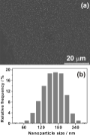
- . Structural characterization The nanostructured electrodes were examined via SEM employing an ESEM XI 30 FEG (Philips, Germany) instrument to characterize the morphology and structural properties. The average particle size and size distribution of Fe nanoparticles were determined by examining the size of 200





Alloyed Pt3M (M = Co, Ni) nanoparticles supported on S- and N-doped carbon nanotubes for the oxygen reduction reaction
Beilstein J. Nanotechnol. 2019, 10, 1251–1269, doi:10.3762/bjnano.10.125
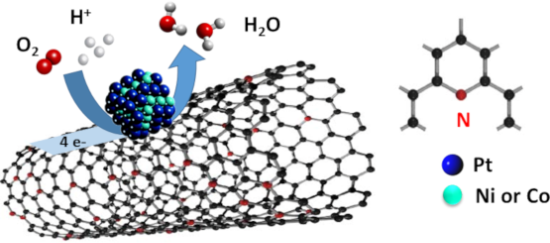
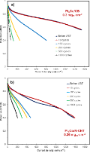
- -CNTs) and S-doped CNT (S-CNTs). To further increase the corrosion resistance and the electrical conductivity of the N-CNTs, they were annealed at 1000 °C to produce N-CNTHT. The introduction of nitrogen or sulfur into the CNT structure has an effect on the structural properties of the prepared







Playing with covalent triazine framework tiles for improved CO2 adsorption properties and catalytic performance
Beilstein J. Nanotechnol. 2019, 10, 1217–1227, doi:10.3762/bjnano.10.121
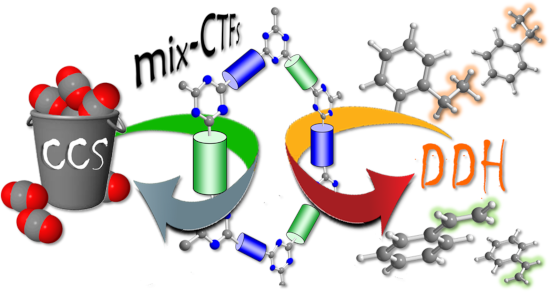
- total pore volume up to 1.31 cm3·g−1 (Table 1, entries 1 and 2). Although their structural properties sound promising for gas-adsorption applications, their N content remains moderate. As N content and related surface basicity play a key role in the CO2 adsorption capacity of CTF samples, we have


Nanoscale optical and structural characterisation of silk
Beilstein J. Nanotechnol. 2019, 10, 922–929, doi:10.3762/bjnano.10.93

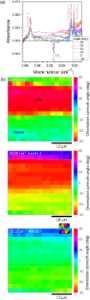
- crystalline building blocks of silk. Nanoscale optical and structural properties of silk have been measured from 100 nm thick longitudinal slices of silk fibers with ca. 10 nm resolution, the highest so far. Optical sub-wavelength resolution in hyperspectral mapping of absorbance and molecular orientation


Co-doped MnFe2O4 nanoparticles: magnetic anisotropy and interparticle interactions
Beilstein J. Nanotechnol. 2019, 10, 856–865, doi:10.3762/bjnano.10.86

- doping on the magnetic properties of Mn1−xCoxFe2O4 nanoparticles was investigated. All samples consist of ensembles of nanoparticles with a spherical shape and average diameter of about 10 nm, showing small structural changes due to the substitution. Besides having the same morpho-structural properties


Electronic properties of several two dimensional halides from ab initio calculations
Beilstein J. Nanotechnol. 2019, 10, 823–832, doi:10.3762/bjnano.10.82
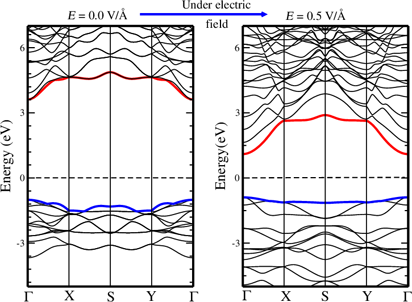
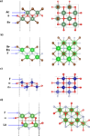
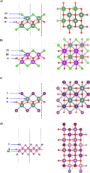
- X′FCl (where X = Ac, Al and X′ = Ba, Bi) for the chlorides, and on XOI(X = Bi, La, Sc, and Y) for the iodides. Structural properties The structure of the bromide (AcOBr and BaFBr) and of the fluoride monolayers (CrOF and LaOF) are shown in Figure 1. The structures of BiOBr and CaFBr are analogous to


Towards rare-earth-free white light-emitting diode devices based on the combination of dicyanomethylene and pyranine as organic dyes supported on zinc single-layered hydroxide
Beilstein J. Nanotechnol. 2019, 10, 760–770, doi:10.3762/bjnano.10.75

- , HPTS or DCM, were tested as well as the combination of these two materials. Finally, the photometric parameters of these systems have been investigated under LED excitation. Results and Discussion Structural properties of Zn-SLH The prepared Zn-SLH in the dry state is a white powder which, in a


Improving control of carbide-derived carbon microstructure by immobilization of a transition-metal catalyst within the shell of carbide/carbon core–shell structures
Beilstein J. Nanotechnol. 2019, 10, 419–427, doi:10.3762/bjnano.10.41

- in the range of 3–4 nm, which are not present in the CDC-Ni0 sample. The structural properties (specific surface area (SSA), total pore volume (VT) and mean pore size (dm)) are summarized in Table 1. There are two types of SSA, SSAN2 and SSACO2, obtained from nitrogen and carbon dioxide sorption


Mechanism of silica–lysozyme composite formation unravelled by in situ fast SAXS
Beilstein J. Nanotechnol. 2019, 10, 182–197, doi:10.3762/bjnano.10.17
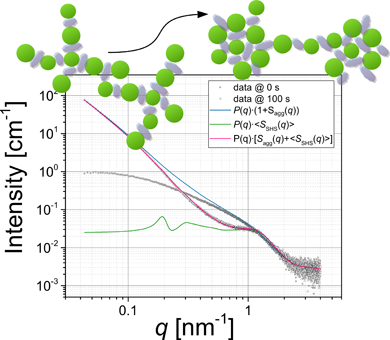
- follow all steps in the formation of SiO2–LZM composites from the individual components. Nevertheless, although such scattering data will reflect the in situ state of a system during measurement, the quantitative information related to any changes in structural properties of the particles/species of
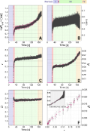
- lysozyme structural properties as the composites evolve over time, without deriving circumstantial models for a system with three electron densities (silica, lysozyme, and the solvent matrix). In period IV (150–300 s, Figure 1A and Figure 1D), we observed a further intensity increase at low q (three-times



Targeting strategies for improving the efficacy of nanomedicine in oncology
Beilstein J. Nanotechnol. 2019, 10, 168–181, doi:10.3762/bjnano.10.16
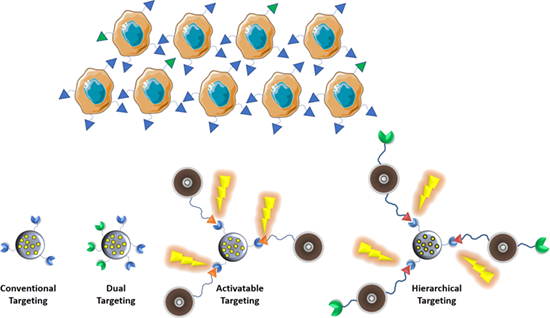
- effects come from the structural properties of the nanocarriers [81]. Usually, the aim of the intracellular vectorization is oriented to nucleus or mitochondria to improve the efficacy of the transported drug for cancer treatments. Fortunately, there are intracellular vectorization motives for almost all


pH-mediated control over the mesostructure of ordered mesoporous materials templated by polyion complex micelles
Beilstein J. Nanotechnol. 2019, 10, 144–156, doi:10.3762/bjnano.10.14
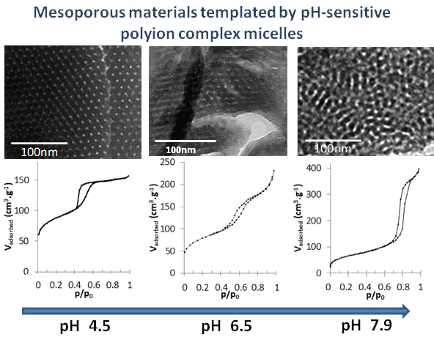
- cylindrical pores was determined from the adsorption branch using the nonlocal density functional theory (NLDFT) model [32] and the width of slit-shaped pores was estimated from the desorption branch using the method of Broekhoff and de Boer [33]. The structural properties were studied by small angle X-ray
- triangles) and EO/Si (open squares) of the hybrid materials synthesized at 3.9 wt % DHBC as a function of pH. Schematic representation of the interactions between silicic species and PEO, OC and PAA entities as a function of pH. Textural and structural properties of the calcined materials synthesized at 3.9



Zn/F-doped tin oxide nanoparticles synthesized by laser pyrolysis: structural and optical properties
Beilstein J. Nanotechnol. 2019, 10, 9–21, doi:10.3762/bjnano.10.2

- bandgap values were shown to increase with the vacuum annealing treatment temperature (from 3.41 eV at 300 °C to 3.60 eV at 600 °C), where the amorphous to crystalline conversion was observed only at 600 °C, accompanied by an almost complete fluorine loss [33]. Results and Discussion Structural properties



Variation of the photoluminescence spectrum of InAs/GaAs heterostructures grown by ion-beam deposition
Beilstein J. Nanotechnol. 2018, 9, 2794–2801, doi:10.3762/bjnano.9.261

- monochromator entrance slit from the reflected harmonics of the exciting laser radiation was carried out by means a Y-1.4 optical filter (light yellow color). A study of the surface morphology of the grown heterostructures was carried out using a Solver HV atomic force microscope. The structural properties of
- heterointerfaces To study the photoluminescence properties of InAs/GaAsBi heterointerfaces, it was necessary to investigate the morphology and structural properties. At first it was necessary to verify the conservation of the stoichiometric composition of GaAs1−xBix during ion-beam deposition. For this purpose
- the sputtering targets. In our opinion, this difference is due to the desorption of Bi from the surface, despite the low deposition temperature of 360 °C. The influence of bismuth on the structural properties of InAs/GaAsBi and InAs/GaAs heterointerfaces was investigated by using Raman spectroscopy


Characterization of the microscopic tribological properties of sandfish (Scincus scincus) scales by atomic force microscopy
Beilstein J. Nanotechnol. 2018, 9, 2618–2627, doi:10.3762/bjnano.9.243

- meaningful comparison we determined the tribological parameters of snake scales and technical surfaces with the same probes, too. Structural properties of sandfish scales Figure 3a,b shows the topography of sandfish dorsal and ventral scales recorded by atomic force microscopy. On the dorsal scale a




Surface energy of nanoparticles – influence of particle size and structure
Beilstein J. Nanotechnol. 2018, 9, 2265–2276, doi:10.3762/bjnano.9.211

- energy. This approach was published in a series of papers discussing the particle size dependence of properties. In a communication on scaling laws of physical properties, Guibiers et al. [29][30] showed that many of the structural properties of small particles show an inverse proportionality with





Electrospun one-dimensional nanostructures: a new horizon for gas sensing materials
Beilstein J. Nanotechnol. 2018, 9, 2128–2170, doi:10.3762/bjnano.9.202
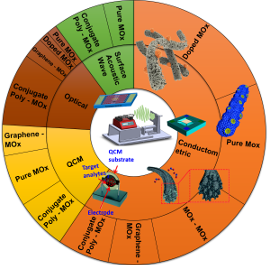
- structural properties, including size and topology of the MOx 1D nanostructures, which leads to a change in their chemical sensing behaviour. [8][147][148][149][150]. Yamazoe et al.[151][152] explained the two types of functionalization mechanisms occurring in metal oxides as chemical sensitization and








Cryochemical synthesis of ultrasmall, highly crystalline, nanostructured metal oxides and salts
Beilstein J. Nanotechnol. 2018, 9, 1755–1763, doi:10.3762/bjnano.9.166

- the fast-moving formation of the particle surface [11]. The high activity of nanostructures in solid-phase processes is a valuable property in ceramics sintering from them. The use of cryotechnological methods leads to an improvement in the structural properties of raw materials, which is very


Absence of free carriers in silicon nanocrystals grown from phosphorus- and boron-doped silicon-rich oxide and oxynitride
Beilstein J. Nanotechnol. 2018, 9, 1501–1511, doi:10.3762/bjnano.9.141

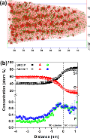
- Information File 1, it can be readily concluded that the P-distribution and NC-incorporation is very similar for both SRO:P and SRON:P. Therefore, the presence of N in the oxynitride matrix has apparently no influence on the structural properties of P-doped NC-samples. The SRO:B material has already been APT



Electronic conduction during the formation stages of a single-molecule junction
Beilstein J. Nanotechnol. 2018, 9, 1471–1477, doi:10.3762/bjnano.9.138

- and examine the interplay between these two conductance pathways. Furthermore, the role of this structure in the formation of single-molecule junctions is studied. Our findings reveal the conductance and structural properties of premature molecular junction configurations and uncover the different


Atomic-level characterization and cilostazol affinity of poly(lactic acid) nanoparticles conjugated with differentially charged hydrophilic molecules
Beilstein J. Nanotechnol. 2018, 9, 1328–1338, doi:10.3762/bjnano.9.126
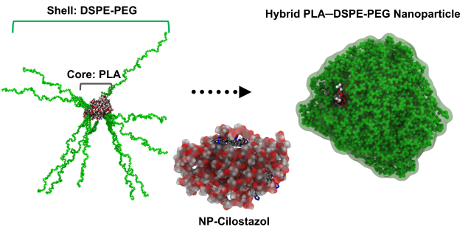
- surface of the micelle [30]. In a recent investigation [31], it was found that different computational simulation strategies can successfully predict the experimental drug affinity and drug loading for PLA–PEG NPs. The aim of this work is to characterize at the atomic level the structural properties of


Formation mechanisms of boron oxide films fabricated by large-area electron beam-induced deposition of trimethyl borate
Beilstein J. Nanotechnol. 2018, 9, 1282–1287, doi:10.3762/bjnano.9.120
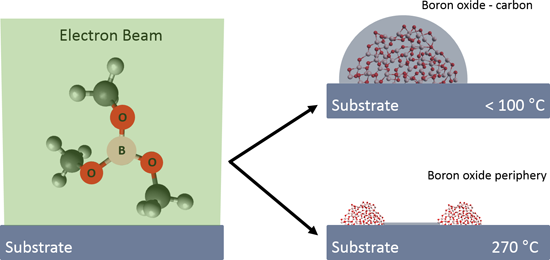
- structural properties similar to those of tetraethyl orthosilicate (TEOS, Si(C2H5O)4), which has been well characterized as a precursor for EBID of silica films [14]. TMB has previously been used for boron doping of SiO2 [15] and diamond [16], and the deposition of BCN fibres [17], BN nanotubes [18] and BN



Review on nanoparticles and nanostructured materials: history, sources, toxicity and regulations
Beilstein J. Nanotechnol. 2018, 9, 1050–1074, doi:10.3762/bjnano.9.98

- their weightless wing material [220][221][222]. Insect wing surfaces demonstrate a rough and highly ordered structure comprised of micro- and nanoscale properties to minimize their mass and protect them against wetting and pollutants. A methodical terminology to explain the structural properties of



Synthesis and characterization of two new TiO2-containing benzothiazole-based imine composites for organic device applications
Beilstein J. Nanotechnol. 2018, 9, 721–739, doi:10.3762/bjnano.9.67
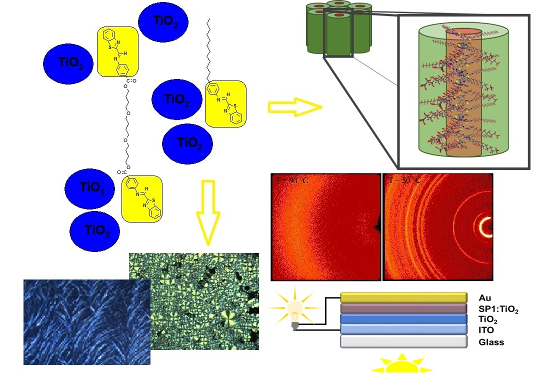
- interaction. Also the temperature of the phase transition was slightly affected with the increase of TiO2 concentration in imine-based composites. The changes observed in the Fourier transform middle-infrared absorption (FT-MIR) spectra confirmed the significant influence of TiO2 on structural properties of
- hydrocarbon chains or aromatic rings are not visible. The observed changes confirmed the significant influence of titanium dioxide on the structural properties of both investigated compounds. It can be explained by the interactions of oxygen vacancies existing on the TiO2 surface with SP1 as well as SP2
- temperatures of both imines addition of TiO2 to SP2 imine significantly changed the POM texture of imine values of the energy gap and HOMO–LUMO levels of both imines decreased with increasing addition of titanium dioxide TiO2 has an influence on the structural properties of SP1 and SP2 imines the imine:TiO2







Cyclodextrin-assisted synthesis of tailored mesoporous silica nanoparticles
Beilstein J. Nanotechnol. 2018, 9, 693–703, doi:10.3762/bjnano.9.64

- /bjnano.9.64 Abstract Mesoporous silica nanoparticles (MSNs) have sparked considerable interest in drug/gene delivery, catalysis, adsorption, separation, sensing, antireflection coatings and bioimaging because of their tunable structural properties. The shape, size and pore structure of MSNs are greatly
- mesoporous silica nanoparticles (MSNs) with tunable structural properties have been developed [1][2][3][4][5][6][7][8][9][10][11]. Yet, there is still ongoing interest in the synthesis of tailored MSNs to optimize their performance in applications, such as catalysis, sensing, drug delivery and adsorption. So



Perovskite-structured CaTiO3 coupled with g-C3N4 as a heterojunction photocatalyst for organic pollutant degradation
Beilstein J. Nanotechnol. 2018, 9, 671–685, doi:10.3762/bjnano.9.62
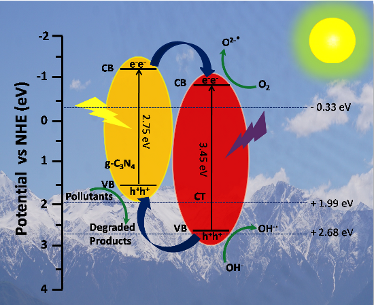
- comprises of all the peaks of g-C3N4 and CT, indicating that the addition of g-C3N4 has not altered the structural properties of CT, which is in agreement with the XRD results. Thermogravimetric studies To investigate the thermal stability of g-C3N4, CT and CTCN heterojunction, thermogravimetric (TGA





