


Search results
Search for "surfactants" in Full Text gives 190 result(s) in Beilstein Journal of Nanotechnology.
Fabrication of photothermally active poly(vinyl alcohol) films with gold nanostars for antibacterial applications
Beilstein J. Nanotechnol. 2018, 9, 2040–2048, doi:10.3762/bjnano.9.193
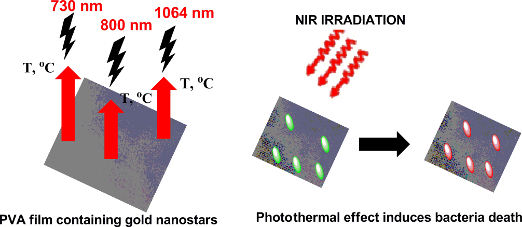
- surfactants, they were coated with either SH-PEG5000–OCH3 or SH-PEG5000–COOH before being incorporated in the PVA matrix, as PEGylation of gold nanostars leads to enhanced stability [9][10] and complete surfactant removal [6][8].The aqueous solutions of PEGylated GNSs were prepared with 0.6 mg/mL Au


Synthesis of rare-earth metal and rare-earth metal-fluoride nanoparticles in ionic liquids and propylene carbonate
Beilstein J. Nanotechnol. 2018, 9, 1881–1894, doi:10.3762/bjnano.9.180

- . Microwave heating and employing suitable ILs and PC as inert reaction media proved to be crucial. Ionic liquids are used as stabilizing reagents and as solvents in syntheses of nanoparticles [27][28][29][30][31]. In contrast to conventional stabilizers, such as surfactants or polymers, the ILs stabilize the


A simple extension of the commonly used fitting equation for oscillatory structural forces in case of silica nanoparticle suspensions
Beilstein J. Nanotechnol. 2018, 9, 1095–1107, doi:10.3762/bjnano.9.101

- , roughness [37] and or potential [38], or addition of varying surfactants [39]. Oscillatory structural forces can be described either theoretically via the solutions of numerical simulations [34][40][41][42] or statistical mechanics equations [43][44][45][46][47][48][49][50] or with a semi empirical approach


Cyclodextrin-assisted synthesis of tailored mesoporous silica nanoparticles
Beilstein J. Nanotechnol. 2018, 9, 693–703, doi:10.3762/bjnano.9.64

- additives in a simple, one-pot reaction system for a wide range of applications. Keywords: cyclodextrin; faceted particles; mesoporous silica nanoparticles (MSN); microporous; Introduction With the availability of several types of surfactants and the increased understanding of sol–gel chemistry, numerous
- far, this has been done by tuning multiple parameters (e.g., type and concentration of surfactants and solvents used) in the synthesis of MSNs to control the shape, size and pore structure of the particles. However, controlling these particle characteristics through a single parameter has remained as



Facile phase transfer of gold nanorods and nanospheres stabilized with block copolymers
Beilstein J. Nanotechnol. 2018, 9, 616–627, doi:10.3762/bjnano.9.58

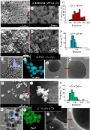
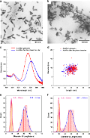
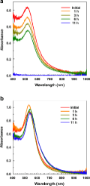
- the use of strong thiol and amine surfactants. Keywords: Au nanorods; block copolymers; optical absorbance spectroscopy; phase transfer; seeded growth method; Introduction The size effects that determine the functional characteristics of nanoparticles are no less important than their precise
- or cetyl trimethylammonium bromide-stabilized Au nanorods with a solution of thiol- [18] or amine-terminated [19] surfactants in organic solvent. With a strong affinity to gold, thiols and amines replace nanoparticle shells via ligand exchange, while the tails of these molecules provide miscibility


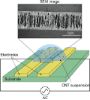
Engineering of oriented carbon nanotubes in composite materials
Beilstein J. Nanotechnol. 2018, 9, 415–435, doi:10.3762/bjnano.9.41
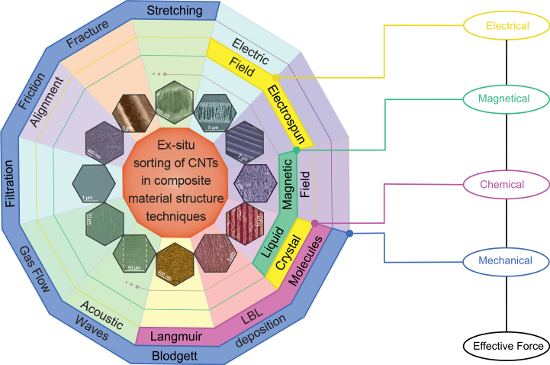
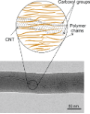
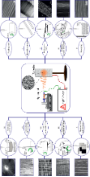
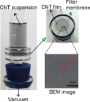
- recommended for producing concentrated and aligned composite nanomaterials. In this method SWCNTs are initially dispersed in an aqueous solution of poly(vinyl alcohol) (PVA) and are stabilized using surfactants. By applying the wet spinning method, a web of nanocomposite material fibers is produced where the








The role of ligands in coinage-metal nanoparticles for electronics
Beilstein J. Nanotechnol. 2017, 8, 2625–2639, doi:10.3762/bjnano.8.263
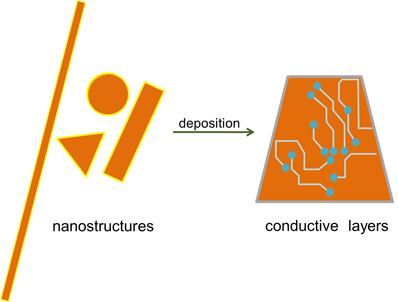
- the silver NPs with surfactants resulted in surfactant-coated particles and increased the composite conductivity to 2 × 10⁵ S/cm compared to untreated silver nanoparticles (5 × 10⁻⁷ S/cm). Sintering at 150 °C further improved conductivity [137]. Jiang et al. reported the effects of ligand length on


Surfactant-induced enhancement of droplet adhesion in superhydrophobic soybean (Glycine max L.) leaves
Beilstein J. Nanotechnol. 2017, 8, 2345–2356, doi:10.3762/bjnano.8.234
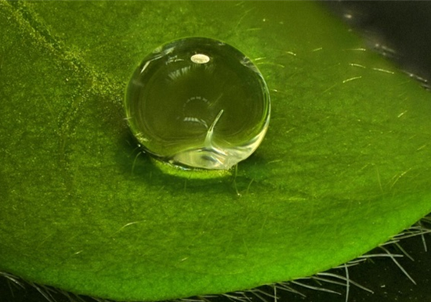
- applied droplets, even on superhydrophobic leaves, to reduce undesirable soil contamination by roll-off of agrochemical formulations from the plant surfaces. The wettability and morphology of soybean (Glycine max L.) leaf surfaces before and after treatment with six different surfactants (Agnique® SBO10
- and five variations of nonionic surfactants) have been investigated. The leaf surface structures show a hierarchical organization, built up by convex epidermal cells (microstructure) and superimposed epicuticular platelet-shaped wax crystals (micro- to nanostructure). Chemical analysis of the
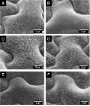
- hairs on the leaves. Agnique® SBO10 and the nonionic surfactant XP ED 75 increased the droplet adhesion and caused an increase of the TA from 20.9° to 85° and 90°, respectively. Scanning electron microscopy showed that surfactants with a hydrophilic–lipophilic balance value below 10 caused a size




Synthesis and characterization of noble metal–titania core–shell nanostructures with tunable shell thickness
Beilstein J. Nanotechnol. 2017, 8, 2083–2093, doi:10.3762/bjnano.8.208
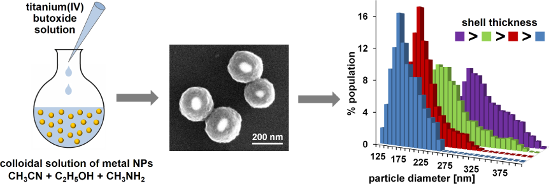
- , various additives such as surfactants or salts, and special reaction conditions in order to slow down the reaction rate. These strategies have been employed in a few successful attempts at controlled synthesis of Ag@TiO2 and Au@TiO2 structures reported in recent years [21][24][25][26][27][28][29][30][31
- the latter approach, control over the shape and size of the synthesized particles is limited. The metal nanoparticles were stabilized before the coating step using various surfactants or stabilizing agents such as Lutensol ON50 [21], cetyltrimethylammonium bromide (CTAB) [27][28][29][30][40], anionic
- complicated approaches. These approaches included the use of the less common and thus more expensive titania precursors, which are laborious in preparation. The other approaches included the use of various solvents or their mixtures, various additives such as surfactants or salts, special reaction conditions

Enhancement of mechanical and electrical properties of continuous-fiber-reinforced epoxy composites with stacked graphene
Beilstein J. Nanotechnol. 2017, 8, 1909–1918, doi:10.3762/bjnano.8.191

- in vacuum to remove the entrapped air. Two nonionic surfactants (Triton X100 and X-15) with different hydrophilic/lyophilic balance (HLB) were used in order to evaluate the thermodynamic effect on the localization of the SG. Hardener TETA was added to the mixture before specimens casting. The basic
- fiberglass (FG) fabrics. CF was used as received, and Kevlar was cleaned by dipping in isopropyl alcohol (IPA) with further drying. FG was used as received or modified by silanes and surfactants. FG specimens (150 × 150 mm) were dipped in solutions of MEMO and GLYMO silanes in IPA/water. The silane/IPA/water
- fabrics with epoxy/SG matrix demonstrated good electrical properties, despite the insulating nature of the fabric. Enhanced rigidity in three-point bending and increased DMA storage moduli were achieved for compositions where EG was impregnated with epoxy resin modified with the surfactants Triton X-100


Methionine-mediated synthesis of magnetic nanoparticles and functionalization with gold quantum dots for theranostic applications
Beilstein J. Nanotechnol. 2017, 8, 1734–1741, doi:10.3762/bjnano.8.174

- aggregation of magnetic NPs during or at the end of the synthesis they must be covered with capping materials such as acid anions [20][21], surfactants [22] or proteins [23]. Besides, for in vivo and in vitro applications of magnetic NPs their capping materials should be biocompatible and allow for the


Development of polycationic amphiphilic cyclodextrin nanoparticles for anticancer drug delivery
Beilstein J. Nanotechnol. 2017, 8, 1457–1468, doi:10.3762/bjnano.8.145

- without the presence of surfactants [21][22][24][32][33][34] due to their favorable self-alignment properties at air–water or oil–water interface [35]. The mean particle size of amphiphilic CD nanoparticles increased linearly with concentration of surfactant. Bilensoy et al. evaluated the effect of the


Cationic PEGylated polycaprolactone nanoparticles carrying post-operation docetaxel for glioma treatment
Beilstein J. Nanotechnol. 2017, 8, 1446–1456, doi:10.3762/bjnano.8.144

- at the tumor site following surgical operation for brain glioma treatment. To obtain positively charged, implantable nanoparticles, the effects of preparation technique, chitosan coating concentration and presence of surfactants were evaluated to obtain optimal nanoparticles with a diameter of less




Characterization of ferrite nanoparticles for preparation of biocomposites
Beilstein J. Nanotechnol. 2017, 8, 1257–1265, doi:10.3762/bjnano.8.127

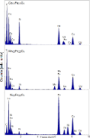
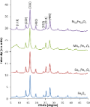
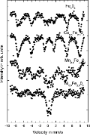
- nature of ferrites and difficulties in obtaining a sufficient surface coverage by surfactants. On the other hand, the preparation of the samples for TEM actually disturbs the functionality of primarily used surfactants, which can no longer maintain the separation of the particles. The lack of self



Recombinant DNA technology and click chemistry: a powerful combination for generating a hybrid elastin-like-statherin hydrogel to control calcium phosphate mineralization
Beilstein J. Nanotechnol. 2017, 8, 772–783, doi:10.3762/bjnano.8.80

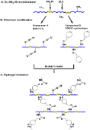
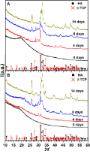
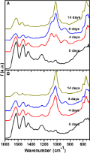
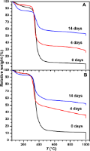
- formation of neuron-like morphology of ACP phase at the soluble state [13]. The approach used in this work, which avoids the need for substances that may harm the human body (methanol, ethylene glycol, surfactants) [54][55][56], shows the merit of controlling the generation of hybrid materials for potential


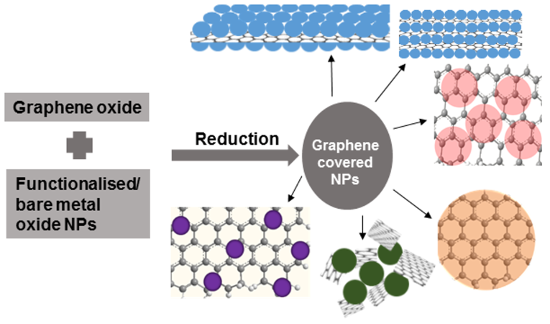
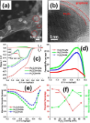
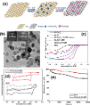
Synthesis of graphene–transition metal oxide hybrid nanoparticles and their application in various fields
Beilstein J. Nanotechnol. 2017, 8, 688–714, doi:10.3762/bjnano.8.74






Dispersion of single-wall carbon nanotubes with supramolecular Congo red – properties of the complexes and mechanism of the interaction
Beilstein J. Nanotechnol. 2017, 8, 636–648, doi:10.3762/bjnano.8.68

- length influences CNT toxicity and cellular uptake [22][23]. Surfactants commonly used for dispersion of CNTs include SDS, CTAB, Triton X-100 or sodium cholate [24][25][26]. A less known approach is based on the interaction of CNTs with a bis-azo dye – Congo red (CR) [27]. This original procedure was


Gas sensing properties of MWCNT layers electrochemically decorated with Au and Pd nanoparticles
Beilstein J. Nanotechnol. 2017, 8, 592–603, doi:10.3762/bjnano.8.64

- reported in the following section. The absence of XPS signals of N 1s, Cl 2p (in Au-modified MWCNTs), and Br 3d (in Pd-modified MWCNTs) derived from TOAC and TOAB surfactants, respectively, demonstrates (within the XPS limit-of-detection) the successful removal of the surfactant molecules from the metal


Formation and shape-control of hierarchical cobalt nanostructures using quaternary ammonium salts in aqueous media
Beilstein J. Nanotechnol. 2017, 8, 494–505, doi:10.3762/bjnano.8.53

- variations of the protocol; (iii) nanostructures are obtained only by the precise control of the synthesis parameters without the addition of surfactants or applying external magnetic fields; (iv) we use electron microscopy to capture important modes of aggregation and growth for highly ordered hierarchical


The longstanding challenge of the nanocrystallization of 1,3,5-trinitroperhydro-1,3,5-triazine (RDX)
Beilstein J. Nanotechnol. 2017, 8, 452–466, doi:10.3762/bjnano.8.49
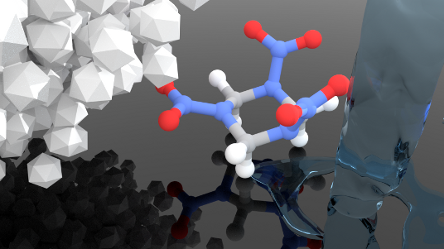
- micrometer-sized agglomerates. CTA is a promising primary explosive compliant with the new REACH legislation [32] forbidding the use of heavy-metal-based materials. Further investigation with surfactants might lead to smaller particles by counteracting the high viscosity of molten droplets. Milling Redner et


Nanoscale isoindigo-carriers: self-assembly and tunable properties
Beilstein J. Nanotechnol. 2017, 8, 313–324, doi:10.3762/bjnano.8.34

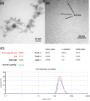
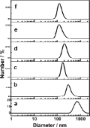
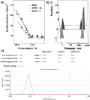
- ; nanoparticles; self-assembly; surfactants; Introduction Studies of amphiphilic isoindigo derivatives have revealed perspectives and high potential in several fields: (i) Supramolecular assemblies of amphiphilic conjugated π-systems can potentially be useful structures with improved tunable optical and
- create nanostructures [43]. Unlike traditional low-molecular surfactants, e.g., π-functional amphiphiles, the self-assembly of amphiphilic drugs bearing a chromophoric moiety can produce more robust self-assemblies [44][45]. Different approaches can be used to produce various supramolecular systems [46
- materials [54]. The latter feature is essential for designing novel antitumor drugs. The second stage of the work was devoted to solubilize amphiphilic isoindigo derivatives using surfactants that are widely used in pharmaceutical industry. The aim of the present work was to investigate the ability of




Performance of colloidal CdS sensitized solar cells with ZnO nanorods/nanoparticles
Beilstein J. Nanotechnol. 2017, 8, 210–221, doi:10.3762/bjnano.8.23

- − electrolyte with a costly Pt-based electrode. Reports on the synthesis of nanoscale CdS by using organic capping agents, polymers, surfactants, or enzymes reveal that they are not very user friendly techniques [17][18][19][20][21][22][23]. Therefore, rather taking a conventional path to synthesizing quantum


Influence of hydrofluoric acid treatment on electroless deposition of Au clusters
Beilstein J. Nanotechnol. 2017, 8, 183–189, doi:10.3762/bjnano.8.19

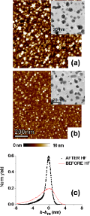
- without stirring. Then the samples were rinsed in water to remove all surfactants and products. They received an additional cleaning in acetone and were dried in air. TEM sample preparation. For plan view, the samples were mechanically thinned from the backside to less than a micrometer. Then they were



When the going gets rough – studying the effect of surface roughness on the adhesive abilities of tree frogs
Beilstein J. Nanotechnol. 2016, 7, 2116–2131, doi:10.3762/bjnano.7.201

- frogs appear to be able to adhere to hydrophobic surfaces just as easily as hydrophilic ones [26], which would not be the case if toe pad fluid were pure water. A preliminary biochemical analysis of the toe pad fluid [26] suggests the presence of carboxylic acids which could act as surfactants, lowering




From iron coordination compounds to metal oxide nanoparticles
Beilstein J. Nanotechnol. 2016, 7, 2074–2087, doi:10.3762/bjnano.7.198

- general, the procedure leading to metal oxide materials consists of the thermal decomposition of adequate precursors under different conditions: by classical heating at high temperature in air (calcination) or in solution, in presence of changing ligands or surfactants. Nonconventional energy sources such
- reactions by the solvothermal method, it was demonstrated that the size and shape of the obtained nanoparticles is highly sensitive to the concentration of surfactants. By changing the solvent, the reaction outcome was not significantly affected. Calcination The simplest method used to obtain nanoparticles
- , spherical, hedgehog-like) by changing the type and amount of surfactants, reaction temperature and time. By thermal decomposition followed by simple filtration, monodisperse nanoparticles were obtained and separated from polydisperse nanoparticles. Starting from the similar reaction mixture as in the





